选择正确的AI Agent记忆策略:决策树方法
英文标题:🔶 Choosing the Right AI Agent Memory Strategy: A Decision-Tree Approach
本文提供了一种基于决策树的AI Agent记忆策略选择方法。文章详细介绍了工作记忆、语义记忆、情节记忆和程序记忆这四种类型,并通过五个问题构成的决策树,指导开发者针对不同信息类别分配合适的记忆层。文中还说明了如何将这些记忆层组合成完整的Agent记忆架构,并总结了常见实现陷阱及其修复方案。这对于需要构建高效、上下文感知AI Agent的开发者极具参考价值。
 11.1 KB
 2.1 MB
 1.5 MB
 1.5 MB
 1.8 MB
 1.8 MB
 48.2 KB
 27.3 KB
 67.3 KB
 39.9 KB
 24.1 KB
 13.7 KB
 10.9 KB
 7.7 KB
 15.8 KB
 9.3 KB
 37.4 KB
 10.9 KB
 3.8 KB
 6.1 KB
中文
在本文中,你将学习如何通过一个简单的决策树,一次一种信息类别,为AI Agent选择正确的记忆策略。
我们将涵盖的主题包括:
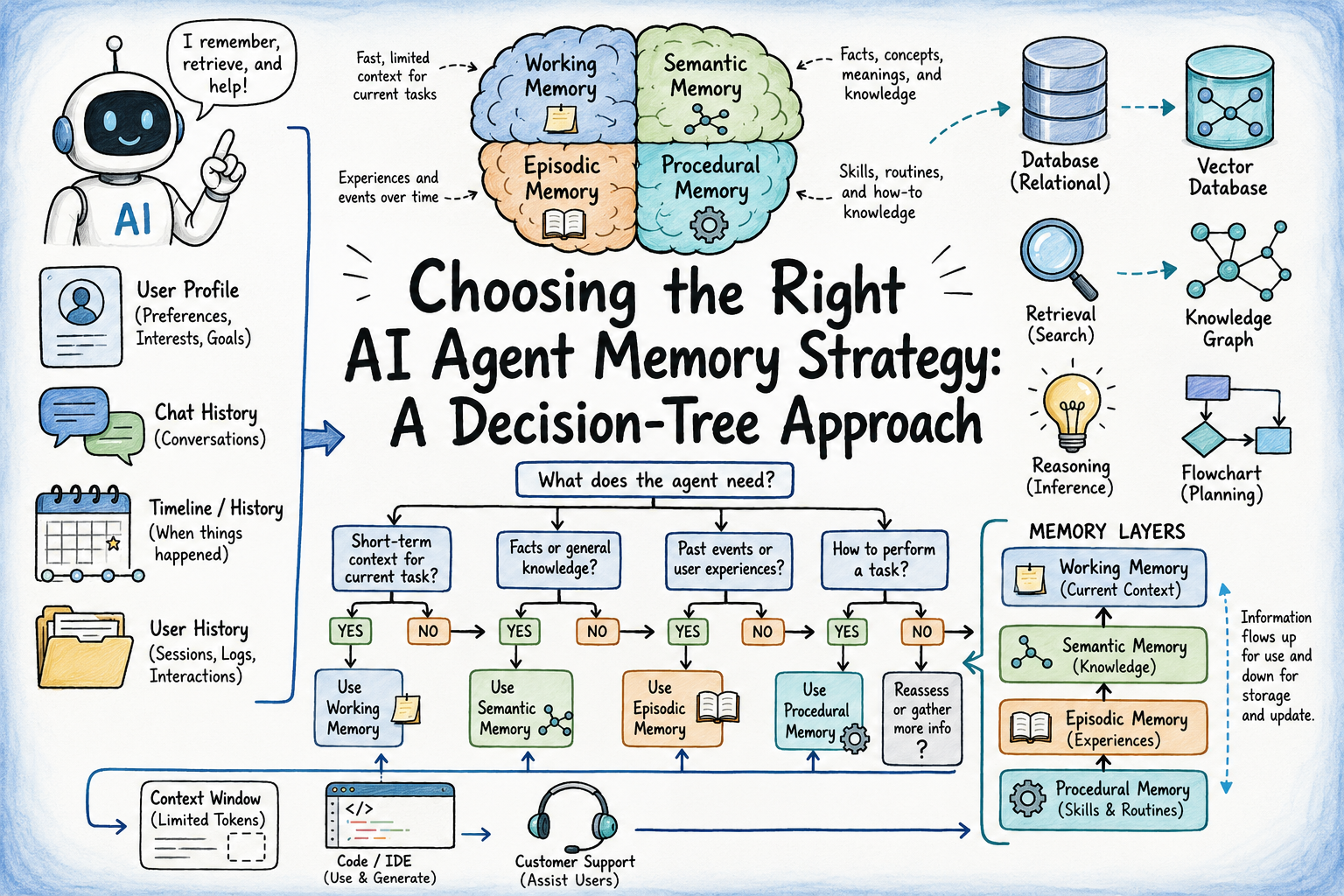
- 四种Agent记忆类型——工作记忆、语义记忆、情节记忆和程序记忆——以及每种对其所持有信息的假设。
- 一个五问题决策树,对给定信息类别实际所需进行分类,以及这些答案如何组合成完整的记忆架构。
- Agent记忆实现后出现的常见陷阱,以及如何修复它们。
让我们开始吧。
引言
记忆是AI Agent的决定性能力之一,然而它往往是事后才被设计。一些Agent会忘记用户期望它们记住的信息,而另一些则被赋予了它们其实并不需要的复杂记忆基础设施。二者通常都源于同一个未回答的设计问题:不同种类的信息应存活多久,以及应如何检索?
Agent记忆策略值得像编排一样精心设计。然而,与编排模式不同,Agent记忆很少是一个单一的架构选择。当前对话、用户陈述的偏好、过去的交互历史以及学到的例行程序,都是不同类别的信息,每种往往需要不同类型的记忆。有用的问题不在于Agent应使用哪个记忆系统,而在于每类信息实际需要哪一层记忆。
本文涵盖:
- 区分工作、语义、情节和程序记忆的核心记忆概念
- 一个五问题决策树,用于对给定信息类别所需进行分类
- 这些分类如何组合成Agent实际交付的分层记忆设置
- 记忆实现并投入使用后出现的陷阱
我们从为什么这种分类很重要的原因开始。
为什么选择AI Agent记忆策略很重要?
在通过决策树前,值得明确每个记忆层对其分配的信息所做的假设。
- 工作记忆基于:所有当前相关信息都位于活跃对话和有限的令牌预算内,修剪或总结较早的轮次不会悄悄丢弃Agent仍需要的内容。
- 语义记忆假设某些信息足够稳定和可重用,以至于存储规范表示比反复推断、重新询问或重新处理更有价值。这包括持久的用户事实,如姓名、角色和偏好语言;领域知识,如业务规则和产品规格;以及从重复交互中提炼的通用知识。
- 情节记忆建立在这样的预期之上:发生的经过本身具有价值,而不仅仅是当前状态:一份过去决策、投诉或交易的记录,应为下一次交互提供信息。
- 程序记忆假定反复解决同类任务应使Agent在下一次尝试时更快或更可靠,而不仅仅是留下过去尝试的记录。
这四个层回答关于信息的不同问题,这就是为什么大多数生产Agent依赖不止一种。
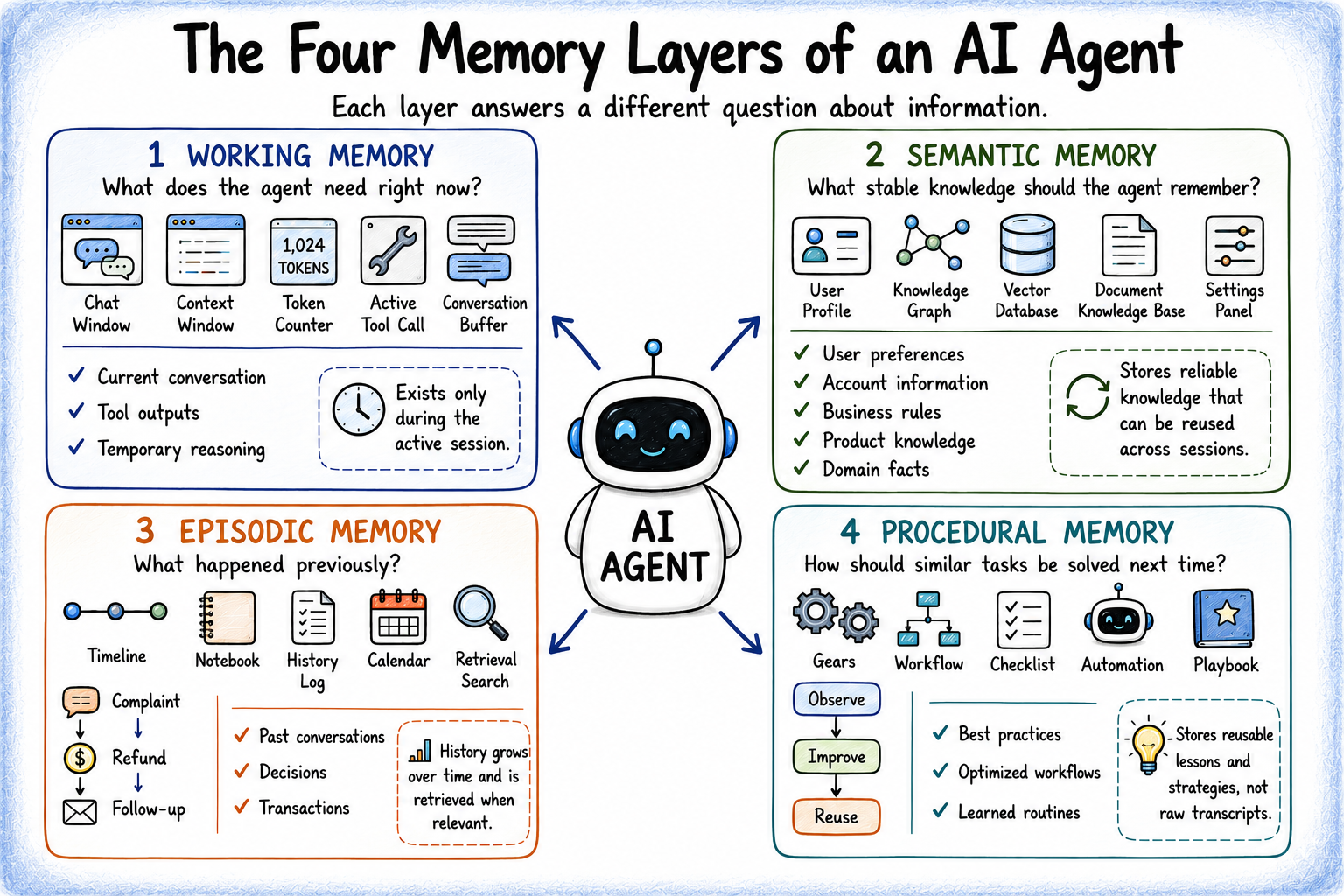
例如,一个客户支持Agent可能将当前工单放在工作记忆中,客户的订阅层级放在语义记忆中,过去的投诉放在情节记忆中,学到的退款处理例程放在程序记忆中。每一层都有不同的目的。
问题出现在信息被存储在错误的层中时。为属于结构化档案的稳定事实使用向量存储会使检索更慢,可靠性更低,而搜索整个交互历史可能浮现出陈旧或矛盾的信息,这些信息本该被结构化记录覆盖。对于有效上下文工程而言,记忆只是竞争有限上下文窗口的上下文来源之一,因此只有能实质性改善Agent响应的信息才应被检索。
选择正确AI Agent记忆策略的决策树
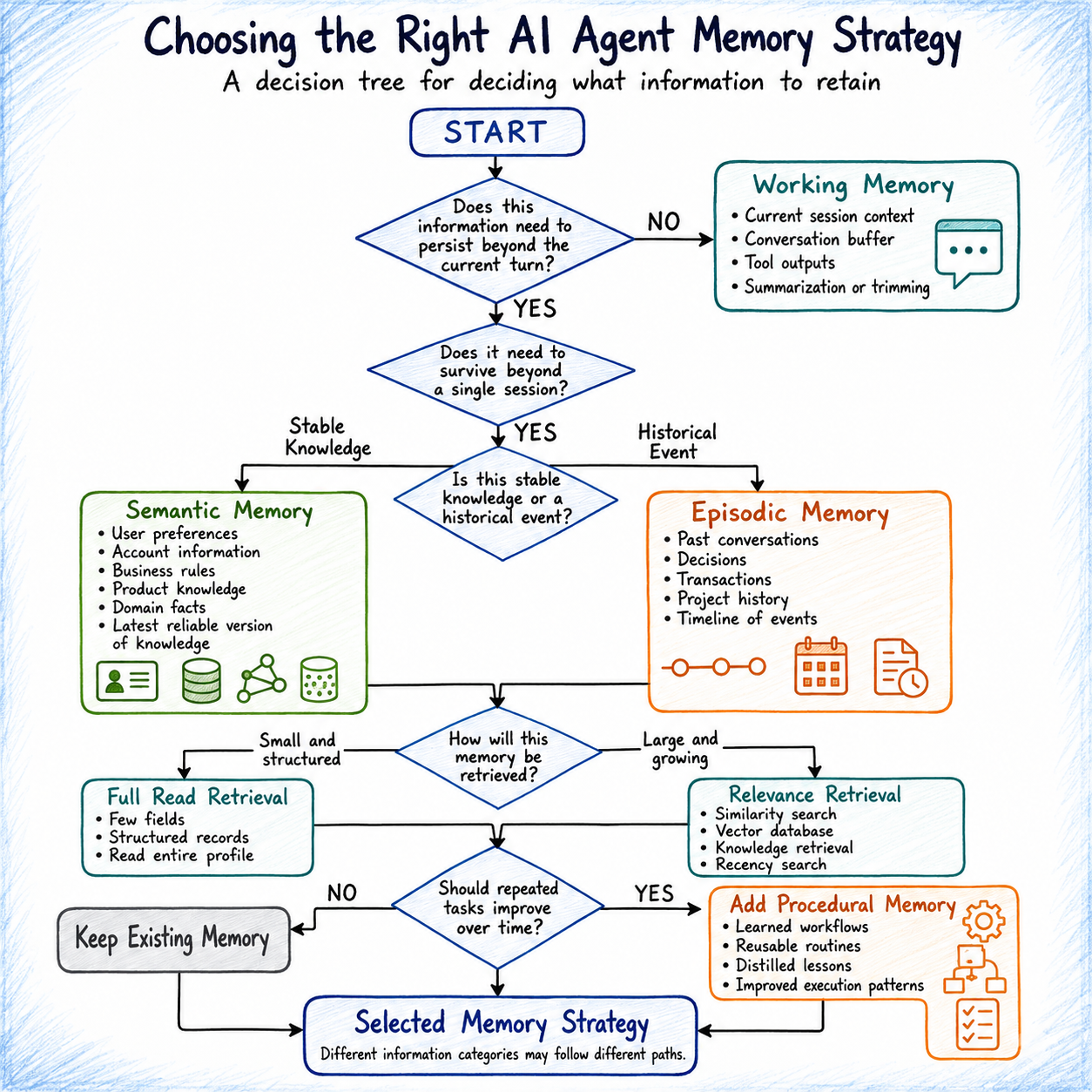
该树有五个分支问题,每个问题根据信息的一个具体属性缩小特定信息类别所需的范围。应为每个类别运行一次决策树,而不是为整个Agent运行一次。支持Agent的“当前工单”、“账户详情”和“投诉历史”是三个独立的类别,每个都可能在树上落点不同。
问题1:此信息是否需要持续到当前轮次之后?
这个问题区分了真正需要记忆的信息和看起来需要的信息。
- 自包含,无需延续:一次性分类请求的措辞,仅用于回答当前问题的工具调用中间输出
- 需要延续,需要记忆:支持Agent在此次对话中已解决的哪个问题,一个编程Agent从昨天恢复的编码项目状态
如果信息是自包含的 → 不需要记忆层;该轮次的上下文窗口就足够了。如果需要延续 → 移至问题2。
问题2:它需要存活超过单个会话吗?
这个问题将工作记忆与任何需要持久化的东西分开。
- 仅在会话内:已询问过的内容,已调用过的工具,已解决的问题 → 对话缓冲区足够,通过修剪或总结保持在界限内。基于会话的记忆管理在OpenAI Agents SDK中直接处理此问题。
- 超出会话:回头客的偏好,持续项目的状态,多日任务 → 仅靠工作记忆不够,因为信息必须独立于任何单一对话存在。
如果只需会话内连续性 → 对于此类别,工作记忆是答案。如果需要存在于会话之外 → 移至问题3。
⚠️ 一个常见的设计错误是将信息与其生命周期不匹配,要么将会话范围内的状态当作永久,要么为仅需在对话期间存在的信息构建持久记忆基础设施。
问题3:这是一个稳定的事实还是一个演变的事件?
这个问题经常被跳过,所有需要持久化的东西都被扔进同一个存储,不管形态如何。
- 稳定事实(语义记忆):姓名、订阅层级、偏好语气、默认收货地址,或其他跨会话保持有效且更适合作为规范事实存储而非反复推断或重新询问的持久知识。
- 演变事件(情节记忆):上个月提交的投诉,早期项目阶段做出的决定,多次交互中的行为模式
记忆架构从认知科学对人类记忆进行分类的方式中借鉴了这个词汇,将稳定知识与对特定过去事件的记忆分开。有些框架将时间维度直接构建到其存储层中。例如,Zep在知识图谱上建模事实,每个事实带有一个有效期窗口,因此被取代的事实会被失效,而不是留下沉默地与较新事实矛盾。
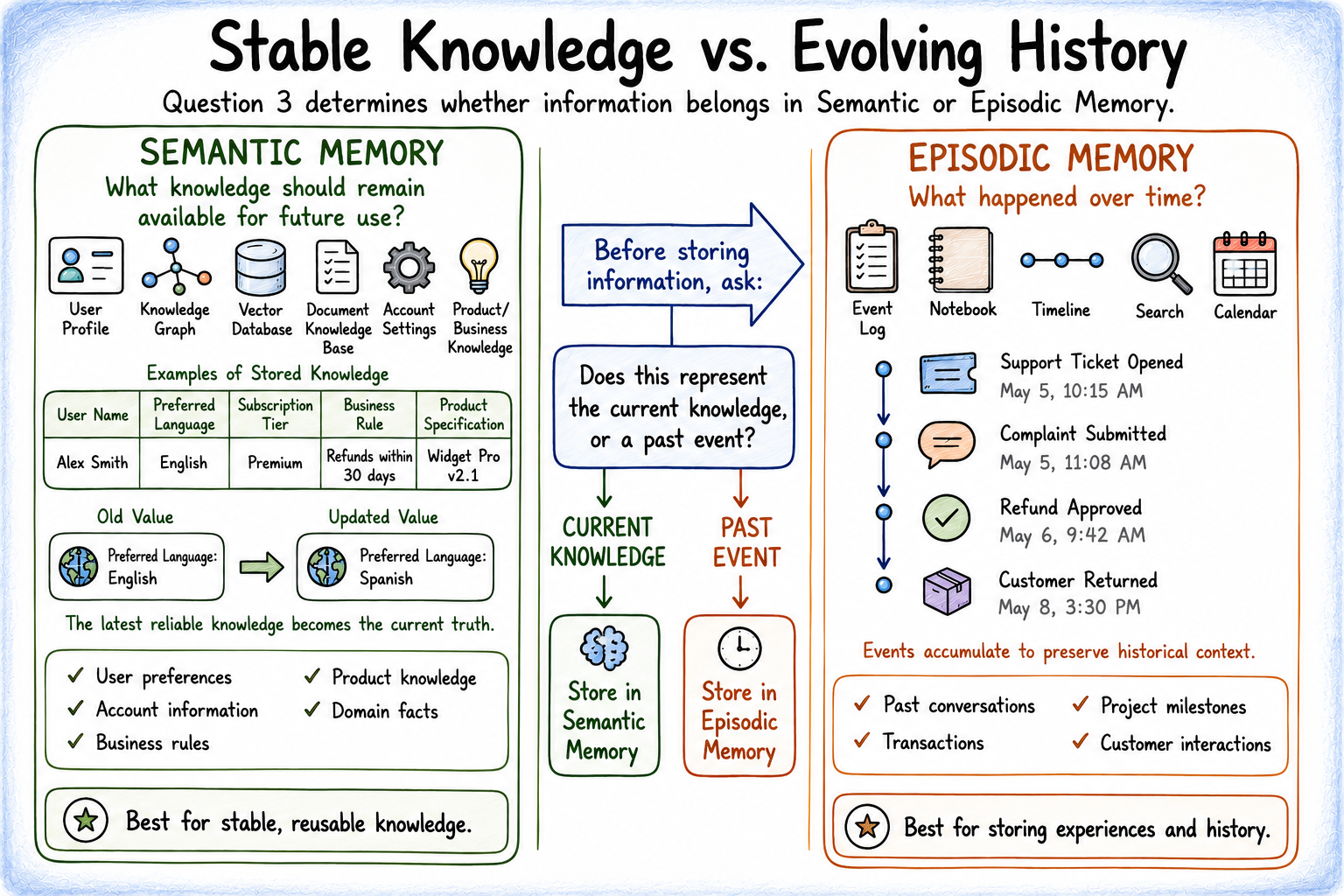
稳定事实属于持久知识存储,无论是用于用户属性的结构化记录、用于关系的知识图谱,还是用于语义可搜索领域知识的向量数据库。演变事件属于更接近日志的东西,其中条目积累,较旧的条目可能需要总结或裁剪。
如果此类别主要是事实和领域知识 → 语义记忆。如果主要是历史 → 情节记忆。下一个问题是该日志如何大规模搜索,这通向问题4。
问题4:此记忆将如何被检索?
这个问题关乎将检索与记忆存储的大小、结构和增长速度相匹配,而不是到处使用相同的检索策略。
- 小型、有界存储(少量用户事实或单个档案):在会话开始时读取整个存储。Anthropic的记忆工具以此方式工作,因为存储保持足够小,全量读取成本低廉。
- 大型、可搜索存储(交互历史、文档语料库或不断扩展的知识库):仅使用语义搜索或混合检索检索最相关的条目,因为读取所有内容很快变得不切实际。Google的Memory Bank是为这种规模设计的,像Mem0这样的记忆框架提供了类似、与提供商无关的方法,可与LangGraph或CrewAI等框架一起使用。
一个Agent同时需要两种检索模式是常见的:为小型语义存储进行全读档案,同时对较大的情节日志或语义知识库进行相似性搜索。
一旦检索适合每个存储的实际大小和结构,移至问题5。
问题5:Agent是否需要学习可重用的程序?
这里是程序记忆登场,它位于任何已有的语义和情节层之上,而不是取代它们。
- 应通过重复改进的重复任务形态(同类型的重构,同类别的工单):值得提炼为程序记忆,这样Agent应用精炼的例程,而不仅仅是重放过去的尝试。
- 一次性或非重复任务:跳过此层;前面选择的语义或情节记忆本身就已足够。
Agent的记忆模块通常与其规划和工具层并排,将学到的上下文反馈回未来计划的制定中。关键的设计决策是写入什么内容。过去运行的原始日志捕获了情节记忆,而程序记忆存储了从那些经验中提炼出的教训、成功步骤和可重用策略。一个有用的程序存储是为未来应用而编写的,允许Agent将经过验证的工作流和模式直接应用于类似任务。
上述问题应给你一个如下的决策树:
记忆层如何组合
为每类信息运行决策树产生一个记忆概况,而不是整个Agent的单一答案。组合这些概况揭示了最适合Agent需求的记忆架构。
例如,一个编程Agent可能对当前会话的编辑使用工作记忆,对用户偏好和工具知识使用语义记忆,对跨项目的变更历史使用情节记忆,对通过重复使用而改进的可重用测试验证工作流使用程序记忆。另一方面,一个简单的FAQ Agent可能只需要工作记忆,因为其所有信息都不需要持久化到当前对话之外。
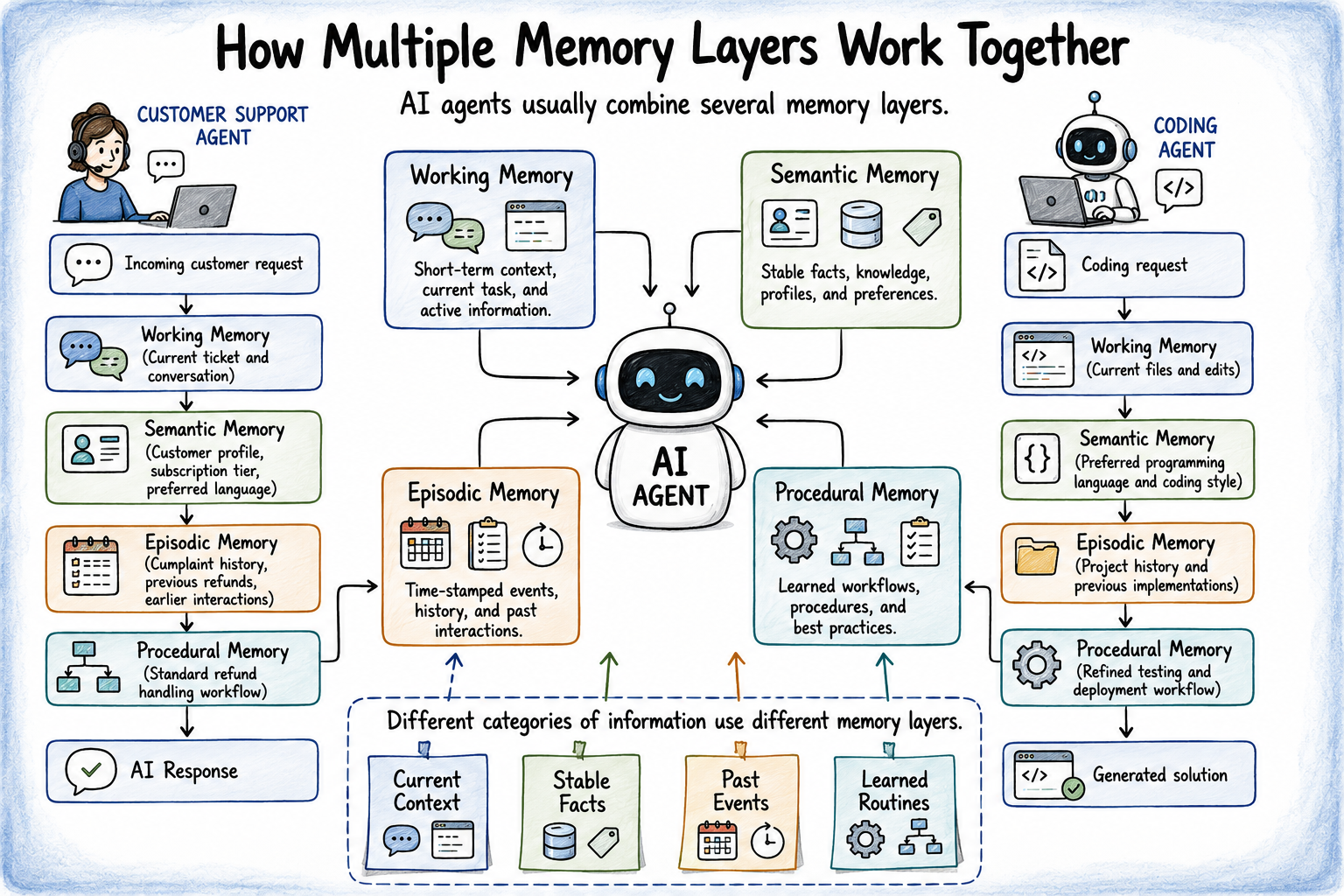
两者都是相同决策过程的有效结果;差异来自Agent需要保留的信息类型以及它需要使用这些信息的方式。
| 层 | 用途 | 典型实现 |
|---|---|---|
| 无持久化 | 自包含信息,无延续需要 | 仅依赖上下文窗口;无记忆层 |
| 工作记忆 | 单个会话内的连续性 | 带修剪或总结的对话缓冲区 |
| 语义记忆 | 跨会话的稳定事实和通用知识 | 存储在结构化档案、知识图谱或向量数据库中用于语义检索;对于小型存储进行全读,对较大的知识库进行相似性搜索 |
| 情节记忆 | 跨会话的演变历史 | 不断增长的日志,通过最近或相关性搜索大规模检索 |
| 程序记忆 | 应通过重复改进的重复任务模式 | 提炼出的、可重用的例程,位于现有语义或情节存储之上 |
常见AI Agent记忆陷阱(及修复)
即使为每个类别选择了正确的层,记忆实现往往以少数可预测的方式失败。下表将常见症状映射到其通常原因和修复。
| 问题 | 可能原因 | 修复 |
|---|---|---|
| Agent重新询问本会话中已提供的信息 | 工作记忆修剪过于激进,或者总结丢失了相关细节 | 扩大保留窗口或改进摘要保留的内容,而不是添加一个长… |
English / 原文
In this article, you will learn how to choose the right memory strategy for an AI agent by working through a simple decision tree, one category of information at a time.
Topics we will cover include:
- The four types of agent memory — working, semantic, episodic, and procedural — and what each one assumes about the information it holds.
- A five-question decision tree that classifies what a given category of information actually needs, and how those answers combine into a full memory architecture.
- The common pitfalls that show up once agent memory is implemented, and how to fix them.
Let’s get started.
Introduction
Memory is one of the defining capabilities of an AI agent, yet it’s often designed as an afterthought. Some agents forget information users expect them to remember, while others are given complex memory infrastructure they never really need. Both often stem from the same unanswered design question: how long should different kinds of information live, and how should they be retrieved?
Agent memory strategy deserves the same deliberate design as orchestration. Unlike orchestration patterns, however, agent memory is rarely a single architectural choice. The current conversation, a user’s stated preferences, past interaction history, and learned routines are different categories of information, and each tends to need a different kind of memory. The useful question isn’t which memory system an agent should use — it’s which layer each category of information actually needs.
This article covers:
- The core memory concepts that separate working, semantic, episodic, and procedural memory
- A five-question decision tree for classifying what a given category of information needs
- How those classifications combine into the layered memory setups agents actually ship with
- The pitfalls that show up once memory gets implemented and used
We start with why this classification matters in the first place.
Why Is Choosing an AI Agent Memory Strategy Important?
Before working through the decision tree, it’s worth being clear about what each memory layer assumes about the information assigned to it.
- Working memory rests on the idea that everything relevant right now lives inside the active conversation and a finite token budget, and that trimming or summarizing older turns won’t quietly drop something the agent still needs.
- Semantic memory assumes that certain information is sufficiently stable and reusable that storing a canonical representation is more valuable than repeatedly inferring, re-asking, or reprocessing it. This includes persistent user facts such as name, role, and preferred language; domain knowledge such as business rules and product specifications; and generalized knowledge distilled from repeated interactions.
- Episodic memory is built on the expectation that the history of what happened carries value on its own, not just the current state: a record of past decisions, complaints, or transactions that should inform the next interaction.
- Procedural memory presumes that solving the same shape of task repeatedly should make the agent faster or more reliable on the next attempt, not just leave behind a transcript of past attempts.
These four layers answer different questions about information, which is why most production agents rely on more than one.
A customer support agent, for example, might keep the current ticket in working memory, a customer’s subscription tier in semantic memory, past complaints in episodic memory, and a learned refund-handling routine in procedural memory. Each layer serves a distinct purpose.
Problems arise when information is stored in the wrong layer. Using a vector store for stable facts that belong in a structured profile makes retrieval slower and less reliable, while searching an entire interaction history can surface stale or contradictory information that a structured record would have overwritten. For effective context engineering, memory is just one source of context competing for a limited context window, so information should only be retrieved if it meaningfully improves the agent’s response.
The Decision Tree for Choosing the Right AI Agent Memory Strategy
The tree has five branching questions, each one narrowing down what a specific category of information needs based on a concrete property of it. Run the tree once per category, not once for the whole agent. A support agent’s “current ticket,” “account details,” and “complaint history” are three separate categories, and each one can land in a different place on the tree.
Question 1: Does This Information Need to Persist Beyond the Current Turn?
This question separates information that genuinely needs memory from information that just looks like it does.
- Self-contained, no carry-forward needed: the wording of a one-off classification request, the intermediate output of a tool call used only to answer the current question
- Carries forward, memory required: which issue a support agent already resolved this conversation, the state of a coding project an agent is picking back up from yesterday
If the information is self-contained → no memory layer is needed; the context window for that turn is enough. If it needs to carry forward → move to Question 2.
Question 2: Does It Need to Survive Beyond a Single Session?
This question separates working memory from anything that needs to be durable.
- Within-session only: what’s already been asked, which tools have already been called, what’s already resolved → a conversation buffer is enough, kept in bounds by trimming or summarization. Session-based memory management in the OpenAI Agents SDK handles this directly.
- Beyond the session: a returning customer’s preferences, an ongoing project’s state, a multi-day task → working memory alone won’t do it, since the information has to exist independently of any single conversation.
If only within-session continuity matters → working memory is the answer for this category. If it needs to outlive the session → move to Question 3.
⚠️ A common design mistake is mismatching information to its lifetime, either treating session-scoped state as permanent or building persistent memory infrastructure for information that only needs to exist during a conversation.
Question 3: Is This a Stable Fact or an Evolving Event?
This question is often skipped, with everything that needs to persist getting thrown into the same store regardless of shape.
- Stable facts (semantic memory): a name, a subscription tier, a preferred tone, a default shipping address, or other persistent knowledge that remains valid across sessions and is more valuable to store as a canonical fact than repeatedly infer or re-ask.
- Evolving events (episodic memory): a complaint filed last month, a decision made during an earlier project phase, a pattern of behavior across several interactions
Memory architectures borrow this vocabulary from how cognitive science categorizes human memory, separating stable knowledge from memory of specific past events. Some frameworks build the temporal dimension directly into their storage layer. For example, Zep models facts on a knowledge graph where each fact carries a validity window, so a superseded fact gets invalidated rather than left to silently contradict the newer one.
A stable fact belongs in a persistent knowledge store, whether that’s a structured record for user attributes, a knowledge graph for relationships, or a vector database for semantically searchable domain knowledge. An evolving event belongs in something closer to a log, where entries accumulate and older ones may need summarizing or pruning.
If this category is mostly facts and domain knowledge → semantic memory. If it’s mostly history → episodic memory. The next question is how that log gets searched at scale, which leads to Question 4.
Question 4: How Will This Memory Be Retrieved?
This question is about matching retrieval to the size, structure, and growth rate of the memory store rather than using the same retrieval strategy everywhere.
- Small, bounded store (a handful of user facts or a single profile): read the entire store at the start of a session. Anthropic’s memory tool works this way because the store stays small enough that a full read is inexpensive.
- Large, searchable store (an interaction history, document corpus, or expanding knowledge base): retrieve only the most relevant entries using semantic search or hybrid retrieval, since reading everything quickly becomes impractical. Google’s Memory Bank is designed for this scale, and memory frameworks like Mem0 offer a comparable, provider-independent approach that you can use with frameworks like LangGraph or CrewAI.
It’s common for one agent to need both retrieval patterns at once: a full-read profile for a small semantic store, alongside similarity search over a larger episodic log or semantic knowledge base.
Once retrieval fits each store’s actual size and structure, move to Question 5.
Question 5: Does the Agent Need to Learn Reusable Procedures?
This is where procedural memory comes in, and it sits on top of whatever semantic and episodic layers are already in place rather than replacing them.
- Recurring task shape that should improve with repetition (the same kind of refactor, the same category of ticket): worth distilling into procedural memory, so the agent applies a refined routine rather than just replaying past attempts.
- One-off or non-repeating tasks: skip this layer; the semantic or episodic memory chosen earlier is enough on its own.
An agent’s memory module typically sits alongside its planning and tool layers, feeding learned context back into how future plans get made. The key design decision is what gets written. Raw logs of past runs capture episodic memory, while procedural memory stores the distilled lessons, successful steps, and reusable strategies extracted from those experiences. A useful procedural store is written for future application, allowing the agent to directly apply proven workflows and patterns to similar tasks.
The above questions should give you a decision tree like so:
How the Memory Layers Combine
Running the tree for each category of information produces a memory profile rather than a single answer for the entire agent. Combining these profiles reveals the memory architecture that best fits the agent’s needs.
For example, a coding agent might use working memory for the current session’s edits, semantic memory for user preferences and tooling knowledge, episodic memory for the history of changes across projects, and procedural memory for reusable test-and-verify workflows improved through repeated use. A simple FAQ agent, on the other hand, may only need working memory because none of its information needs to persist beyond the current conversation.
Both are valid outcomes of the same decision process; the difference comes from the type of information the agent needs to retain and how it needs to use that information.
| Layer | What It Is For | Typical Implementation |
|---|---|---|
| No persistence | Self-contained information with no carry-forward | Rely on the context window alone; no memory layer |
| Working memory | Continuity within a single session | Conversation buffer with trimming or summarization |
| Semantic memory | Stable facts and generalized knowledge that persist across sessions | Stored in structured profiles, knowledge graphs, or vector databases for semantic retrieval; retrieved through full reads for small stores or similarity search for larger knowledge bases |
| Episodic memory | Evolving history that persists across sessions | Growing log, retrieved by recency or relevance search at scale |
| Procedural memory | Recurring task patterns that should improve with repetition | Distilled, reusable routines layered on top of an existing semantic or episodic store |
Common AI Agent Memory Pitfalls (and Fixes)
Even with the right layer chosen for each category, memory implementations tend to fail in a handful of predictable ways. The table below maps common symptoms to their usual cause and fix.
| Issue | Likely Cause | Fix |
|---|---|---|
| Agent re-asks for information already given this session | Working memory trimmed too aggressively, or summarization drops the relevant detail | Widen the retained window or improve what the summary keeps, rather than adding a long-term memory layer |
| Retrieval returns irrelevant or contradictory results | Stable facts and evolving events mixed into one undifferentiated store | Split them: use a small structured store for facts and a separate log for events |
| Semantic memory gets overwritten with bad information | No validation or versioning at write time | Add confirmation, versioning, or a review step before a fact replaces an existing one |
| Procedural memory never seems to improve anything | The store holds raw replays of past runs rather than distilled lessons | Write the digested lesson learned, not a transcript of the attempt |
| One memory system is handling facts, history, and session state all at once | Every category of information was forced through the same store instead of being classified separately | Run the decision tree per category and let each one land on the layer it actually needs |
Wrap-Up and Next Steps
The decision tree turns memory design into a set of clear choices rather than a single default approach. It asks the key questions before any storage is built: how long should this information persist, is it a stable fact or a past event, how will it be retrieved later, and does it represent a reusable behavior that can improve future tasks?
Many memory problems come from treating all information an agent handles as the same type of data. As discussed, working memory, semantic memory, episodic memory, and procedural memory serve different purposes and require different storage and retrieval strategies. Effective agents combine these layers based on what information needs to persist, how it should be retrieved, and whether it should improve future behavior.
The next step is to explore the agent memory frameworks and tools available. In a future article, we will walk through how to evaluate these frameworks and choose the right one based on your application’s requirements.