Condé Nast 如何借助 Amazon Bedrock 构建多模态视频发现能力
英文标题:How Condé Nast built multimodal video discovery with Amazon Bedrock
Condé Nast 的编辑团队过去仅依靠标题和描述,在超过 14 万条视频中检索素材,单次内容发现任务平均耗时 250 分钟。该公司与 AWS Generative AI Innovation Center 合作,基于 Amazon Bedrock、Amazon OpenSearch Service 和 TwelveLabs Marengo 构建了多模态语义视频搜索方案,可同时理解视频画面、音频和转录文本。该方案将单次检索时间缩短至 2 分钟以内,降幅达 99.2%,并预计每年节省约 80 万美元运营成本。该架构将异步视频摄取与索引、同步查询与服务解耦,为大规模视频库的低延迟检索、持续更新和高可用运行提供了可复用模式。
 1.3 MB
 101.1 KB
 124.1 KB
 345.0 KB
 141.2 KB
 346.5 KB
 871.4 KB
 27.5 KB
 24.9 KB
 22.7 KB
 4.5 KB
 55.6 KB
中文
Condé Nast 的编辑团队此前没有快速进行多模态视频发现的方式。他们需要在一个包含超过 14 万条视频的资料库中手动浏览,平均每项内容发现任务耗时 250 分钟。他们依赖标题和描述来寻找相关片段。在一个内容上线速度直接决定营收获取能力的媒体环境中,这一流程为 Vogue、GQ、Vanity Fair 和 Wired 等品牌带来了可量化的运营阻力。
核心问题在于结构性限制:现有搜索工具无法查看视频内容内部。团队依赖组织内部知识来定位资产,当特定人员无法工作时,这就形成了单点故障。与此同时,大量未被充分利用的内容沉睡在档案库中,难以被发现,因为标题或描述中的关键词无法将其与编辑实际执行的查询关联起来。
为解决这一问题,Condé Nast 与 AWS Generative AI Innovation Center (GenAIIC) 合作,构建了一个由 AI 驱动的多模态视频发现解决方案。该方案构建于 Amazon Bedrock 和 Amazon OpenSearch Service 之上,可针对视频转录文本、视觉元素和音频执行基于意图的语义搜索。团队选择了 TwelveLabs Marengo 嵌入模型,因为它原生支持联合编码视觉、音频和转录文本信号。Marengo 为下一节所述的全部五项能力提供支持。该方案将每项任务的发现时间从 250 分钟缩短至不足 2 分钟。
本文介绍该方案的架构,说明选择特定技术方案的原因,并分享该解决方案带来的业务成果。
为什么选择语义搜索(以及为什么采用这一架构)
团队界定问题范围时,有两项约束塑造了解决方案设计。
首先,关键词搜索从根本上并不够用。编辑团队不会搜索“yoga_tutorial_march_2024.mp4”,而是搜索“带有舒缓背景的初学者瑜伽内容”或“时装周幕后花絮”。搜索层需要理解意图,而不是匹配字符串。这直接指向可跨模态(视觉、音频和转录文本)捕捉语义含义的向量嵌入。仅靠人工编写的元数据无法提供这种层次的理解。
其次,视频库规模足够大(超过 14 万条视频),任何解决方案都必须将生成嵌入这一高成本、计算密集型的工作,与提供低延迟搜索结果的工作分开。单体架构会迫使系统在摄取吞吐量和查询响应能力之间取舍。解耦后,每个平面都可以独立扩展、独立故障恢复和独立演进。这一决定在回填处理期间被证明至关重要。
这两项约束促成了方案的核心设计:通过 Amazon Bedrock 上的 TwelveLabs Marengo 模型生成多模态向量嵌入,将其索引到 Amazon OpenSearch Service,并通过专门构建的查询层提供服务。该层将自然语言转换为向量搜索,并返回精确时间戳。我们通过 Amazon Bedrock 访问 Marengo,因为 Bedrock 可通过单一 API 提供一系列基础模型(FM)。它还应用 AWS 治理控制,包括用于访问控制的 AWS Identity and Access Management (IAM)、用于网络隔离的 Amazon Virtual Private Cloud (Amazon VPC),以及用于审计能力的 AWS CloudTrail。这一组合让团队能够采用专门的嵌入模型,而无需自行构建或运营模型服务基础设施。对于向量索引,Amazon OpenSearch Service 提供托管式 k 最近邻(k-NN)搜索、多可用区复制以及面向混合查询的元数据筛选。这使团队无需管理底层搜索集群,即可对超过 14 万条视频执行低延迟相似性搜索。
解决方案能力
该方案让编辑团队能够以完全不同的方式与视频资料库交互。该方案提供以下能力:
- **基于意图的搜索:**用户可用自然语言描述需求(例如“初学者瑜伽内容”或“关于可持续发展的名人访谈”),并获得带有精确时间戳、在语境上相关的片段。
- **多模态理解:**搜索可同时覆盖视频转录文本、视觉元素和音频。片段可通过其中说了什么、展示了什么或听到了什么被发现。
- **基于图像的查询:**用户可上传参考图像,在整个档案库中寻找视觉上相似的内容。
- **拼写错误容忍与意图解析:**搜索层能够处理不精确的查询,关注含义而非精确关键词匹配。
- **时间戳精度:**结果可定位视频中的精确时刻,无需观看完整片段。
下图展示了高层架构,包括摄取与索引平面,以及查询与服务平面。
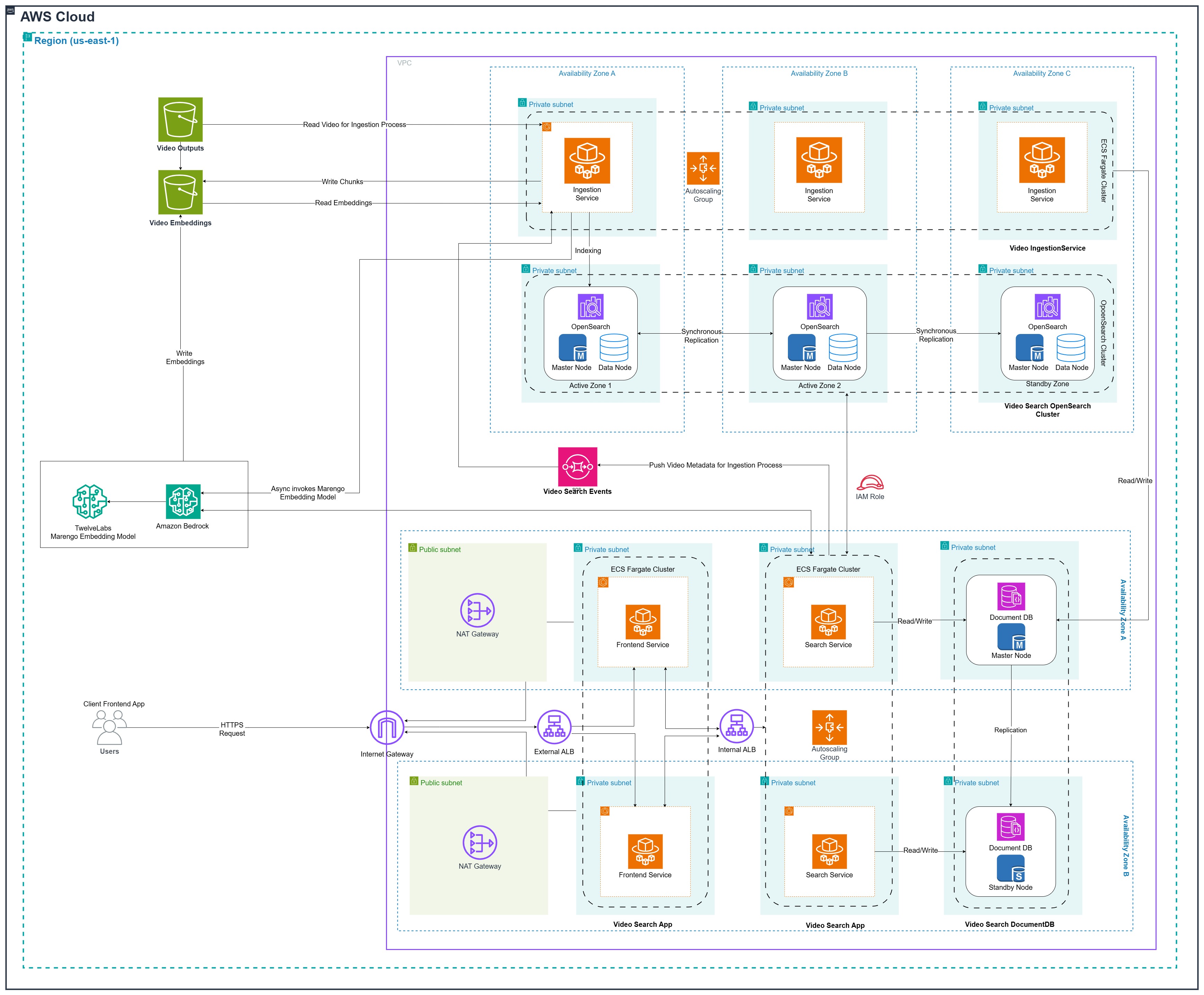
图 1:多模态视频发现解决方案的高层架构,展示摄取与索引平面以及查询与服务平面。
架构详解
该方案由两个解耦平面组成:一个让视频可被搜索的异步摄取管道,以及一个处理用户查询的同步服务层。
摄取与索引平面
上传新视频时,将执行以下流程:
- **上传:**视频进入一个存放源视频的 Amazon Simple Storage Service(Amazon S3)存储桶(图中为 Video Outputs)。
- **编排:**新的上传会触发一个事件(图中为 Video Search Events)。该事件会将视频元数据推送至摄取流程,并协调整个管道。
- **预处理:**摄取服务验证视频并提取元数据,包括格式、时长和分辨率。
- **分块:**同一摄取服务运行于搭配 AWS Fargate 的 Amazon Elastic Container Service(Amazon ECS)上,将视频拆分为多个片段。Auto Scaling 组会跨多个可用区水平扩展,以并行处理这些分块。
- **嵌入生成:**每个分块通过 Amazon Bedrock 上的 TwelveLabs Marengo 嵌入模型进行异步调用处理。Marengo 会生成多模态向量嵌入,捕捉每个片段在视觉、音频和转录文本维度上的语义内容。
- **索引:**生成的嵌入会写入 Amazon S3 存储桶以确保持久性(图中为 Video Embeddings),并索引到 Amazon OpenSearch Service 集群中,以执行向量相似性搜索。
该管道采用事件驱动,并进行了端到端编排。这为团队提供了逐步骤重试逻辑、跨分块并行处理能力,以及用于调试的完整可追溯性。这些能力在初始的 14 万条视频回填过程中被团队大量使用。
查询与服务平面
用户执行搜索时,将执行以下流程:
- **请求路由:**请求通过互联网网关进入 VPC,并抵达外部 Application Load Balancer(ALB)。
- **后端处理:**外部 ALB 将请求分发至运行于搭配 AWS Fargate 的 Amazon ECS 上的前端服务。前端服务通过内部 ALB 调用搜索服务。Auto Scaling 组会在多个可用区扩展这两项服务。
- **向量搜索:**搜索服务将用户查询转换为向量嵌入,并针对 Amazon OpenSearch Service 索引执行 k-NN 相似性搜索。
- **元数据丰富:**搜索服务从 Amazon DocumentDB(兼容 MongoDB)读取视频元数据,包括标题、缩略图和引用信息,以丰富搜索结果。
- **响应:**整合后的结果会返回给用户,其中包含相关片段和精确时间戳。
高可用性(HA)设计
该方案全链路采用多可用区部署。以下组件为实现弹性而部署:
- **Amazon OpenSearch Service:**跨三个可用区进行同步复制(两个活跃节点、一个备用节点)。
- **Amazon DocumentDB:**主节点和备用副本分布在两个可用区中。
- **计算层:**摄取服务、前端服务和搜索服务使用分布于各可用区的 Auto Scaling 组,ALB 可绕过故障节点进行路由。
- **网络隔离:**计算和数据工作负载位于私有子网中。只有外部 ALB 可从公网访问,出站流量则通过 NAT 网关流动。
成果
Condé Nast 于 2026 年 5 月开展了一次基准测试研讨会,以量化该方案的影响。以下结果反映了 Condé Nast 在该研讨会中的测量数据。
- 内容发现时间缩短 99.2%,每项任务从 250 分钟降至约 2 分钟(数据来自此前所述的 2026 年 5 月基准测试研讨会)。
- **人工视频审核工作量减少超过 90%。**团队可以直接获得带有精确时间戳的目标片段,而无需逐条浏览视频(数据来自此前所述的 2026 年 5 月基准测试研讨会)。
- 预计每年节省约 80 万美元运营成本,这一估算基于全组织范围内减少重复人工搜索所带来的生产率提升(估算源自此前所述的 2026 年 5 月基准测试研讨会)。
- **提升资产可发现性:**此前未被充分利用的视频可通过仅依赖元数据的搜索无法识别的语义关联被发现。
- **加速营收获取:**更快的发现速度意味着能更快响应广告主需求和销售机会,缩短从询盘到变现的路径。
“AWS 团队与 GenAI 和 TwelveLabs 的参会者一道,帮助我们清晰、简洁地阐释了业务案例。我乐观地认为,在不久的将来,我们将朝着工作流目标取得更多进展。”
— Billy Keenly,Condé Nast 创意优化全球高级总监
我们学到的经验
在超过 14 万条视频的资料库上构建该方案,带来了一些超出架构图所能表达范围的实践经验。
早期用户研究塑造了整个嵌入和查询设计。团队访谈了编辑人员,以了解他们如何用自己的语言描述内容。这些对话确定了语义搜索恰当的抽象层级。没有这一基础,系统可能会针对用户实际上从不输入的查询进行优化。
在这一规模下,将摄取与服务分离被证明至关重要。每个平面都可以独立演进、扩展和发生故障。该方案已在生产环境运行六个月,在摄取管道重新处理回填内容或接收更新时,生产搜索服务始终保持可用。
找到合适的视频片段时长需要有意识的实验。过短的片段会丢失上下文,过长的片段则会稀释语义信号。团队通过针对真实编辑查询的迭代基准测试,确定了能够平衡精确率和召回率的时长。
在这一规模下,异步嵌入生成不可或缺。若对嵌入模型进行同步调用,将会在超过 14 万条视频上造成瓶颈。通过 AWS Step Functions 进行异步调用,使管道能够在不阻塞的情况下处理积压任务,并且这仍是持续摄取所采用的模式。
从第一天起就构建多可用区可用性,避免了昂贵的后期改造。对于编辑团队在整个工作日都依赖的解决方案,即使短暂宕机也会直接导致生产率损失。从一开始就构建这一能力,比之后再添加成本更低。
结论
本文介绍了 Condé Nast 和 AWS 如何使用 Amazon Bedrock、Amazon OpenSearch Service 以及 TwelveLabs Marengo 构建多模态视频智能解决方案。该方案以覆盖视觉、音频和转录文本模态的基于意图的语义搜索,替代了仅依赖元数据的搜索。结果是:在超过 14 万条视频的资料库中,内容发现时间缩短 99.2%,预计每年节省 80 万美元运营成本。
这一模式适用于管理大型视频库的组织,包括广播机构、流媒体服务、体育联盟和企业媒体团队。随着多模态 AI 能力演进,这一解耦架构能够适配不同的嵌入模型和内容类型。
开始使用:
- 了解更多 Amazon Bedrock 信息,并查阅 Amazon Bedrock 用户指南获取实施指导。
- 探索 Amazon OpenSearch Service 以及 k-NN 向量搜索文档,了解相似性搜索。
- 阅读 Amazon Bedrock 上的 TwelveLabs 模型,了解多模态视频理解。
- 查阅 AWS Step Functions 文档,了解经过编排的处理管道。
- 联系 AWS Generative AI Innovation Center 讨论您的使用场景,或联系您的 AWS 客户团队。
如需开始在 AWS 上进行多模态视频发现,请访问 Amazon Bedrock 和 Amazon OpenSearch Service。如需了解 AWS Generative AI Innovation Center 如何帮助您的团队构建解决方案,请联系该中心。
English / 原文
Condé Nast’s editorial teams had no fast way to do multimodal video discovery. They were spending an average of 250 minutes per content discovery task, manually scrubbing through a library of more than 140,000 videos. They relied on titles and descriptions to find relevant clips. In a media environment where speed-to-market directly determines revenue capture, this process created measurable operational drag across brands such as Vogue, GQ, Vanity Fair, and Wired.
The core problem was structural: Existing search tools can’t look inside video content. Teams depended on institutional knowledge to locate assets, creating single points of failure when specific individuals were unavailable. Meanwhile, underutilized content sat in the archive undiscoverable because no keyword in a title or description connected it to the queries editors were actually running.
To solve this, Condé Nast partnered with the AWS Generative AI Innovation Center (GenAIIC) to build an AI-powered multimodal video discovery solution. Built on Amazon Bedrock and Amazon OpenSearch Service, the solution runs intent-based semantic search across video transcripts, visual elements, and audio. The team selected the TwelveLabs Marengo embedding model for its native ability to jointly encode visual, audio, and transcript signals. Marengo powers all five capabilities described in the following section. This reduced discovery time from 250 minutes to under 2 minutes per task.
In this post, we describe the architecture, explain why we chose specific technology choices, and share the business outcomes the solution delivered.
Why semantic search (and why this architecture)
When the team scoped the problem, two constraints shaped the solution design.
First, keyword search was fundamentally insufficient. Editorial teams don’t search for “yoga_tutorial_march_2024.mp4.” Instead, they search for “beginner yoga content with calming backgrounds” or “behind-the-scenes fashion week moments.” The search layer needed to understand intent, not match strings. This pointed directly to vector embeddings that capture semantic meaning across modalities (visual, audio, and transcript). Human-authored metadata alone could not provide that level of understanding.
Second, the video library was large enough (over 140,000 videos) that any solution needed to separate the expensive, compute-heavy work of generating embeddings from the low-latency work of serving search results. A monolithic architecture would force a tradeoff between ingestion throughput and query responsiveness. Decoupling them meant each plane could scale, fail, and evolve independently. This decision proved essential during backfill processing.
These two constraints led to the solution’s core design: multimodal vector embeddings generated by the TwelveLabs Marengo model on Amazon Bedrock, indexed in Amazon OpenSearch Service, and served through a purpose-built query tier. This tier converts natural language into vector searches and returns precise timestamps. We accessed Marengo through Amazon Bedrock because Bedrock offers a range of foundation models (FMs) through a single API. It also applies AWS governance controls, including AWS Identity and Access Management (IAM) for access, Amazon Virtual Private Cloud (Amazon VPC) for network isolation, and AWS CloudTrail for auditability. That combination let the team adopt a specialized embedding model without building or operating its own model-serving infrastructure. For the vector index, Amazon OpenSearch Service provides managed k-nearest neighbor (k-NN) search with multi-AZ replication and metadata filtering for hybrid queries. This let the team run low-latency similarity search across more than 140,000 videos without managing the underlying search cluster.
Solution capabilities
The solution gives editorial teams a fundamentally different way to interact with their video library. The following capabilities are available through the solution:
- Intent-based search: Users describe what they need in natural language (for example, “beginner yoga content” or “celebrity interview about sustainability”) and receive contextually relevant clips with precise timestamps.
- Multimodal understanding: Search spans video transcripts, visual elements, and audio simultaneously. A clip is discoverable by what’s said, what’s shown, or what’s heard.
- Image-based queries: Users can upload a reference image to find visually similar content across the archive.
- Typo tolerance and intent resolution: The search layer handles imprecise queries and focuses on meaning rather than exact keyword matches.
- Timestamp precision: Results pinpoint exact moments within videos, alleviating the need to watch entire clips.
The following diagram illustrates the high-level architecture, showing the ingestion and indexing plane and the query and serving plane.
Figure 1: High-level architecture of the multimodal video discovery solution, showing the ingestion and indexing plane and the query and serving plane.
Architecture walkthrough
The solution consists of two decoupled planes: an asynchronous ingestion pipeline that makes videos searchable, and a synchronous serving tier that handles user queries.
Ingestion and indexing plane
When a new video is uploaded, the following sequence executes:
- Upload: The video lands in an Amazon Simple Storage Service (Amazon S3) bucket that holds source video (Video Outputs in the diagram).
- Orchestration: A new upload raises an event (Video Search Events in the diagram). That event pushes the video’s metadata into the ingestion process and coordinates the pipeline.
- Preprocessing: The ingestion service validates the video and extracts metadata (format, duration, resolution).
- Chunking: The same ingestion service, running on Amazon Elastic Container Service (Amazon ECS) with AWS Fargate, splits the video into segments. An Auto Scaling group scales it horizontally across multiple Availability Zones to process chunks in parallel.
- Embedding generation: Each chunk is processed through the TwelveLabs Marengo embedding model on Amazon Bedrock using asynchronous invocation. Marengo generates multimodal vector embeddings capturing the semantic content of each segment across visual, audio, and transcript dimensions.
- Indexing: Generated embeddings are written to an Amazon S3 bucket for durability (Video Embeddings in the diagram) and indexed into an Amazon OpenSearch Service cluster for vector similarity search.
The pipeline is event-driven and orchestrated end to end. This gives the team per-step retry logic, parallel processing across chunks, and full traceability for debugging. These were capabilities the team relied on heavily during the initial 140,000-video backfill.
Query and serving plane
When a user performs a search, the following sequence executes:
- Request routing: The request enters the VPC through an internet gateway and reaches the external Application Load Balancer (ALB).
- Backend processing: The external ALB distributes requests to the frontend service on Amazon ECS with AWS Fargate. The frontend service calls the search service through an internal ALB. Auto Scaling groups scale both services across multiple Availability Zones.
- Vector search: The search service converts the user’s query into a vector embedding and performs a k-NN similarity search against the Amazon OpenSearch Service index.
- Metadata enrichment: The search service reads video metadata (titles, thumbnails, references) from Amazon DocumentDB (with MongoDB compatibility) to enrich results.
- Response: Combined results return to the user with relevant clips and precise timestamps.
High availability (HA) design
The solution is multi-AZ throughout. The following components are deployed for resilience:
- Amazon OpenSearch Service: Synchronous replication across three Availability Zones (two active, one standby).
- Amazon DocumentDB: Primary node and standby replica across two Availability Zones.
- Compute tiers: The ingestion service and the frontend and search services use Auto Scaling groups distributed across Availability Zones, with the ALBs routing around failures.
- Network isolation: Compute and data workloads reside in private subnets. Only the external ALB is publicly reachable, and outbound traffic flows through NAT gateways.
Results
Condé Nast conducted a benchmarking workshop in May 2026 to quantify impact. The following results reflect Condé Nast’s measurements from that workshop.
- 99.2 percent reduction in content discovery time , from 250 minutes to approximately 2 minutes per task (measured in the May 2026 benchmarking workshop described earlier).
- Over 90 percent reduction in manual video review effort. Teams receive targeted clips with precise timestamps instead of scrubbing through individual videos (May 2026 benchmarking workshop described earlier).
- Approximately $800,000 in estimated annual operational savings , based on productivity gains from alleviating repetitive manual search across the organization (estimate derived from the May 2026 benchmarking workshop described earlier).
- Improved asset discoverability: Previously underutilized videos surfaced through semantic connections that metadata-only search could not identify.
- Accelerated revenue capture: Faster discovery means faster response to advertiser requests and sales opportunities, shortening the path from inquiry to monetization.
“The AWS team, along with the GenAI and TwelveLabs attendees, helped us explain the business case clearly and concisely. I am optimistic about notching more progress towards our workflow goals in the near future.”
— Billy Keenly, Global Senior Director, Creative Optimization, Condé Nast
What we learned
Building this solution across an over 140,000 video library surfaced practical lessons that go beyond what architecture diagrams capture.
Early user research shaped the entire embedding and query design. The team interviewed editorial staff to understand how they describe content in their own words. Those conversations defined the right abstraction level for semantic search. Without that grounding, the system risked optimizing for queries no one actually types.
Separating ingestion from serving proved essential at this scale. Each plane could evolve, scale, and fail independently. The solution has been running in production for six months, and production search stayed available while the ingestion pipeline reprocessed backfill content or received updates.
Finding the right video segment length required deliberate experimentation. Short segments lost context. Long segments diluted the semantic signal. Iterative benchmarking against real editorial queries drove the team toward a duration that balanced precision and recall.
Asynchronous embedding generation was non-negotiable at this scale. Synchronous calls to the embedding model would have created bottlenecks across over 140,000 videos. Asynchronous invocation through AWS Step Functions allowed the pipeline to process the backlog without blocking, and it remains the pattern for ongoing ingestion.
Building in multi-AZ availability from day one avoided costly retrofits. For a solution that editorial teams rely on throughout the workday, even brief outages translate directly to lost productivity. It’s cheaper to build this in from the start than to add it later.
Conclusion
This post described how Condé Nast and AWS built a multimodal video intelligence solution using Amazon Bedrock, Amazon OpenSearch Service, and TwelveLabs Marengo. The solution replaces metadata-only search with intent-based semantic search across visual, audio, and transcript modalities. The result: a 99.2 percent reduction in discovery time and an estimated $800,000 in annual operational savings across an over 140,000 video library.
This pattern applies to organizations managing large video libraries, including broadcasters, streaming services, sports leagues, and enterprise media teams. The decoupled architecture adapts to different embedding models and content types as multimodal AI capabilities evolve.
To get started:
- Learn more about Amazon Bedrock and explore the Amazon Bedrock User Guide for implementation guidance.
- Explore Amazon OpenSearch Service and the k-NN vector search documentation for similarity search.
- Read about TwelveLabs models on Amazon Bedrock for multimodal video understanding.
- Review the AWS Step Functions documentation for orchestrated processing pipelines.
- Contact the AWS Generative AI Innovation Center to discuss your use case or reach out to your AWS account team.
To get started with multimodal video discovery on AWS, visit Amazon Bedrock and Amazon OpenSearch Service. To learn how the AWS Generative AI Innovation Center can help your team build AI-powered solutions, visit the AWS Generative AI Innovation Center page.
Related posts
Acknowledgements
We would like to thank the following contributors for their work on this solution: Shinan Zhang, Xiaoye Qian, Jessica Malca, Elvis Joseph, and Jason Janetzke.
About the authors
Mariah Miller
Mariah is a Senior Generative AI Strategist at the AWS Generative AI Innovation Center, where she leads AI innovation strategy for technology, media, entertainment, sports, and gaming. She drove the overall solution architecture strategy and customer engagement for this project, aligning multimodal AI capabilities to Condé Nast’s content discovery requirements.
Sirajus Salekin
Sirajus is an Applied Scientist at the AWS Generative AI Innovation Center, where he builds generative AI solutions with enterprise customers, turning early prototypes into scalable production systems across multimodal AI use cases. In this project, he led the multimodal video understanding and semantic search work, designing how video content is embedded, indexed, and made searchable by intent across Condé Nast’s library. He also ran the evaluation and validation of the solution’s results.
Dan Alvarez
Dan is a Senior Solutions Architect based out of New York City. He enjoys working with enterprise customers to revolutionize how they think about technology and their journey on the cloud. Dan has always been a builder at heart and loves diving deep to solve difficult business and technical problems. In his spare time, you’ll find him riding his bike or enjoying all the pizza NYC has to offer.
Shashank Nigam
Shashank is a Customer Solutions Manager in AWS covering media and entertainment customers and helping them re-invent their businesses. He led the implementation and deployment of the solution on the customer’s AWS environment.