Cresta 如何基于 Claude Agent SDK 将客户体验专长打造为智能体构建器
英文标题:ArticleOct 5, 2026How Cresta turned CX expertise into an agent builder on the Claude Agent SDKClaude Platform
客户体验 AI 平台 Cresta 推出了一款名为 Conductor 的自然语言智能体构建器(Meta-Agent),旨在帮助企业团队将复杂的业务上下文转化为生产级 AI 智能体。Conductor 依托 Claude Agent SDK 作为通用的底层执行框架,结合 Cresta 深度的对话智能与 CX 领域知识,使早期用例的初始部署时间减少了约 50%。该方案展示了如何通过将领域专长与通用 Agent SDK 相结合,在平衡业务确定性与大模型自适应灵活性的同时,建立持续自我改进的知识飞轮,为企业级 Agent 的快速交付与可靠运维提供了重要范例。
 204.6 KB
 228.5 KB
 184.1 KB
 176.1 KB
 28.0 KB
中文
在我们的专栏系列**「初创公司如何基于 Claude 进行构建」(How startups build with Claude)**中,我们深入探讨了 AI 产品背后的技术决策。本文将剖析 Cresta 如何将其在打造 AI 原生客户体验方面的专业经验,融入到 Conductor 之中——这是一款帮助开发者构建和优化其他智能体的 Agent。
构建面向客户体验(CX)场景的企业级 AI Agent,需要充分理解贯穿在海量客户互动中的上下文。例如,客户可能会:
- 申请退款但未说明是哪一笔订单;
- 在同一条消息中同时反馈账单问题和登录异常;或者
- 在超过退货窗口期后提出退款申请。
为了给出正确的响应,Agent 可能需要核实客户购买的商品、退款政策、账户历史记录或支付状态。
Cresta 在大规模场景下持续处理着这类互动。其平台致力于赋能客户体验:打造能够独立处理对话的 AI Agent,为并肩工作的人类坐席提供实时指导,并提炼对话智能以向企业指明改进方向。
构建和维护客户体验 Agent 需要企业在运营需求层面做出关键决策:Agent 需要了解什么、必须访问哪些系统,以及其行为在何处应当保持灵活、何处必须完全确定。Cresta 希望让更多团队能够直接运用这种判断力,而无需从零开始摸索。
Conductor 应运而生:这是一款自然语言智能体构建器,能帮助团队将复杂的业务上下文转化为可直接用于生产环境的 Agent。用户只需描述他们想要构建的内容,Conductor 便会引导整个流程,从基于事实的蓝图设计,一直贯穿到实现、评估和优化阶段。
Cresta 最初使用 Claude Sonnet 和 Claude Opus 构建了 Conductor 的早期版本,以帮助内部团队支持客户交付。随后摆在面前的问题是:Cresta 能否将该系统打造成一款成熟产品,供客户直接在平台内部构建 Agent?
为了胜任这种开放式的开发工作,Conductor 采用了 Claude Agent SDK 作为通用的底层运行框架(harness),用于收集上下文、调用工具、编写并运行代码,并根据执行结果进行动态调整。
“我们最初在内部将 Claude Code 作为开发工具使用,因为它在构建 Agent 的软件工程环节非常高效,”Cresta Conductor 工程主管 Renjie Li 表示,“Claude Agent SDK 为我们提供了一种以可编程方式使用这套 Agent 开发框架的途径。在 Conductor 中,我们将其与 Cresta 深厚的对话智能、CX 专长、评估体系及运行时相连接,为用户带来我们在第一天就梦寐以求的 Agent 构建体验。”
Cresta 报告称,在 Cresta 及其合作伙伴的早期实践中,Conductor 将初始部署时间缩短了大约一半。
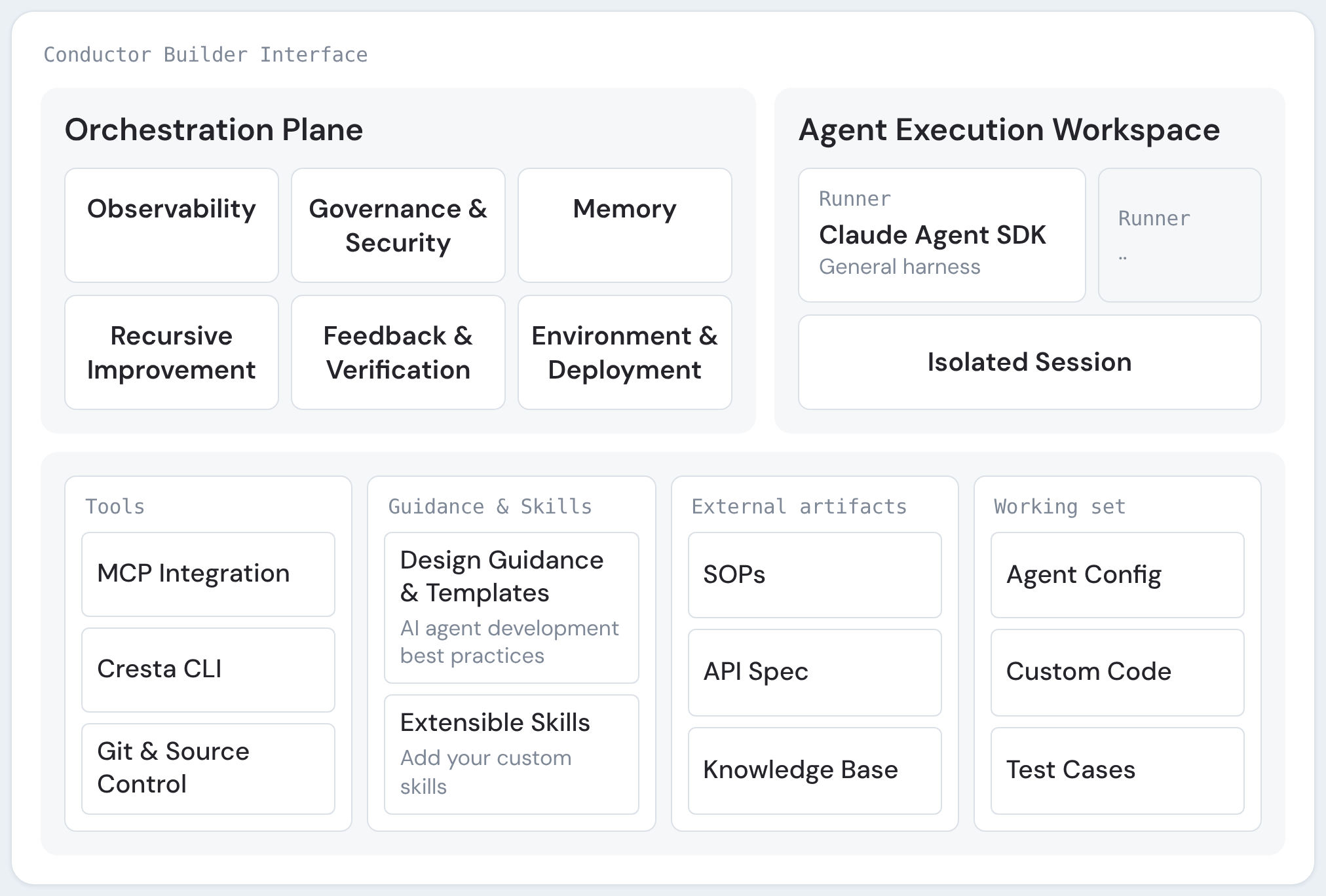
Conductor 是一个基于成熟 CX Agent 开发最佳实践构建的、具备自改进能力的 Meta-Agent(元智能体)。随着团队使用它构建和打磨出越来越多的 Agent,他们自身经过验证的模式、工作流以及专家判断也会被沉淀下来。这形成了一个知识飞轮,使未来的开发变得更加迅速且更具一致性。
上线后,生产环境中的交互、工作流执行结果和反馈都会转化为下一次迭代优化的新信号。
Conductor 能够协助构建者将每次 Agent 构建中吸取的经验转化为可复用的记忆资产(memory artifact),囊括模式、业务规则和评估方法。随后,他们可以将其作为一项技能(skill)共享给团队的其他成员,以便大家都能基于相同且经过验证的实践展开构建。
让关键决策变得更轻松
编写第一条 Prompt 只是构建实用 Agent 的冰山一角。更为艰难的抉择之一在于:对话在何处应保持灵活性,又在何处必须遵循明确的业务规则和严格可控的工具行为。
“你不能走向绝对的确定性,否则你就是在试图穷尽每一个分支、造出一棵庞大无比的决策树……但某些企业核心工作流确实需要确保百分之百可靠运行,尤其是在低风险容忍度的高合规行业,”Renjie 说道,“Conductor 能够帮助团队发掘并固化这些确定性要求与实现方案,同时保留灵活度以提升整体体验。”
Conductor 借鉴历史对话数据,帮助团队明确在哪些环节需要保留人工介入(human in the loop),在哪些环节可以赋予模型自主适应的空间。划定边界之后,开发者仍需针对确定性组件所承载的要求进行测试,并在底层业务规则变化时及时修订这些测试用例。
Cresta 如何评测 Conductor
衡量 Conductor 的标准在于它构建 Agent 的能力有多出色。为此,Cresta 让 Conductor 运行一系列构建任务:
- 构建一个全新的 Agent
- 为现有 Agent 编写测试用例
- 修改已经存在的 Agent
- 执行根本原因分析(Root Cause Analysis)
完成任务并非唯一的衡量门槛。团队还会考察最终产出的成果、Conductor 的推演路径,以及它在整个过程中调用的工具和资源。
这些任务同时发挥着安全防护网的作用。当新的 Claude 模型发布或 Conductor 框架更新时,Cresta 都会重新运行评估。团队使用相同的任务与评分标准来确定哪些地方得到了改善、哪些地方仍待优化,然后再最终提交和合并代码变更。
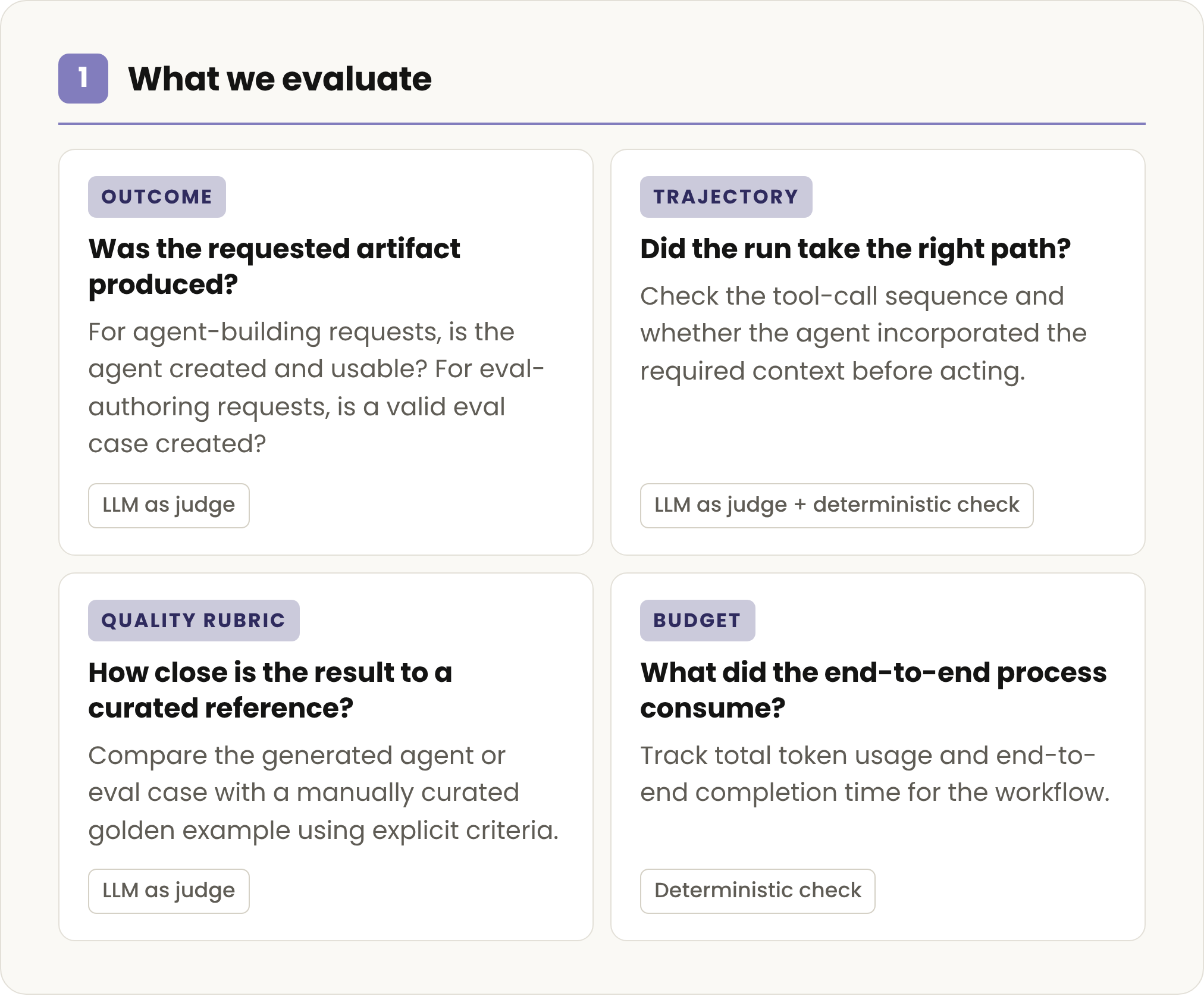
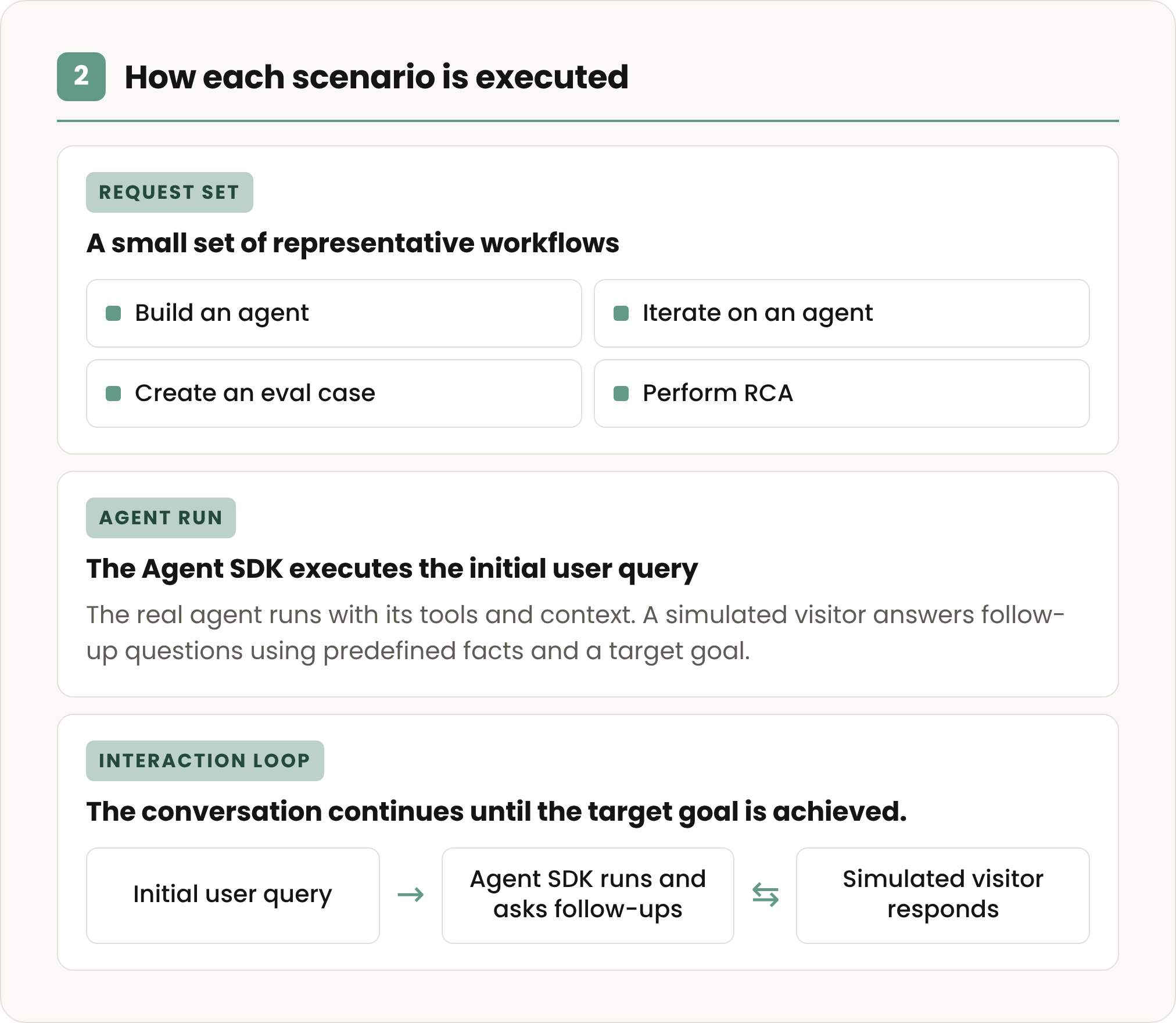
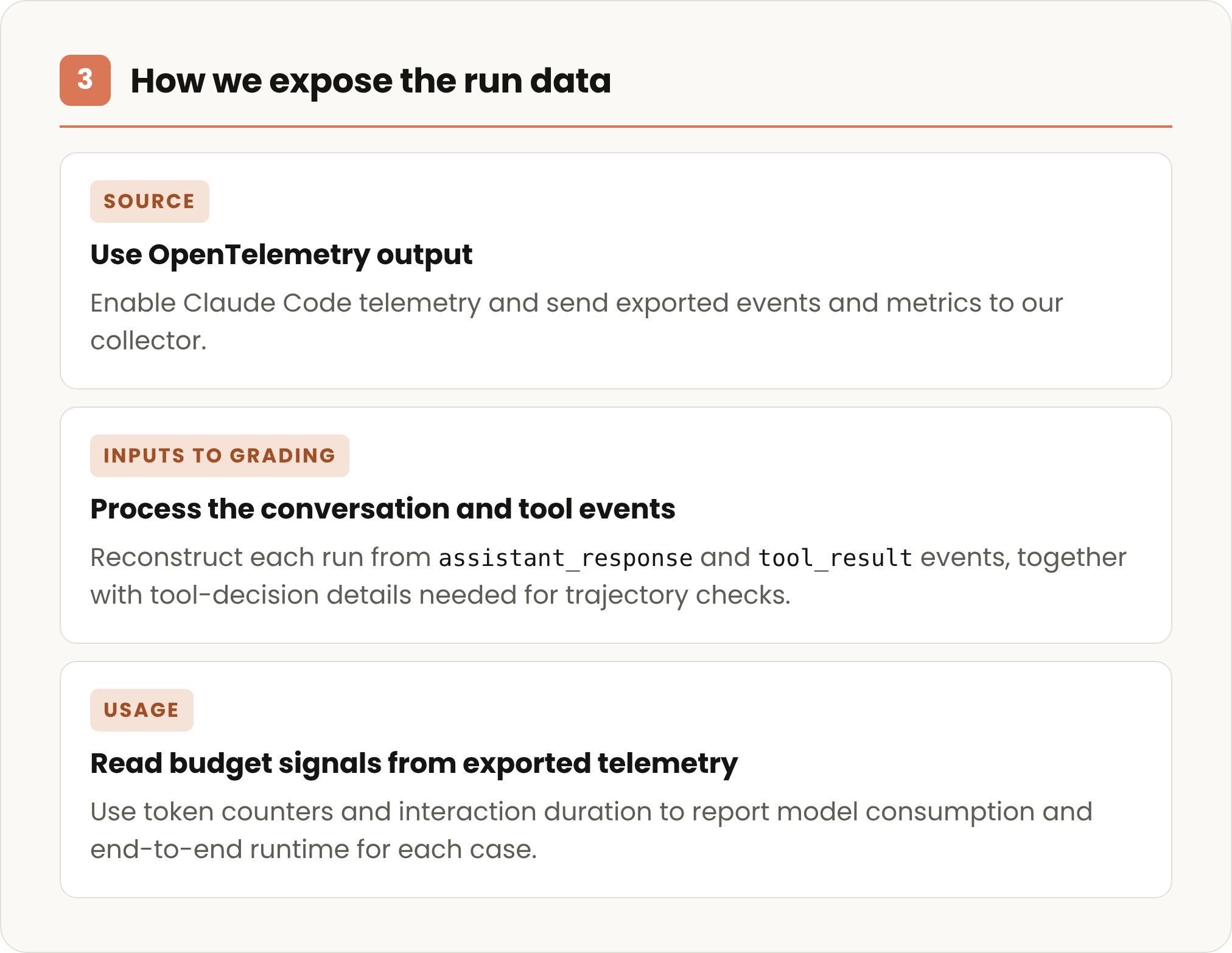
这套同样的评估规范也被内置到了 Conductor 当中,使平台用户能够随时检验并确认他们的 Agent 是否符合预期运行。Conductor 会将构建阶段捕捉到的业务需求和边缘情况,直接转化为其评估模块中的自动化测试。
随着策略、关联系统和对话模式的不断变化,团队可以持续监控那些不容有失的工作流。这为他们提供了一种切合实际的方式:在业务演化时轻松更新 Agent,同时不会削弱已固化工作流的可靠性。
基于 Claude Agent SDK 构建 Conductor
Cresta 将 Conductor 设计为专门面向 CX 领域的 Agent 开发控制平面(control plane)。它汇集了对话数据、领域专长和工程实践,随后通过策略治理、可观测性、校验以及基于反馈的持续改进来管理每次 Agent 运行。
Claude Agent SDK 作为通用执行框架构成了 Conductor 的底层支撑。它负责管理上下文收集、工具调用以及代码编写与执行等任务;Conductor 则在这一基础上叠加了 Cresta 专有的 CX 工作流、工具集和领域上下文。
团队根据 Conductor 所需承担的工作任务对 SDK 进行了严格评估,涵盖多步骤任务、大规模上下文以及频繁的工具调用。审查维度覆盖了整套实现方案的数据隐私合规、多租户架构、组织级密钥分发、权限控制以及全链路可观测性。
“Anthropic 为我们开展智能体软件开发提供了坚实、通用的基石。这让我们能够把工程研发精力集中投入在 Cresta 能创造最持久客户价值的地方,”Cresta 工程副总裁 Xiangru Chen 表示。
将 Cresta 的工程专长直接交到客户手中
Conductor 起初萌芽于 Cresta 内部,帮助其前线部署工程团队厘清了哪些开发任务可以实现标准化复用、哪些地方上下文最为关键,以及构建者在开发全流程中需要对哪些环节进行审查。内部实践的成功,赋予了团队将相同能力赋能给客户与合作伙伴的信心。
对于那些面临“产品交付定制 Agent 的速度超过工程师纯手工构建速度”的团队而言,Cresta 的实践提供了极具价值的参考范式:对于 Agent 乃至 Meta-Agent 来说,初始构建完成之后的持续维护与演进,往往才是最具挑战性的工作。
了解 Conductor 如何将业务上下文转化为卓越的 Agent 设计、落地实现与持续优化。
English / 原文
In our series,How startups build with Claude , we look at the decisions behind AI products. Here, we explore how Cresta brought its expertise building AI-native customer experience into Conductor, an agent that helps developers build and improve other agents.
Building enterprise AI agents for customer experience use cases requires understanding the context embedded across a wide range of customer interactions. For example, customers may:
- Ask for a refund without saying which purchase they mean,
- Report a billing problem and a login issue in the same message, or
- Request a refund after the return window has closed.
To respond correctly, the agent may need to check what the customer bought, the refund policy, their account history, or the payment status.
Cresta sees these interactions at volume. Its platform powers customer experience, AI agents that handle conversations on their own, provide real-time guidance for the human agents working alongside them, and surface conversation intelligence that shows the business where to improve.
Building and maintaining customer experience agents requires organizations to make key decisions on operating requirements: what the agent needs to know, which systems it must access, and where its behavior should be flexible or deterministic. Cresta wanted to make that judgment available to more teams without each one starting from scratch.
Conductor is the result: a natural language agent builder that helps teams turn complex business context into production-ready agents. Users describe what they want to build, and Conductor guides the work from a grounded blueprint through implementation, evaluation, and optimization.
Cresta originally built an early version of Conductor using Claude Sonnet and Claude Opus to help internal teams support customer deployments. The open question was whether Cresta could turn that system into a product customers could use to build agents directly within the platform.
To carry out open-ended development work, Conductor uses the Claude Agent SDK as a general-purpose harness to gather context, use tools, write and run code, and adapt based on the results.
“We used Claude Code internally as a dev tool because it was very effective at the software development aspects of building an agent,” said Renjie Li, Engineering Lead for Cresta Conductor. “The Claude Agent SDK gave us a way to use that same agentic development harness programmatically. With Conductor, we’ve connected it with Cresta’s deep conversation intelligence, CX expertise, evaluations, and runtime to give users the agent-building experience we wish we’d had from day one.”
Cresta reports that in early use cases across Cresta and its partners, Conductor cut initial deployment time roughly in half.
Conductor is a self-improving meta-agent built on established best practices for CX agent development. As teams build and refine more agents with it, they capture their own proven patterns, workflows, and expert judgment. This creates a knowledge flywheel that makes future development faster and more consistent.
After launch, production interactions, workflow outcomes, and feedback become new signals for the next improvement.
Conductor helps builders turn what they learned from an agent build into a reusable memory artifact, capturing patterns, business rules, and evaluation approaches. They can then share it as skill with the rest of the team, so others can build from the same proven practices.
Making the important decisions easier
Writing the first prompt is only one part of building a useful agent. One of the harder calls is where a conversation should stay flexible and where it needs explicit business rules and controlled tool behavior.
"You don't want to go too deterministic, otherwise you create a giant decision tree trying to map out every possible branch… but there are enterprise-critical workflows that you need to make sure work all the time, especially for highly regulated industries with low risk tolerance," said Renjie. "Conductor helps discover and harden those deterministic requirements and the implementation with the flexibility to improve the overall experience."
Conductor draws on historical conversations to help teams identify where a human should stay in the loop and where the model can be given room to adapt. Once those boundaries are set, developers still need to test the deterministic pieces against the requirements they're meant to enforce, and revise those tests as the underlying business rules change.
How Cresta evaluates Conductor
Conductor is measured on how well it builds agents. To that end, Cresta runs Conductor through a set of build tasks:
- Build a new agent
- Write a test case for one
- Change an agent that already exists
- Perform root cause analysis
Finishing the task is not the only bar. The team also looks at the outcomes, how Conductor got there, and what it used along the way.
Those same tasks function as a safety net. When a new Claude model is launched or the Conductor framework is updated, Cresta reruns its evaluations. It uses the same tasks and same scoring to identify what improved and what still needs work before anyone commits to the change.
That same evaluation discipline is built into Conductor, which allows its users to check and see if their agents are performing as intended. Conductor turns requirements and edge cases captured during the build phases into tests within its evaluation module.
Teams can then monitor the workflows that need to work every time as policies, connected systems, and conversation patterns change. That gives them a practical way to update an agent as the business changes without losing the reliability of the workflows they have already hardened.
Building Conductor on the Claude Agent SDK
Cresta designed Conductor as the CX-specific control plane for agent development. It brings together conversation data, domain expertise, and development practices, then governs each agent run through policy, observability, verification, and feedback-driven improvement.
The Claude Agent SDK sits beneath Conductor as a general-purpose execution harness. It manages the work of gathering context, calling tools, and writing and running code; Conductor layers Cresta's CX workflows, tools, and domain context on top.
The team evaluated the SDK against the work Conductor needed to perform: tasks with multiple steps, substantial context, and repeated tool use. Its review covered data privacy, tenant architecture, organization-level key distribution, controls, and observability across the implementation.
"Anthropic gives us a strong, general-purpose foundation for agentic software development. That lets us put our engineering investment where Cresta creates the most durable customer value," said Xiangru Chen, VP of Engineering at Cresta.
Putting Cresta's engineering expertise directly in customers' hands
Conductor started inside Cresta, helping its own forward-deployed team learn which development tasks could become repeatable, where context mattered most, and what builders needed to inspect along the way. Its success in that internal work gave the team confidence to bring the same capabilities to customers and partners.
For any team whose product deploys custom agents faster than its engineers can hand-build them, Cresta's approach is a useful reference point: with agents or meta-agents, the work after the initial build is often the hardest part.
See how Conductor turns business context into better agent design, implementation, and ongoing improvement.