Anthropic 销售团队如何利用 Claude Managed Agents 重构入境获客流程
英文标题:ArticleSep 30, 2026How Anthropic's sales team rebuilt inbound with Claude Managed AgentsCarl Johnson, a sales development leader at Anthropic, shares how a Claude-powered buying agent now answers most inbound customers, and how that changed the way our sales team works.Claude Platform
Anthropic 销售团队分享了基于 Claude Managed Agents(测试版)构建全天候“采购智能体”(Buying Agent)的实践。该智能体每日承接数千次客户互动,既能解答定价、合规等常见咨询并直接引导结账,也能在复杂场景下将线索无缝移交人工。数据显示,经智能体筛选转交的销售线索转化为商机的概率较传统表单提升超一倍,成单周期缩短约五天,销售代表成单效率提升达2.5倍。该案例展示了企业如何通过托管型 Agent 平台降低工程基建开销,实现技术与业务深度协同并重塑 B2B 销售体验。
 63.0 KB
 139.6 KB
 128.4 KB
 20.8 KB
中文
作为一名销售负责人,不得不承认,不久前那些想为公司购买 Claude 的客户并不能迅速获得所需答案,这让我感到十分痛心。他们填写了我们的“联系销售”表单,却需要等待很久才能收到回复,有时甚至要等上好几天。他们的大多数问题其实很简单:某方案费用是多少、是否有最低席位要求,或者我们能否满足 HIPAA 合规合同要求。答案都在我们的文档和支持文章中,但客户希望有人能迅速带领他们了解清楚。
因此,我们基于 Claude Managed Agents(测试版)构建了一个采购智能体(Buying Agent),带领潜在客户完成从“我想为公司购买 Claude”到最终完成购买的全过程。现在,该采购智能体每天进行数千次对话,解答客户最迫切的问题,并引导他们完成结账。它转交给销售团队的客户已经充分了解了相关信息,做好了购买决策的准备:他们转化为商机的几率是以前表单线索的两倍以上,成单速度也加快了约五天。我们有意将此体验设计为自选机制(opt-in),这意味着客户在开始时可以根据自己的偏好,选择与智能体还是与销售代表交谈。
旧入境流程为何失效
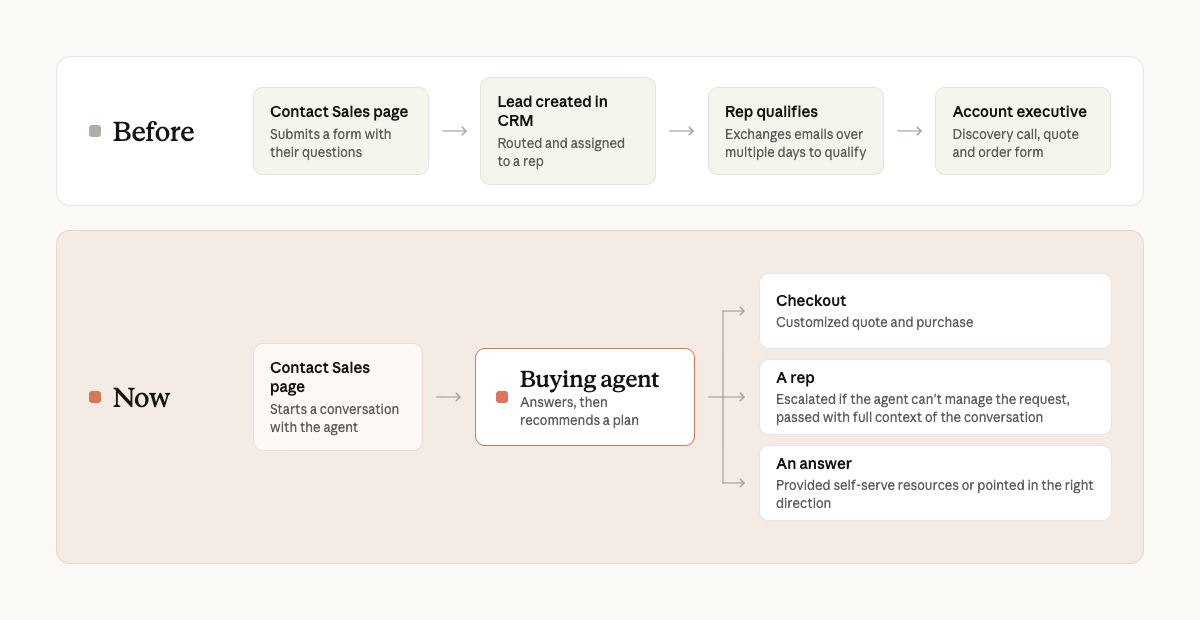
在构建采购智能体之前,我们的入境流程相当简单直接。买家填写表单,销售线索被分配给业务拓展代表(BDR),由其进行资格筛选并转交给客户经理(AE)。当团队能够与每位对产品感兴趣的人交谈时,这种方式效果依然不错。
然而,我们每月收到数万个入境咨询,入境 BDR 团队根本应接不暇。销售代表整天都在回答文档中已有明确说明的问题,而我们缺乏有效途径联系队列中的所有客户。这不是我们希望给客户带来的体验。
我们希望每位客户在任何时间、以任何语言都能获得专业的解答,并能以他们喜欢的方式完成购买——这通常意味着无需与销售代表交谈。我们希望销售代表将时间投入到那些能够真正改变结果走向的深入沟通中。
弥合差距的采购智能体
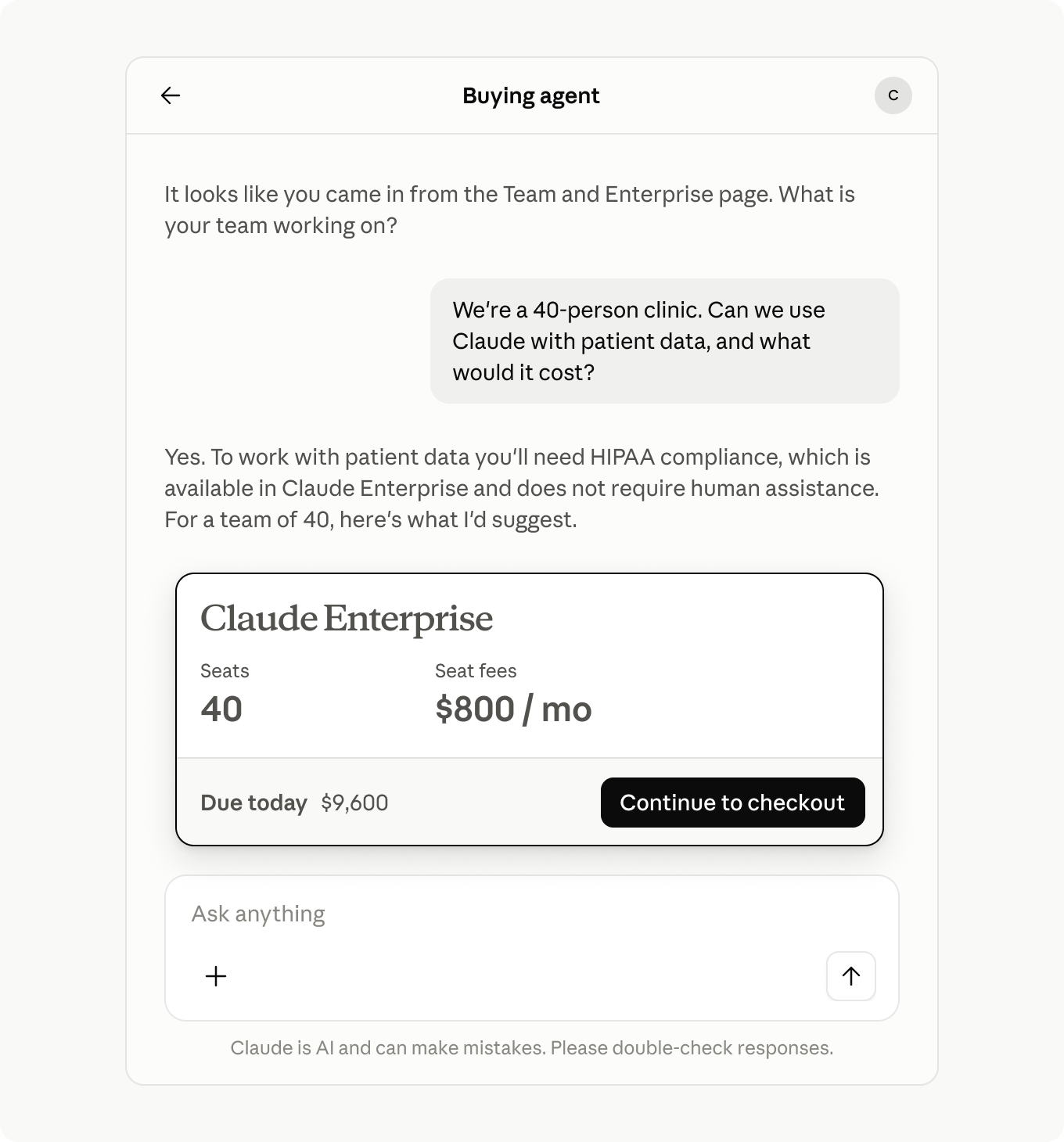
我们将智能体部署在客户已经提出问题的地方:我们的联系销售与定价页面、产品内部以及我们的电子邮件中。任何客户都可以在我们的 Claude.ai 产品内找到该采购智能体,这是一种简单的聊天交互体验,旨在帮助客户了解哪种方案最适合他们。客户说明其团队需求,智能体提出几个跟进问题,随后在推荐方案和席位数之前解答有关定价、安全与数据的问题。每次对话会以以下三种方式之一结束:
- 购买。 买家直接进入结账环节。
- 转接。 对于规模更大或更复杂的交易,智能体将买家连同完整的对话细节一并转交给销售代表。
- 快速解答。 有时这正是客户唯一需要的。
我们构建该智能体时遵循与销售代表相同的工作流程,这意味着需要理解客户试图解决的问题、了解他们目前使用 Claude 的情况,以及我们如何才能最好地帮助他们。
我们为什么选择 Claude Managed Agents?
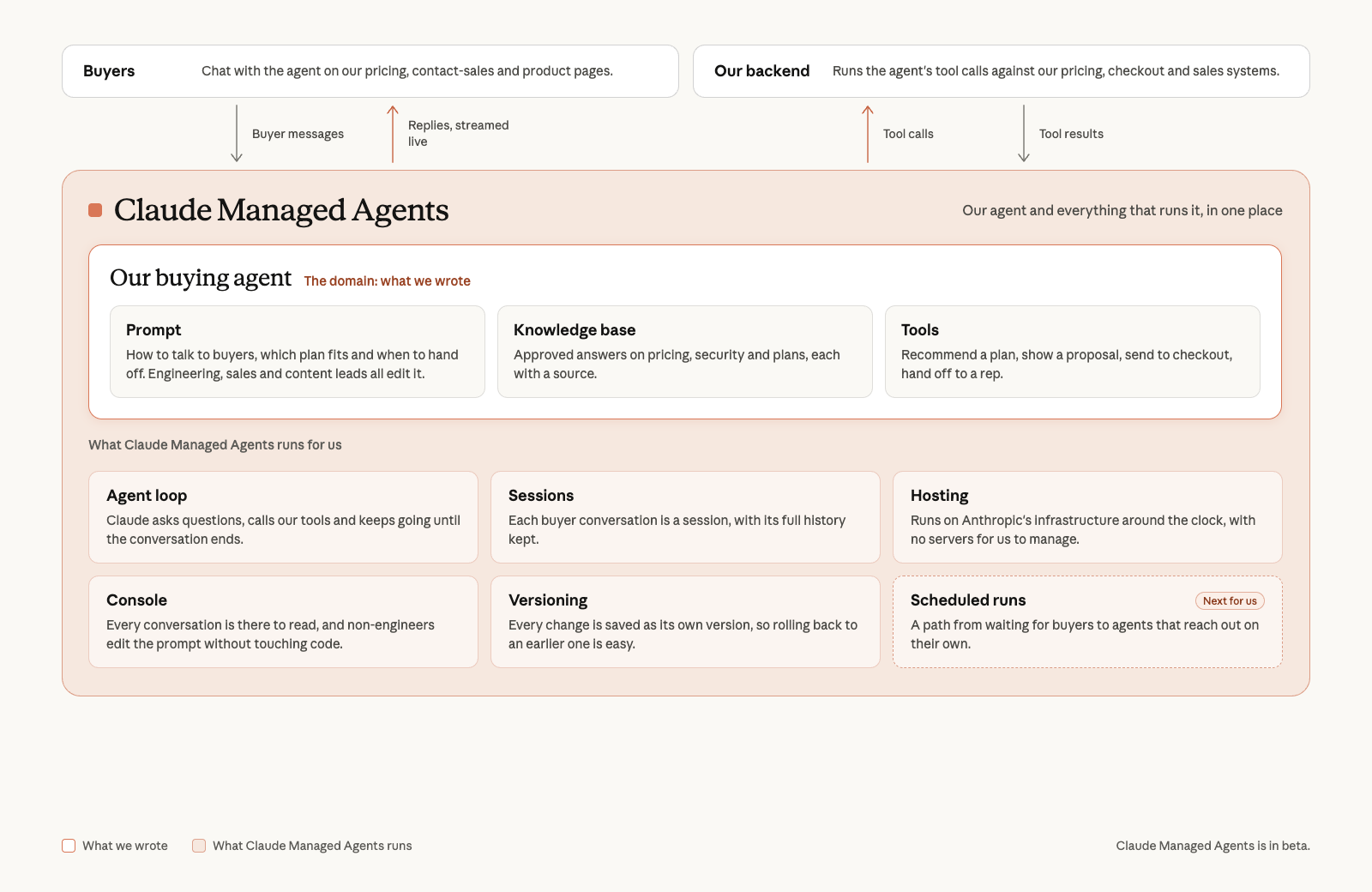
从底层来看,采购智能体的构成其实很简单:一个 Prompt(提示词)、少量工具以及运行在 Claude Managed Agents 上的 Claude。由于平台承担了托管、会话管理和工具编排等工作,我们的工程师得以把时间花在与销售团队一起设计购买体验上,而无需从头构建底层基础设施。
我们最终选择 Managed Agents 出于以下几点原因:
- 快速上线投产。 仅一名工程师在短短数周内就基于 Managed Agents 构建出了采购智能体的初始版本。
- 技术与非技术人员共同协作。 工程团队掌控代码,而销售和内容负责人可以直接在控制台(Console)中审查并编辑系统 Prompt。所有更改都会先部署到预发环境智能体(staging agent),方便任何人在变更推向客户前先行试用微调效果。
- 专注业务领域,而非底层框架。 Managed Agents 负责运行智能体循环(agent loop)、会话及托管。我们将精力完全集中在 Prompt、工具和知识库上——这三者正是专属销售业务的核心所在。
- 版本控制降低迭代成本。 对智能体的每次更改都会保存为一个独立版本。在内部测试大约一周时我们就已经迭代到了 v7,并在发布后持续每周推送 Prompt 更新。必要时,我们能够轻松地将新会话回滚指向先前的版本。
- 灵活支持更多使用场景。 目前,客户是在我们的网站上发现该智能体。Managed Agents 支持定时运行任务(scheduled runs),这为我们探索其他类型的客户互动模式提供了途径。
构建采购智能体的经验总结
给 Claude 设定目标,而非死板规则。 阐明智能体的目标比提供详尽的指令清单更有效。例如,像“你的目标是理解客户需求、筛选合格潜客,并推荐最佳方案”这样简单的一句话,比在流程图中罗列所有资格筛选要求更为有效。
少即是多(Less is more)。 我们尝试了不同长度、复杂度和结构的 Prompt,发现“少即是多”的原则效果最好。当今的模型能够理解复杂、微妙的目标,并据此反向推导方案。在实践中,这意味着不要过度束缚 Claude,而是赋予它取得成功所需的知识与上下文,例如基于席位的定价包含哪些内容,或是账单周期的运行方式。
将领域专家(SME)引入开发闭环。 在智能体辅助编程大幅加快开发周期的今天,这一点的价值正变得日益显著。得益于使用 Managed Agents 和 Claude Code 节省的时间,我们的工程师能够投入更多时间与销售团队紧密配合,塑造以客户为中心的体验。我们得以尽早且高频地测试智能体,从而实现敏捷迭代。
专注于对客户真正有益的事。 该智能体经常会引导小型团队选择我们的 Team 方案而不是 Enterprise 方案,因为在某些情况下这对他们而言才是最合适的选择。我们认定这是一项关键特性。一个买家匹配到了合适的方案而不是被强行推销追加升级,其留存率往往更高,体验也更好。
将智能体向代表的每次转接视作反馈。 每次智能体将买家转接给销售代表时,它都会阐明原因。在早期,大部分原因在于客户尚无法通过我们的自助服务产品独立完成某些操作。这些反馈推动了我们不断改进体验,如今需要人工协助成单的对话比例已下降了约一半。
给客户带来的改变
该智能体现已实现全天候运行,每天处理数千次对话。客户可以立即获得疑问解答,而无需等待预约电话或在多天内来回发送电子邮件。我们的许多客户实际上更倾向于与智能体沟通,而非与人工交谈,因为智能体可以在疑问出现时迅速提供信息详尽的解答。我们的许多新自助 Enterprise 客户在购买前都会与采购智能体交谈,我们发现,事先与智能体沟通的客户对他们所购买的内容有着更深入的理解。
智能体如何重塑我们的销售组织
智能体改变了我们销售代表日常的工作重心。如今,我们能够将团队的大部分时间和精力集中在客户购买旅程的早期进行深度引导、展开更多实时客户沟通,以及参与线下活动的面对面交流。
最显著的改变在于,我们的代表现在获得的销售线索准备更充分,线索转化为商机的转化率高于过去的联系表单,并且成单速度加快了约五天。销售代表在开启对话时,就已经清楚了解客户的需求、已告知客户的内容以及我们能如何为他们提供最佳帮助。
例如,我们的内勤销售代表(inside sales rep)Ojas 过去完成一笔交易大约需要往返 10 封电子邮件;现在大约只需 6 封。自推出采购智能体以来,他的成单签约(closed won)产出提升了 2.5 倍,因为该智能体使他能够专注于那些信息完备、已做好准备且仅需临门一脚协助的客户。
不久之前,入境获客还是一条我们团队疲于应对的待办队列。如今,它变成了任何买家在任何时间都能即时发起的对话,我们的销售代表也能更高效地利用时间。采购智能体是我们迈向贯穿整个客户生命周期的智能体体系的第一步。
准备好构建属于你自己的智能体了吗?进一步了解 Claude Managed Agents,或与我们的团队交谈,探讨如何将 Agent 引入你的销售流程。
本文由 Carl Johnson 撰写,Izzy Lee、Bobby P.、Lina Ochman、Yana Gevorgyan、Jerico Johns 以及 Taylre Duarte 亦有贡献。
English / 原文
As a sales leader, it pains me to admit that not long ago, people who wanted to buy Claude for their company weren’t getting the answers they needed quickly enough. They had filled out our Contact Sales form but would wait too long to hear back, sometimes for multiple days. Most of their questions were simple: what a plan costs, whether there's a seat minimum, or whether we can meet HIPAA’s contract requirements. The answers were in our documentation and support articles, but customers wanted someone to walk them through, quickly.
So we built a buying agent on Claude Managed Agents (beta) that takes a prospect from "I want Claude for my company" to a completed purchase. The buying agent now holds thousands of conversations a day, answers customers’ most pressing questions, and gets them through checkout. The customers it escalates to our team arrive educated and more ready to make purchase decisions: they turn into opportunities more than twice as often as leads from the old form, and close about five days faster. We intentionally left this experience as opt-in, meaning our customers choose at the start if they’d like to talk to an agent or sales rep based on their preference.
Why the old inbound process broke
Before building the buying agent, our inbound process was fairly straightforward. A buyer filled out a form. The lead was routed to a business development rep, who qualified it and passed it to an account executive. That still works well when a team can talk to everyone who’s interested in the product.
We had tens of thousands of inbound requests every month, and our inbound BDR team couldn’t keep up. Reps spent their days answering questions the docs already covered, and we didn’t have an effective way to reach all of the customers in the queue. This wasn't the experience we wanted for our customers.
We wanted every customer to get a knowledgeable answer at any hour and in any language, and to be able to buy however they preferred, which often means without talking to a sales rep. We wanted our reps to spend their time on the conversations where they can change the trajectory of the outcome.
A buying agent that closes the gap
We deployed the agent where customers were already asking questions: on our Contact Sales and Pricing pages, inside the product, and in our emails. Any customer can find the buying agent within our Claude.ai product, it’s a simple chat experience to help customers understand what plan is best for them. A customer describes what their team needs, the agent asks a few follow-up questions, and it then answers the ones about pricing, security and data before recommending a plan and seat count. Each conversation ends one of three ways:
- Purchase. The buyer goes straight to checkout.
- Hand-off. For larger or more complex deals, the agent passes the buyer to a rep along with the full conversation details.
- A quick answer. Sometimes that's all a customer needs.
We built the agent to follow the same work of our sales reps, which means understanding what the customer is trying to solve, what their current Claude usage looks like, and how we can best help them.
Why did we use Claude Managed Agents?
Under the hood, the buying agent is simple: a prompt, a handful of tools, and Claude, running on Claude Managed Agents. Because the platform takes care of hosting, session management and tool orchestration, our engineers spent their time with sales designing the buying experience instead of building the infrastructure.
We ultimately landed on Managed Agents for the following reasons:
- Fast to production. One engineer built the initial buying agent on Managed Agents in just a few weeks.
- **Tech & non-tech contributors. **Engineering owned the code, but sales and content leads reviewed and edited the system prompt directly in the Console. Changes went to our staging agent first, so anyone could try a tweak before it reached customers.
- Focus on the domain, not the harness. Managed Agents runs the agent loop, sessions and hosting. We spent our time on the prompt, the tools, and the knowledge base—the three things that are specific to selling.
- Versioning makes iteration less expensive. Every change to the agent is saved as its own version. We were on v7 about a week into internal testing, and we kept shipping prompt changes weekly after launch. When needed, we could easily point new sessions back to a previous version.
- Flexibility to support more use cases. Today, customers discover the agent on our website. Managed Agents supports scheduled runs, which gives us a path to explore other types of customer engagement.
What we learned building the buying agent
Give Claude a goal, not rules. Explaining the goal of the agent worked better than a detailed list of instructions. For example, something as simple as "Your goal is to understand customer requirements, qualify prospects, and recommend the best plan" was more effective than listing out every qualification requirement in a flowchart.
Less is more. We experimented with prompts of varying lengths, complexity, and structure, and found the maxim of 'less is more' works best. Models today can understand complex, nuanced goals and work backwards from them. In practice, that has meant getting out of Claude's way by giving it the knowledge and context it needs to be successful, such as what seat-based pricing covers or when billing cycles run.
Use SMEs in the development loop. This is something that is becoming increasingly valuable in a world where agent coding is speeding up development cycles. By virtue of saving time using Managed Agents and Claude Code, our engineers were able to spend more time with the sales team to shape a customer-centric experience . We were able to test the agent early and often, leading to quick iterations.
Focus on what’s right for the customer. The agent often points small teams to our Team plan instead of Enterprise, because that's the right answer for them in some cases. We decided that's a feature. A buyer who lands on the right plan instead of being upsold is more likely to stay and have a better experience.
Treat every agent to rep escalation as feedback. Each time the agent passes a buyer to a rep, it explains why. Early on, most of those reasons were things customers couldn't yet do on their own with our self-service products. Those reasons shaped how we improve the experience, and the share of conversations that needed a person to help close the deal has fallen by about half.
What changed for customers
The agent now holds thousands of conversations a day, around the clock. Customers get their questions answered instantly instead of waiting for a scheduled call or exchanging emails over multiple days. A lot of our customers actually prefer to talk to an agent rather than a human, because it can give them quick, informed answers as questions arise. Many of our new self-serve Enterprise customers talk to the buying agent before they buy, and we've found that those who talked to the agent beforehand had a better understanding of what they were buying.
How the agent changed our sales organization
The agent changed what our reps spend their days. We've now been able to focus the majority of the team's time and energy on educating customers earlier in their buying journey, having more live customer conversations and spending time in person at events.
The most impactful change has been that our reps now get more informed leads, convert leads to sales opportunities more often than our old contact form, and they close about five days faster. A rep starts the conversation already knowing what the customer needs, what they've been told, and how we can best help them.
For example, one of our inside sales reps, Ojas, used to exchange about 10 emails to close a deal; now it takes about six. He’s been able to 2.5x his output on closed won deals since launching the Buying Agent as it allowed him to focus on highly educated and ready customers who just needed help getting across the line.
Not long ago, inbound was a queue our team couldn't keep up with. Now it's a conversation any buyer can start at any hour, and our reps spend their time more efficiently. The buying agent is our first step toward agents across the whole customer relationship.
Ready to build your own? Learn more aboutClaude Managed Agents, or talk to our team about bringing agents to your sales motion.
This article was written by Carl Johnson, with contributions from Izzy Lee, Bobby P., Lina Ochman, Yana Gevorgyan, Jerico Johns, and Taylre Duarte.