Qlik 如何借助 Amazon Bedrock 构建有依据、企业级规模的 AI
英文标题:How Qlik built grounded, enterprise-scale AI with Amazon Bedrock
Qlik 基于 Amazon Bedrock 推出 Qlik Answers,为全球超过 4 万家客户提供可追溯来源的企业数据问答能力,覆盖结构化分析数据与非结构化文档。该系统采用分层、多 Agent 架构,将快速路由、深度推理、检索、分析和模型访问解耦,并通过 Amazon OpenSearch Service、Amazon Bedrock Guardrails 与 LLM 网关实现可信回答。自 2026 年 2 月正式发布以来,Qlik Discovery Agent 已为客户发现超过 10 万项洞察,多数启用了 Agent 工具的 Qlik Cloud 账户持续活跃使用。该案例表明,跨区域推理、租户级功能控制、统一安全校验和提前容量预测,是将生成式 AI 扩展到全球受监管企业环境的关键实践。
 1.3 MB
 1.3 MB
 2.4 KB
 345.0 KB
 141.2 KB
 346.5 KB
 77.5 KB
 460.9 KB
 19.5 KB
 29.6 KB
 14.7 KB
 265.5 KB
中文
Qlik Answers 在 Amazon Bedrock 上构建有依据的 AI,旨在解决一个常见的企业问题:员工并不缺少数据,他们缺少的是一种快速向数据提出真实问题并获得可信答案的方式。分析师往往要花数小时搜索文档、仪表板和机构记忆,才能回答同事用一句话就能提出的问题。当组织试图通过生成式 AI 弥合这一差距时,许多都会撞上同一堵墙:答案没有来源、结果无法验证,并且没有路径可将工具部署到受监管环境中。
Qlik 是数据集成、数据质量、分析和 AI 领域的全球领导者。该公司构建 Qlik Answers,旨在为其全球超过 40,000 家客户解决这一问题。自 2026 年 2 月正式发布以来,Qlik Answers 已从早期能力发展为日常使用的产品:Qlik Discovery Agent 是一款由 AI 驱动的异常和离群值检测 Agent,仅该产品自发布以来便已为客户发现超过 100,000 项洞察;而且,在启用了 Agent 工具的 Qlik Cloud 账户中,多数都在积极使用这些工具。
本文介绍 Qlik 如何构建支撑这一采用率的工具,以及 Amazon Bedrock 如何为其提供全球规模支持。
挑战
Qlik 识别出,为了将 Qlik Answers 面向其客户群投入生产,必须同时解决三个问题:
- 在不拖慢用户的前提下编排专业化推理。 企业问题的差异很大:有些需要快速查询,有些则需要从结构化分析数据、非结构化文档、术语表定义或自动化流程中提取信息。随着功能不断增加,单一的通用助手往往会变得更慢、准确性也更低。
- 满足跨区域的数据主权要求。 Qlik 的客户遍布欧洲、亚太和美洲,各地都有自身的数据驻留预期。单一的全球部署模式无法满足这些要求,但分别构建 11 个区域版本又难以持续维护和一致地改进。
- 提前数月预测模型容量。 在重大产品发布前 3 至 6 个月,就需要规划 Token 消耗和模型可用性。客户开始使用产品后,Qlik 再通过实际使用量验证这些预测,确保采用率增长不会演变为容量问题。
解决方案概览
Qlik Answers 为员工而不只是分析师提供了一个统一入口,用户可以用自然语言提出问题并获得有依据、可追溯来源的答案。根据问题的不同,答案可能来自知识库、实时分析应用、术语表定义或文档。底层系统会决定采用哪一条路径。
以下三个部署案例展示了客户的使用方式:
- Bystronic 是一家全球钣金加工专家,在 15 分钟内部署了一个 AI 聊天机器人,使员工能够查询实时运营数据,并跨部门获得带来源的答案。
- Lintech International 在 Qlik Answers 中索引了超过 17,000 份技术文档,减少了人工研究时间,并将响应速度提高了 75%,让业务经理每周最多可节省 7 小时。
- TouchPoint Support Services 为 650 个医疗站点提供服务,并计划将规模扩大一倍。该公司使用 Qlik Answers,为在受监管、快节奏环境中工作的 15,000 名员工提供快速且符合合规要求的指导。
为实现大规模支持,Qlik 围绕清晰的架构边界构建了系统,而不是使用一个庞大的单体助手。关键层如下:
- 入口层。 Qlik Cloud 内部稳定的对话入口,因此可以增加新的后端能力,而无需改变客户与助手的交互方式。
- 路由层。 一个轻量级层,读取用户消息和对话上下文,并决定请求应发送到哪里。它的唯一职责是快速、准确地进行路由决策,而不是解决任务本身。
- 回答层。 在请求完成路由后协调答案生成,在简单请求的快速路径与更审慎的路径之间进行选择;后者会将问题拆分为子问题,并从多个来源提取信息。
- 专业 Agent 层。 一个共享的群体运行时定义专业 Agent、工具、状态和人在回路步骤的工作方式,因此可以添加新的专业 Agent,而无需让每个 Agent 自行设计编排模型。
- 对话式分析层。 处理结构化数据问题,将其路由至专为分析而非通用文本生成构建的、具备应用感知能力的推理路径。
- 检索层。 非结构化文档索引和检索在 Amazon OpenSearch Service 上运行,该服务存储并搜索用于支撑 Qlik Answers 知识库和文档问答响应的内容。
- 模型访问层。 该层通过 Qlik 自有的大语言模型(LLM)网关访问,并连接至 Amazon Bedrock,以支持聊天、流式输出、嵌入和重排序。它还会对每一项请求和响应应用 Amazon Bedrock Guardrails:针对提示注入、个人身份信息(PII)、机密信息和禁止主题进行内容过滤,同时对生成答案进行依据验证检查。当客户所依赖的模型尚未通过 Bedrock 在所在区域提供时,Qlik 会改为将其托管在 Amazon SageMaker AI 上;在该区域的模型可用性跟进后,再将工作负载迁回 Bedrock。有关按 AWS 区域划分的模型可用性,请参阅 Amazon Bedrock 中的“Supported models by AWS Region”。
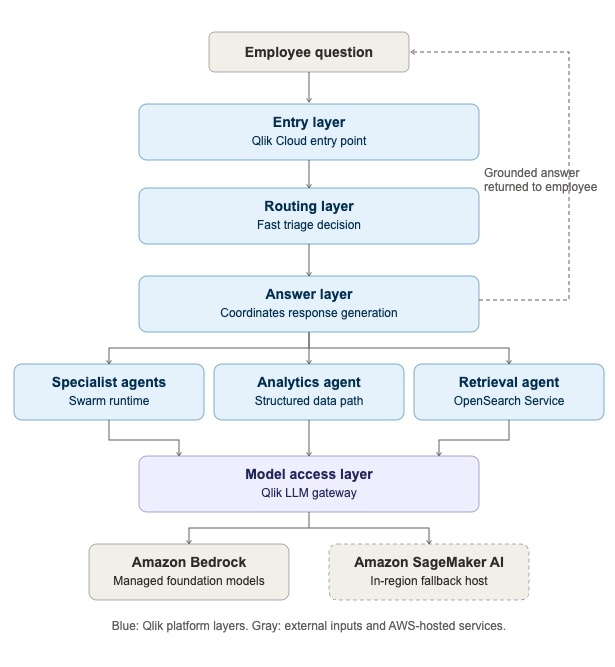
图 1:员工问题先流经入口层、路由层和回答层,随后分流至专业 Agent、分析 Agent 和检索 Agent(由 Amazon OpenSearch Service 支持),最后汇聚至模型访问层。该层访问 Amazon Bedrock 上可用的基础模型,并以 Amazon SageMaker AI 作为区域内备用方案。
将答案建立在真实来源之上
依据性是该框架中最重要的设计决策之一。回答层会根据问题从多种上下文中提取信息:结构化应用元数据、检索到的知识库内容、术语表定义、自动化上下文,以及用于摘要的文档内容。在返回完整答案所需的各个要素后,系统会组装完整响应并呈现给用户。
仅依靠检索并不能保证准确性。Qlik 还会对生成答案运行依据验证检查,利用 Amazon Bedrock Guardrails 的上下文依据能力,将每个答案与其所使用的源内容进行比对。这使依据性从单纯的检索步骤,转变为经过检查的生产控制机制。对于非结构化问题,该工具会从 Amazon OpenSearch Service 检索与问题相关的内容,并保留这一上下文,确保最终答案包含引用。对于结构化问题,系统会将工作交给对话式分析路径。包括术语表查询、自动化和文档摘要在内的更多能力,均通过能力控制逐步发布,因此 Qlik 可以扩展工具功能,而不会同时破坏所有客户的默认体验。租户特定的能力选项意味着,Qlik 可以针对每项请求重新构建可用的编排路径,从而选择性启用能力,同时让整体架构在不同客户之间保持一致。
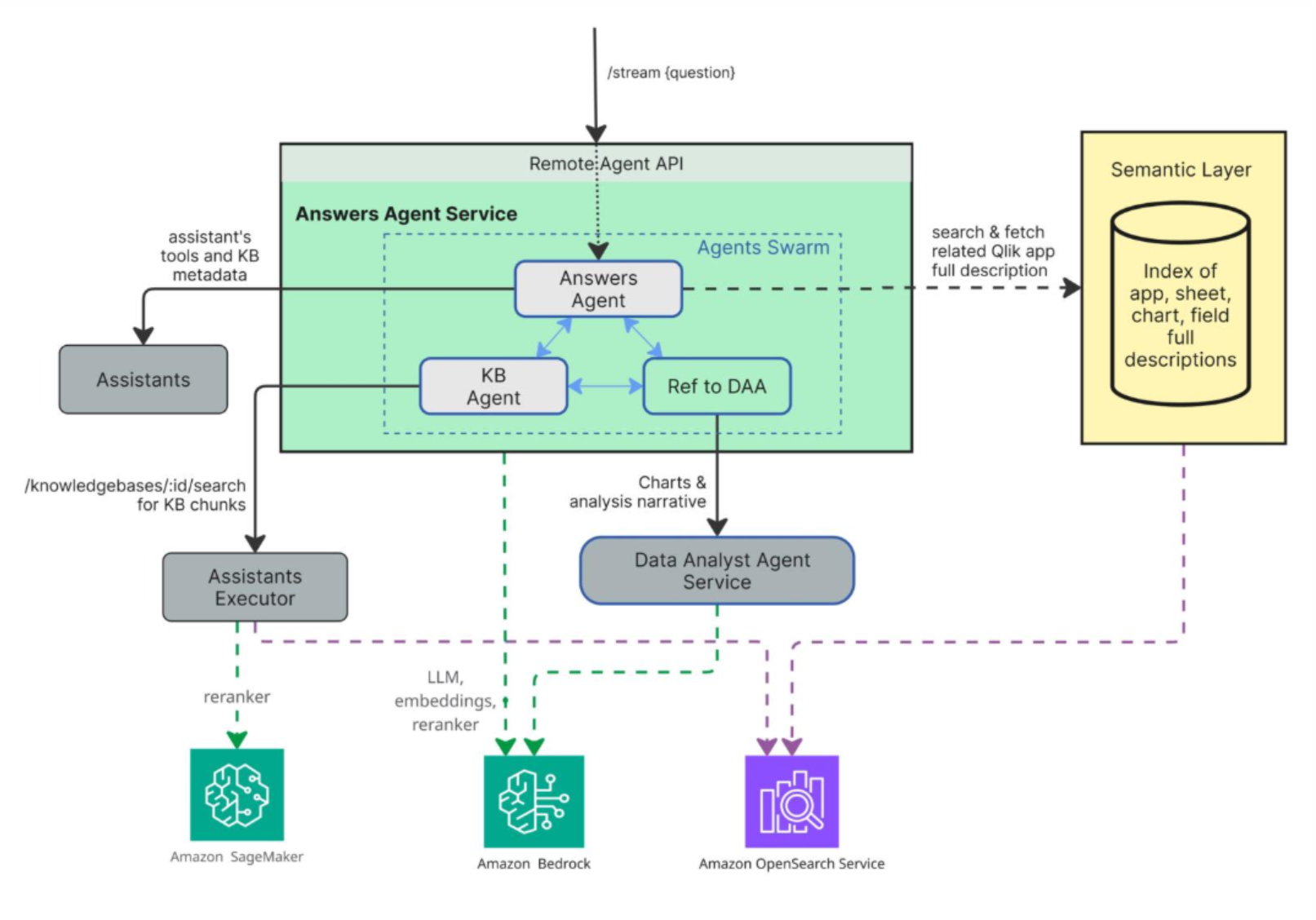
图 2:专业 Agent 群体架构,其中共享状态、工具和人在回路步骤使新的专业 Agent 能够接入一个通用运行时。
为什么选择 Amazon Bedrock
Qlik 根据前文描述的三个问题评估了其模型策略,而 Amazon Bedrock 直接解决了其中每一个问题。
多模型灵活性。 借助 Bedrock,Qlik 可以为每个 Agent 的任务分配最适合的模型,而不是让整个系统受限于单个模型的取舍。
大规模数据主权。 借助 Amazon Bedrock 跨区域推理(CRIS),Qlik 能够服务全部 11 个区域,同时在合规要求下将数据保留在相应驻留地。这在一项托管能力中结合了全球覆盖能力与主权控制。
可选择性采用托管服务的空间。 AWS 的区域部署模型和容量预留选项,使 Qlik 能够在当前持续扩展时保有充足余量。在准备就绪后,Amazon Bedrock AgentCore 等服务让 Qlik 可以为特定工作负载卸载更多运维开销,而不需要为此进行全面迁移。
Qlik 通过自有 LLM 网关使用 Bedrock,而不是将应用逻辑直接绑定到某一个模型。产品团队可以按任务更换模型选择,而无需重写周边应用程序。对于一个预期模型策略将持续演进的系统来说,这种分离至关重要。
提前规划容量以应对需求
由于 Qlik 会在重大产品发布前 3 至 6 个月预测模型容量,团队构建了一个工作模型,按功能和区域预测 Token 消耗;随后在每次发布后,将实际使用量与这些预测进行核对。这种纪律是 2 月正式发布能够在自身采用率增长下顺利扩展、未造成压力的原因之一。
业务成果与客户影响
自 Qlik 的 Agent 体验于 2026 年 2 月正式发布以来,Discovery Agent 已为客户发现超过 100,000 项洞察;而且,启用了 Agent 工具的 Qlik Cloud 账户中,多数都在积极使用其 Agent,而不是试用一次后便停止使用。
另行公布的客户层面结果包括:Lintech International 的响应速度提高 75%,并让业务经理每周最多节省 7 小时,以及 Bystronic 在 15 分钟内部署聊天机器人的成果。
经验总结
在超过 40,000 家客户中构建和扩展 Qlik Answers,使团队总结出一些可能帮助其他团队在 Bedrock 上构建 Agent 工具的经验:
- 尽早将快速路由与深度推理解耦。将两者捆绑意味着每项请求都要为超出实际需要的处理付费。
- 对多 Agent 执行采用一个统一的编排框架,而不是让每个新增专业 Agent 自行设计运行时。运营一个应用程序比运营一组彼此割裂的 Agent 系统更容易。
- 将安全与依据检查视为系统级关卡,而不是每项功能的事后补充。在模型访问层统一执行一次检查,意味着每个新的专业 Agent 都会自动继承同样的保护措施。
- 在租户层面使用功能标志,逐步扩展能力。这可以防止较新、验证不足的能力影响核心体验的可靠性。
- 在真正需要之前就养成容量预测习惯。每次发布后用实际使用量验证预测使用量,能将容量规划从猜测转变为可重复的流程。
下一步计划
Qlik 的路线图刻意保持架构开放且具备适应性。团队正在评估将 Amazon Bedrock AgentCore 用于部分工作负载:在这些场景中,托管 Agent 运行时可以降低运维开销;同时,在开放标准和自有编排层能为 Qlik 提供更强成本、延迟或可移植性控制的场景中,团队会继续基于这些能力构建。目标是在托管服务有帮助时保留采用它们的选择权,而不让整个框架围绕任何单一服务设计。Qlik 还在构建一套系统化框架,用于评估模型性能。这意味着,当更适合的模型出现时,Qlik 可以迁移至这些模型,而不会破坏客户已经依赖的体验。
结论
Qlik Answers 自 2026 年 2 月发布以来的采用情况,体现了一种旨在减少阻碍的架构:在速度重要时快速,在准确性重要时审慎,始终以真实来源为依据,并且安全到足以让受监管行业信赖。Amazon Bedrock 提供的模型灵活性、区域主权控制,以及基于 Guardrails 的内容过滤和依据验证,为 Qlik 在全球规模上构建这一体验奠定了基础。截至目前,成果包括发现超过 100,000 项洞察、为 Lintech 和 TouchPoint 等公司的员工节省工作时间,以及多数启用了 Agent 工具的账户在试用后继续使用其 Agent。
如需了解 Qlik Answers 能如何处理您的数据,可以开始 Qlik Cloud Analytics 免费试用、申请 Qlik Answers 演示 或 Qlik 与 AWS 演示,也可以访问 Qlik Answers 产品页面 了解更多信息。
关于作者
Sunil Yerkola
Sunil 是 AWS 的高级解决方案架构师。他为独立软件供应商(ISV)领域的客户提供支持,帮助他们构建高度可扩展且成本优化的云解决方案。Sunil 已在 AWS 工作超过 4 年,帮助客户在 AWS 上迁移和扩展其基础设施。Sunil 喜欢与家人和朋友共度时光,也喜欢观看或参与体育运动。
Sathisan Vannadil
S
English / 原文
Building grounded AI on Amazon Bedrock, Qlik Answers tackles a common enterprise problem: employees aren’t short on data. They are short on a fast way to ask a real question of it and get an answer they can trust. Analysts spend hours searching through documents, dashboards, and institutional memory to answer things a colleague could ask in a sentence. And when organizations try to close that gap with generative AI, many run into the same wall: answers without sources, no way to verify a result, and no path to deploy the tool in a regulated environment.
Qlik, a global leader in data integration, data quality, analytics, and AI, built Qlik Answers to solve that problem for its more than 40,000 customers worldwide. Since general availability in February 2026, Qlik Answers has moved from an early capability to daily use: Qlik’s Discovery Agent, an AI-driven anomaly and outlier detection agent, alone has surfaced more than 100,000 discoveries for customers since launch, and the majority of Qlik Cloud accounts with agentic tools turned on are actively using them.
This post explains how Qlik built the tool behind that adoption, and how Amazon Bedrock supports it at global scale.
Challenge
Qlik identified three problems it needed to solve at the same time to bring Qlik Answers to production across its customer base:
- Orchestrating specialized reasoning without slowing anyone down. Enterprise questions vary widely: some need a quick lookup, others require pulling from structured analytics, unstructured documents, glossary definitions, or automations. A single, general-purpose assistant tends to get slower and less accurate as more capability gets added to it.
- Meeting data sovereignty requirements across Regions. Qlik serves customers across Europe, Asia Pacific, and the Americas, each with its own data residency expectations. A single global deployment model wouldn’t satisfy those requirements, but 11 separate Regional builds would be difficult to maintain and improve consistently.
- Forecasting model capacity months ahead of demand. Token consumption and model availability needed to be planned 3–6 months before major launches. Qlik then validated these projections against actual usage once customers started using the product, so growth in adoption doesn’t turn into a capacity problem.
Solution overview
Qlik Answers gives employees, not only analysts, a single place to ask a natural-language question and receive a grounded, sourced answer. Depending on the question, that answer can come from a knowledge base, a live analytics app, a glossary definition, or a document. The underlying system decides which path to take.
Three deployments illustrate what that looks like for customers:
- Bystronic , a global sheet-metal processing specialist, deployed an AI chatbot in 15 minutes, giving employees a way to query real-time operations data and get sourced answers across departments.
- Lintech International indexed more than 17,000 technical documents in Qlik Answers, cutting manual research time and speeding up response times by 75 percent, which gave business managers back as much as 7 hours a week.
- TouchPoint Support Services , which serves 650 healthcare sites and is aiming to double in size, uses Qlik Answers to give fast, compliance-aligned guidance to 15,000 staff working in regulated, fast-paced environments.
To support this at scale, Qlik built the system around clear architectural boundaries rather than one large assistant. The key layers are as follows:
- Entry layer. A stable conversational entry point inside Qlik Cloud, so new backend capability can be added without changing how customers interact with the assistant.
- Routing layer. A lightweight layer that reads the user’s message and conversation context and decides where the request should go. Its only job is a fast, accurate routing decision, not solving the task itself.
- Answer layer. Coordinates response generation once a request is routed, choosing between a fast path for simple requests and a more deliberate path that breaks a question into sub-questions and pulls from multiple sources.
- Specialist agent layer. A shared swarm runtime defines how specialist agents, tools, state, and human-in-the-loop steps work, so new specialists can be added without each one inventing its own orchestration model.
- Conversational analytics layer. Handles structured data questions by routing them to an app-aware reasoning path built for analytics rather than general text generation.
- Retrieval layer. Unstructured document indexing and retrieval runs on Amazon OpenSearch Service, which stores and searches the content that grounds Qlik Answers’ responses to knowledge-base and document questions.
- Model access layer. Reached through Qlik’s own large language model (LLM) gateway, this layer connects to Amazon Bedrock for chat, streaming, embeddings, and reranking. It also applies Amazon Bedrock Guardrails to every request and response: content filtering for prompt injection, personally identifiable information (PII), secrets, and denied topics, plus a grounding-validation check on generated answers. When a model a customer relies on is not yet available in-Region through Bedrock, Qlik hosts it on Amazon SageMaker AI instead, then moves that workload back to Bedrock after Regional availability catches up. For model availability by AWS Region, refer to Supported models by AWS Region in Amazon Bedrock.
Figure 1: Employee questions flow through the entry, routing, and answer layers, then branch to specialist agents, the analytics agent, and the retrieval agent (backed by Amazon OpenSearch Service), before converging on the model access layer, which reaches foundation models available on Amazon Bedrock, with Amazon SageMaker AI as an in-Region fallback
Grounding answers in real sources
Grounding was one of the more important design decisions in the framework. The answer layer pulls from several kinds of context depending on the question: structured app metadata, retrieved knowledge base content, glossary definitions, automation context, and document content for summarization. After the elements of a complete answer are returned, the full response is assembled and presented to the user.
Retrieval alone doesn’t guarantee accuracy. Qlik also runs a grounding-validation check on generated answers, comparing each one against the source content it drew from, using the contextual grounding capability in Amazon Bedrock Guardrails. That turns grounding from a retrieval step into a checked production control. For unstructured questions, the tool retrieves question-specific content from Amazon OpenSearch Service and carries that context forward so the final answer includes citations. For structured questions, it hands the work to the conversational analytics path. Further capabilities, including glossary lookup, automations, and document summarization, roll out with capability controls, so Qlik can expand what the tool can do without destabilizing the default experience for every customer at once. Tenant-specific capability options mean Qlik can rebuild the available orchestration path per request, so capabilities can be turned on selectively while the overall architecture stays consistent across customers.
Figure 2: The specialist agent swarm, where shared state, tools, and human-in-the-loop steps let new specialist agents plug into a common runtime
Why Amazon Bedrock
Qlik evaluated its model strategy against the three problems described earlier, and Amazon Bedrock addressed each one directly.
Multi-model flexibility. With Bedrock, Qlik can assign the best-suited model to each agent’s task instead of locking the whole system to one model’s tradeoffs.
Data sovereignty at scale. With Amazon Bedrock cross-Region inference (CRIS), Qlik can serve all 11 Regions while keeping data resident where compliance requires it. This combines global reach and sovereignty controls in a single managed capability.
Room to adopt managed services selectively. The AWS Regional deployment model and capacity reservation options give Qlik headroom to keep scaling today. When ready, services like Amazon Bedrock AgentCore give Qlik the option to offload more of the operational overhead for specific workloads, without requiring a full migration to get there.
Qlik uses Bedrock through its own LLM gateway rather than binding application logic directly to one model. Product teams can change model choice by task without rewriting the surrounding application. That separation matters for a system that expects model strategy to keep evolving.
Planning capacity ahead of demand
Because Qlik forecasts model capacity 3–6 months ahead of major launches, the team built a working model for projecting token consumption by feature and Region, then checked actual usage against those projections after each rollout. That discipline is part of why the February general availability scaled without straining under its own adoption.
Business outcomes and customer impact
Since the February 2026 general availability of Qlik’s agentic experience, Discovery Agent has surfaced more than 100,000 discoveries for customers, and the majority of Qlik Cloud accounts with agentic tools turned on are actively using their agents rather than trying them once and stopping.
Customer-level results reported separately include Lintech International’s 75% faster response times and up to 7 hours per week returned to business managers, and Bystronic’s 15-minute chatbot deployment.
Lessons learned
Building and scaling Qlik Answers across 40,000+ customers surfaced a few lessons that might help other teams building agentic tools on Bedrock:
- Separate fast routing from deep reasoning early. Bundling them means every request pays for more processing than it needs.
- Standardize on one orchestration framework for multi-agent execution rather than letting each new specialist invent its own runtime. It’s easier to operate one application than a set of disconnected agent systems.
- Treat safety and grounding checks as a system-level gate, not a per-feature afterthought. Running them once, at the model access layer, means every new specialist agent inherits the same protections automatically.
- Use feature flags at the tenant level to expand capability gradually. This keeps new, less-proven capabilities from affecting the reliability of the core experience.
- Build a capacity forecasting habit before you need one. Validating projected usage against actual usage after each launch is what turns capacity planning from guesswork into a repeatable process.
What’s next
Qlik’s roadmap keeps the architecture deliberately open and adaptable. The team is evaluating Amazon Bedrock AgentCore for select workloads where a managed agentic runtime would reduce operational overhead, while continuing to build on open standards and its own orchestration layer where that gives Qlik more control over cost, latency, or portability. The goal is to keep the option to adopt managed services where they help, without designing the framework around any one of them. Qlik is also building a systematic framework for evaluating model performance. This means Qlik can move to better-fit models as they become available, without disrupting the experience customers already rely on.
Conclusion
Qlik Answers’ adoption since its February 2026 launch reflects an architecture built to stay out of the way: fast where speed matters, deliberate where accuracy matters, grounded in real sources throughout, and safe enough for regulated industries to depend on. The model flexibility, Regional sovereignty controls, and Guardrails-based content filtering and grounding validation in Amazon Bedrock gave Qlik a foundation to build that experience at global scale. The result so far includes more than 100,000 discoveries surfaced, hours returned to employees at companies like Lintech and TouchPoint, and a majority of accounts with agentic tools turned on continuing to use their agents after trying them.
To see what Qlik Answers can do with your data, start a free trial of Qlik Cloud Analytics, request a Qlik Answers demo or a Qlik and AWS demo, or visit the Qlik Answers product page to learn more.
About the authors
Sunil Yerkola
Sunil is a Senior Solutions Architect at AWS. He supports customers in independent software vendors (ISVs) and helps them build highly scalable, cost-optimized cloud solutions. Sunil has been with AWS for over 4 years, helping customers migrate and scale their infrastructure on AWS. Sunil enjoys spending time with his family and friends, and watching or playing sports.
Sathisan Vannadil
Sathisan is a Sr. Partner Solutions Architect at AWS, helping leading Data & AI ISVs architect and operationalize enterprise AI systems on AWS at scale through platform strategy and ecosystem leadership.
Kent McLean
Kent is a Senior Director of Engineering at Qlik, supporting teams that deliver predictive AI and generative AI solutions to Qlik’s clients and partners. Kent loves organizing and building systems that multiply value at any scale. Kent extends his love of creating and building to his hobbies and projects at home and in his community.