AI 编程 Agent 生成更多代码,却未带来更多软件
英文标题:AI coding agents generate more code, but not more software
一项研究发现,AI 编程 Agent 虽然提升了代码生成速度,但其效率收益被更长的人类代码审查流程所抵消。AI Agent 引入后,从提交 Pull Request 到合并代码的平均审查周期增加了49%,要求修改的 Pull Request 占比几乎翻倍,每个 Pull Request 的评论数增加35%。尽管80%的受测企业已使用某种 AI 代码审查工具,但截至2026年3月,AI 仅贡献了23.3%的审查评论和10.8%的 Pull Request,人工审查仍是主要瓶颈。研究表明,企业是否能从 AI 编程 Agent 中获得净效率提升,取决于其能否同步改善代码审查和协作流程。
 43.4 KB
 117.1 KB
 79.1 KB
 115.9 KB
 82.6 KB
 91.2 KB
 82.1 KB
 94.3 KB
 45.1 KB
 3.4 KB
 7.8 KB
 2.4 KB
 115.5 KB
中文
造成这种差异的原因,可以直接从代码审查流程中找到:在引入 AI 编程 Agent 后,代码审查平均耗时显著增加。总体而言,在引入 AI Agent 后,从 Pull Request 提交到合并进代码库的平均“审查流程”时间增加了49%。更细粒度的数据也体现了这一影响:研究人员写道,在转向 AI Agent 后,“要求修改的 Pull Request 占比几乎翻倍,且每个 Pull Request 的评论数量增加了35%”。
为应对这一变化,研究人员发现,在引入 AI Agent 后,参与代码审查的员工占比增加了14%。在考察 Jellyfish 平台上的活跃员工总数,并与这些公司在 LinkedIn 上的数据交叉比对后,他们还指出,“无法将显著的就业变化归因于 AI”。
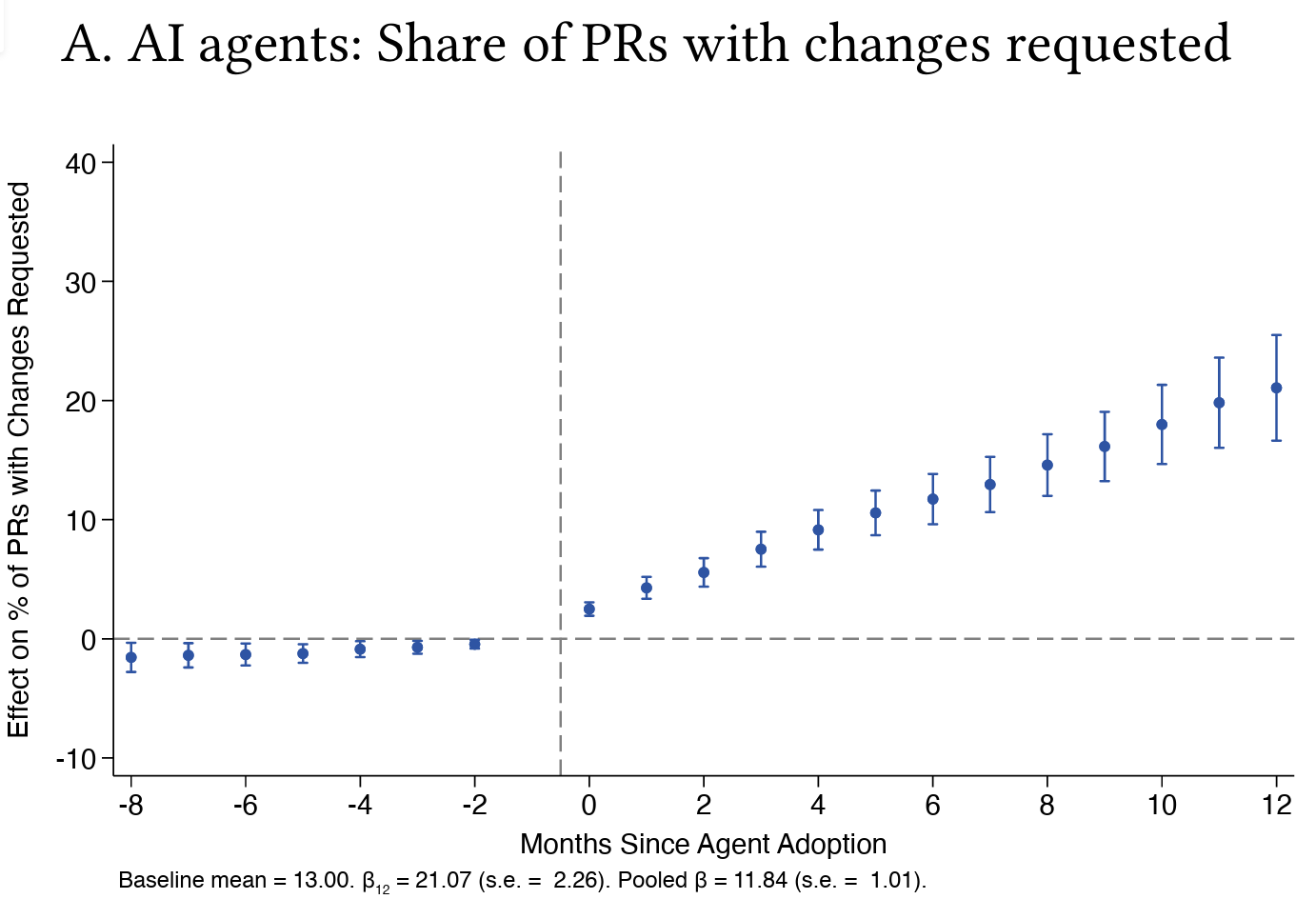
在“Agentic Coding(智能体编程)”时代,Pull Request 更频繁地需要修改。
在“Agentic Coding(智能体编程)”时代,Pull Request 更频繁地需要修改。
尽管理论上 AI 也能帮助完成这类审查流程,但研究人员发现,截至目前,其影响仍然有限。到2026年3月,虽然80%的受测企业使用了某种形式的 AI 代码审查工具,但 AI Agent 仅负责全部审查评论中的23.3%,以及全部 Pull Request 中的10.8%,这表明绝大多数此类工作仍由人类承担。
当然,AI Agent 仍是编程领域相对较新的组成部分,即使在这项研究于2026年3月截止收集数据之后,其输出能力也已经经历了显著更新和升级。尽管研究中的95%企业目前已部署 AI 编程 Agent,但许多企业无疑仍在学习:何时、以何种方式部署这些工具才最合适。随着软件工程团队对让 AI Agent 处理特定编程问题的利弊积累更多经验,这类“编程时间与审查时间”之间的权衡可能会有所改善。
但就目前而言,让 AI 编写代码似乎是一把双刃剑:编码速度的提升,被人类代码审查时间和工作量的相应增加所抵消。这一结果让人不禁怀疑:对于大多数公司而言,为使 AI 编程 Agent 正常工作而投入的大量时间和成本,是否真的值得。
English / 原文
The reason for that discrepancy can be found directly in the code review process, which takes markedly longer on average after the introduction of AI coding agents. Overall, the average “review process” time between a pull request getting submitted and it being merged into the codebase balloons 49 percent on average after AI agents are introduced. That effect can be seen in more granular data, too, with “the share of pull requests with changes requested nearly doubl[ing], and the number of comments per pull request increas[ing] by 35%” following the AI agent shift, the researchers write.
In response to this change, the researchers found a 14 percent increase in the share of workers performing code reviews after AI agents’ introduction. They also write that they “cannot attribute significant employment changes to AI” after looking at total active workers across Jellyfish and cross-referencing with LinkedIn data at those firms.
Pull requests need changes a lot more often in the “agentic coding” era.
Pull requests need changes a lot more often in the “agentic coding” era.
Credit: Chen and Stratton
While AI could also theoretically help with this review process, the researchers found that, so far, that impact has been marginal. Although 80 percent of measured firms used some form of AI code review by March 2026, AI agents were only responsible for 23.3 percent of all review comments and 10.8 percent of all pull requests, suggesting humans were still responsible for the vast majority of this work.
AI agents are still a relatively new part of the coding world, of course, and there have been significant updates and upgrades to their output even since this study’s March 2026 data cutoff. And while 95 percent of firms in the study have implemented AI coding agents by this point, many are doubtlessly still going through a learning process regarding when and how to best deploy them. These kinds of “coding time versus review time” trade-offs could improve as software engineering teams gain more experience with the pros and cons of siccing an AI agent on particular coding problems.
For now, though, letting AI write your code looks like a double-edged sword, with increases in coding speed counteracted by similar increases in human code review time and effort. It’s the kind of result that makes us wonder if the considerable time and expense to get AI coding agents working is really worth it for most companies.