赢下接力赛:高价值客户旅程中的长程运行 Agent
英文标题:new Winning the Relay Race: Long-Running Agents in High-Value Customer Journeys
AI Agent 正从处理单次、边界清晰的客服任务,进化为能够跨越数周乃至数月、协调多步骤工作的长程运行系统。文章以原告律师事务所办案流程为例,说明这类 Agent 可减少客户流失、持续推进证据收集、完整保留案件上下文,并提升最终和解价值。若 Agent 能够覆盖完整客户旅程,供应商有机会按工作成果或业务结果收费,分享客户收入增长,而不再仅靠节省人力成本获利。文章还提出平台销售、服务交付和全栈运营三种商业化路径,并认为长程运行 Agent 将把 AI 的可服务市场从劳动力预算扩展至收入份额。
 280.5 KB
 52.3 KB
 228.1 KB
 37.3 KB
 218.3 KB
 39.6 KB
 159.6 KB
 789.9 KB
 568.0 KB
中文
传统上,当你因服务中断致电互联网服务商的客服热线时,流程大致是这样的:一个机械的语音先以“尊贵客户”欢迎你,接着让你花上几分钟在电话菜单中层层选择(“技术支持请按 3,互联网服务请按 2,其他所有问题请按 4”)。随后你会被置于等待状态,感觉自己被遗忘了;终于有客服代表接听后,又会询问你的姓名、账户号码和问题详情。如果重启路由器没有解决问题,你会再次被置于等待状态,然后向另一位客服代表从头讲述一遍,才能预约技术人员上门。
AI 已经在改变这类支持互动。如今,用户不必再与机械语音和多名客服代表周旋,AI Agent 可以立即接听。它能够查看你的账户,核查你所在地区是否还有其他客户受到影响,并直接解决简单问题或预约技术人员。不再有“我们所有客服代表目前都在忙”,也不再有等待音乐。直到最近,这仍是技术能力的边界。
但现在,新的能力使 Agent 能够在更长的时间跨度内跟进线索并执行任务。我们相信,这将让 AI 公司超越单次客户互动,重新思考如何解决持续数周乃至数月的复杂客户旅程。AI 将引导保险客户从初次来电走到赔付,引导抵押贷款借款人从预审批走到交割,并引导企业销售线索从第一次产品演示走到签约。这不仅会为客户带来更好的结果,也将使 AI 供应商能够根据由此带来的收入增长获得报酬,而不只是根据成本节约获得报酬。
**价值只会在接力赛终点显现
**
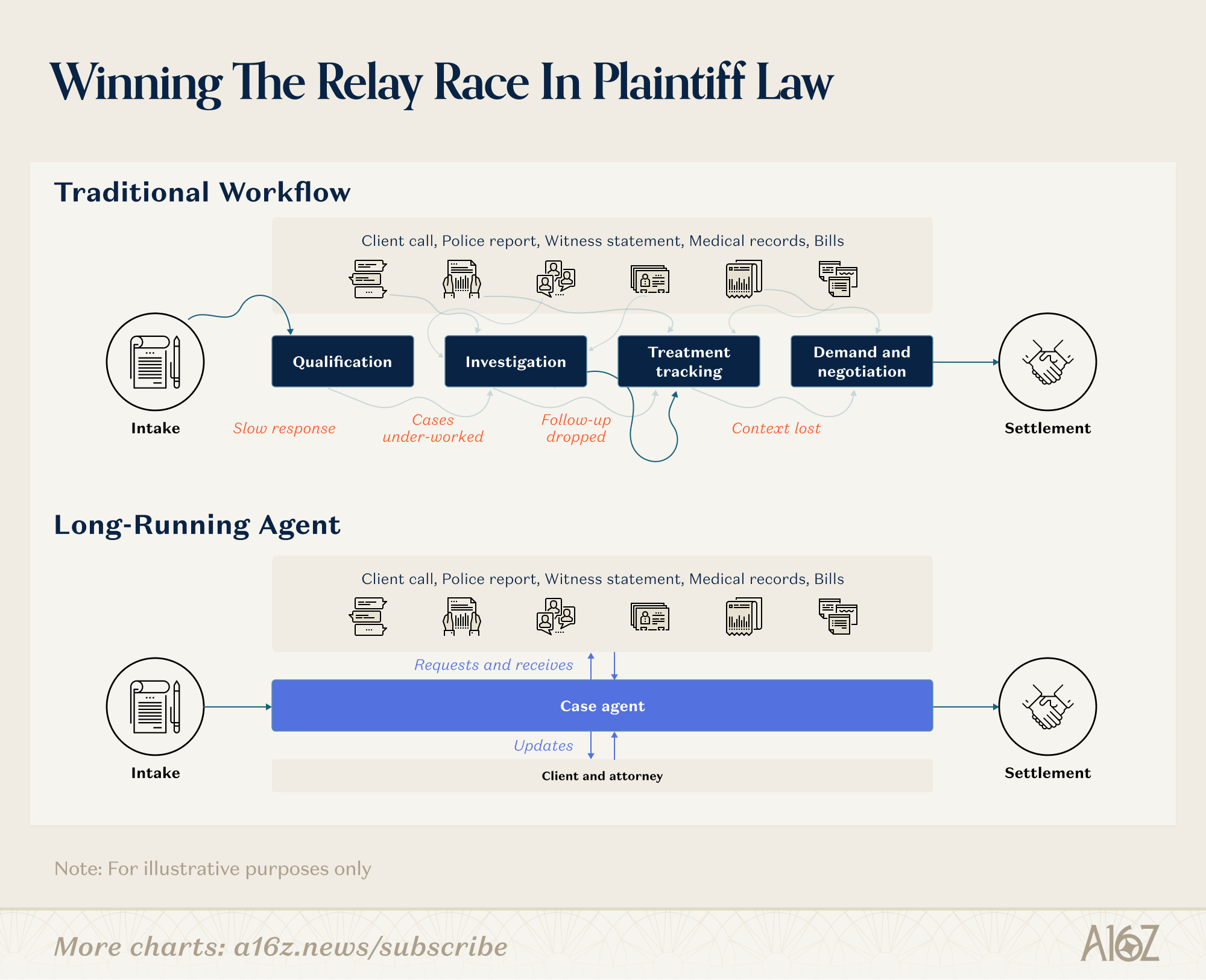
许多类型的企业都需要经过多个步骤、历时数周乃至数月,才能为客户创造价值。以传统原告律师案件的准备流程为例。潜在案件通常以电话线索的形式进入,接案专员收集关键事实,再将其转交给律师,由律师评估是否接手该客户。一旦律所签下案件,便进入调查和证据收集阶段:律师助理会调取警方报告、尝试联系证人,并向被告发送证据保全函,在向客户更新进展的同时保全证据。随后,律所会等待客户完成治疗,再起草医疗时间线,并将信息交给律师完成索赔函。
从历史上看,这一流程可以称为一场“接力赛”:这是一个漫长的旅程,每一次交接都存在客户流失或价值泄漏的风险。潜在客户通常会致电多家人身伤害律师事务所,并常常选择回复最快的那一家。因此,如果客户只接通语音信箱,或资格评估决策过慢,案件就可能从漏斗中流失。客户签约后,证据收集涉及许多同时推进的并行线索;如果前四次联系均未获回应,律所可能没有足够的持续性去第五次致电潜在证人。此外,劳动力限制可能导致律所无法详细审查每一份证据,尤其是对于看似常规、价值较低的索赔。若能仔细阅读医生记录,或许会发现脑损伤迹象,从而提高和解价值,但律所可能在此之前就接受了第一份报价。最后,案件可能持续数月,需要众多参与者,并涉及分散在文件、利益相关方和系统中的信息。这几乎不可能让团队持续掌握每位客户的全貌。因此,重要账单可能未被纳入索赔函,治疗中断也可能没有得到解释,最终导致更低的和解金额。
**长程运行 Agent 的机遇
**
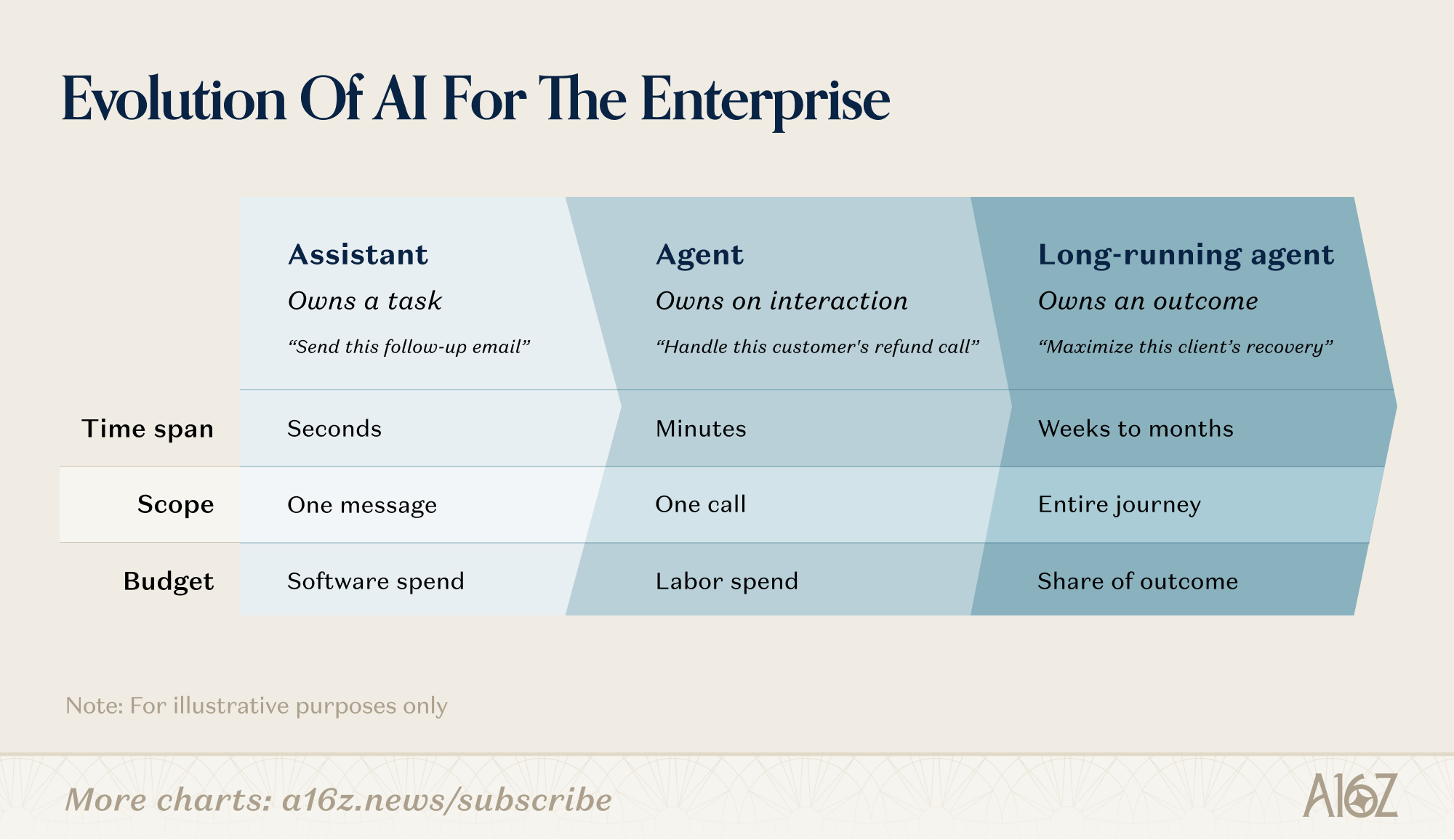
直到最近,AI Agent 主要处理边界明确的任务(“发送这封跟进邮件”“总结那通电话”“创建这份文档”)以及狭窄的交互场景。例如,客户支持一直是 AI 的一个优秀早期应用场景,因为问题空间定义明确,能够实现很高的可靠性,同时仍可根据企业特定政策进行定制。交互时间短、结果可验证;如果 AI Agent 遇到无法处理的边缘情况,现有客服团队通常仍可负责升级处理。
如今,长程运行 Agent 能够跨越数十个步骤、多种交互模态和更长时间跨度来追求目标,从而可以从头到尾承担这类接力赛。在原告律师案件的例子中,可以从初次接案电话开始,将一个案件交给长程运行 Agent,并以最大化客户赔偿为目标。该 Agent 会在需要时保存和检索案件上下文。它会根据事件或截止日期被唤醒,主动调度子 Agent,通过电话、电子邮件或短信联系证人、更新客户情况,并与律师互动。然后,它会汇总发现、规划后续行动、起草文件供审核,并推动案件取得尽可能好的结果。它还能在不同客户案例中持续学习,因为每个案件都会生成数据,帮助 Agent 比处理当前案件时更好地处理下一个案件。
该 Agent 能够解决当前“接力赛”中观察到的关键价值泄漏问题。在旅程开始时,由于 Agent 不分昼夜、周末均可提供服务,且几乎可以瞬时评估案件,客户不再会因案件评估缓慢而流失。证据收集也不再受人力容量限制,因为案件 Agent 随时可以启动额外的子 Agent,进行第五次、第十次甚至第二十次电话联系。由于 Agent 几乎可无限扩展,即使是看似常规的案件也能得到完整处理,每一份证据都会被详细审查,从而发现原本可能被遗漏的潜在脑损伤。最后,Agent 会保存案件的完整记录,从证人通话记录到警方报告和医疗记录,确保没有信息丢失。
**按结果获得报酬
**
除了弥补这些泄漏,拥有完整客户旅程还能够改变 Agent 供应商的经济模式。随着 Agent 以更高质量和更快速度帮助交付结果,它们可以推动收入提升,而不只是帮助客户削减成本。更重要的是,由于 Agent 的影响可以被观察和归因,供应商可以通过按工作成果或结果定价,分享自身创造的上行收益。以原告法律业务为例,单个案件是一个离散的工作单元,而最终结果——和解金额——的价值也清晰可辨。此外,当 Agent 推动了最终工作成果中的更大部分时,结果也更容易与 Agent 建立关联。供应商因此可以分享营收增长,获得那些仅聚焦成本削减时无法实现的合同价值。
诚然,转向结果导向定价并非毫无阻力。在原告法律业务中,美国多数州禁止非律师参与法律费用分成,因此定价需要与和解价值保持一致,但不能直接从中抽成。在其他垂直行业中,供应商可能会遭遇采购团队的反对,因为后者尚未有结果导向合同的先例。即使 Agent 越来越接近全面承担结果责任,关于归因的争议在初期也很可能出现。因此,成功部署长程运行 Agent,将是一项商业挑战,其重要性不亚于技术挑战。
不过,在高价值客户旅程中按结果获得报酬并不是一个新想法。
**AI 原生 Red Ventures 的案例
**
Red Ventures(RV)是一个出色的历史案例。RV 由 Ric Elias 和 Dan Feldstein 创立,率先推出了面向长期消费者合同的数字化端到端外包销售运营模式。以保险保单为例,RV 会在客户搜索相关产品时收集其信息(通过拥有如 homeinsurance.com 这样的网站),随后联系客户,带其了解保险覆盖选项,并完成保单销售。由于完整拥有这一旅程,RV 每促成一份保单,便从保险公司获得一笔付款。这一模式过去非常成功:根据标普全球的数据,RV 在 2022 年实现了约 14 亿美元销售额和约 3.7 亿美元 EBITDA。
如今,这一模式似乎正面临结构性威胁。在漏斗顶端,消费者发现产品的方式正在变化。消费者不再依赖 Google 搜索或比价网站来探索和比较产品,而是可以直接向 Meta 的 Muse 或 Instinct 等个人 Agent 询问产品推荐,这降低了拥有传统产品探索网站的价值。在漏斗的更下游,长程运行 Agent 可以取代数百名沿线性漏斗工作的人工人员,覆盖复杂得多的旅程。它们可以跨产品、跨通信模态并行工作,支持任何语言、实现大规模运行,并具备无限的持续性。受客户流失和广告支出走弱影响,RV 的 EBITDA在 2025 年预计降至约 1.6 亿美元,这已初步表明该模式的脆弱性;未来 AI 将进一步改变这个行业。
**三种市场进入方式
**
将长程运行 Agent 推向市场有不同方式。
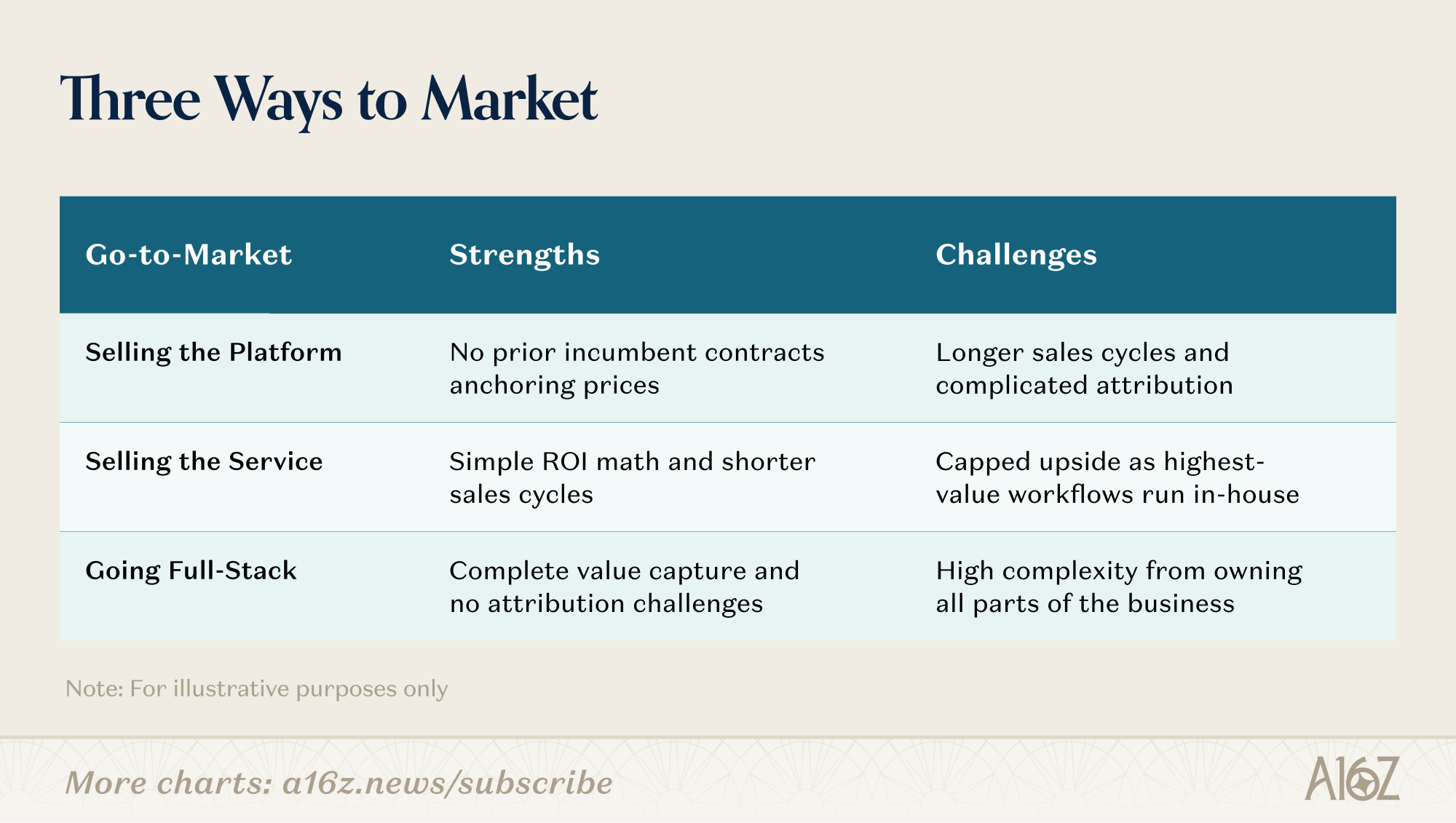
(1) **销售平台:**在这种模式下,供应商将长程运行 Agent 作为软件出售,支持企业在既有运营体系中使用。例如,为原告律师案件 Agent 接入现有团队及其工作流。销售平台具备收入上行空间,因为市场上通常没有可比的软件或外包服务合同来锚定价格。然而,这也会延长销售周期,因为需要创建新的预算科目;此外,当一个 Agent 与企业内多个部门交互时,也更难清晰地将结果归因于它。
(2) **销售服务:**在这种模式下,供应商接管一项已被外包的服务,以更有效的方式交付预期结果,正如 Red Ventures 为保险公司完整负责整个客户获取旅程。这种方式可以缩短销售周期,因为买方的 ROI 测算简单,而且 BPO 的预算科目已经存在。然而,既有的 AI 时代之前定价模式可能无法反映长程运行 Agent 所能交付的真实价值;同时,许多高价值旅程目前仍由企业内部运营,这限制了这种方式的覆盖范围。
(3) **走向全栈:**全栈模式意味着进行垂直整合,并成为一家 AI 原生企业。例如,与其向债务催收公司销售长程运行 Agent,不如自行购买债务资产包并开展催收,从而完整捕获 AI 创造的上行收益,并解决归因问题。不过,这也意味着需要负责客户旅程之外的服务环节,例如牌照或合规,因而会增加干扰和运营复杂性。
现在判断哪一种方式最终胜出还为时尚早,但我们相信,长程运行 Agent 将大规模赢下这场接力赛,并将 AI 的可服务市场从劳动力预算中的一部分,扩展到收入中的一部分。原告案件准备只是一个例子;我们预计,Agent 将在抵押贷款发起、保险理赔处理、复杂企业销售以及无数其他高价值旅程中推动结果。如果你正在探索如何把握这一机会,我们很乐意听到你的消息!
English / 原文
Traditionally, calling your internet provider’s support hotline about an outage went something like this. A robotic voice greeted you as a valued customer, then made you spend several minutes on phone menus (“press 3 for technical support, 2 for internet, then 4 for all other issues”). You were put on hold, feeling forgotten, until a service representative finally picked up and asked for your name, account number and issue. If restarting your router didn’t fix the problem, you were put on hold again, only to tell another representative the whole story a second time before receiving a technician appointment.
AI is already transforming support interactions like this one. Instead of grappling with a robotic voice and several service representatives, an AI agent can now pick up right away. It can see your account, check whether other customers in your area are also affected and either resolve simple problems directly or book a technician. No more “all our service representatives are currently busy” and no more hold music. Until recently, this was the technological limit.
But now, new capabilities are allowing agents to follow threads and execute tasks over longer horizons. We believe this will allow AI companies to go beyond individual customer interactions and rethink how to address complex customer journeys that run over weeks and months. AI will guide insurance customers from an initial call to payout, mortgage borrowers from pre-approval to closing, and enterprise leads from their first demo to signature. This will not only create better outcomes for those customers, but also let the AI vendor get paid for the resulting revenue expansion, not just for cost savings.
**Value Only Appears At The End Of The Relay Race
**
There are many kinds of businesses where creating value for customers takes many steps, over weeks and months. Let’s take the traditional plaintiff law case preparation journey as an example. Prospective cases often arrive as leads by phone, where intake specialists gather the key facts and pass them to an attorney who evaluates whether to take on a client. Once a firm signs a case, investigation and evidence collection follow: Paralegals order police reports, try to get in contact with witnesses, and send spoliation letters to defendants to preserve evidence while keeping clients updated on progress. Firms then wait for client medical treatment to conclude before drafting a medical chronology and handing information to attorneys to finalize the demand letter.
This process is what we historically would have called a “relay race”: a long journey with risk of drop-off or value leakage at each handoff. Potential clients usually call several personal injury firms and often sign with the firm that gets back to them the quickest. So cases can drop out of the funnel if clients only reach voicemail or if the qualification decision is slow. Once a client is signed, evidence collection involves many parallel threads at once and firms may not have the persistence to call a potential witness for the fifth time after the previous four attempts went unanswered. In addition, labor constraints can keep firms from reviewing every piece of evidence in detail, especially for seemingly routine, low-value claims. A firm may accept the first offer when a detailed read of the doctor’s note would have surfaced indicators of a brain injury, increasing settlement value. Finally, cases can run for months, require numerous contributors, and involve information distributed across documents, stakeholders, and systems. This makes it nearly impossible to maintain the full picture on every client. As a result, important bills may not be reflected in the demand letter or treatment gaps may remain unexplained, driving lower settlement value.
**The Long-Running Agent Opportunity
**
Until recently, AI agents mostly handled bounded tasks (“Send this follow-up email”, “Summarize that call”, “Create this document”) and narrow interactions. For instance, customer support has been a great early AI use case because the problem space is well-defined, making high reliability achievable, while still allowing for customization based on company-specific policies. Interactions are brief, outcomes are verifiable and if AI agents encounter edge cases they cannot handle, existing support teams are usually still in place for escalations.
Now, long-running agents are able to pursue goals across dozens of steps, modalities, and longer time horizons, allowing them to take on relay races from start to finish. In the plaintiff law example, a long-running agent could be assigned to a case from the initial intake call with the goal of maximizing the client’s recovery. The agent would save and retrieve context on the case as needed. It wakes based on events or deadlines, proactively dispatches sub-agents to contact witnesses, update the client, and interact with attorneys across phone, email, or text. It then consolidates findings, plans subsequent moves, drafts documents for review, and drives the case towards the best possible outcome. Across clients, it keeps learning, as each case generates data which helps the agent process the next case better than the current one.
The agent addresses key value leaks observed in today’s relay race. At the start of the journey, clients are no longer lost to slow case evaluation as the agent is available regardless of the hour or weekday and can assess cases nearly instantaneously. Evidence collection is no longer bounded by human capacity, as the case agent can spin up an additional sub-agent at any moment to place the fifth, tenth, or even twentieth phone call. As agents are nearly infinitely scalable, even seemingly routine cases get worked fully and each piece of evidence is reviewed in detail, surfacing the potential brain injury that might otherwise have been missed. And finally, the agent keeps a complete record of the case, from witness phone call transcripts to police reports and medical records, making sure no information gets lost.
**Getting Paid For Outcomes
**
Beyond closing these leaks, owning the full customer journey can change the economics for the agent vendor. As agents help deliver outcomes with higher quality at greater speed, they can drive revenue uplift, not just cost reduction for customers. More importantly, as impact is observable and attributable to agents, vendors can participate in the upside they create by pricing based on work products or outcomes. In plaintiff law, for instance, a single case is a discrete unit of work and the value of the resulting outcome, the settlement amount, is clearly identifiable. In addition, outcomes can be linked to agents more easily as they drive a larger share of the final work product. Vendors may then share in topline expansion, reaching contract values previously unattainable by solely focusing on cost reduction.
Admittedly, switching to outcome-based pricing is not frictionless. In plaintiff law, most states prohibit non-lawyers from sharing in legal fees, so pricing would need to align with settlement values without taking a direct share of them. In other verticals, vendors may face objections from procurement teams who do not yet have precedents for outcome-based contracts. And even though agents move closer to fully owning outcomes, attribution debates will likely surface initially. Successfully deploying long-running agents will therefore be a commercial challenge as much as a technical one.
Still, getting paid for outcomes on high-value customer journeys is not a new idea.
**The Case For An AI-native Red Ventures
**
Red Ventures (RV) is a great historical example. RV was founded by Ric Elias and Dan Feldstein and pioneered digital end-to-end outsourced sales operations for long-term consumer contracts. As an example, for insurance policies, RV would collect details on customers when they were searching for these products (by owning sites like homeinsurance.com), reach out, walk them through coverage options, and close the policy. By fully owning this journey, RV collected a payment from the insurer for each policy it closed. This used to work extremely well: according to S&P Global, RV generated ~$370M in EBITDA on ~$1.4B in sales in 2022.
Now, this model seems structurally under threat. At the top of the funnel, consumers are changing how they discover products. Instead of relying on Google search or comparison sites to explore and compare products, they can now ask a personal agent like Meta’s Muse or Instinct for product recommendations directly, lowering the value of owning traditional exploration sites. Further downstream, instead of hundreds of humans running linear funnels, long-running agents can work across far more complex journeys. They will do so across products, and communication modalities, in parallel, in any language and at scale, with infinite persistence. RV’s EBITDA decline to an estimated ~$160M in 2025, driven by customer churn and softer ad spend, provides an early indication of the model’s vulnerability as AI will transform the industry further going forward.
**Three Ways To Market
**
There are different ways to bring long-running agents to market.
(1) Selling the Platform: Under this motion, the vendor sells the long-running agent as software, supporting the enterprise in its existing operations. The plaintiff law case agent integrating with an existing team and their workflows is a good example. Selling a platform allows for revenue upside as there are often no comparable software or outsourced services contracts in place anchoring prices. This, however, also extends sales cycles as new budget lines need to be created, and it is harder to clearly attribute outcomes to an agent that interfaces with several departments across the enterprise.
(2) Selling the Service: Here, the vendor takes over an already outsourced service to deliver a desired outcome more effectively, just like Red Ventures owning the entire customer acquisition journey for an insurance carrier. This approach shortens sales cycles as the ROI math for buyers is simple and budget lines for BPOs already exist. However, existing, pre-AI pricing models may not reflect the true value the long-running agent can deliver and many high-value journeys are run in-house today, limiting the reach of this approach.
(3) Going Full-Stack : A full-stack approach means vertically integrating and becoming an AI-native player. For instance, instead of selling a long-running agent to a debt collection firm, you could buy debt portfolios and collect them yourself, allowing you to fully capture any AI upside created and address attribution problems. However, this also means owning parts of the service like licensing or compliance which are outside the actual customer journey, adding distractions and operational complexity.
It is too early to tell which of these approaches will prevail, but we are convinced that long-running agents will win the relay race at scale and expand the market addressable by AI from a share of labor budgets to a share of revenue. Plaintiff case preparation is only one example and we expect to see agents drive outcomes across other high-value journeys like mortgage origination, insurance claims processing, complex enterprise sales and countless others. If you are working on capturing this opportunity, we would love to hear from you!