IskayPet 如何借助 Amazon Bedrock 托管知识库统一企业知识
英文标题:How IskayPet unified corporate knowledge with Amazon Bedrock Managed Knowledge Bases
伊比利亚半岛领先的宠物护理公司 IskayPet 借助 Amazon Bedrock 托管知识库(Managed Knowledge Bases),成功构建了跨越 3 个国家、4 种语言的企业级知识问答助手,无需自行运维向量数据库与 RAG 管道。该方案通过原生 SharePoint 连接器与文档级权限控制,无缝复用了现有权限体系,并将端到端检索问答时间从 3–5 分钟压缩至约 7 秒,员工查找规程耗时减少约 95%。小规模开发团队结合基于 Claude Haiku 4.5 的 Agent 开发环境 Kiro 快速完成了从前端到 AWS 架构的落地,为企业快速构建安全、低成本的无服务器 RAG 提供了极具参考价值的实践范例。
 1.3 MB
 1.3 MB
 2.4 KB
 345.0 KB
 141.2 KB
 346.5 KB
 413.0 KB
 22.2 KB
 28.2 KB
 25.9 KB
 31.6 KB
 119.9 KB
中文
IskayPet 的办公团队此前一直面临知识检索方面的挑战。日常运营问题的答案——例如退货政策、兽医诊疗规范或入职流程等——分散在横跨 4 种语言和 3 个国家的数百个 Microsoft SharePoint 文档中。在庞大的文档库中检索正确信息往往需要耗费大量时间,而随着新门店、新国家或新业务流程的不断增加,这一问题也愈发严峻。
检索增强生成(RAG)是解决此类问题的常规方案。然而,在生产环境中运行 RAG 通常意味着团队必须自行维护向量数据库、Embedding 管道以及数据摄取任务。
在本文中,我们将展示伊比利亚半岛领先的宠物护理公司 IskayPet 如何基于 Amazon Bedrock 托管知识库(Amazon Bedrock Managed Knowledge Bases)构建企业知识助手。该助手能够解答员工在零售运营、兽医护理、人事入职及采购等业务领域提出的问题,覆盖 4 种语言与 3 个国家,且完全无需自行管理 RAG 基础设施。团队借助运行在 Claude Haiku 4.5 上的 Kiro 智能体(Agent)开发环境,完成了从面向门店的前端到 AWS 整体架构与部署的全部工作。本文将深入介绍该方案的架构设计、SharePoint 集成、检索配置决策以及在生产环境中的实际成效。
关于 IskayPet
IskayPet 是伊比利亚半岛领先的宠物护理企业,在西班牙、葡萄牙和法国运营着超过 330 家门店,旗下拥有 Kiwoko、Tiendanimal、Kivet、Clinicanimal 和 Animalis 等知名品牌。IskayPet 拥有超过 4,500 名员工和 700 万客户,业务涵盖零售、宠物诊所、动物护理、供应链采购以及人事入职培训。每个业务领域都拥有各自独立的政策与规程,并分别使用西班牙语、葡萄牙语、法语和英语撰写。
面临的挑战
在 IskayPet 的各个业务领域,后台办公人员过去都需要手动检索数百份 SharePoint 文档,以回答有关业务流程、政策制度、合同条款和员工入职等方面的运营问题。面对跨越 3 个国家和 4 种语言的复杂运营体系,手动查找极为耗时,且找到的答案往往已经过时甚至有误。
当时企业内部缺乏一种可靠的统一企业知识查询方式,并且每新增一个国家、一个业务部门或一份新文档,问题就会进一步加剧。IskayPet 急需一套能够实现以下目标的解决方案:
- 基于企业自身文档回答自然语言问题,确保内容有据可依。
- 在无需维护多套独立系统的前提下,原生支持 4 种语言。
- 将每个问题准确路由到对应的知识域(特定业务领域、国家),杜绝不同领域间的信息交叉污染。
- 支持轻松扩展至新业务领域和新国家,而无需重构底层架构。
- 自动引用参考来源,确保员工能够信任并核实答案。
- 复用现有的 SharePoint 文档库,避免成本高昂的数据迁移。
为什么选择 Amazon Bedrock 托管知识库
IskayPet 最终选择了 Amazon Bedrock 托管知识库,核心原因在于其全托管的 RAG 基础设施消除了自行运维向量存储、Embedding 管道或数据摄取任务的负担。主要考量包括:
- 托管式 RAG: Amazon Bedrock 负责处理数据摄取、多模态解析、向量存储、Embedding 生成和检索全流程。IskayPet 只需为实际存储和检索的内容付费。
- 原生 SharePoint 连接器: 该连接器可直接从 IskayPet 现有的 SharePoint 环境中摄取文档,免去了数据迁移工作。开启高级索引(Advanced indexing)后,它还能解析文档中嵌入的图片内容。
- 内置混合检索: 无需额外付费即可将语义检索与关键词(BM25)检索相结合,有效召回纯语义检索容易遗漏的精确术语(如产品代码、物料编号等)。
- 托管重排序(Reranking): 自动根据相关性对召回的段落重新排序,同样无需额外收费。
- 文档级访问控制: 知识库可以在检索时强制执行源系统的原生权限,确保查询仅返回当前用户本身有权查阅的文档段落。这使 IskayPet 能够直接复用现有的 SharePoint 权限体系,而无需重新搭建一套鉴权模型。
- 模型灵活性: IskayPet 可以先从高性价比的模型起步,后续无需改写底层基础设施即可平滑切换为其他模型。
- 原生 RAG 评估: 团队可以使用内置的评估工具在每个阶段持续衡量系统质量。
解决方案概览
下图展示了完整的端到端业务流:从员工提出问题开始,经过具备权限感知的检索流程,最终生成基于事实且带来源引用的回答。
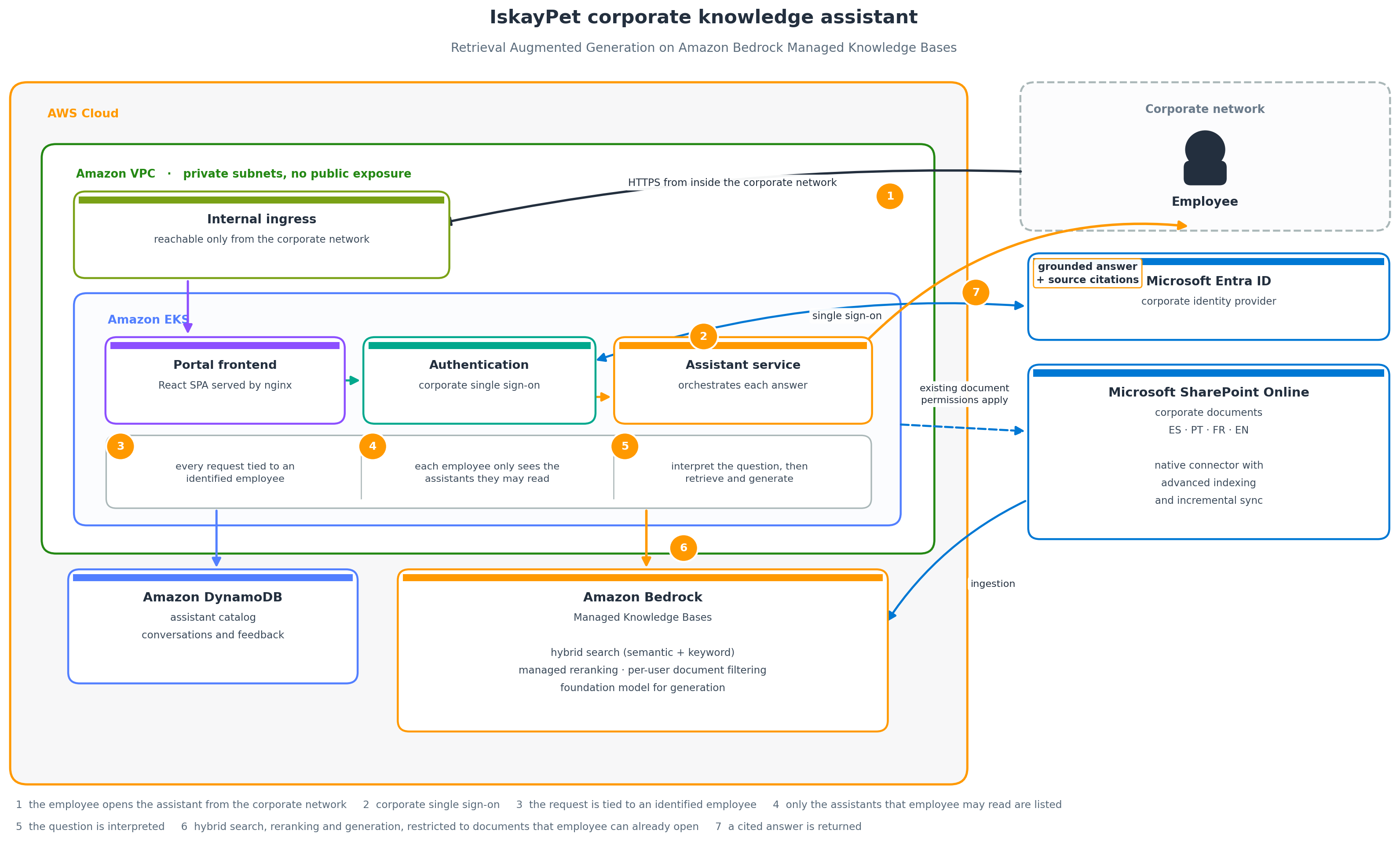
图 1:解决方案架构
该方案以企业助手的形式呈现,员工可通过现有工作渠道直接访问。当员工提问时,助手会从知识库中检索出最相关的段落(严格限制在当前员工有权访问的文档范围内),随后以员工所使用的语言生成附带引用来源的事实答案。
从高层视角来看,整体流程如下:
- 员工通过聊天界面提交自然语言问题。
- 应用程序调用对应助手的知识库,同时传入员工的身份凭证,以便在检索阶段应用文档级权限过滤。
- 知识库对已索引内容执行混合检索(语义与关键词),对结果进行重排序,并返回包含源引用的最相关段落。
- 基础模型(FM)基于召回的段落生成有据可依的回答。Prompt 会要求模型标明参考来源,并在检索内容不足以回答问题时明确说明“在检索内容中未找到答案”。
- 员工接收到答案及相关源文档引用,并可提供点赞或点踩反馈,这些反馈将沉淀为评估数据集。
使用 Kiro 与 Claude Haiku 4.5 构建解决方案
IskayPet 团队借助运行在 Amazon Bedrock 上的 Claude Haiku 4.5 与 Agent 开发环境 Kiro,完成了从面向门店的前端界面到 AWS 后端架构与服务部署的整套方案。随着 Amazon Bedrock 上线更多新模型,IskayPet 也计划针对各个具体用例进行评估并持续引入。
有关各 AWS 区域的模型可用性,请参阅 Amazon Bedrock 中各 AWS 区域支持的模型。
- 门店前端界面 – 团队利用 Kiro 构建了供门店员工与助手交互的前端界面,并通过 Claude Haiku 4.5 快速生成并迭代 UI 代码。
- 架构设计与部署 – Kiro 还辅助完成了整个底层 AWS 架构的设计与服务编排,包括知识库配置、数据源接入、AWS Identity and Access Management (IAM) 角色以及应用层搭建。
借助 Kiro 的 Agent 式工作流搭配 Claude Haiku 4.5 这类快速且高性价比的模型,一个小规模团队也能迅速完成从方案验证到生产上线的全过程,同时保持应用代码与基础设施的高度一致性与可维护性。
数据摄取:具备高级索引功能的 SharePoint 连接器
IskayPet 的各类文档此前已按业务领域和国家组织在 SharePoint 中。团队没有选择迁移数据,而是直接采用了 Amazon Bedrock 托管知识库的原生 SharePoint 连接器。
在数据源的“高级配置”(Advanced configurations)中,团队在“内容索引”(Content indexing)与“高级索引”(Advanced indexing)下启用了“文档中的视觉内容”(Visual content in documents)。该设置支持自动提取文档(PDF、DOCX、PPTX)中嵌入的图片内容以及独立图片中的信息。规程文档中包含的图表和扫描件内容无需经过额外的前置预处理管道即可直接被索引和检索。
连接器支持增量同步,因此新增和更新的文档都会在后续的每次同步中被自动拾取。
跨国家、多领域架构设计
系统设计中的关键决策之一是如何为 4 种语言、多个业务领域和 3 个国家合理组织知识库。IskayPet 曾权衡了两种方案:
- 单一共享知识库: 为每份文档打上所属国家和业务领域的标签,在每次查询时通过检索过滤器(retrieval filter)筛选。这种方式能最大限度复用共享内容,但会将所有业务域紧密耦合在同一个索引中。
- 按助手配置独立知识库: 为每个助手分配专用的知识库,各自限定在对应的 SharePoint 站点或文档库范围内。这样可以在端到端层面实现知识域的物理隔离,并支持对每个助手进行独立调优。
IskayPet 最终选择了“每个助手配置独立知识库”的方案。每个助手精准指向特定的 SharePoint 站点,并通过包含路径(inclusion paths)进一步收敛至特定的文档库或文件夹,从而确保仅对目标内容建立索引,而不会拉取整个企业站点。当需要新增业务领域或国家时,只需新增一个助手并指向对应内容即可,完全无需改动系统架构。
访问控制
系统访问严格受用户在 SharePoint 中的现有权限管控。助手本身不会赋予员工任何新权限,它的核心价值在于让员工能够更便捷地查询原本就拥有访问权限的文档。这一机制体现在两个层面:
- 员工能看到哪些助手 – 员工只能看到其拥有底层文档阅读权限的助手,无论该权限是来自直接授权、用户组成员身份还是对特定文件夹的访问权。如果无法确认权限,系统将默认隐藏该助手。
- 哪些文档参与生成答案 – 权限控制在检索阶段会再次逐文档生效:员工的身份信息会被传递给知识库,知识库仅返回该员工被授权查看的文档段落。Amazon Bedrock 托管知识库原生支持这种文档级访问控制,因此对于同一个问题,权限不同的两位员工所获得的答案合情合理地可能存在差异。
由于每次访问检查都会实时从 SharePoint 读取权限状态,因此在 SharePoint 中撤销或授予权限会即时反映在助手上,无需对应用程序做任何变更。
检索与生成配置
RAG 系统的质量主要取决于数据摄取、检索以及生成这三个阶段,微调(Fine-tuning)则是一项互补技术。在本用例中,IskayPet 针对以下配置进行了细致调优:
- 分块(Chunking)– 完全交由托管知识库处理,团队无需自行构建或调试分块管道,从而省去了自建 RAG 中通常需要耗费大量运维精力的模块。
- 混合检索(Hybrid search)– 知识库将语义检索与关键词检索相结合,精准捕获了纯语义检索容易漏掉的精确术语(例如产品编号)。
- 返回结果数量(Number of results)– 基于评估数据集进行了微调。助手最初召回 25 个段落,在剔除重复内容以及上下文过短的无效片段后,最多将 15 个段落注入 Prompt 中。这一数量是控制成本的核心杠杆,因为每一次提问都会成倍增加输入 Token 的开销。
- 生成 Prompt(Generation prompt)– 严格规范了企业官方语调,强制要求标注来源引用,并明确要求模型在检索内容不足以回答问题时直接说明,从而显著降低幻觉并增强答案的可溯源性。
作为生产级安全防线,团队正在引入 Amazon Bedrock Guardrails,对生成的答案施加内容过滤与负责任 AI(Responsible AI)安全策略。
- 评估(Evaluation)– 采用原生 Amazon Bedrock RAG 评估功能,将实际业务使用中的点赞和点踩反馈作为评估数据集,在每次变更前后量化对比系统质量。
生成回答
在生成回答环节,IskayPet 采用了 Amazon Bedrock 上兼具高性价比的基础模型。由于知识库将检索层与生成层完全解耦,IskayPet 可以在不改动数据摄取或检索层的前提下自由切换或升级生成模型。这使得团队在未来业务量增长时,能够持续平衡成本与答案质量。
成本效益
由于知识库已免费内置了多模态解析、Embedding 生成以及重排序功能,IskayPet 的日常运行成本主要来自于索引存储、检索 API 调用以及生成模型的 Token 消耗。在实际生产环境中,由于注入到每次 Prompt 中的上下文段落较多,输入 Token 构成了主要的成本支出。随着使用规模的扩大,团队正在评估进一步的优化措施,包括针对 Prompt 固定部分启用 Prompt 缓存(Prompt Caching),以及针对非交互式批处理任务采用批量推理(Batch Inference)。
实施成果
在投入生产运行的最初约两个月内,IskayPet 取得了显著的业务成效:
- 响应更快捷 – 查找日常运营问题答案的时间从原来的 3–5 分钟大幅缩短至约 7 秒。
- 生产力显著提升 – 员工在查找规章流程和政策制度上花费的时间减少了约 95%。
- 规模化应用 – 该方案预计将在各个业务部门和国家之间每月处理约 100,000 次查询。
总结
IskayPet 借助 Amazon Bedrock 托管知识库成功构建了生产级企业知识助手,在无需自建和运维任何 RAG 基础设施的前提下,服务于 3 个国家、4 种语言和多个业务领域。原生 SharePoint 连接器让团队能够充分盘活现有文档资产;按助手独立划分知识库的策略实现了清爽的跨国多业务域设计,并在端到端层面保持了各领域的独立隔离;全托管的解析、Embedding 和重排序功能则有效控制了运维负担与成本支出。同时,借助 Kiro 和 Claude Haiku 4.5 构建前端与 AWS 架构,让精干的小团队得以快速完成生产落地。
如果您也面临类似的知识检索挑战,可借助 AWS 免费套餐在 Amazon Bedrock 控制台中快速搭建您的第一个知识库。如需深入探索,请参考以下资源,并在您自己的文档上体验 SharePoint 连接器与文档级访问控制:
English / 原文
IskayPet’s office teams had a knowledge challenge. Answers to everyday operational questions, such as a return policy, a veterinary protocol, or an onboarding step, lived in hundreds of Microsoft SharePoint documents spread across four languages and three countries. Finding the right information in large document repositories took a long time. Every new store, country, or procedure made the problem bigger.
Retrieval Augmented Generation (RAG) is the usual way to solve this. But running RAG in production normally means operating vector databases, embedding pipelines, and ingestion jobs yourself.
In this post, we show how IskayPet, a leading pet care company in Iberia, built a corporate knowledge assistant on Amazon Bedrock Managed Knowledge Bases. The assistant answers employee questions across retail operations, veterinary care, people and onboarding, and procurement, in four languages and across three countries, with no RAG infrastructure to manage. The team built the whole solution, from the store-facing frontend to the AWS architecture and deployment, using Kiro with Claude Haiku 4.5. We cover the architecture, the SharePoint integration, the retrieval configuration decisions, and the results in production.
About IskayPet
IskayPet is a leading pet care company in Iberia. It operates more than 330 stores across Spain, Portugal, and France under the Kiwoko, Tiendanimal, Kivet, Clinicanimal and Animalis brands. With more than 4,500 employees and 7 million customers, IskayPet runs operations that span retail, veterinary clinics, animal care, procurement, and people and onboarding. Each area has its own policies and procedures, in Spanish, Portuguese, French, and English.
The challenge
Across every business area, IskayPet office staff searched hundreds of SharePoint documents by hand to answer operational questions about procedures, policies, contracts, and onboarding. With operations in three countries and four languages, this took real time, and the answer was often outdated or wrong.
There was no reliable way to query corporate knowledge, and the problem grew with every country, area, or document added. IskayPet needed a solution that could do the following:
- Answer natural-language questions grounded in their own corporate documents.
- Work across four languages without maintaining separate systems.
- Route each question to the right body of knowledge (an area, a country) without cross-contamination.
- Scale to new areas and countries without re-architecting.
- Cite its sources so employees can trust and verify answers.
- Reuse their existing SharePoint repositories without a costly migration.
Why Amazon Bedrock Managed Knowledge Bases
IskayPet chose Amazon Bedrock Managed Knowledge Bases for its managed RAG infrastructure, which removed the need to run vector stores, embeddings, or ingestion pipelines. The main reasons were:
- Managed RAG: Amazon Bedrock handles data ingestion, multimodal parsing, vector storage, embedding generation, and retrieval. IskayPet pays only for what it stores and retrieves.
- Native SharePoint connector: The connector ingests documents directly from IskayPet’s existing SharePoint environment, which avoided a data migration. With advanced indexing enabled, it also processes content from images embedded in documents.
- Built-in hybrid search: Combining semantic and keyword (BM25) search at no extra cost recovers exact terms, such as product codes and references, that pure semantic search can miss.
- Managed reranking: Retrieved passages are reordered by relevance at no additional charge.
- Document-level access control: The knowledge base can enforce the source system’s own permissions at retrieval time, so a query returns only passages from documents the requesting user is already allowed to read. This lets IskayPet reuse SharePoint permissions instead of rebuilding an authorization model.
- Model flexibility: IskayPet can start with a cost-effective model and change it later without rewriting infrastructure.
- Native RAG evaluation: The team measured quality at each step with the built-in evaluation tools.
Solution overview
The following diagram shows the end-to-end flow, from the employee’s question through permission-aware retrieval to the grounded, cited answer.
Figure 1: Solution architecture
The solution is an assistant that employees reach through their existing channels. When an employee asks a question, the assistant retrieves the most relevant passages from its knowledge base, restricted to the documents the employee is allowed to read. It then generates a grounded, cited answer in the employee’s language.
At a high level, the flow works as follows:
- An employee submits a natural-language question through the chat interface.
- The application calls the knowledge base for the requested assistant, passing the employee’s identity so that document-level permissions are applied to the retrieval.
- The knowledge base runs hybrid search (semantic and keyword) over the indexed content, reranks the results, and returns the most relevant passages with their source references.
- A foundation model (FM) generates a grounded answer from the retrieved passages. The prompt requires source citation and tells the model to say when the answer isn’t in the retrieved content.
- The employee receives the answer along with the source documents and can leave feedback (thumbs up or down) that feeds the evaluation set.
Building the solution with Kiro and Claude Haiku 4.5
IskayPet built the whole solution, from the store-facing frontend to the AWS architecture and service deployment, using Kiro, the agentic development environment, running on Claude Haiku 4.5 on Amazon Bedrock. As new models become available on Amazon Bedrock, IskayPet plans to evaluate and adopt them for each use case.
For model availability by AWS Region, see Supported models by AWS Region in Amazon Bedrock.
- Store-facing frontend – The team used Kiro to build the frontend that store employees use to interact with the assistant, generating and iterating on the UI code with Claude Haiku 4.5.
- Architecture and deployment – Kiro also helped design the AWS architecture and provision the services behind the solution: knowledge base configuration, data sources, AWS Identity and Access Management (IAM) roles, and the application layer.
An agentic workflow with Kiro and a fast, cost-effective model like Claude Haiku 4.5 helped a small team move from concept to production quickly. It also kept the application code and the infrastructure consistent and maintainable.
Ingestion: The SharePoint connector with advanced indexing
IskayPet’s documents already lived in SharePoint, organized by area and country. Rather than migrate them, the team used the native SharePoint connector in Amazon Bedrock Managed Knowledge Bases.
In the data source’s Advanced configurations, under Content indexing and Advanced indexing, IskayPet enabled Visual content in documents. This setting extracts content from images embedded in documents (PDF, DOCX, PPTX) and from standalone images. Figures and scanned content inside procedure documents became searchable without a separate preprocessing pipeline.
The connector syncs incrementally, so new and updated documents are picked up on each sync.
Multi-country, multi-area architecture
A key design decision was how to structure knowledge for four languages, several business areas, and three countries. IskayPet weighed two approaches:
- A single shared knowledge base, with every document tagged by country and area and a retrieval filter applied per query. This maximizes reuse of shared content but couples all domains into one index.
- A dedicated knowledge base per assistant, each scoped to the relevant SharePoint sites or libraries. This keeps each body of knowledge isolated end to end and lets each assistant be tuned independently.
IskayPet chose a knowledge base per assistant. Each assistant points at specific SharePoint sites and can be narrowed further to specific document libraries or folders through inclusion paths, so it indexes only the intended content and not the whole corporate site. Adding a new area or country means adding an assistant and pointing it at the right content, not re-architecting the system.
Access control
Access is governed by the users’ existing SharePoint permissions. The assistant doesn’t grant access to anything new: It only makes it more straightforward to query documents an employee could already open. This works on two levels.
- Which assistants a user sees – An employee is shown only the assistants whose underlying documentation they’re entitled to read, whether that entitlement comes from direct permission, group membership, or access to a specific folder. If access can’t be confirmed, the assistant is hidden rather than shown.
- Which documents inform an answer – Access is enforced again at retrieval time, per document: The employee’s identity is passed to the knowledge base, which returns passages only from documents that person is authorized to see. Amazon Bedrock Managed Knowledge Bases supports this document-level access control natively, so the same answer to the same question can legitimately differ between two employees with different permissions.
Because permissions are read from SharePoint on every access check, revoking or granting access in SharePoint is reflected in the assistant without changes to the application.
Retrieval and generation configuration
The quality of a RAG system is decided mainly at ingestion, retrieval, and generation. Fine-tuning is a complementary technique. For this use case, IskayPet tuned the following settings:
- Chunking – Handled by the managed knowledge base, so the team didn’t build or tune a chunking pipeline. This removed a component that’s usually significant operational effort in a self-managed RAG.
- Hybrid search – The knowledge base combines semantic and keyword retrieval, which recovers exact terms such as product codes that pure semantic search can miss.
- Number of results – Tuned against an evaluation set. The assistant retrieves 25 passages and, after removing duplicates and fragments too short to add context, injects up to 15 into the prompt. This number is the main cost lever, because it multiplies input tokens on every question.
- Generation prompt – Enforces a corporate tone, requires source citation, and tells the model to say when the answer isn’t in the retrieved content, which reduces hallucination and adds traceability.
As a production control, the team is adding Amazon Bedrock Guardrails to apply content filtering and responsible AI policies to the generated answers.
- Evaluation– Native Amazon Bedrock RAG evaluation, using the thumbs up and down feedback from real usage as an evaluation set to measure quality before and after each change.
Generating the response
For answer generation, IskayPet uses a cost-effective foundation model on Amazon Bedrock. Because the knowledge base decouples retrieval from generation, IskayPet can switch or upgrade the generation model without touching the ingestion or retrieval layers. This lets the team balance cost and answer quality as usage grows.
Cost efficiency
The knowledge base includes multimodal parsing, embedding generation, and reranking at no additional charge, so IskayPet’s ongoing cost comes mainly from index storage, retrieval API calls, and generation-model tokens. In production, input tokens dominate that cost, because of the passages injected into each prompt. The team is evaluating further optimizations as usage grows, including prompt caching for the stable part of the prompt and batch inference for non-interactive workloads.
Results
In roughly the first two months in production, IskayPet has seen:
- Faster answers – Time to find an operational answer dropped from 3–5 minutes to about 7 seconds.
- Higher productivity – Around 95 percent less time spent searching for procedures and policies.
- Scale – The solution is expected to handle roughly 100,000 queries per month across all business areas and countries.
Conclusion
IskayPet built a production corporate knowledge assistant on Amazon Bedrock Managed Knowledge Bases that serves three countries, four languages, and several business areas, with no RAG infrastructure to run. The native SharePoint connector reused their existing repositories. A dedicated knowledge base per assistant gave them a clean multi-country design with each domain isolated end to end. Managed parsing, embedding, and reranking kept both operational effort and cost low. Building the frontend and the AWS architecture with Kiro and Claude Haiku 4.5 lets a small team reach production quickly.
If you’re facing a similar knowledge-retrieval challenge, you can start on the AWS Free Tier and build your first knowledge base on the Amazon Bedrock console. To go deeper, see the following resources and try the SharePoint connector and document-level access control against your own documents.
To learn more, see Amazon Bedrock Managed Knowledge Base and Evaluate the performance of RAG sources using Amazon Bedrock evaluations.
About the authors
Daniel Martinez Rubio
Daniel is a Senior Solutions Architect at AWS, where he has been focused on guiding enterprise customers in Iberia in their cloud adoption, as well as implementing artificial intelligence use cases. He is passionate about solving complex business challenges with cloud technology.
Irene Arroyo Delgado
Irene is a GenAI & ML Specialist Solutions Architect at AWS. She led the Amazon Bedrock, Amazon Bedrock AgentCore, and Knowledge Bases enablement for IskayPet and works with enterprise customers across Iberia on generative AI.
Arturo Lorenzo Hernandez
Arturo is an AI Engineer in the Data & AI team at IskayPet. He has been making the developments of the Iskaypet data platform as well as projects involving generative AI.
Francisca del Rosario Suárez Rodríguez
Francisca is the Data Manager at IskayPet, where she owns the data platform behind the group’s lakehouse and leads the portfolio of AI use cases as project manager. She works across business, technology and governance to turn operational data into products the organization can rely on.