Rescale 如何基于 Strands Agents 与 AI-DLC 构建智能测试分类 Agent
英文标题:How Rescale built an AI triage agent with Strands Agents and AI-DLC
数字工程平台 Rescale 基于 AWS 上的 AI 驱动开发生命周期(AI-DLC)框架、Strands Agents 与 Amazon Bedrock,仅用 5 天就完成了端到端测试故障分类 Agent 的预发环境部署,并在数周内成功推向生产环境。该 Agent 借助 Claude Opus 4.8 与 MCP 协议自动进行故障分类、日志检索与修复建议生成,使排查测试故障阻塞发布的时间缩短了 20%,分类准确率提升至 68%。这一实践展现了在以人为本的前提下,AI-DLC 如何通过结构化协作让 AI 负责方案提议与代码实现、人类负责架构决策与把关,为工程团队规模化落地 AI 原生开发提供了参考范本。
 1.3 MB
 1.3 MB
 2.4 KB
 345.0 KB
 141.2 KB
 346.5 KB
 118.7 KB
 21.5 KB
 22.0 KB
 20.6 KB
 20.4 KB
 20.3 KB
 15.5 KB
 29.5 KB
 30.2 KB
 25.7 KB
 40.0 KB
中文
每个工程团队都经历过这种日常工作,Rescale 也不例外:夜间测试套件出现失败,值班工程师调取日志、分类根本原因,并将其转派给对应团队——第二天一早又重复相同的流程。在跨分布式服务和数十个代码仓库的规模下,这项日常工作演变成了一项隐藏在轮值之中的全职负担。
Rescale 是为 AI 时代构建的数字工程平台。航空航天、汽车、能源、生命科学、半导体和制造业的研发与工程团队利用 Rescale 平台加速创新,将智能 HPC、先进建模与仿真、Agent 驱动的数字工程以及 AI 物理仿真整合在单一平台上。
除了编写代码,Rescale 还在整个工程生命周期(从规划、设计到实现、测试、代码审查和运维)中广泛应用 AI,同时确保工程师对最终结果负责。AI 可以提出方案并执行,但由人类来定义范围、验证成果并批准生产变更。工程师由此能够专注于架构设计、产品判断,以及运营复杂分布式系统所需的上下文知识。
在本文中,我们将展示 Rescale 如何利用 AWS 上的 AI 驱动开发生命周期(AI-DLC) 框架构建智能分类分发 Agent(triage agent)。他们仅用 5 天时间就完成了从问题定义到预发布环境(staging)部署,并在数周内推向生产环境。本文还将介绍 Rescale 如何在其整个工程组织中推广 AI-DLC。
面临的挑战
随着 Rescale 平台的不断扩大,维持其运行的运维开销也随之激增。工程师们需要将大量时间耗费在一项重复但至关重要的任务上:对自动化端到端测试失败进行分类。测试套件中运行着数百个测试用例,一旦出现失败,每个警报、缺陷报告和上报都需要被分类、排定优先级并分派给正确的团队。在分派之后,工程师在开始调试前,还需要从多个日志与监控系统以及若干源码仓库中收集证据。通过端到端测试是向生产环境部署服务的必要前置条件,因此调试这些系统级失败直接处于向生产环境交付新变更的关键路径上。
在手动工作流中,工程师需要从测试报告切换到日志、历史模式记录和源代码,以对失败进行分类并定位可能的归属团队。由于这些集成测试卡控着每周的生产版本发布,未解决的失败可能会将多个团队卷入长达数小时的跨部门沟通协调中,之后才允许继续部署。
团队对于解决方案有着清晰的构想:构建一个能够自动分类和路由问题的智能 Agent。他们真正寻求的是一种结构化的方法,以便从这种构想平稳过渡到生产环境中的运行系统,并具备足够的结构化扩展能力,便于后续推广到其他业务场景。
为什么 Rescale 选择 AI-DLC
Rescale 的分类 Agent 属于边界明确但时间紧迫的项目。团队需要一种既能保持高速推进,又不会跳过决定系统能否在生产环境中稳定运行的架构决策的开发方法。
AI 驱动开发生命周期(AI-DLC) 是一套开源的、以 AI 为中心的软件开发方法论,围绕两大核心理念构建:
- AI 执行,人类决策:AI 生成工作计划、编写代码并提出架构方案,但它会抛出决策点并提出澄清性问题,而不是自行盲猜。人类在每一步进行验证和把控方向。
- 团队协作会话取代异步交接:AI-DLC 不采用单人独立开发并随后提审的方式,而是采用高度聚焦的群体会话:群智细化(Mob Elaboration,共同定义需求)和群智构建(Mob Construction,共同构建的同时由 AI 处理实现)。所有决策都在实时发生。
AI-DLC 非常契合这一场景,因为其中的难点不在于编写代码,而在于确保 AI 理解团队想要构建的内容。在群体协作会话中,Rescale 工程师共同回答 AI 提出的问题,并在 AI 继续推进之前审批每份计划,杜绝了任何未经确认的臆测。
方案概览
Rescale 的分类 Agent 实现了夜间端到端测试失败的自动分类与路由。它作为 Rescale 现有运行在 Amazon Elastic Kubernetes Service (Amazon EKS) 上的 Argo Workflows 持续集成与持续交付 (CI/CD) 流水线中的一个环节运行。当包含数百个测试用例的夜间 Playwright 测试套件产生失败时,流水线会触发该分类 Agent 的 Pod。
该 Agent 执行以下步骤:
- 调用 Amazon Bedrock 上的 Claude Opus 4.8,将每次失败归入根本原因分类:基础设施问题、代码缺陷、偶发性测试(flaky test)或环境问题。
- 从知识库中检索相关的历史失败模式以补充上下文。
- 通过模型上下文协议(Model Context Protocol,MCP)查询 Pod 日志,以获取支持分类的运行时证据。
- 生成结构化的修复报告,包含具体的文件引用、函数名称和推荐修复方案,供工程师在采取行动前进行审查。
Agent 在数秒内完成此工作流,并直接输出到团队现有的报告流水线中。下图展示了这些组件如何协同工作:
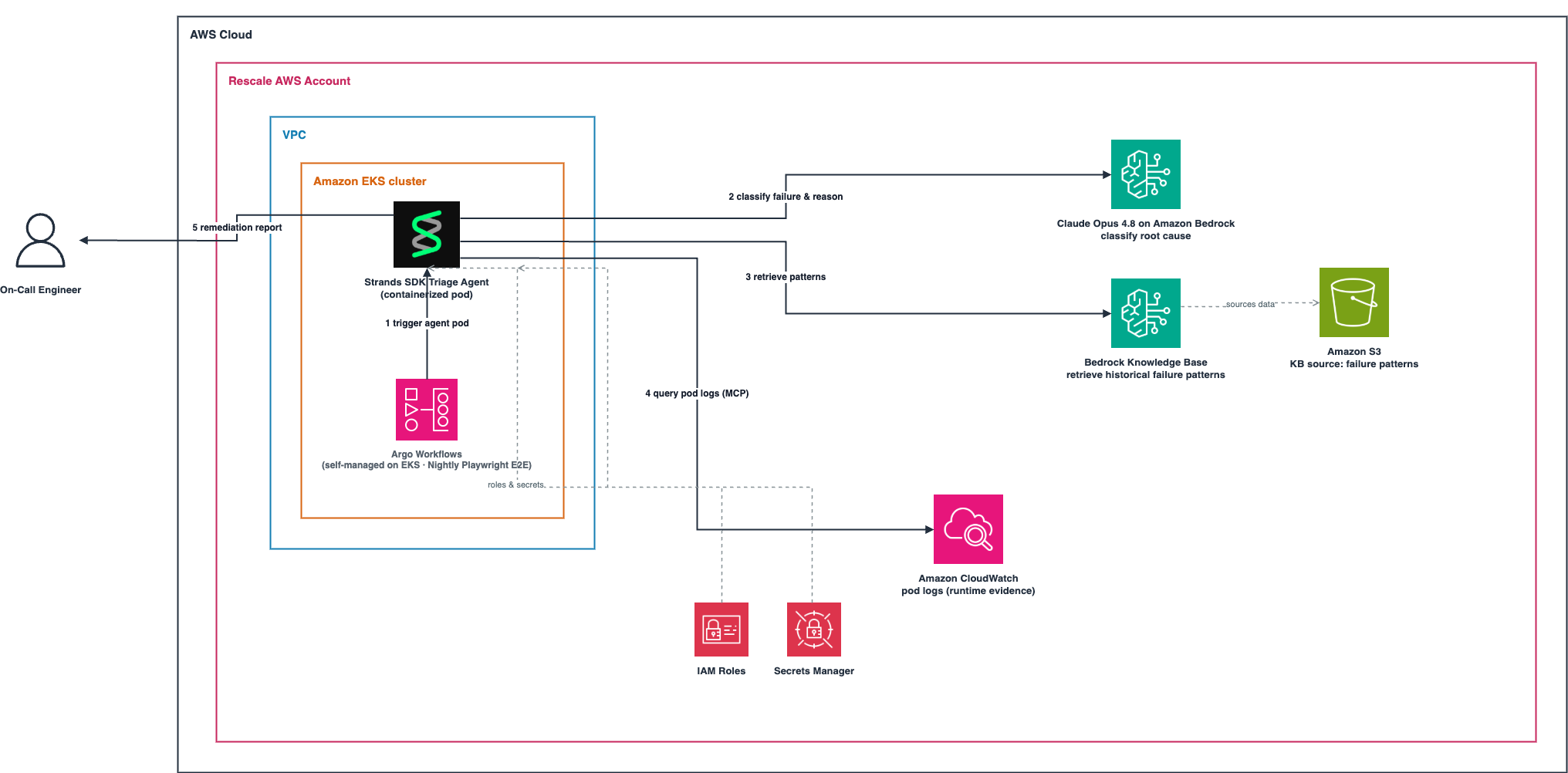
图 1:Rescale AI 分类 Agent 架构,运行在 Amazon EKS 上,采用 Amazon Bedrock 进行分类,配合用于历史失败模式的知识库,以及集成 Amazon CloudWatch 的基于 MCP 的日志检索
AI-DLC 工作坊实践历程
该项目以线下为期五天的工作坊形式展开。AWS 架构师进行构建指导,Rescale 工程师亲自上手编码,实时进行协同构建。
需求阶段(第 1–2 天):从愿景到验证后的需求
团队首先进行需求界定,将意图沉淀在愿景文档和技术环境文档中,在动手编码前为工作打下基础。最初的构想只是一句简单的陈述:“我们想要一个基于 AI 的测试分类分发功能,能够分类失败原因并推荐修复方案。”通过群智协作模式,团队共同回答了 AI 生成的 20 多个澄清性问题。由此产出了一份经过严格界定的需求文档,明确划分了第一阶段(Phase 1)的边界,并将第二阶段(Phase 2)的内容延后处理。五项用户故事被整合成四个工作单元:
- 存放历史失败模式的知识库。
- 作为核心分类与修复引擎的 AI 分类 Agent。
- 用于触发、基础设施与部署的 Argo Workflow 集成。
- 用于准确性度量和防回归卡控的评测框架(Evaluation Harness)。
人类决策确立了关键边界:哪些属于第一阶段、哪些进入第二阶段、优先顺序如何,以及像自动生成 Pull Request(PR)这样被延后实现的功能。
构建阶段(第 2–4 天):从架构到可运行代码
团队定义了接口契约与数据架构,完成了功能性和非功能性设计问题的梳理,并签署确认了架构设计。在构建过程中出现了两次架构调整,团队在改变路线前均进行了充分验证。
首先,团队原计划在 Amazon Bedrock AgentCore 上托管该 Agent,随后将其迁移到了 Amazon EKS——Rescale 的 Argo Workflows CI/CD 流水线原本就运行在上面。将 Agent 放在现有集群中意味着无需运维新的运行时环境,并具备来自 Argo 的直接触发链路。其次,在早期构建中,Agent 通过 MCP 从第三方日志服务提取日志证据。团队随后将日志检索迁移到了 Amazon CloudWatch,这简化了依赖链。MCP 模式保持不变,改变的只是其背后的数据源。得益于 AI-DLC 将需求和设计决策维护在共享文档中,团队可以直接原地更新文档并继续构建,不会丢失上下文。
该 Agent 使用 Strands SDK 构建,支持并发失败分析,具备 JSON 和 HTML 格式的结构化输出,并在 Amazon EKS 上进行容器化。
到第 4 天,整套流水线已在预发环境中成功运行:Argo 工作流触发、分类 Agent Pod、MCP 日志查询、知识库检索以及结构化的分类输出。
运维阶段(第 5 天):评估与交付
团队构建了一个基于 PyTest 的评估框架,支持在线与打桩(stubbed)测试模式,建立了初始的分类一致性基准,以此来度量 Agent 的表现并持续改进。Agent 向 Rescale 的 CTO 和工程副总裁进行了现场演示,准确分类了一起基础设施故障和一起真实的代码缺陷,并提供了精确到文件级的修复建议。
AI-DLC 如何根据复杂度适配严谨度
并非每个工作单元都需要同等程度的处理。知识库只需要极简的设计,并在几小时内就通过 Terraform 完成了部署。分类 Agent 则获得了全流程的严谨对待:架构评审、接口契约、12 项设计问题探讨以及迭代式代码审查。Argo 集成聚焦于基础设施契约和 IAM 权限。评测框架采用了轻量级设计配合密集的代码实现。AI-DLC 能够自动将设计深度与系统复杂度进行匹配。
截至第 5 天结束时,该 Agent 已在预发布环境中上线运行,基于已测量的准确率基准处理真实的测试失败,并具备清晰的投产路径。
生产环境成果
自工作坊结束以来,该分类 Agent 一直在生产环境中稳定运行。它自动对夜间端到端测试失败进行分类,用自动化的初筛取代了人工初次分类,后续再由工程师进行确认。针对每次失败,Agent 会生成包含可操作后续步骤的结构化修复报告,而非晦涩的原始日志。Agent 分类与人工分类的一致性比例已从刚部署时的 44% 提升到了如今的 68%,并且随着团队对黄金数据集(golden dataset)和 Prompt 工程的持续迭代,该指标仍在稳步提升。
自该分类 Agent 投入生产以来,团队测得分析测试失败导致生产部署受阻的时间减少了 20%。由于这些测试直接卡控着 Rescale 每周的生产版本发布,这一缩短直接体现为变更交付生产环境的速度加快。工程师们也得以在轮值过程中减少在重复性分类上消耗的时间。
工作坊之后:从单个 Agent 到 AI 优先的研发实践
工作坊交付了一个投入生产的 Agent,但其更深远的影响在于改变了 Rescale 开展工程工作的方式。该分类 Agent 是 Rescale 为 AI 时代交付数字工程能力这一宏大推进计划的一部分。在内部,Rescale 正在将其工程组织全面受惠于 AI 的这套实践经验铺开。AI-DLC 为 Rescale 的工程师提供了一种结构化、可复现的方式来落地这一方向。
在整个组织中推广 AI-DLC
Rescale 正在评估建立内部的 AI-DLC 卓越中心(Center of Excellence),这是一个小型团队,负责梳理沉淀最佳实践并协助其他团队独立采纳该方法论。
参与工作坊的工程师们已经在运用所学到的方法。其中一位工程师指出,这个流程“将成为我今后工作流的一部分”,这不仅适用于构建 Agent,也适用于任何需要 AI 参与协助的复杂开发工作。
更广泛的 AI 原生研发
Rescale 目前正在将 AI-DLC 整合进新型工程仿真产品的标准软件开发生命周期中。该框架将仿真领域专业知识、产品需求、平台架构、验证与运维带入一个结构化的设计流程中。团队提前解决关键问题,将评审后的决策沉淀为可执行规范,并为编码 Agent 分配具有清晰验收标准的明确任务。这缩短了从产品概念到验证实现的路径,同时保持工程师对产品正确性承担最终责任。
同样的模式已被应用于产品支撑平台和 Agent 系统的构建中:
- HPC 仿真应用程序目录管理。
- 针对政府合规要求的容器漏洞跟踪与修复。
- 基于工作流的云端编码 Agent。
总结
对于这个分类 Agent 而言,AI-DLC 最有价值的产出并不是代码本身,而是从初始构想到经过审查的系统设计的结构化路径:澄清问题、界定需求和确立评估指标。
这份规范给编码 Agent 提供了一个范围更小、定义更清晰的问题去解决。团队无需让 Agent 在实现代码的同时去推断架构,而是可以利用 Agent 针对人类已审阅的决策进行专注的构建。其成果是产生更聚焦、更具可审查性、且更易于集成和优化的输出。对 Rescale 而言,这就是一套可复现的模式:利用 AI-DLC 组织设计讨论,将决策转化为规范,进而借助编码 Agent 加速实现。
核心要点
- 从真实问题出发。Rescale 分类 Agent 之所以成功,是因为它解决了一项真实的工程痛点。是问题驱动了解决方案,而非本末倒置。
- 人工把关起到了加速而非减速的作用。系统中每一次令架构完善的调整,都源于人类对 AI 提议的验证。AI 生成与人类确认相结合的群智协作模式,比单打独斗更加敏捷高效。
- AWS 技术栈提供了 Agent 所需的每一层支持。Amazon Bedrock 在 Rescale 已有的技术环境中提供了用于分类的基础模型访问能力,使得团队无需承担额外的模型基础设施运维负担,即可构建出完整的分类工作流。
English / 原文
Every engineering team knows the ritual, and Rescale was no exception. A nightly test suite fails. An on-call engineer pulls the logs, classifies the root cause, and routes it to the right team, only to repeat the process the next morning. At scale, across distributed services and dozens of repositories, this ritual becomes a full-time job hiding inside an on-call rotation.
Rescale is the digital engineering platform built for the AI era. R&D and engineering teams across aerospace, automotive, energy, life sciences, semiconductor, and manufacturing use the Rescale platform to accelerate innovation, bringing intelligent HPC, advanced modeling and simulation, agentic digital engineering, and AI physics together on a single platform.
Beyond coding, Rescale uses AI across the engineering lifecycle, from planning and design through implementation, testing, review, and operations, while keeping engineers accountable for the result. AI can propose and execute, but people define scope, validate the work, and approve production changes. Engineers can then focus on architecture, product judgment, and the context required to operate complex distributed systems.
In this post, we show how Rescale used the AI-Driven Development Lifecycle (AI-DLC) framework on AWS to build an intelligent triage agent. They went from problem definition to staging deployment in five days, and to production within weeks. The post also covers how Rescale is extending AI-DLC across their engineering organization.
The challenge
As Rescale’s platform grew, so did the operational overhead of keeping it running. Engineers were spending significant time on a repetitive but critical task: classifying automated end-to-end test failures. Hundreds of test cases run in the suite, and when failures appeared, every alert, bug report, and escalation needed to be classified, prioritized, and routed to the right team. After routing, engineers would need to gather evidence from multiple logging and monitoring systems, along with several source repositories before debugging could even begin. Passing end-to-end tests were required to deploy services to production and thus debugging these system failures was in the critical path to getting new changes to production.
In the manual workflow, engineers moved from the test report to logs, historical patterns, and source code to classify failures and identify the likely owning team. Because these integration tests gate weekly production releases, unresolved failures could pull several teams into hours of coordination before a deployment was allowed to proceed.
The team had a clear idea of what a solution looked like: an intelligent agent that could classify and route issues automatically. What they were looking for was a structured way to go from that understanding to a working system in production, with enough structure to extend the approach to other use cases afterward.
Why Rescale chose AI-DLC
Rescale’s triage agent was a well-scoped problem with a tight timeline. The team needed a development approach that could move at that pace without skipping the architectural decisions that would determine whether the system worked in production.
The AI-Driven Development Lifecycle (AI-DLC) is an open source, AI-centric methodology for software development built around two ideas:
- AI executes, humans decide: AI generates work plans, writes code, and proposes architecture, but it surfaces decision points and asks clarifying questions rather than guessing. Humans validate and steer at each step.
- Team sessions replace async handoffs: Instead of one person building alone and requesting review later, AI-DLC uses focused group sessions: Mob Elaboration (defining requirements together) and Mob Construction (building together while AI handles implementation). Decisions happen in real time.
AI-DLC fit because the hard part wasn’t writing code. It was making sure the AI understood what the team wanted to build. In mob sessions, Rescale engineers answered the AI’s questions together and approved each plan before the AI moved on, so nothing was left to assumptions.
Solution overview
Rescale’s triage agent automates the classification and routing of nightly end-to-end test failures. It runs as a step within Rescale’s existing Argo Workflows continuous integration and continuous delivery (CI/CD) pipeline on Amazon Elastic Kubernetes Service (Amazon EKS). When a nightly Playwright suite of hundreds of test cases produces failures, the pipeline triggers the triage agent pod.
The agent performs the following steps:
- Invokes Claude Opus 4.8 on Amazon Bedrock to classify each failure into a root cause category: infrastructure issue, code bug, flaky test, or environment problem.
- Retrieves relevant historical failure patterns from a knowledge base for additional context.
- Queries pod logs through Model Context Protocol (MCP) for runtime evidence supporting the classification.
- Generates a structured remediation report with specific file references, function names, and recommended fixes for engineer review before any action is taken.
The agent completes this workflow in seconds and outputs directly into the team’s existing reporting pipeline. The following diagram shows how these components fit together:
Figure 1: Architecture for Rescale’s AI triage agent, running on Amazon EKS with Amazon Bedrock for classification, a knowledge base for historical failure patterns, and MCP-based log retrieval through Amazon CloudWatch integration
The AI-DLC workshop experience
The engagement was structured as a five-day, in-person workshop. AWS architects guided the build while Rescale engineers worked hands-on-keyboard, co-building in real time.
Inception phase (days 1–2): From vision to validated requirements
The team started by scoping requirements, capturing the intent in a vision document and a technical environment document that grounded the work before any building began. That intent began as a single statement, “We want AI-powered test triage that classifies failures and recommends remediation”. Working collaboratively in mob format, the team answered 20+ clarification questions generated by AI. This produced a scoped requirements document with Phase 1 boundaries explicitly defined and Phase 2 items deferred. Five user stories were consolidated into four units of work:
- Knowledge base for historical failure patterns.
- AI triage agent as the core classification and remediation engine.
- Argo Workflow Integration for trigger, infrastructure, and deployment.
- Evaluation Harness for accuracy measurement and regression gating.
Human decisions drove the critical boundaries: what belongs in Phase 1 versus Phase 2, priority ordering, and deferred features like automated pull request (PR) generation.
Construction phase (days 2–4): Architecture to running code
The team defined interface contracts and data schemas, completed functional and non-functional design questions, and signed off on the architecture. Two architecture pivots emerged during the build, and the team validated each one before changing course.
First, the team planned to host the agent on Amazon Bedrock AgentCore, then moved it to Amazon EKS, where Rescale already runs its Argo Workflows CI/CD pipeline. Keeping the agent in the existing cluster meant no new runtime to operate and a direct trigger path from Argo. Second, in the early build the agent pulled log evidence from a third-party logging service through MCP. The team moved log retrieval to Amazon CloudWatch, which simplified the dependency chain. The MCP pattern stayed the same. Only the source behind it changed. Because AI-DLC keeps requirements and design decisions in shared documents, the team updated them in place and kept building without losing context.
The agent was built using the Strands SDK, supporting concurrent failure analysis with structured output in JSON and HTML, containerized on Amazon EKS.
By Day 4, the full pipeline was running in staging: Argo workflow trigger, triage agent pod, MCP log query, knowledge base retrieval, and structured triage output.
Operations phase (day 5): Evaluation and handoff
The team built a PyTest-based evaluation framework with live and stubbed test modes, establishing an initial classification-agreement baseline to measure the agent against and improve from. The agent was demoed live to Rescale’s CTO and VP of Engineering, correctly classifying both an infrastructure failure and a real code bug with specific file-level fix recommendations.
How AI-DLC scaled rigor to complexity
Not every unit of work gets the same treatment. The knowledge base needed minimal design and deployed using Terraform in hours. The Triage Agent got full rigor: architecture review, interface contracts, 12 design questions, and iterative code review. Argo Integration focused on infrastructure contracts and IAM. The Evaluation Harness used lightweight design but heavy implementation. AI-DLC matched depth to complexity automatically.
By the end of Day 5, the agent was live in staging, processing real test failures with a measured accuracy baseline and a clear path to production.
Production outcomes
The triage agent has been running in production since the workshop. It automatically classifies nightly end-to-end test failures, replacing manual first-pass triage with an automated first pass that engineers validate. For each failure, the agent generates a structured remediation report with actionable next steps rather than raw logs. The agent’s classification agreement with human triage has risen from 44% at initial deployment to 68% today. It continues to improve as the team iterates on the golden dataset and prompt engineering.
Since the triage agent entered production, the team has measured a 20% decrease in time blocking production deployment while test failures are analyzed. Because these tests gate Rescale’s weekly production releases, that reduction shows up directly in how quickly changes reach production. Engineers also spend less of the on-call rotation on repetitive classification.
Life after the workshop: From one agent to an AI-first practice
The workshop delivered one production agent, but its larger effect was on how Rescale approaches engineering work. The triage agent is part of a broader push at Rescale to deliver digital engineering capabilities for the AI era. Internally, Rescale is applying these same benefits realized from AI across its own engineering organization. AI-DLC gave Rescale’s engineers a structured, repeatable way to put that direction into practice.
Scaling AI-DLC across the organization
Rescale is evaluating an internal AI-DLC Center of Excellence , a small group that codifies best practices and helps other teams adopt the methodology independently.
The engineers who participated are already applying what they learned. One of the engineers noted that the process “will be part of my workflow going forward,” not only for building agents, but for any complex development work where AI can contribute.
Broader AI-native development
Rescale is now incorporating AI-DLC into the standard software development lifecycle for new engineering simulation products. The framework brings simulation-domain expertise, product requirements, platform architecture, validation, and operations into one structured design process. Teams resolve key questions early, capture reviewed decisions in executable specifications, and give coding agents focused work with clear acceptance criteria. This shortens the path from product concept to validated implementation while engineers remain accountable for product correctness.
The same approach is already being used in product-enabling platform work and agent systems:
- HPC simulation application catalog management.
- Container vulnerability tracking and remediation for government compliance requirements.
- Workflow-based cloud coding agents.
Conclusion
For the triage agent, the most useful output of AI-DLC was not the code itself. It was the structured path from an initial idea to a reviewed system design: clarifying questions, scoped requirements, and evaluation criteria.
That specification gave coding agents a narrower, better-defined problem to solve. Instead of asking an agent to infer the architecture while implementing it, the team could use agents for focused construction against decisions that humans had already reviewed. The result was more focused, reviewable output that was easier to integrate and improve. For Rescale, that is the repeatable pattern: use AI-DLC to structure the design conversation, turn the decisions into a specification, and then use coding agents to accelerate implementation.
Key takeaways
- Start with a real problem. Rescale’s triage agent succeeded because it solved an engineering challenge. The problem drove the solution, not the other way around.
- Human oversight accelerates, not decelerates. Every architecture pivot that improved the system came from human validation of AI proposals. The mob format, where AI generates and humans validate, is faster than working alone.
- The AWS stack provided each layer the agent needed. Amazon Bedrock supplied foundation-model access for classification in an environment Rescale was already using, so the team could build the triage workflow without taking on additional model-infrastructure overhead. The Strands SDK provided the agent framework, and Amazon EKS hosted the containerized agent within Rescale’s existing pipeline.
Get started with AI-DLC
About the authors
Isha Doshi
Isha is an ISV Solutions Architect II at AWS, specializing in machine learning and artificial intelligence. She helps customers build scalable, secure, and innovative solutions on AWS. In her free time, Isha enjoys hiking and photography.
Ayush Ahuja
Ayush is a Customer Solutions Manager at AWS, where he partners with AI-native and high-performance computing ISVs to accelerate their cloud and AI journeys through strategic engagements and Experience-Based Accelerations (EBAs).
Matt Martin
Matt is an ISV Account Executive at AWS, where he partners with AI-native and high-performance computing customers to accelerate growth through cloud migration and AI/ML adoption.
Shree Krishnamurthi
Shree is a Technical Engagement Manager on the AWS Prototyping and AI Customer Engineering (PACE) team, where she leads strategic AI prototyping engagements and AI-DLC programs that guide customer teams through structured, AI-native development. Drawing on experience across software development, enterprise solutions, and cloud transformation, she helps engineering teams turn emerging AI capabilities into production-ready systems.
Jimin Kim
Jimin is a Senior AI Engineer at AWS in New York. She was one of the founding engineers of AWS MCP Servers and helps enterprises adopt AI-driven development. Outside of work, she enjoys knitting, playing piano, and kettlebell training.
Mark Whitney
Mark is Vice President of Engineering at Rescale, where he leads the engineering organization and the company’s AI-native engineering strategy.
Evan Richardson
Evan is a Senior Software Engineer at Rescale who helped build and operates Rescale’s AI-powered test-triage agent, and participated in the AWS AI-DLC workshop.
Gustavo Frizzo
Gustavo is a Senior Software Engineer at Rescale who participated hands-on in the AWS AI-DLC workshop and applied the methodology to agent-runtime engineering.
Michael Dillon
Michael is a Senior Manager of Software Engineering at Rescale who leads core platform teams and helps advance the company’s AI-native engineering initiatives.