深入 Anthropic S-1 文件:5180 亿美元云端承诺与科技巨头的 AI 资本支出内卷循环
英文标题:🔶 Anthropic's S-1, $518B in cloud commitments, and circular AI capex
Anthropic 正式提交纳斯达克上市 S-1 注册招股书,其 2026 上半年营收达到 162.9 亿美元,但因非公开估值暴涨导致的可转债按公允价值重估,录得高达 807.5 亿美元的 GAAP 净亏损。招股书附注揭示出 Anthropic 已向 Google、AWS 和微软签下超过 5180 亿美元的长期“照付不议”云算力采购协议,而这些巨头反手又向其注资数百亿美元,形成了庞大的资本内循环。对于开发者与整个行业而言,这表明即便表面上采用多模型路由来分散供应商风险,底层计算硬件与云设施仍被极少数垄断巨头牢牢锁定。
 215.7 KB
 2.3 KB
 164.7 KB
 202.4 KB
 203.5 KB
 193.1 KB
 177.5 KB
 113.0 KB
 166.6 KB
 9.8 KB
 371.6 KB
中文
翻阅 Anthropic 拟以代码 ANT 在纳斯达克 IPO 的 S-1 SEC 注册声明 时,附注中呈现的若干基础设施与会计细节格外引人注目——它们揭示了大型科技公司的 AI 营收中,有相当大一部分实际上是同一笔资本在七家公司之间来回流转。
2026 年 10 月 26 日,Anthropic 正式宣布向 SEC 提交 S-1 招股文件。在 EDGAR 系统上传(CIK 0002130357,受理编号 0001628280-26-067168)后的几分钟内,开发者与金融分析师便开始深入挖掘附注细节。这些附注不仅揭示了 Claude 自身的故事,更勾勒出一个将 Sundar Pichai(Google)、Satya Nadella(微软)、黄仁勋(Jensen Huang)(NVIDIA)、Mark Zuckerberg(Meta)、Elon Musk(xAI 与特斯拉)、Tim Cook(苹果)、Andy Jassy(AWS)以及 Dario Amodei(Anthropic)紧密串联在一起的 5000 亿美元以上循环供应商融资闭环。
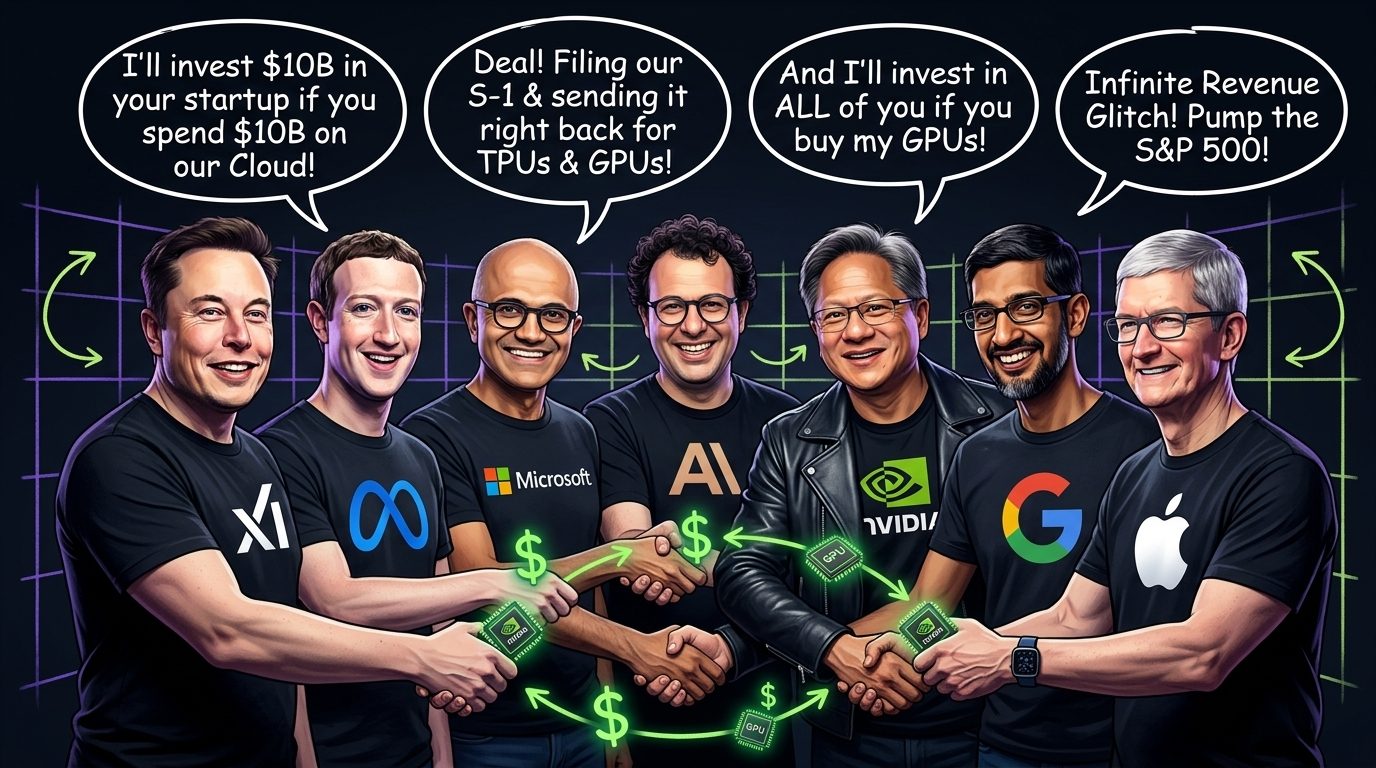 可视化图表:万亿美元握手。Elon Musk、Mark Zuckerberg、Satya Nadella、Dario Amodei、黄仁勋、Sundar Pichai 与 Tim Cook 如何用风险投资换取云算力与 GPU 订单。
剖析 Anthropic S-1 文件:163 亿美元上半年营收、807 亿美元 GAAP 亏损与 5180 亿美元云端锁定
在追踪这些资金去向之前,我们先来看看 Anthropic S-1 文件(anthropicpbc-sx1.htm) 中的原始数据。从表面上看,得益于 Claude Code 和企业级 API 的普及,Anthropic 的营业收入增速堪称硅谷历史上最快的企业级软件增长奇迹。其全年营收从 2024 财年的约 3.81 亿美元飙升 12 倍至 2025 财年的 46 亿美元。仅在 2026 年前六个月(2026 上半年),其营收便达到 162.86 亿美元,其中 2026 年第二季度单季便创造了 115.55 亿美元。
然而,当你审视损益表和合同附注时,两项沉重的现实便赫然跃然纸上:
- 2026 上半年 807.48 亿美元的 GAAP 净亏损: 尽管 Anthropic 将 2026 上半年的核心运营亏损收窄至 6.93 亿美元,并实现了 39.29 亿美元的正向经营性现金流,但其该六个月的 GAAP 净亏损却高达令人咋舌的 807.48 亿美元。究其原因,是因为随着 Anthropic 的非公开估值飙升逼近 9650 亿美元,发行给亚马逊和 Google 等超大规模云厂商支持者的可转债与衍生负债产生了 723.88 亿美元的非现金按市值公允价值重估。
- 5180 亿美元的“照付不议”云房贷: 正如《纽约时报》关于 Google 向 Anthropic 承诺注资 400 亿美元的报道所指出的那样,Google 在先前逾 30 亿美元的持股基础上,追加了承诺高达 400 亿美元的资金(100 亿美元即时现金加上 300 亿美元按里程碑支付的分期融资);与此同时,亚马逊也将其 80 亿美元的投资扩增了最高 250 亿美元(总计最高达 330 亿美元)。作为交换,Anthropic 签署了不可撤销的多年期云算力采购承诺:到 2033 年 7 月须向 Google Cloud 采购 1111 亿至 1145 亿美元,到 2036 年 4 月须向 AWS 采购 1100 亿美元,到 2033 年须向微软 Azure 采购 314 亿至 449 亿美元。算上博通(Broadcom)TPU 租赁以及 GPU 新兴云(neocloud),Anthropic 在未来十年内被锁定了约 4500 亿至 5180 亿美元以上的固定基建履约责任,其中近 80% 均构建为严苛的“照付不议”(take-or-pay)合同。
- 16% 的云市场过路费: 2025 年,Anthropic 总营收的 47%(21.6 亿美元)通过 AWS Bedrock 和 Google Cloud Vertex AI 市场产生。企业通过 Bedrock 或 Vertex AI 在 Claude 上每花费 1 美元,亚马逊和 Google 就会在最前端抽取大约 16 美分的渠道分发提成,随后 Anthropic 还要向这些完全相同的云厂商支付数十亿美元以租用底层的 Trainium2 和 TPU 芯片。
| S-1 指标 / 治理架构层级 | 文件数据(SEC CIK 0002130357) | 交易对手 / 持有方 | 为什么对开发者与投资者至关重要 |
|---|---|---|---|
| 2026 上半年营收 vs 2025 财年 | 162.86 亿美元(2026 上半年)vs 46 亿美元(2025 财年) | Claude Code、API 及企业客户 | 上半年同比增长 14 倍,但 2025 年有 47% 的销售额经由 AWS/GCP 市场完成,并被收取约 16% 的抽成。 |
| 2026 上半年 GAAP 净亏损 | -807.48 亿美元(-6.93 亿美元运营亏损) | 可转换票据持有方(AMZN、GOOGL) | 723.88 亿美元属于估值攀升至 9650 亿美元引发的可转债非现金公允价值调整。 |
| Google Cloud 采购履约责任 | 1111 亿美元至 1145 亿美元(2026 至 2033 年) | Alphabet / Google Cloud(TPU v5p、Trillium) | 与 Google 高达 400 亿美元的投资承诺相绑定;资金重新流回 GCP 成为其云营收。 |
| AWS 采购履约责任 | 1100 亿美元(2026 至 2036 年) | Amazon Web Services(Trainium2、Bedrock) | 与亚马逊高达 330 亿美元的投资相绑定;将 Anthropic 锁定在 AWS 定制自研芯片上。 |
| 微软 Azure 履约责任 | 314 亿美元至 449 亿美元(截至 2033 年) | Microsoft Azure AI Foundry | 哪怕是 OpenAI 的最大金主,也能从 Anthropic 这里分得数百亿美元有保障的云开销。 |
| 总算力承诺 | 4500 亿至 5180 亿美元以上(约 80% 属于“照付不议”) | GCP、AWS、Azure、Broadcom、Lambda、Nscale | 无论未来模型推理价格如何下降,Anthropic 都必须为吉瓦(GW)级集群全额买单。 |
| A 类 / F 类 / T 类 / N 类股份 | A 类股份表决权上限为 49.9%;1 股 F 类股拥有 50.1% 表决权 | 公众(A 类)、创始人(F 类)、LTBT 信托(T 类)、GOOGL/AMZN(N 类) | IPO 参与的公众买家仅获极少数投票权;长远利益信托(Long-Term Benefit Trust)牢牢掌控董事会。 |
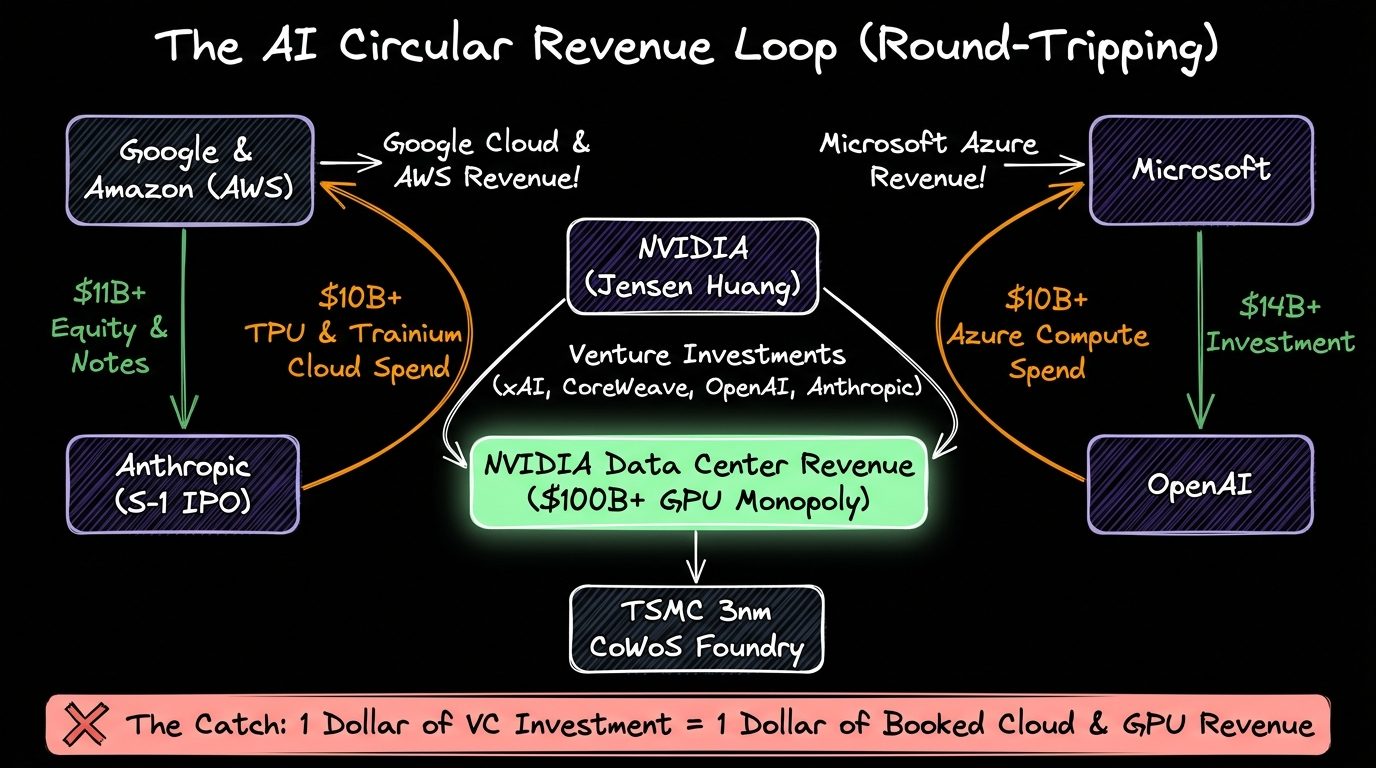 架构图:AI 循环营收闭环(往返交易)。超大规模云厂商投入的每一美元风险投资,几乎立刻变回自己账面上确认的一美元云服务和 GPU 收入。
Dario Amodei 的两篇长文 vs S-1 资产负债表:打造一个“天才之国”要花多少钱?
要理解 Anthropic 为何会签下 5180 亿美元不可撤销的云租赁协议,就必须将 Dario Amodei 的两篇核心长文与 S-1 中的风险因素对照研读。2024 年 10 月,Dario 发表了《仁慈之光的机器:AI 如何让世界变得更美好》(Machines of Loving Grace: How AI Could Transform the World for the Better)。在这篇文章中,他创造了_“数据中心里的天才之国”_这一词汇:数百万个比诺贝尔奖得主更聪明的自主前沿模型实例,以人类 10 到 100 倍的速度运行,将长达 50 到 100 年的生物学研究、癌症攻坚、神经科学与经济发展压缩进短短 5 到 10 年的时间窗口。
十五个月后,即 2026 年 1 月,Dario 发表了视角更为灰暗的姊妹篇《技术的青春期:直面并克服强人工智能的风险》(The Adolescence of Technology: Confronting and Overcoming the Risks of Powerful AI)。开篇引用了卡尔·萨根(Carl Sagan)在《接触未来》(Contact)中的著名发问(“你们是如何渡过这场技术青春期而没有毁灭自己的?”),Dario 描绘了五个生存危机领域:自主对齐失败(“对不起,戴夫”)、生物与网络武器化(“令人震惊且可怕的赋能”)、威权监视(“令人憎恶的体系”),以及第 4 节以库尔特·冯内古特小说命名的_“自动钢琴”_(Player piano)——极度的经济动荡与财富向极少数掌握算力的实体集中的风险。
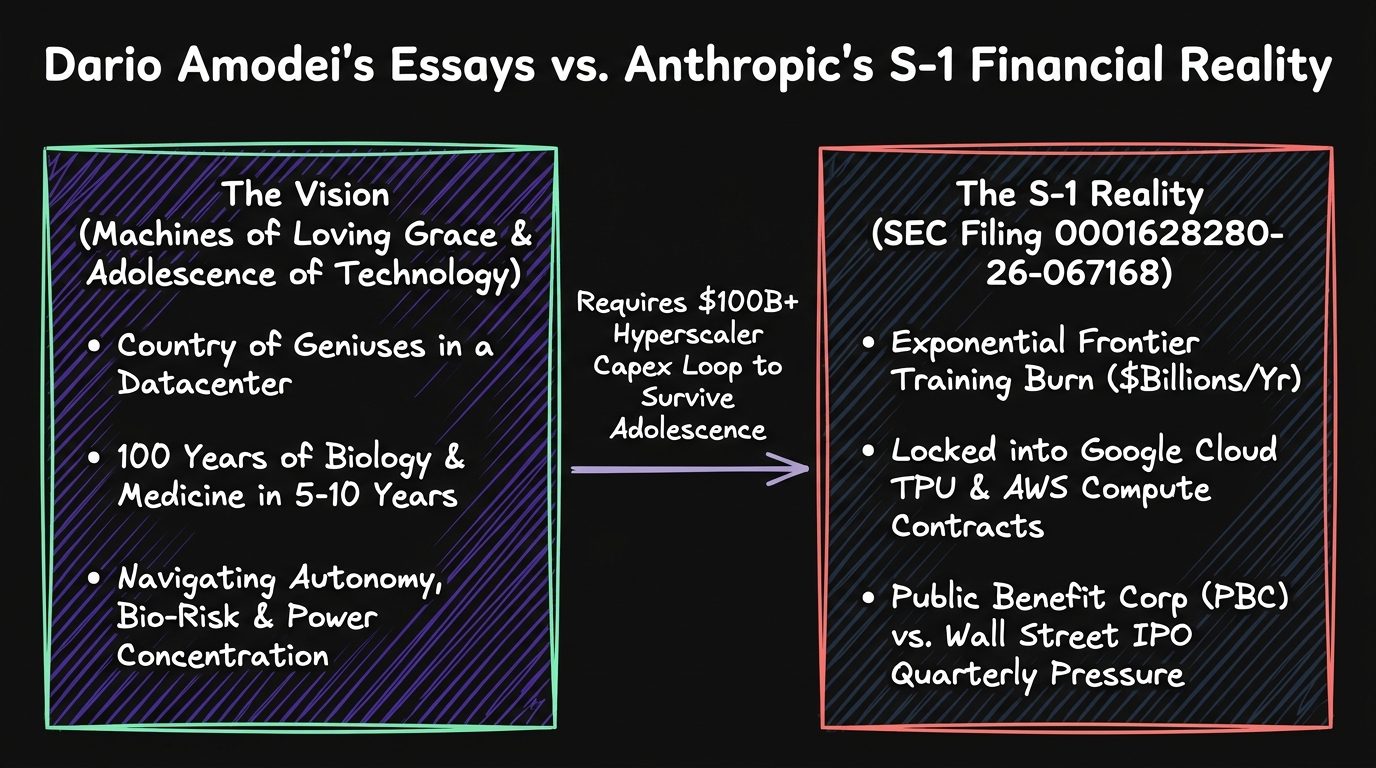 可视化图表:Dario Amodei 的哲学愿景 vs Anthropic 的 S-1 财务现实。打造一个“数据中心里的天才之国”,需要向全球最大的几家云垄断巨头抵押 5180 亿美元。
这正是 S-1 文件所揭示的核心悖论:在《技术的青春期》中,Dario 警示 AI 可能会将空前的经济权力集中在少数几家巨型企业手中。然而仅仅九个月后,Anthropic 的 S-1 文件却表明,为了在构建这个“天才之国”的算力竞备中存活下来,公司不得不向 Google、亚马逊、微软、NVIDIA 和博通签署超过 5180 亿美元的“照付不议”基础设施合同。即便 Anthropic 设立了长远利益信托(Class T 股)和控制 50.1% 投票权的创始人超级投票权股票(Class F 股),一家背负着半万亿美元不可撤销云租金的公共利益公司(PBC),在面对华尔街每季度的增长预期时,也根本不可能停下这架疯狂运转的跑步机。
究竟谁在依赖谁?七大 AI 巨头“亦敌亦友”技术栈深度拆解
在公众视野中,Mark Zuckerberg、Elon Musk、黄仁勋(Jensen Huang)、Sundar Pichai、Satya Nadella 和 Tim Cook 将各自的公司塑造成争夺 AI 霸权地位的死敌。但在水面之下,他们的基础设施技术栈早已盘根错节。每一个“竞争对手”同时又扮演着对方的客户、供应商、房东或风投投资方角色:
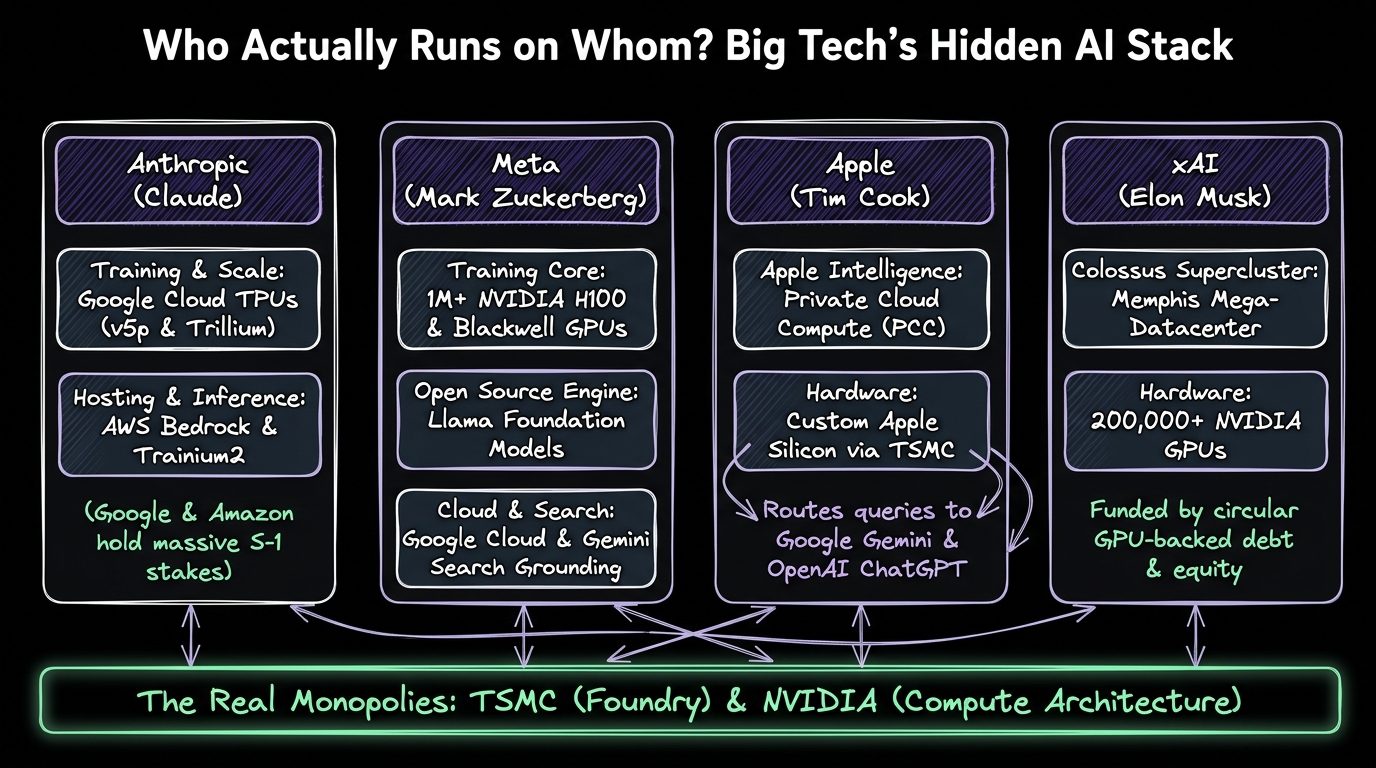 架构图:究竟谁在依赖谁?在竞争品牌 Logo 的掩盖下,Anthropic、Meta、苹果和 xAI 互相交叉许可模型、云容量以及搜索接地(Search grounding),并将庞大的资本开支源源不断地输送给台积电(TSMC)和 NVIDIA。
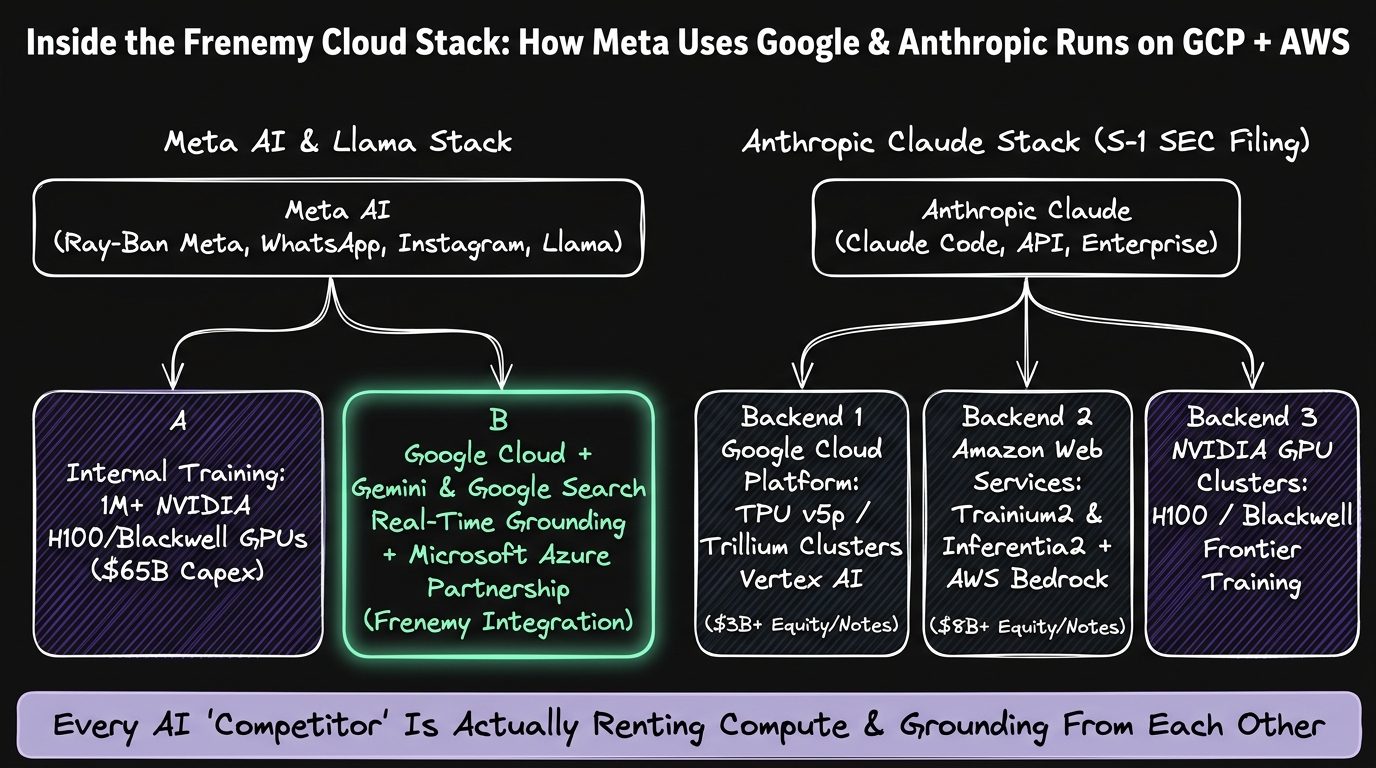 架构图:亦敌亦友的云技术栈内幕。Meta 如何将 100 万颗以上的 NVIDIA GPU 与 Google Cloud 及 Gemini 搜索接地相结合,而 Anthropic 则将其工作负载切分给 Google Cloud TPU 和 AWS Trainium2。
| 领导者与公司 | 2026 年度 AI 资本开支 | 循环投资与股权架构 | 隐藏的“亦敌亦友”技术栈依赖 |
|---|---|---|---|
| Sundar Pichai(Google / Alphabet) | 1950 亿至 2050 亿美元 | 向 Anthropic 注资最高达 400 亿美元(约 14% 的无投票权 N 类股) | 在 GCP TPU 上托管 Anthropic(1145 亿美元合同);用 Gemini 为 Apple Intelligence 提供支持;为 Meta AI 提供 Google Cloud 与搜索接地能力。 |
| Satya Nadella(微软) | 约 1750 亿美元 | 向 OpenAI 投资逾 140 亿美元,同时持有 Anthropic、Mistral、G42 股份 | 同时从 OpenAI 与 Anthropic 获取 Azure 算力支出(Anthropic S-1 披露有 314 亿至 449 亿美元采购合同);在 Azure Foundry 上托管 Llama、Grok 和 Claude。 |
| 黄仁勋(NVIDIA) | 硬件“军火商”(约 80% 毛利率) | 投资 OpenAI、xAI、CoreWeave、Mistral、Perplexity、Scale AI、Lambda | 数据中心约 45% 至 50% 以上的营收来自微软、Meta、Google、亚马逊和 xAI;底层 100% 依赖台积电 3nm/2nm 制程及 CoWoS 封装工艺。 |
| Mark Zuckerberg(Meta Platforms) | 1300 亿至 1450 亿美元以上 | 实施开源权重 Llama 策略以商品化付费模型 API | 采购 100 万颗以上 NVIDIA H100/Blackwell GPU;在 Meta AI 和 Ray-Ban Meta 智能眼镜中引入 Google Cloud、Google Search/Gemini 接地支持以及微软 Azure。 |
| Elon Musk(xAI 与特斯拉) | 每个集群轮次 120 亿美元以上(Colossus 1 & 2) | 获 NVIDIA、AMD、Valor、a16z 及主权财富基金(MGX、QIA、PIF)注资 | 孟菲斯 Colossus 超级集群通过戴尔/超微机架部署 20 万至 50 万颗以上 NVIDIA GPU;通过微软 Azure Foundry 分发 Grok。 |
| Tim Cook(苹果) | 轻资产资本开支模式(端侧芯片 + 私有云) | 零巨额资本开支消耗;通过 22 亿台以上的 iOS/macOS 终端渠道变现 | 将 Apple Intelligence 查询请求路由至 Google Gemini、OpenAI ChatGPT 和 Anthropic Claude;Apple Silicon 依赖台积电 3nm/2nm 晶圆代工厂。 |
| Andy Jassy 与 Jeff Bezos(亚马逊 / AWS) | 1000 亿至 1500 亿美元以上 | 向 Anthropic 注资最高达 330 亿美元(80 亿美元初始票据 + 250 亿美元追加投资) | 作为 Anthropic 的核心云/训练伙伴(到 2036 年在 AWS Trainium2/Inferentia2 Project Rainier 上承载 1100 亿美元承诺);对 Bedrock 流水抽成约 16%。 |
代码见真章:追踪一次穿过云巨头收费站的“多模型”请求
作为解决方案架构师(Solutions Engineers)和全栈开发者,我们在构建多提供商模型路由系统时,往往以为自己把供应商风险分散到了 Anthropic、Meta、Google 和苹果。然而在现实中,当你在 TypeScript 中追踪一次生产请求时,你的 API 调用击中的恰恰是完全相同的底
English / 原文
While reading through Anthropic's Form S-1 SEC registration statement for its proposed Nasdaq IPO under ticker ANT today, a few infrastructure and accounting details in the footnotes stood out that show how much of Big Tech's AI revenue is the same pile of capital circulating between seven companies.
On October 26, 2026, Anthropic officially announced its S-1 filing with the SEC. Within minutes of the EDGAR upload (CIK 0002130357, Accession No. 0001628280-26-067168), developers and financial analysts started digging through the footnotes. What those footnotes reveal is not just the story of Claude. It is the blueprint for a $500B+ circular vendor-financing loop connecting Sundar Pichai (Google), Satya Nadella (Microsoft), Jensen Huang (NVIDIA), Mark Zuckerberg (Meta), Elon Musk (xAI and Tesla), Tim Cook (Apple), Andy Jassy (AWS), and Dario Amodei (Anthropic).
Visual Diagram: The Trillion-Dollar Handshake. How Elon Musk, Mark Zuckerberg, Satya Nadella, Dario Amodei, Jensen Huang, Sundar Pichai, and Tim Cook trade venture investments for cloud compute and GPU orders.
Inside Anthropic's Form S-1: $16.3B H1 Revenue, an $80.7B GAAP Loss, and $518B in Cloud Lock-In
Let's look at the raw numbers inside Anthropic's S-1 filing (anthropicpbc-sx1.htm) before we trace where the money goes. On the surface, Anthropic's top-line growth is the fastest enterprise software ramp in Silicon Valley history, driven by Claude Code and enterprise API adoption. Full-year revenue jumped 12x from roughly $381 million in FY 2024 to $4.6 billion in FY 2025. In the first six months of 2026 alone (H1 2026), revenue hit $16.286 billion, with Q2 2026 generating $11.555 billion in a single quarter.
Then you look down the income statement and contractual footnotes, and two massive realities jump off the page:
- The $80.748 Billion H1 2026 GAAP Net Loss: While Anthropic narrowed its H1 2026 core operating loss to $693 million and generated $3.929 billion in positive operating cash flow, its GAAP net loss for those six months was a jaw-dropping $80.748 billion. Why? Because $72.388 billion of that loss came from non-cash mark-to-market revaluations of convertible notes and derivative liabilities issued to hyperscaler backers like Amazon and Google as Anthropic's private valuation surged toward $965 billion.
- The $518 Billion Take-or-Pay Cloud Mortgage: As reported by The New York Times on Google's $40B Anthropic commitment, Google committed up to $40 billion ($10 billion immediate cash plus $30 billion milestone-contingent financing) on top of its earlier $3B+ stake, while Amazon expanded its $8 billion investment by up to another $25 billion (up to $33 billion total). In exchange, Anthropic signed non-cancellable multi-year cloud purchase commitments totaling $111.1B to $114.5B to Google Cloud through July 2033, $110B to AWS through April 2036, and $31.4B to $44.9B to Microsoft Azure through 2033. Including Broadcom TPU leases and GPU neoclouds, Anthropic is locked into roughly $450B to $518B+ of fixed infrastructure obligations over the next decade, with nearly 80% structured as rigid take-or-pay contracts.
- The 16% Cloud Marketplace Toll: In 2025, 47% of Anthropic's total revenue ($2.16 billion) flowed through AWS Bedrock and Google Cloud Vertex AI marketplaces. For every dollar an enterprise spends on Claude through Bedrock or Vertex AI, Amazon and Google skim roughly 16 cents off the top in distribution fees before Anthropic pays those exact same clouds billions more to rent the underlying Trainium2 and TPU silicon.
| S-1 Metric / Governance Tier | Filing Figure (SEC CIK 0002130357) | Counterparty / Holder | Why It Matters for Developers & Investors |
|---|---|---|---|
| H1 2026 Revenue vs. FY 2025 | $16.286B (H1 2026) vs. $4.6B (FY 2025) | Claude Code, API & Enterprise | 14x YoY H1 growth, but 47% of 2025 sales ran through AWS/GCP marketplaces at a ~16% fee. |
| H1 2026 GAAP Net Loss | -$80.748B (-$693M operating loss) | Convertible Note Holders (AMZN, GOOGL) | $72.388B is non-cash fair-value adjustment on convertible debt as valuation hit $965B. |
| Google Cloud Purchase Obligation | $111.1B to $114.5B (2026 to 2033) | Alphabet / Google Cloud (TPU v5p, Trillium) | Paired with Google's up to $40B investment commitment; recycles cash into GCP revenue. |
| AWS Purchase Obligation | $110.0B (2026 to 2036) | Amazon Web Services (Trainium2, Bedrock) | Paired with Amazon's up to $33B investment; locks Anthropic into AWS custom silicon. |
| Microsoft Azure Obligation | $31.4B to $44.9B (through 2033) | Microsoft Azure AI Foundry | Even OpenAI's biggest backer gets tens of billions in guaranteed Anthropic cloud spend. |
| Total Compute Commitments | $450B to $518B+ (~80% Take-or-Pay) | GCP, AWS, Azure, Broadcom, Lambda, Nscale | Anthropic must pay for multi-gigawatt clusters regardless of future model pricing drops. |
| Class A / Class F / Class T / Class N Shares | Class A capped at 49.9%; 1 Class F share = 50.1% | Public (A), Founders (F), LTBT Trust (T), GOOGL/AMZN (N) | Public IPO buyers get minority voting power; Long-Term Benefit Trust controls the board. |
Architecture Diagram: The AI Circular Revenue Loop (Round-Tripping). One dollar of hyperscaler venture capital immediately returns as one dollar of booked cloud and GPU revenue.
Dario Amodei's Two Essays vs. The S-1 Balance Sheet: How Much Does a 'Country of Geniuses' Cost?
To understand why Anthropic signed $518 billion in non-cancellable cloud leases, you have to read Dario Amodei's two foundational essays side by side with the S-1 risk factors. In October 2024, Dario published Machines of Loving Grace: How AI Could Transform the World for the Better. In that essay, he coined the phrase "a country of geniuses in a datacenter" : millions of autonomous frontier model instances smarter than Nobel Prize winners, running at 10x to 100x human speed, compressing 50 to 100 years of biological research, cancer cures, neuroscience, and economic development into a single 5 to 10 year window.
Fifteen months later, in January 2026, Dario published the darker companion essay, The Adolescence of Technology: Confronting and Overcoming the Risks of Powerful AI. Opening with Carl Sagan's famous question from Contact ("How did you survive this technological adolescence without destroying yourself?"), Dario mapped out five existential danger zones: autonomous alignment failures ("I'm sorry, Dave"), biological and cyber weaponization ("A surprising and terrible empowerment"), authoritarian surveillance ("The odious apparatus"), and in Section 4, titled "Player piano" after Kurt Vonnegut's novel, the risk of extreme economic disruption and wealth concentration in a tiny handful of compute-owning entities.
Visual Diagram: Dario Amodei's Philosophical Vision vs. Anthropic's S-1 Financial Reality. Building a 'country of geniuses in a datacenter' required mortgaging $518B to the world's largest cloud monopolies.
Here is the central paradox exposed by the S-1 filing: in The Adolescence of Technology, Dario warns that AI could concentrate unprecedented economic power in a few giant corporations. Yet nine months later, Anthropic's S-1 proves that surviving the compute race to build that "country of geniuses" required signing over $518 billion in take-or-pay infrastructure contracts to Google, Amazon, Microsoft, NVIDIA, and Broadcom. Even with Anthropic's Long-Term Benefit Trust (Class T shares) and founder super-voting stock (Class F controlling 50.1%), a Public Benefit Corporation that owes half a trillion dollars in non-cancellable cloud rent cannot simply pause the treadmill when Wall Street expects quarterly growth.
Who Actually Runs on Whom? Deep Breakdown of the 7 AI Titans' Frenemy Stack
In public, Mark Zuckerberg, Elon Musk, Jensen Huang, Sundar Pichai, Satya Nadella, and Tim Cook position their companies as fierce rivals fighting for AI dominance. Under the hood, their infrastructure stacks are completely entangled. Every "competitor" is simultaneously a customer, supplier, landlord, or venture investor in the others:
Architecture Diagram: Who Actually Runs on Whom? Beneath the rival brand logos, Anthropic, Meta, Apple, and xAI cross-license models, cloud capacity, and search grounding while funneling capex into TSMC and NVIDIA.Architecture Diagram: Inside the Frenemy Cloud Stack. How Meta combines 1M+ NVIDIA GPUs with Google Cloud and Gemini Search grounding, while Anthropic splits its workload across Google Cloud TPUs and AWS Trainium2.
| Leader & Company | 2026 Annual AI Capex | Circular Investment & Equity Stakes | Hidden Frenemy Stack Dependencies |
|---|---|---|---|
| Sundar Pichai (Google / Alphabet) | $195B to $205B | Up to $40B in Anthropic (~14% non-voting Class N stake) | Hosts Anthropic on GCP TPUs ($114.5B obligation); powers Apple Intelligence with Gemini; provides Google Cloud & Search grounding to Meta AI. |
| Satya Nadella (Microsoft) | ~$175B | $14B+ in OpenAI, plus stakes in Anthropic, Mistral, G42 | Collects Azure compute spend from both OpenAI and Anthropic ($31.4B to $44.9B S-1 obligation); hosts Llama, Grok, and Claude on Azure Foundry. |
| Jensen Huang (NVIDIA) | Hardware Arms Dealer (~80% Gross Margin) | Invests in OpenAI, xAI, CoreWeave, Mistral, Perplexity, Scale AI, Lambda | Gets ~45% to 50%+ of Data Center revenue from Microsoft, Meta, Google, Amazon, and xAI; relies 100% on TSMC 3nm/2nm and CoWoS packaging. |
| Mark Zuckerberg (Meta Platforms) | $130B to $145B+ | Open-weights Llama strategy to commoditize paid model APIs | Buys 1M+ NVIDIA H100/Blackwell GPUs; uses Google Cloud and Google Search/Gemini grounding plus Microsoft Azure for Meta AI and Ray-Ban Meta glasses. |
| Elon Musk (xAI & Tesla) | $12B+ per cluster round (Colossus 1 & 2) | Backed by NVIDIA, AMD, Valor, a16z, and sovereign funds (MGX, QIA, PIF) | Memphis Colossus supercluster runs 200k to 500k+ NVIDIA GPUs via Dell/Supermicro racks; distributes Grok on Microsoft Azure Foundry. |
| Tim Cook (Apple) | Capex-light (On-device silicon + Private Cloud) | Zero mega-capex burn; monetizes 2.2B+ iOS/macOS distribution | Routes Apple Intelligence queries to Google Gemini, OpenAI ChatGPT, and Anthropic Claude; depends on TSMC 3nm/2nm fabs for Apple Silicon. |
| Andy Jassy & Jeff Bezos (Amazon / AWS) | $100B to $150B+ | Up to $33B in Anthropic ($8B initial notes + $25B expansion) | Primary cloud/training partner for Anthropic ($110B commitment through 2036 on AWS Trainium2/Inferentia2 Project Rainier); takes ~16% Bedrock cut. |
Show Me the Code: Tracing a 'Multi-Model' Request Through the Frenemy Cloud Tollbooth
As Solutions Engineers and full-stack developers, we often design multi-provider model routers assuming we are diversifying our vendor risk across Anthropic, Meta, Google, and Apple. In reality, when you trace a production request in TypeScript, your API call hits the exact same three cloud balance sheets and two hardware bottlenecks. Here is what a real-world enterprise router telemetry audit looks like when you account for the underlying cloud host, custom silicon, and marketplace cut disclosed in Anthropic's S-1:
// src/lib/frenemy-stack-audit.ts
export interface ModelRouteAudit {
  logicalProvider: "anthropic-claude" | "meta-llama" | "apple-intelligence" | "xai-grok";
  physicalCloudHost: "google-cloud-vertex" | "aws-bedrock" | "azure-foundry" | "xai-colossus";
  acceleratorSilicon: "gcp-tpu-v5p-trillium" | "aws-trainium2" | "nvidia-blackwell-b200";
  foundryMonopoly: "TSMC-3nm-CoWoS";
  grossSpendUsd: number;
  hyperscalerMarketplaceCutUsd: number;
  recycledCapexObligationBln: number;
}

const S1_MARKETPLACE_FEE_RATE = 0.16; // ~16% AWS Bedrock & GCP Vertex AI fee disclosed in S-1

export function auditFrenemyCloudFlow(
  route: ModelRouteAudit["logicalProvider"],
  backend: ModelRouteAudit["physicalCloudHost"],
  monthlySpendUsd: number
): ModelRouteAudit {
  switch (route) {
    case "anthropic-claude": {
      const isGcp = backend === "google-cloud-vertex";
      return {
        logicalProvider: "anthropic-claude",
        physicalCloudHost: backend,
        acceleratorSilicon: isGcp ? "gcp-tpu-v5p-trillium" : "aws-trainium2",
        foundryMonopoly: "TSMC-3nm-CoWoS",
        grossSpendUsd: monthlySpendUsd,
        // 47% of Anthropic's 2025 revenue ran through AWS/GCP marketplaces at ~16% fee
        hyperscalerMarketplaceCutUsd: Number((monthlySpendUsd * S1_MARKETPLACE_FEE_RATE).toFixed(2)),
        // Google Cloud ($114.5B) + AWS ($110B) + Azure ($44.9B) S-1 commitments
        recycledCapexObligationBln: isGcp ? 114.5 : backend === "aws-bedrock" ? 110.0 : 44.9,
      };
    }
    case "meta-llama":
      return {
        logicalProvider: "meta-llama",
        physicalCloudHost: backend, // Often served via Google Cloud, AWS Bedrock, or Azure
        acceleratorSilicon: "nvidia-blackwell-b200",
        foundryMonopoly: "TSMC-3nm-CoWoS",
        grossSpendUsd: monthlySpendUsd,
        hyperscalerMarketplaceCutUsd: Number((monthlySpendUsd * S1_MARKETPLACE_FEE_RATE).toFixed(2)),
        recycledCapexObligationBln: 140.0, // Meta's 2026 annual AI capex run-rate
      };
    default:
      return {
        logicalProvider: route,
        physicalCloudHost: backend,
        acceleratorSilicon: "nvidia-blackwell-b200",
        foundryMonopoly: "TSMC-3nm-CoWoS",
        grossSpendUsd: monthlySpendUsd,
        hyperscalerMarketplaceCutUsd: 0,
        recycledCapexObligationBln: 100.0,
      };
  }
}
AJ Pro-Tip from Alex: If your engineering org routes production traffic to Claude through AWS Bedrock and fails over to Claude on Google Cloud Vertex AI, you have cloud region redundancy, which is great for uptime. Just do not confuse multi-cloud routing with financial independence: both endpoints pay a ~16% marketplace toll to Anthropic's two biggest convertible-note holders, and every single TPU and Trainium2 chip underneath those endpoints is fabricated on TSMC 3nm CoWoS lines.
The Passive Index Funnel: How VOO, SPY, QQQ, VTI, FXAIX, and VT Put Every 401(k) in One AI Trade
You might think: "I don't buy private AI venture rounds or IPOs like ANT, I just dollar-cost average into low-cost index funds in my 401(k) and IRA." Because modern index funds are market-cap weighted, passive investing has turned into a giant momentum funnel. Every two weeks, automatic paycheck contributions from tens of millions of workers allocate 33% to nearly 50% of every retirement dollar into the exact eight companies passing AI capex back and forth.
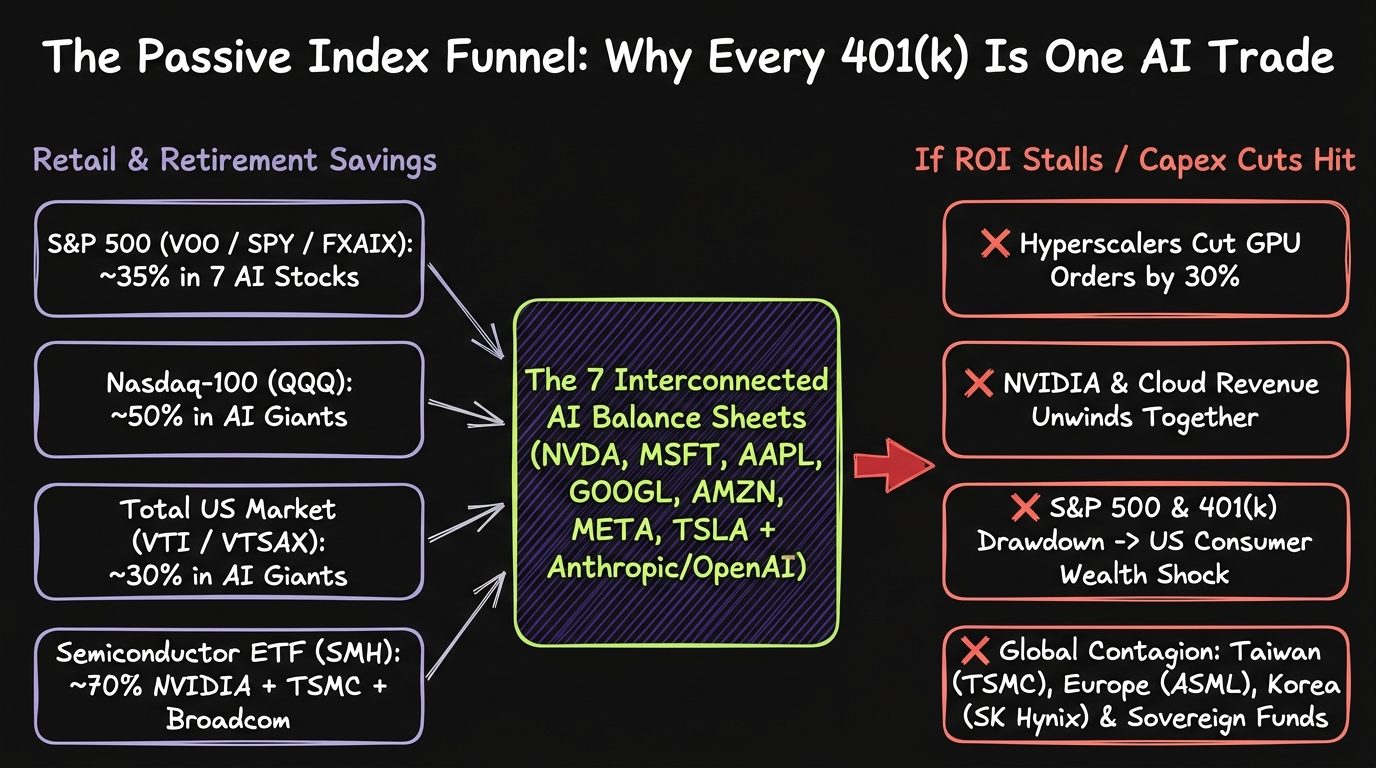 Visual Diagram: The Passive Index Funnel. How passive 401(k) ETFs concentrate retirement savings into one circular AI capex trade, and the four-stage domino cascade if ROI stalls.
| Company (Ticker) | S&P 500 (SPY, VOO, IVV, FXAIX, VFIAX) | Nasdaq-100 (QQQ, QQQM) | Total US Market (VTI, VTSAX) | US Tech Sector (XLK / VGT) | Semiconductors (SMH / SOXX) | Total World & Intl (VT / VXUS) |
|---|---|---|---|---|---|---|
| NVIDIA (NVDA) | 8.1% to 8.4% | 9.0% to 9.5% | ~7.1% | 20.5% (XLK) / 16.8% (VGT) | 20.5% (SMH) / 6.8% (SOXX) | 4.3% (VT) |
| Apple (AAPL) | 7.0% to 7.4% | 8.5% to 8.9% | ~6.6% | 14.6% (VGT) | 0.0% | 3.8% (VT) |
| Microsoft (MSFT) | 5.7% to 5.8% | 7.8% to 8.2% | ~5.2% | 19.5% (XLK) / 9.5% (VGT) | 0.0% | 3.2% (VT) |
| Alphabet (GOOGL / GOOG) | 5.4% to 5.5% | 5.2% to 5.6% | ~4.9% | Excluded (Comm. Services) | 0.0% | 3.0% (VT) |
| Amazon (AMZN) | 3.7% to 3.8% | 5.1% to 5.4% | ~3.3% | Excluded (Cons. Discret.) | 0.0% | 2.1% (VT) |
| Broadcom (AVGO) | 2.6% to 2.7% | 4.5% to 5.0% | ~2.3% | 4.8% (XLK) / 4.1% (VGT) | 8.5% (SMH) / 6.1% (SOXX) | 1.3% (VT) |
| Meta Platforms (META) | 1.9% to 2.5% | 3.5% to 4.5% | 1.7% to 2.1% | Excluded (Comm. Services) | 0.0% | 1.2% (VT) |
| Tesla (TSLA) | 1.5% to 2.0% | 2.5% to 3.2% | 1.4% to 1.7% | Excluded (Cons. Discret.) | 0.0% | 0.9% (VT) |
| TSMC (TSM) + ASML + SK Hynix | Excluded (Non-US) | ~0.8% (ASML only) | Excluded (Non-US) | Excluded | 16.3% (SMH: TSM + ASML) | 2.4% (VT) / 7.0%+ (VXUS) |
| Combined AI Capex Cohort Weight | 36.0% to 38.0% of S&P 500 | 46.0% to 49.0% of Nasdaq-100 | 32.5% to 34.0% of Total US | 45% to 55% in 3 to 4 stocks | 45%+ in NVDA, TSM, AVGO, ASML | 22.2% of Planet (VT) / 8.5% Intl |
Look closely at the rightmost column of that table. Even investors who buy VXUS (Vanguard Total International Stock ETF) thinking they are diversifying outside US Big Tech find that their #1 international holding is TSMC (~4.1%) , followed closely by ASML (~1.5%) , SK Hynix (~1.4%) , and Samsung. And once Anthropic completes its Nasdaq listing under ANT at a projected $1T to $2T valuation, it will be added directly into QQQ, VTI, and eventually VOO and SPY. That means passive 401(k) holders will simultaneously own Anthropic (and its $518B cloud debt) AND the hyperscaler landlords collecting that debt.
What Happens to the US and Global Economy If the Circular AI Capex Loop Fails?
What happens if enterprise AI revenue grows slower than required to justify $700 billion to $800 billion per year in hyperscaler capital expenditures, or if algorithmic breakthroughs allow smaller models to run at 10% of today's compute cost? Because the circular loop connects corporate earnings, GDP accounting, utility grids, and global semiconductor exports, an unwind hits five macroeconomic fault lines at once:
| Contagion Vector | Current 2026 Exposure Scale | Accounting / Structural Mechanism | Impact If Hyperscaler Capex Cuts 30% to 40% |
|---|---|---|---|
| 1. Real US GDP Growth | $700B to $800B/yr CapEx (~2.6% of US GDP) | BEA counts AI servers, GPUs, and data center construction as Non-Residential Fixed Investment (30% to 50%+ of recent GDP growth). | Immediate 0.75% to 1.2% subtraction from headline US GDP, triggering a technical recession before layoffs even peak. |
| 2. S&P 500 Earnings & Depreciation Trap | ~50% of S&P 500 EPS growth tied to AI cycle | NVIDIA/Broadcom book GPU sales as immediate revenue; MSFT/GOOGL/AMZN capitalize GPUs as PP&E and depreciate over 4 to 6 years. | Double whammy: chipmaker revenue drops immediately while hyperscalers are crushed by $150B+/yr in locked-in depreciation charges. |
| 3. US 401(k)s & Consumer Wealth Effect | 42% to 48% of US household financial assets in equities | Top 8 AI stocks represent ~$20T in market cap; every $1 lost in equity wealth reduces consumer spending by $0.03 to $0.05. | A 40% AI valuation reset wipes out $8T to $10T in household net worth and cuts US consumer spending by $300B to $500B. |
| 4. Power Grids & Municipal Bonds | Multi-gigawatt gas/nuclear buildouts (VA, TX, OH, TN) | Data centers take 24 months to build; utility turbines and transmission lines take 5 to 10 years and amortize over 30 to 40 years. | Stranded utility debt is socialized onto residential electricity bills via rate-base hikes; municipal bond downgrades in data center towns. |
| 5. Global Semiconductor & Sovereign Contagion | Taiwan (TSMC), Korea (SK Hynix), Europe (ASML), Gulf SWFs | US designs the models, while Asia and Europe own the high-fixed-cost physical fabs; Sovereign funds (MGX, PIF, QIA, GIC) hold private equity. | Immediate export recession in Taiwan and South Korea (HBM memory glut), EUV order cancellations in Europe, and sovereign write-downs. |
The most dangerous accounting detail in that table is the Capex-to-Depreciation asymmetry. When Microsoft, Google, or Amazon spends $100 billion on NVIDIA Blackwell racks and Broadcom TPUs today, NVIDIA and Broadcom book $100 billion of immediate top-line revenue and $60B+ of net profit in the current quarter. Meanwhile, Microsoft, Google, and Amazon do not expense that $100 billion on their income statements today: they capitalize the servers as Property, Plant, and Equipment (PP&E) and depreciate them over four to six years. That makes S&P 500 earnings look artificially high during the buildout phase, and guarantees a multi-year depreciation hangover the moment capex growth slows down.
Frequently Asked Questions (FAQ)
What did Anthropic disclose in its 2026 Form S-1 SEC filing?
In its October 26, 2026 Form S-1 registration statement (CIK 0002130357, ticker ANT), Anthropic disclosed $16.286 billion in H1 2026 revenue (up from $4.6 billion in full-year 2025), an $80.748 billion H1 2026 GAAP net loss driven by $72.388 billion in non-cash convertible note mark-to-market revaluations, and between $450 billion and $518 billion in multi-year non-cancellable cloud compute commitments across Google Cloud ($111.1B to $114.5B), AWS ($110B), and Microsoft Azure ($31.4B to $44.9B).
How does circular AI financing (round-tripping) work between Google, AWS, Microsoft, NVIDIA, and AI labs?
In circular AI financing, hyperscalers and chipmakers (Google, Amazon, Microsoft, NVIDIA) invest tens of billions of dollars in equity or convertible notes into AI model labs and neoclouds (Anthropic, OpenAI, xAI, CoreWeave). In exchange, those AI labs sign multi-decade take-or-pay contracts obligating them to spend that capital, plus roughly 16% marketplace distribution fees, renting cloud TPUs, Trainium2 chips, and NVIDIA GPUs right back from the investors.
How much of the S&P 500 and Nasdaq-100 ETFs is concentrated in the circular AI economy?
As of late 2026, the eight primary US AI capex stocks (NVIDIA, Apple, Microsoft, Alphabet, Amazon, Broadcom, Meta, and Tesla) account for roughly 36% to 38% of S&P 500 ETFs and mutual funds (VOO, SPY, IVV, FXAIX, VFIAX), 46% to 49% of the Nasdaq-100 (QQQ), and 32.5% to 34% of the Total US Stock Market (VTI, VTSAX), while TSMC, ASML, and SK Hynix represent over 7% of international index funds (VXUS).
Conclusion: Build on the Models, Watch the Balance Sheets
Make no mistake: the engineering breakthroughs inside Claude, Gemini, Llama, and Grok are real, and we use them every single day in production at CodingCat.dev. But as Anthropic's Form S-1 makes crystal clear, the financial plumbing underneath those models is a high-wire act of $518 billion take-or-pay cloud mortgages and circular hyperscaler capex. Come tell us on X (@CodingCatDev) and LinkedIn what you think of Anthropic's S-1 numbers, watch our architectural deep dives on the CodingCat.dev YouTube Channel, and explore more hands-on Courses, Podcasts, and Blog Posts right here on CodingCat.dev.