基于 Amazon Nova Act 构建意图驱动的 UI 测试
英文标题:Building intent-driven UI testing with Amazon Nova Act
阳狮集团(Publicis Groupe)旗下营销技术公司 Epsilon 基于 Amazon Nova Act 和 Amazon Bedrock AgentCore Browser Tool,构建了一套多租户托管式 UI 测试平台。开发团队无需维护底层浏览器基础设施与脆弱的 DOM 选择器,只需用自然语言编写意图驱动的测试步骤即可运行端到端测试。Epsilon 内部基准测试显示,该方案将测试用例编写速度提升了 4 到 6 倍,并借助轨迹复用机制在重放时达成 100% 通过率。这一实践展现了 AI Agent 在自动化测试领域降低维护成本、加速持续交付的巨大潜力。
 1.3 MB
 1.3 MB
 2.4 KB
 345.0 KB
 141.2 KB
 346.5 KB
 192.7 KB
 24.2 KB
 18.1 KB
 38.8 KB
 30.5 KB
 152.9 KB
 1.1 MB
 148.6 KB
中文
为了在各个产品团队中规模化推广意图驱动的 UI 测试,Publicis Groupe 旗下的数据、技术与营销服务公司 Epsilon 引入了 Amazon Nova Act。面对数以亿计的消费者画像与数千家品牌客户,Epsilon 迫切需要一种能够紧跟应用快速迭代节奏的 UI 测试方案,同时又不能给各产品团队增加维护负担。
在 Epsilon 内部,由 50 名工程师组成的 Agentic 平台团队负责构建共享基础设施,以便其他产品团队能够安全地构建、部署、管控和运行 AI Agent。借助该共享平台,各团队可以获得基于技能的 Agent 构建工具、联合身份认证与前置鉴权(Pre-flight Authorization)、Model Context Protocol (MCP) 集成以及跨账户配置能力。当某个产品团队希望引入 AI 工具时,无需自行重新解决身份认证、安全、浏览器基础设施或模型集成问题,即可直接开箱获取相应能力。
其中一项托管能力便是 UI 测试。依托 Amazon Nova Act 与 Amazon Bedrock AgentCore Browser(Amazon Bedrock AgentCore 的一项功能),Epsilon 平台团队成功将弹性高、意图驱动的测试作为一项服务交付给平台上的各个团队。
在本文中,我们将深入解析 Epsilon 将 UI 测试作为托管平台服务交付的架构设计,展示 Nova Act 与 Amazon Bedrock AgentCore Browser Tool 的核心集成代码,重点介绍一个具体的 18 步测试工作流,并分享最佳实践与实测成效。
挑战:提升覆盖率,而非替代现有成熟方案
Epsilon 原有的 UI 测试体系并未失效。团队一直维护着一套基于 Playwright 的回归测试套件,用于验证其 Web 应用程序的功能,且运行状况良好。直到今天,Playwright 依然是他们的回归测试骨干。
Epsilon 发现的机遇是增量互补性的,而非替代颠覆性的:
- 脚本化 Playwright 测试在确定性回归检查方面非常高效。然而,它们与选择器和页面结构高度耦合。即使底层功能完全正常,轻微的 UI 视觉样式调整也可能导致测试失败。
- 多个产品团队都需要针对各自的应用实现全面的测试覆盖。如果每个团队都要自行搭建浏览器基础设施、管理依赖项并集成身份系统,势必会造成大量重复工作。
- 平台团队希望 UI 测试成为一种契合其现有 Agent 模型的托管能力,而不是每个接入团队都必须单独运维的一套定制 CLI。
团队的目标是:在现有 Playwright 回归测试套件之上,叠加一层基于意图的测试。以多租户平台服务的形式进行交付,让 Epsilon 的每个产品团队都能通过使用其他 Agent 能力时的相同 API 接口来使用它。
Epsilon 围绕两项核心需求对各种方案进行了评估:自然语言测试编写(作为基于选择器的 Playwright 测试的补充)和托管浏览器基础设施(契合其多租户平台模型)。结合使用 Amazon Nova Act 与 Amazon Bedrock AgentCore Browser Tool,Epsilon 同时满足了这两点:
- 自然语言步骤:测试步骤是由 Nova Act 执行的纯英文指令。它们能抵御 UI 界面样式变更的干扰,非工程人员也能轻松读懂。像 “Confirm the rewards balance is visible”(确认奖励余额可见) 这样的步骤,生命周期远比脆弱的 CSS 选择器持久。
- AWS 托管的临时浏览器会话:借助 Amazon Bedrock AgentCore Browser Tool,团队无需分发二进制文件或维护显示服务器,即可获得隔离的浏览器实例。Amazon Bedrock AgentCore Browser Tool 还提供用于人工观察或接管的实时视图(在处理验证码或多因素认证时非常实用)、支持将录屏自动保存到 Amazon Simple Storage Service (Amazon S3),以及 AWS CloudTrail 审计日志,所有这些都无需额外配置。
- 基于 AWS Identity and Access Management (AWS IAM) 的身份认证:借助 Nova Act,可以通过标准 AWS 凭据链(Task Role)进行身份验证。这与 Epsilon 现有的安全模型高度契合,无需单独分发 API Key。
- 良好的跨账户支持:借助 Nova Act 和 Amazon Bedrock AgentCore Browser Tool,可以无缝融入现有的 AWS Security Token Service (AWS STS) AssumeRole 配置流程。每个接入的团队都可以在各自的 AWS 账户内、在限定权限的角色下运行测试,从而保证了隔离性与可审计性。
Epsilon 之所以选择 Amazon Bedrock AgentCore Browser Tool,正是因为它消除了管理浏览器二进制程序、显示服务器及会话生命周期的运维负担——Agentic 平台团队完全无意自行维护此类底层基础设施。
解决方案:架构与实现
Epsilon 的解决方案包含三个核心组件:用于创建工作流的平台 API、用于执行工作流的后台任务运行器,以及驱动浏览器的 Nova Act 和 Amazon Bedrock AgentCore Browser Tool 集成模块。
平台架构
Epsilon 的 UI 测试功能遵循清晰的处理流水线:
- 用户通过平台 API 创建工作流,指定
target_url和一系列自然语言步骤。 - 创建完成后,平台会在 AWS 上注册一个 Nova Act 工作流定义。
- 执行时,后台任务运行器(Celery,一个用于异步任务处理的 Python 框架)会启动一个 Amazon Bedrock AgentCore Browser Tool 浏览器会话。它通过 Chrome DevTools Protocol (CDP) WebSocket(以编程方式控制 Chromium 浏览器的标准接口)利用 Nova Act 执行每个步骤,包括条件逻辑(例如 “如果出现导览弹窗,跳过它”)。
- 系统会捕获每一步的屏幕截图,跟踪每一步的成功/失败状态,计算总体通过率,并持久化所有内容(结果 JSON、S3 中的屏幕截图、会话 ID)。
- 触发完成钩子(Completion Hook),将结果写回平台。
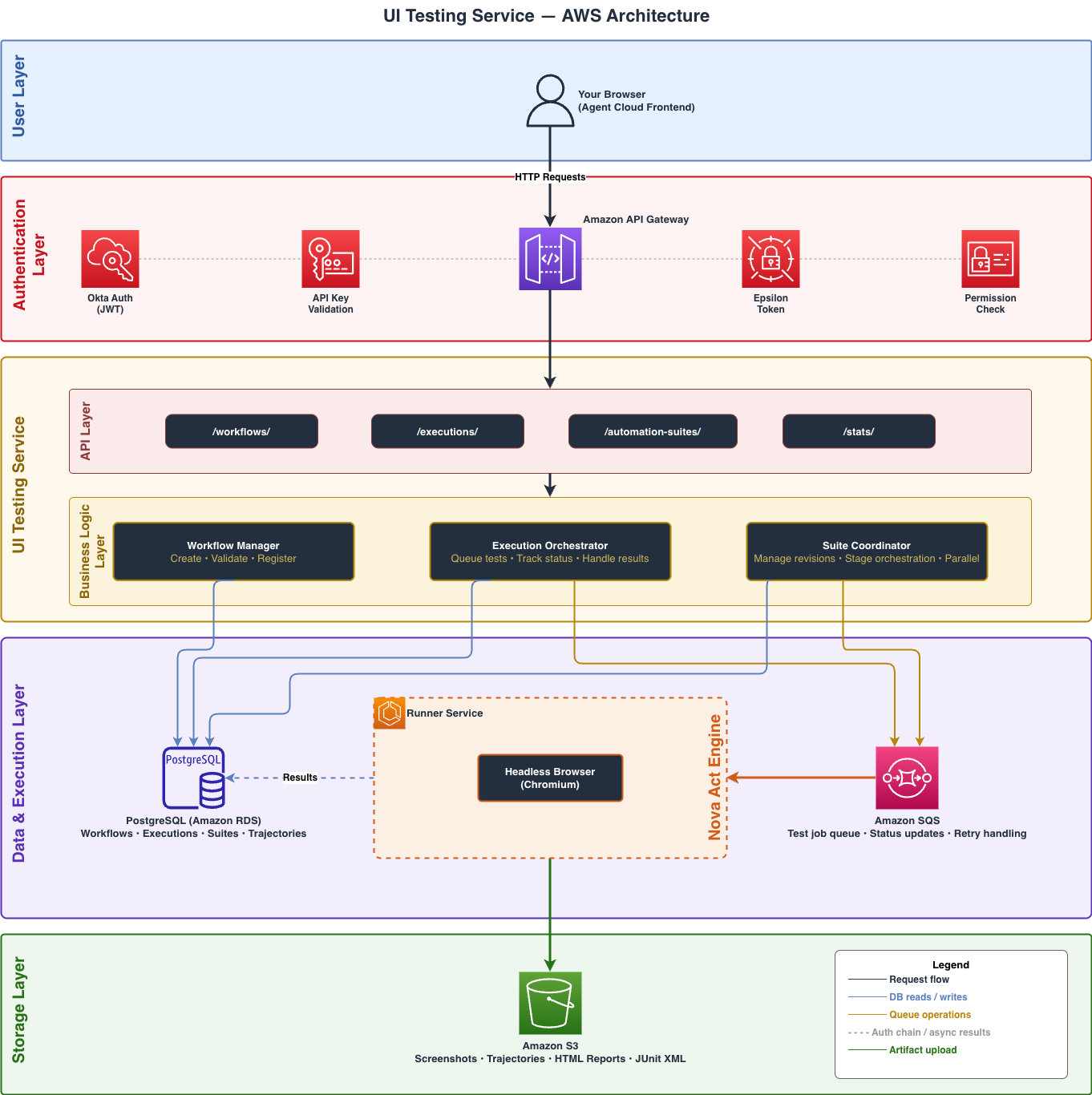
图 1:Epsilon UI 测试服务架构
图 1 展示了 Epsilon UI 测试服务的分层架构。用户请求从 Agent Cloud 前端发起,经过包含身份验证与权限检查的 API 网关。API 层(Django REST)暴露工作流、执行记录、自动化测试套件和统计数据的相关端点。业务逻辑层包括 Workflow Manager、Execution Orchestrator 和 Suite Coordinator。测试任务排入 Amazon Simple Queue Service (Amazon SQS),并由运行在 Amazon Elastic Container Service (Amazon ECS) 上的 Runner Service 提取,该运行器包含 Nova Act 引擎和无头 Chromium 浏览器。结果、截图、轨迹(Trajectories)和 HTML 报告统一存储在 Amazon S3 中。
该能力被封装为一个标准的 Agent(ui-test-agent),包含两项技能:
- ui-test-recorder:交互式探索场景并录制自然语言步骤。
- ui-test-executor:运行已录制的步骤并返回结构化测试结果。
已接入的团队使用 UI 测试的方式与使用任何其他平台 Agent 完全一致,无需运维额外基础设施。接入流程清晰简便:平台团队为新团队配置跨账户 IAM 角色,注册其目标应用 URL,并通过现有平台 API 授予访问 ui-test-agent 的权限。从这时起,团队就可以通过他们使用其他平台能力时的相同界面,创建工作流、触发执行并获取结果。
核心集成实现
Nova Act 与 Amazon Bedrock AgentCore Browser Tool 的集成代码十分简洁:
python import boto3 from bedrock_agentcore.tools.browser_client import browser_session from nova_act import NovaAct
boto_session = boto3.Session(region_name=region)
with browser_session(region) as client: ws_url, headers = client.generate_ws_headers() with NovaAct( cdp_endpoint_url=ws_url, cdp_headers=headers, boto_session=boto_session, starting_page=url ) as nova_act: result = nova_act.act(instruction)
这种模式——开启托管浏览器会话、通过 CDP WebSocket 建立连接,并使用自然语言驱动操作——构成了基石。Epsilon 在此基础上封装了其平台的多租户编排、结果捕获与可观测性层。
示例:自动化“创建 Agent”流程
为了直观展示基于意图的测试,以下是 Epsilon 平台的一个代表性工作流。它涵盖了登录、表单输入、条件处理、页面滚动和断言验证。以下步骤凸显了 Nova Act 的差异化特性:
| 步骤 | 指令 |
|---|---|
| 1 | 输入用户名并选择 Next |
| 2 | 输入密码并选择 Verify |
| 3 | 导航至 Create Agent 并选择 Design a new specification 卡片 |
| 4 | 如果出现新手导览弹窗,选择 Skip Tour,然后验证是否加载了正确的页面 |
| 5 | 填写 Agent 名称和描述字段 |
| 6 | 向下滚动直到 Goal Statement 字段可见,然后进行填写 |
| 7 | 如果技能搜索框不可见,向下滚动直到其出现。然后搜索并添加一项技能 |
| 8 | 选择 Save,确认成功提示,返回上一页,并验证新 Agent 是否出现在列表中 |
步骤 4 和步骤 7 展示了条件逻辑:“如果某个元素出现,则处理它”以及“如果目标元素不可见,滚动直到其可见”。在传统测试框架中,这些模式都需要编写显式的条件分支代码;而 Nova Act 依托语言理解能力即可自然处理。
运行时隔离
Epsilon 将 UI 测试运行在独立的运行器服务(FastAPI Sidecar)中,锁定支持 Workflow 和 IAM 身份验证的 nova-act 3.x 版本以及 Amazon Bedrock AgentCore Browser Tool 客户端。这使得依赖项与主后端完全解耦,避免与 Strands Agent 技术栈发生冲突。如果该运行器被停用,Worker 可以回退到进程内执行模式,从而确保部署期间的系统韧性。
最佳实践
结合将 UI 测试构建为平台能力的实战经验,Epsilon 团队给出了如下建议:
1. 编写意图,而非机械操作
text 推荐: "Confirm the rewards balance is visible" 不推荐: await page.locator('#rewards-balance-container > span.amount').toBeVisible()
基于意图的步骤能够经受住 UI 界面改版的考验。不写代码的产品经理和质量保证(QA)负责人也能直接审阅测试用例。
2. 隔离 Nova Act 运行时
将 Nova Act 和 Amazon Bedrock AgentCore Browser Tool 依赖锁定在独立的服务或容器中。Epsilon 发现,无论浏览器会话处于哪个区域,Nova Act 的签名端点默认均指向 us-east-1。在带有独立依赖锁文件(lockfile)的独立服务中运行它,可以防止难以排查的冲突。
3. 复用录制的轨迹以降低成本
Epsilon 在**草稿状态(Draft State)下进行轨迹重试探索,保存成功的执行轨迹,并在活跃状态(Active State)**下进行回放。重复执行时会跳过大语言模型(LLM)冗余的“思考”过程,从而在回归类的重复执行中同时降低延迟与成本。
4. 从第一天起就针对多租户进行设计
使用带有受限 IAM 策略的跨账户 AssumeRole 机制。每个租户的测试都在其各自账户下的专用角色中运行。这样无需为每个团队单独搭建定制基础设施,即可实现隔离性、审计能力以及故障范围控制。
5. 充分利用托管可观测性
借助 Amazon Bedrock AgentCore Browser Tool,团队开箱即可获得实时视图、会话录屏以及 AWS CloudTrail 集成能力。Epsilon 直接使用这些内置能力替代了自研可观测系统,降低了运维负担,并为合规团队提供了熟悉的审计界面。
在编写 Nova Act 步骤提示词时,需要考虑 Amazon Bedrock AgentCore Browser Tool 的默认视口大小。包含滚动的步骤(例如“向下滚动直到 Goal Statement 文本框可见”)可以确保 Nova Act 正确处理页面下方区域的内容。
结果与成效
Epsilon 的 UI 测试能力已在多个团队中投入使用,多租户架构在生产环境中得到了充分验证。
| 维度 | Amazon Nova Act | Playwright(对等实现) |
|---|---|---|
| 编写行数 | 18 条自然语言步骤 | 约 80-150 行代码 |
| 选择器/DOM 审查 | 无需 | 每个交互步骤均需审查 |
| 编写时间(单工作流) | 约 5-10 分钟 | 约 30-90 分钟 |
| 投入精力比 | 基准 | 高出 4-6 倍精力 |
以下是实际测得的效果数据:
- 测试编写速度提升 4-6 倍(基于 Epsilon 内部基准测试):编写一个典型的 18 步工作流,Nova Act 仅耗时 5–10 分钟;相比之下,编写等效的 Playwright 脚本(80–150 行代码)则需要 30–90 分钟。在 Playwright 脚本中,每个交互步骤都需要审查 DOM 结构、选取稳定的选择器,并针对条件情况编写显式的等待、断言和分支逻辑。Nova Act 彻底消除了每个步骤的这些开销,仅用 18 条自然语言指令,零选择器、零 DOM 审查,并完全通过纯文本表达条件逻辑(例如导览弹窗和滚动至可见)。
- 轨迹重放实现 100% 通过率(基于 Epsilon 内部基准测试):当工作流通过最初的探索阶段(通常需 4–5 次提示词迭代)后,Epsilon 会保存成功的轨迹并在生产回放中实现稳定复用。
English / 原文
To scale intent-driven UI testing across its product teams, Epsilon, a data, technology, and marketing-services company and part of Publicis Groupe, turned to Amazon Nova Act. With hundreds of millions of consumer profiles and thousands of brand relationships, Epsilon needed UI testing that could keep pace with rapid application changes. The solution could not create maintenance overhead for every product team.
Within Epsilon, the Agentic Platform team (50 engineers) builds shared infrastructure so other product teams can build, deploy, govern, and run AI agents safely. With this shared platform, teams get a skills-based agent builder. They also get federated identity and pre-flight authorization, Model Context Protocol (MCP) integration, and cross-account provisioning. When a product team wants to adopt AI tooling, they get capabilities without additional configuration and without re-solving identity, security, browser infrastructure, or model integration on their own.
One of those managed capabilities is UI testing. With Amazon Nova Act and Amazon Bedrock AgentCore Browser (a capability of Amazon Bedrock AgentCore), Epsilon’s platform team could deliver resilient, intent-driven testing as a service to teams on the platform.
In this post, we walk through Epsilon’s architecture for delivering UI testing as a managed platform service, show the core Nova Act and Amazon Bedrock AgentCore Browser Tool integration code, highlight a concrete 18-step test workflow, and share best practices and measured results.
The challenge: Enhancing coverage, not replacing what works
Epsilon’s existing UI testing practice was not broken. The team maintained a Playwright-based regression suite that validated functionality across their web applications, and it worked well. Playwright remains their regression backbone today.
The opportunity Epsilon identified was additive, not corrective:
- Scripted Playwright tests are effective for deterministic regression checks. However, they are tightly coupled to selectors and page structure. Cosmetic UI changes can break them even when the underlying functionality is sound.
- Multiple product teams needed full testing coverage against their own applications. Standing up browser infrastructure, managing dependencies, and integrating with identity systems per team created duplicative effort.
- The platform team wanted UI testing to be a managed capability that fit their existing agent model, not a custom CLI that every onboarded team had to operate.
The goal: layer intent-based testing on top of the existing Playwright regression suite. Deliver it as a multi-tenant platform service so that each Epsilon product team could consume through the same API surface they used for every other agent capability.
Epsilon evaluated options against two requirements: natural-language test authoring (to complement selector-based Playwright tests) and managed browser infrastructure (to fit their multi-tenant platform model). With Amazon Nova Act combined with Amazon Bedrock AgentCore Browser Tool, Epsilon could address both.
- Natural-language steps. Test steps are plain-English instructions executed by Nova Act. They are resilient to cosmetic UI changes and readable by non-engineers. A step like “Confirm the rewards balance is visible” ages far better than a brittle CSS selector.
- AWS managed, ephemeral browser sessions. With Amazon Bedrock AgentCore Browser Tool, teams get isolated browser instances with no binaries to ship and no display server to maintain. Amazon Bedrock AgentCore Browser Tool also offers live view for human observation or takeover (useful for CAPTCHAs or multi-factor authentication), session recording to Amazon Simple Storage Service (Amazon S3), and AWS CloudTrail audit, all without additional configuration.
- AWS Identity and Access Management (AWS IAM)-based authentication. With Nova Act, you can authenticate through the standard AWS credential chain (the task role). This fits Epsilon’s existing security model without distributing separate API keys.
- Cross-account friendly. With Nova Act and Amazon Bedrock AgentCore Browser Tool, you can slot into your existing AWS Security Token Service (AWS STS) AssumeRole provisioning. Each onboarded team can run tests inside their own AWS account under a scoped role. This maintains isolation and auditability.
Epsilon chose Amazon Bedrock AgentCore Browser Tool specifically because it eliminates the operational burden of managing browser binaries, display servers, and session lifecycle. The Agentic Platform team had no interest in owning that infrastructure.
The solution: Architecture and implementation
Epsilon’s solution has three main components: a platform API for creating workflows, a background task runner for executing them, and the Nova Act and Amazon Bedrock AgentCore Browser Tool integration that drives the browser.
Platform architecture
Epsilon’s UI testing capability follows a clear pipeline:
- A user creates a workflow through the platform API, specifying a
target_urland a list of natural-language steps. - On create, the platform registers a Nova Act workflow definition on AWS.
- On execute, a background task runner (Celery, a Python framework for asynchronous job processing) opens an Amazon Bedrock AgentCore Browser Tool browser session. It runs each step through Nova Act over a Chrome DevTools Protocol (CDP) WebSocket (the standard interface for programmatically controlling Chromium browsers), including conditional logic (for example, “if a tour box appears, skip it”).
- The system captures a screenshot per step, tracks pass/fail per step, computes an overall pass rate, and stores everything (results JSON, screenshots in Amazon S3, session ID).
- A completion hook fires so the result is recorded back into the platform.
Figure 1: Epsilon’s UI Testing Service architecture
Figure 1 shows the layered architecture of Epsilon’s UI Testing Service. User requests flow from the Agent Cloud Frontend through an API Gateway with authentication and permission checks. The API layer (Django REST) exposes endpoints for workflows, executions, automation suites, and stats. The business logic layer includes a Workflow Manager, Execution Orchestrator, and Suite Coordinator. Test jobs are queued in Amazon Simple Queue Service (Amazon SQS) and picked up by the Runner Service running on Amazon Elastic Container Service (Amazon ECS), which contains the Nova Act engine and a headless Chromium browser. Results, screenshots, trajectories, and HTML reports are stored in Amazon S3.
The capability is exposed as a standard agent (ui-test-agent) with two skills:
- ui-test-recorder : Explore a scenario interactively and record natural-language steps.
- ui-test-executor : Run recorded steps and return structured results.
Onboarded teams consume UI testing the same way they consume any other platform agent. No additional infrastructure to manage. The onboarding process is straightforward. The platform team provisions a cross-account IAM role for the new team, registers their target application URLs, and grants access to the ui-test-agent through the existing platform API. From that point, teams create workflows, trigger executions, and retrieve results through the same interface they already use for other platform capabilities.
The core integration
The Nova Act + Amazon Bedrock AgentCore Browser Tool integration is concise:
import boto3
from bedrock_agentcore.tools.browser_client import browser_session
from nova_act import NovaAct

boto_session = boto3.Session(region_name=region)

with browser_session(region) as client:
    ws_url, headers = client.generate_ws_headers()
    with NovaAct(
        cdp_endpoint_url=ws_url,
        cdp_headers=headers,
        boto_session=boto_session,
        starting_page=url
    ) as nova_act:
        result = nova_act.act(instruction)
This pattern (open a managed browser session, connect through the CDP WebSocket, and drive actions with natural language) is the foundation. Epsilon wraps it with their platform’s multi-tenant orchestration, result capture, and observability layers.
Example: Automating the ‘Create an agent’ flow
To illustrate intent-based testing, here is a representative workflow from Epsilon’s platform. It exercises login, form entry, conditional handling, scrolling, and verification. The following steps highlight the differentiating patterns of Nova Act:
| Step | Instruction |
|---|---|
| 1 | Type the username and choose Next |
| 2 | Enter the password and choose Verify |
| 3 | Navigate to Create Agent and select the Design a new specification card |
| 4 | If an onboarding tour box appears, choose Skip Tour , then verify the correct page loaded |
| 5 | Fill in the agent name and description fields |
| 6 | Scroll down until the Goal Statement field is visible, then fill it in |
| 7 | If the skills search box is not visible, scroll until it appears. Then search for and add a skill |
| 8 | Choose Save , confirm the success prompt, navigate back, and verify the new agent appears in the list |
Steps 4 and 7 demonstrate conditional logic : “if an element appears, handle it” and “if a target isn’t visible, scroll until it is.” These patterns would require explicit branching in a traditional framework. Nova Act handles them naturally through language understanding.
Runtime isolation
Epsilon runs UI tests in a dedicated runner service (a FastAPI sidecar) that pins nova-act 3.x with Workflow and IAM authentication support, plus the Amazon Bedrock AgentCore Browser Tool client. This keeps dependencies separate from the main backend so they don’t collide with the Strands agent stack. The worker falls back to in-process execution if the runner is disabled, providing resilience during deployments.
Best practices
Based on their experience building UI testing as a platform capability, the Epsilon team recommends:
1. Write steps as intent, not mechanics
GOOD: "Confirm the rewards balance is visible"
BAD: await page.locator('#rewards-balance-container > span.amount').toBeVisible()
Intent-based steps survive UI redesigns. Product managers and quality assurance (QA) leads who might not write code can review them directly.
2. Isolate the Nova Act runtime
Pin Nova Act and Amazon Bedrock AgentCore Browser Tool dependencies in a dedicated service or container. Epsilon learned that the signing endpoint for Nova Act targets us-east-1 regardless of the browser session’s region. Running it in a separate service with its own dependency lockfile prevents hard-to-debug conflicts.
3. Reuse recorded trajectories to cut cost
Epsilon uses trajectory retries in draft state , saves the successful trajectory, and replays it in active state. Repeat runs skip redundant large language model (LLM) “thinking,” reducing both latency and cost for regression-style repeated executions.
4. Design for multi-tenancy from day one
Use cross-account AssumeRole with scoped IAM policies. Each tenant’s tests run under their own role in their own account. This provides isolation, auditability, and failure scope containment without custom infrastructure per team.
5. Lean on managed observability
With Amazon Bedrock AgentCore Browser Tool, teams get live view, session recording, and AWS CloudTrail integration. Epsilon uses these built-in capabilities instead of building custom observability, reducing maintenance and giving compliance teams familiar audit surfaces.
When prompting Nova Act steps, account for the browser viewport defaults of Amazon Bedrock AgentCore Browser Tool. Steps that reference scrolling (for example, “scroll down until the Goal Statement textbox is visible”) verify that Nova Act handles content in the lower portion of the page correctly.
Results and impact
Epsilon’s UI testing capability is operational across multiple teams, with the multi-tenant architecture proven in production.
| Dimension | Amazon Nova Act | Playwright (equivalent) |
|---|---|---|
| Lines authored | 18 natural-language steps | ~80-150 lines of code |
| Selector/DOM inspection | None | Required per interactive step |
| Authoring time (per workflow) | ~5-10 minutes | ~30-90 minutes |
| Effort ratio | Baseline | 4-6x more effort |
Here are the measured outcomes:
- 4-6x faster test authoring (based on Epsilon’s internal benchmarks). A representative 18-step workflow took 5–10 minutes to author with Nova Act, compared to 30–90 minutes for the equivalent Playwright script (80–150 lines of code). Each interactive step in the Playwright script requires inspecting the DOM, choosing a stable selector, and coding explicit waits, assertions, and branching for conditional cases. Nova Act replaces that per-step overhead with 18 natural-language instructions and zero selector or DOM inspection, with conditional logic (such as the tour-box and scroll-until-visible steps) expressed in plain English.
- 100 percent pass rate on trajectory replay (based on Epsilon’s internal benchmarks). After a workflow passes the initial explore phase (typically 4–5 prompt iterations), Epsilon saves the successful trajectory and replays it deterministically. Saved trajectories achieve a 100 percent pass rate across repeated runs.
- Lower barrier to test authoring. Steps read like plain English. Team members beyond core test engineers can read, review, and propose tests, broadening ownership of quality.
- Built-in audit trail. AWS CloudTrail integration and Amazon Bedrock AgentCore Browser Tool session recording made debugging and compliance conversations easier. This was a benefit the team did not initially set out to achieve.
- Zero per-team infrastructure overhead. Onboarded teams get UI testing through the same API surface as every other platform agent. No browser binaries, no Selenium grid, no display servers to manage.
- Pass/fail visibility per step. Screenshot capture at each step provides granular debugging context, reducing mean time to diagnose failures.
“Nova Act let us turn UI testing from a brittle, selector-chasing chore into a managed platform capability. Our tests now describe intent in plain English, run on AWS managed browsers, and every product team we onboard gets reliable testing without additional configuration.”
— Epsilon Agentic Platform Team
Learn more
Epsilon’s Agentic Platform team demonstrated how to deliver resilient, intent-driven UI testing as a managed service using Amazon Nova Act and Amazon Bedrock AgentCore Browser Tool. You can apply the same pattern to your own multi-tenant platform to eliminate browser infrastructure overhead and make test authoring accessible to non-engineers.
If you want to build similar intent-driven UI testing capabilities with Amazon Nova Act and Amazon Bedrock AgentCore Browser Tool, here are resources to get started:
To learn more about how your organization can use intent-based browser automation for testing, visit the Amazon Nova Act product page.
Epsilon is a Publicis Groupe company. Learn more at epsilon.com.
About the authors
Sakthivel Chellapparimanam
Sakthivel is a Solutions Architect at Amazon Web Services based in Chennai, India. He works with enterprise customers on AI/ML adoption, agentic architectures, and cloud-native modernization.
Sidhartha Kotha
Sidhartha is a Technical Account Manager at AWS. He works with enterprise customers on AI-driven solutions and focuses on adopting generative AI for operational efficiency. Outside of work, he enjoys exploring open-source automation frameworks and mentoring aspiring cloud engineers.
Manik Sahu
Manik is a Senior Software Engineering Manager at Epsilon, specializing in Data Engineering, Agentic AI, and Cloud Architecture. Based in Bengaluru, he brings extensive expertise in designing advanced technical systems using frameworks like FastAPI, Amazon Bedrock, and LangGraph.
Swastika Sinha
Swastika is a Software Engineer at Epsilon, working on the Agentic Platform team in Bangalore, India. Her work focuses on architecting and building Generative AI platforms and services that enable the building and hosting of AI agents, knowledge graphs, MCP servers, agentic workflows, and other next-generation GenAI technologies.
Sekh Mohammad Warish
Sekh is a Dallas-based Senior Technical Account Manager at AWS with 22 years of IT experience across GenAI, SAP, and cloud modernization. He helps enterprise customers adopt emerging technologies like agentic AI and Amazon Nova and turn them into production-ready solutions. A World and India Book of Records holder for the most IT certifications, he brings a lifelong passion for learning to every engagement.
Sudeesh Veettil
Sudeesh is a Senior Technical Account Manager at AWS based in the Dallas, TX area with over 20 years of experience in the technology industry. He helps enterprise customers design, build, and operate secure, resilient, and efficient solutions on AWS, specializing in operational excellence for AI workloads and resilience engineering.