Worldwide Express 如何利用 Amazon Bedrock 实现货运计费异常处理自动化
英文标题:How Worldwide Express automated freight exceptions with Amazon Bedrock
大型物流企业 Worldwide Express 联手 AWS 与 LTM,基于 Amazon Bedrock 构建了多 Agent AI 解决方案,用于自动化处理零担货运(LTL)的账单异常。该系统针对行项目不匹配、价格差异和意外附加费分别设立专业 Agent,并与 TMS 深度集成。上线仅 6 个月,积压异常减少 75%,回款周期缩短 4 周,释放了 1000 万美元的自由现金流,且错误率低于 1%。这为物流行业及需要结合复杂业务规则落地 Agentic AI 的开发者提供了极具价值的端到端生产级参考范式。
 1.3 MB
 1.3 MB
 2.4 KB
 345.0 KB
 141.2 KB
 346.5 KB
 147.8 KB
 20.7 KB
 27.7 KB
 27.6 KB
 21.6 KB
 268.5 KB
中文
Worldwide Express(隶属于 ShipStation Global)业务规模庞大:全系统营收约 50 亿美元,连接超过 75 家零担货运(LTL)承运商和 13 万余家客户。然而,如此庞大的体量背后却隐藏着巨大成本。每月有 1500 万美元的自由现金流被冻结在尚未解决的计费异常中。每一笔异常都必须人工排查,逐一核对每家承运商各自独立的规则。Worldwide Express 曾将此业务外包给一个团队,由其逐案处理,针对每笔争议分别致电客户和承运商。异常越积越多,现金流持续滞留,每笔订单转化为实际收入的耗时也越来越长。
Worldwide Express 与 AWS 及 LTM 合作,基于 Amazon Bedrock 构建了一套多 Agent(多智能体)AI 解决方案,直接接入其运输管理系统(TMS)SpeedShip。上线六个月后,该公司公布的数据显示:活跃异常减少了 75%,回款周期缩短了 4 周,年节省成本达 100 万美元,并一次性释放了 1000 万美元的自由现金流。
在本文中,我们将详细介绍这一挑战、Worldwide Express 设计多 Agent 解决方案的过程以及最终取得的成效。
挑战
在零担货运(LTL)领域,约有 14% 的发票无法通过采购订单(PO)、收货单和承运商发票之间的标准三向匹配(three-way match)。一旦匹配失败,发票就会进入异常处理流程。在 Worldwide Express,异常主要分为三类:
- 行项目不匹配(Line-item mismatches): 货物数量或服务代码与发运记录不一致。
- 价格差异(Pricing variances): 承运商开具的费率与合同价格不符。
- 非预期附加费(Unexpected accessorial charges): 原始报价中未包含升降尾板费、居民区派送附加费或重新称重调整费等。
每笔异常都会触发一个包含五个步骤的人工流程:
- 通过交叉比对发票与采购订单、收货单及价格条款,识别异常类型。
- 在供应商记录中排查根本原因。
- 向承运商或仓库发送包含争议详情的电子邮件。
- 等待回复。
- 在 TMS 中执行解决方案。
由于每家承运商都有自己的运价结构和争议处理工作流,该流程占用了财务运营(FinOps)团队的大部分精力。
基于规则的流程自动化(RPA)虽然能处理结构化、可预测的工作流,但异常解决需要情境化的业务判断:解读承运商的附加费政策、将收费项与发运数据进行比对,并结合具体承运商、异常类型和金额来裁决其有效性。正是这种高可变性,使得该问题非常契合 Agentic AI 框架的应用场景。
从评估到投产
2025 年 6 月,Worldwide Express 聘请 AWS 业务转型与价值咨询团队,梳理出贯穿“订单到回款”(Order-to-Cash)全生命周期的 19 个自动化机会。在明确了异常自动化的商业价值后,Worldwide Express 在不到 6 个月内就完成了从评估到生产上线的全过程。
工作原理
该解决方案运行在 AWS 之上。Amazon Bedrock 提供 AI 推理能力,Amazon Elastic Compute Cloud (Amazon EC2) 作为计算引擎。该架构设计旨在对每个 Agent 的推理方式、决策边界的确立以及异常在 Agent 之间的路由进行细粒度控制。直接在 Amazon EC2 上构建框架,并由 Amazon Bedrock 提供推理支持,不仅使团队牢牢掌控编排逻辑,还支持集成各类开源 Agent 库。针对业务逻辑的生产级管控机制使得每个 Agent 的职责、输入和决策边界明确且可审计。在账单争议工作流中,每一项自动化决策都必须具备可解释性。
Agents(智能体)
当系统检测到发票异常时,会将其路由至三个专业 AI Agent 之一,分别处理特定类型的计费争议:
- 发票匹配 Agent(Invoice Matching Agent): 查找相匹配的发运记录,并标记不符之处。
- 价格差异 Agent(Pricing Variance Agent): 将承运商收费与合同费率进行比对,判定差额是否合理。
- 附加费核验 Agent(Accessorial Validation Agent): 核查非预期费用(如居民区配送费或升降尾板费)是否有实际交付事件的支撑。
每个 Agent 在给出建议前,都会拉取特定承运商的计费规则和政策。异常解决后,系统会生成一份通俗易懂的说明,解释发现了什么问题以及采取了何种操作。
每个自定义 Agent 都包含一段指令提示词(定义其角色、决策边界和输出格式)、一组操作(与 SpeedShip 的集成接口),并能访问承运商专属知识库。通过使用 Amazon Bedrock,每个 Agent 都能通过统一的 API 调用合适的基础模型,同时继承 AWS 原有的治理机制。关于各区域的模型可用性,请参阅 Amazon Bedrock 支持的区域和模型。
Actions(操作)
Agent 通过分析师平时使用的相同 API 与 SpeedShip 连接。这意味着 AI 看到的内容与人工审核员完全一致(合同费率、发运详情、交付凭证),并直接将解决方案写入同一工作流中。SpeedShip 在 AWS 上部署有 API,因此 Agent 可以像其他既有系统一样直接接入相同的端点。
承运商知识库
每家承运商的计费规则、费用定义和争议处理流程都不尽相同。Worldwide Express 存储了每家承运商的文档:运价规则、附加费定义、争议流程以及差异容忍阈值。当 Agent 处理异常时,会在决策前检索该承运商的具体政策和标准作业程序(SOP)文档,确保每项决策都严格基于承运商自身的规则。同一套三 Agent 架构无需编写任何特定承运商的代码,即可处理所有承运商的业务。
人机协同(Human-in-the-loop)
在初期推广阶段,设置人工审批步骤对于 FinOps 团队顺利接纳该系统至关重要。最初,人工审核员会使用现有的 SpeedShip 界面对建议进行审批确认后再最终执行。随着准确率突破 99%,批量审批逐渐成为了默认操作模式。
可观测性(Observability)
Worldwide Express 团队构建了监控仪表盘,用于跟踪各承运商的自动化率、各异常类型的错误率、解决时长以及人工介入覆盖的频率。当审核员驳回某项建议时,系统会记录反馈。团队会根据历史驳回记录持续优化指令提示词和知识库,稳步提升自动化覆盖率。
端到端流程
下图展示了从异常检测、分发至三个专业 Agent,再到人工审批的端到端流程。图中显示,来自数据源(SpeedShip TMS、发运系统、电子数据交换 (EDI) 服务器以及承运商与供应商门户)的异常被检测到后,会被路由至三个 Agent 之一。每个 Agent 均运行在具备 Auto Scaling 的 Amazon EC2 上,采用包含自身提示词、工具和承运商知识库的 Agent 框架,并调用 Amazon Bedrock 进行模型推理。随后 Agent 生成处理报告,费用核定结果及 AI 撰写的说明将提交给人工审核员在 SpeedShip 分析师 UI 中进行审批。
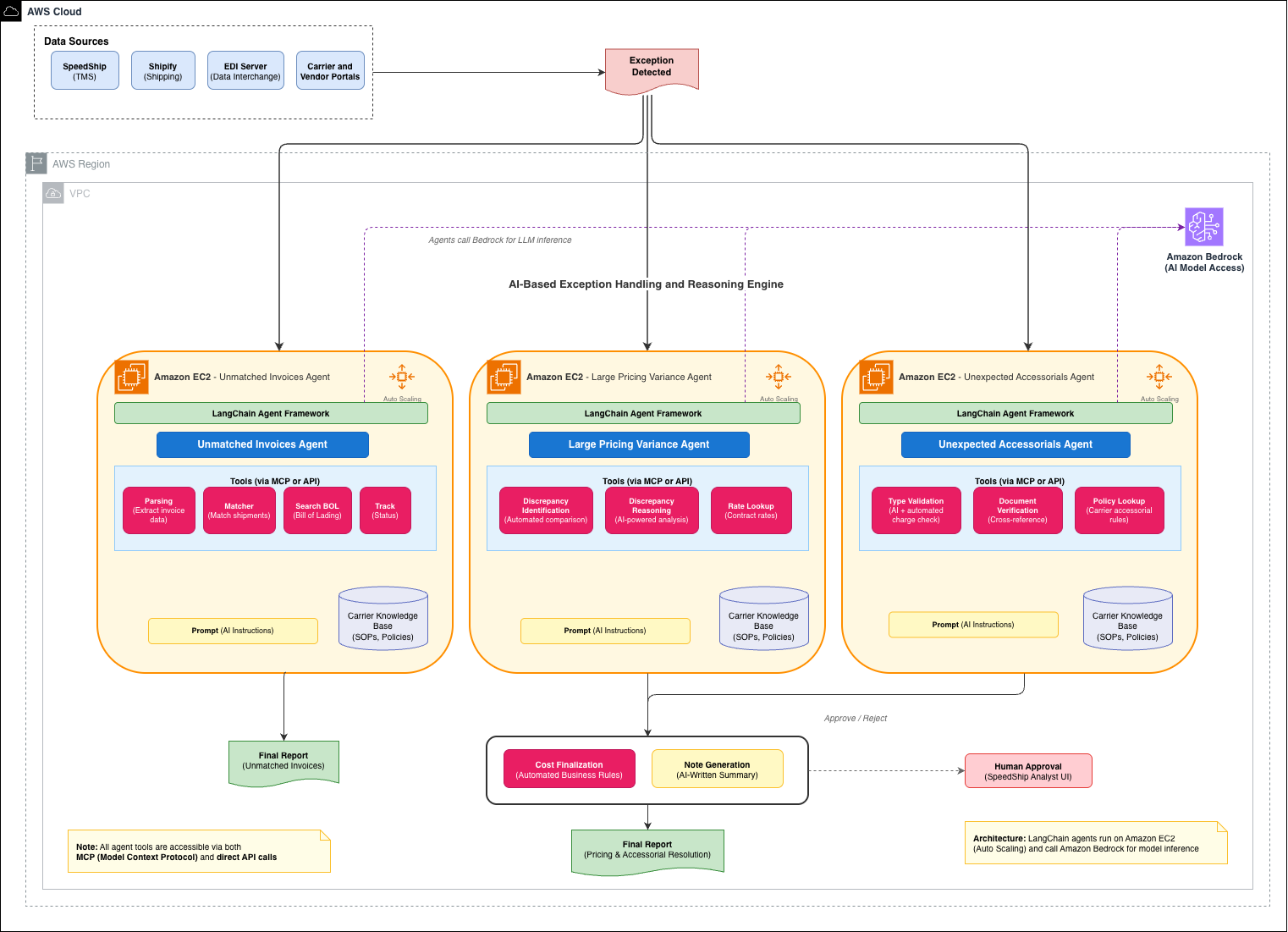
图 1:Worldwide Express 基于 AWS 构建的 AI 驱动异常处理架构
成效
上线六个月以来,Worldwide Express 已在 40 多家零担承运商中部署了该解决方案。目前,Agent 每周能够结案 10,000 笔异常(约占总量的 50%),错误率低于 1%。这使 FinOps 团队得以从例行处理工作中解脱出来,专注于复杂、高价值的争议。
这一成效在活跃异常的积压量上体现得最为明显:该数值从 2025 年 6 月的 1500 万美元骤降至六个月后的 400 万美元,降幅达 75%。Worldwide Express 成功释放了 1000 万美元的流动资金,每年节省成本超过 100 万美元,首年投资回报率(ROI)达 60 倍。据该公司报告,回款周期缩短了整整四周。
“借助 AWS,我们实现了每周 40% 以上计费异常的自动化处理,不仅大幅削减了成本,还将计费周期从数天缩短至数分钟。如今,我们每周能以以往无法企及的速度,多释放约 1000 万美元的客户账单款项。”
—— Nathanael Pearson,Worldwide Express 财务运营(FinOps)副总裁
未来展望
Worldwide Express 已着手将该方法推广至“订单到回款”周期的其他环节。对于管理大量承运商的物流企业而言,可行的落地路径是由小处着手:首先对重复性最高的一类异常实现自动化,验证其准确性,随后再推广至其余业务组合。
总结
Worldwide Express 的异常自动化实践充分展示了当 Agentic AI 遇上边界清晰的业务问题时所能激发的巨大潜力。Amazon Bedrock、承运商专属知识库与人机协同审批设计的有机结合,让 Worldwide Express 在保持财务严谨管控的同时,于不到 6 个月内完成了从评估到投产的全过程。目前,该公司正在将自动化版图拓展至其他“订单到回款”流程中。
如需探讨类似方案是否适用于贵组织,欢迎申请沟通联系您的客户团队,或进一步了解 Amazon Bedrock。像 LTM 这样的合作伙伴也可以基于您的自有数据开展价值验证(Proof of Value)冲刺。
关于作者
Saumya Shah
Saumya 担任 AWS 客户解决方案经理已有四年。她专注于协助交通与物流企业加快 AI 从概念验证(PoC)走向生产落地的进程。
Nikhil Bhagat
Nikhil 是 AWS 高级解决方案架构师。他在广域网(WAN)、DNS 和数据中心网络架构方面拥有十余年经验,专注于云基础设施、网络以及生成式 AI(GenAI)。他帮助客户设计、构建和优化云解决方案,并构建 Agentic AI 框架。他将保障弹性网络所依托的严谨原则(包括高可靠连接、隔离和精细的流量设计)融入现代 AI 背后的分布式系统架构之中。
Lynette Woolfolk
Lynette 是 AWS 交通与物流行业的大客户总监,在 AWS 工作了 6 年。她担任企业客户的战略顾问,致力于通过变革性技术解决方案和 AI 驱动的创新,帮助客户发掘可衡量的业务价值。
Arjun Srinivasan
Arjun 是企业级 AI 高管兼 ShipStation Global 的 AI 与数据科学高级副总裁(SVP)。他在分销、物流、能源、制造和零售等领域推动数据、分析及 AI 转型拥有超过 20 年的丰富经验。他曾主导涵盖生成式 AI(GenAI)、Agentic AI、智能自动化、预测分析、计算机视觉和物理仿真等大规模 AI 战略规划、治理与产品化落地工作。Arjun 擅长将前沿技术转化为切实的业务成效,并与高管团队密切合作,推动 AI 从试点项目扩展到企业级全面应用。他也是专注于实用、可信且价值导向的 AI 创新的知名演讲嘉宾、顾问和生态构建者。
English / 原文
Worldwide Express (part of ShipStation Global) had built something big: approximately $5 billion in systemwide revenue, over 75 less-than-truckload (LTL) carriers and more than 130,000 customers. But that same scale had a hidden cost. Every month, $15 million in free cash flow sat frozen, locked in billing exceptions no one had resolved yet. Each one had to be chased down by hand, carrier by carrier, with its own rules to check. Worldwide Express outsourced to a team that worked cases one at a time, calling customers and carriers for each dispute. The exceptions piled up, cash stayed stuck, and every order took longer to turn into money.
Worldwide Express worked with AWS and LTM to build a multi-agentic AI solution with Amazon Bedrock that plugs directly into their transportation management system (TMS), SpeedShip. Six months after launch, the company reported a 75 percent reduction in active exceptions, a 4-week improvement in time-to-cash, $1M annual savings, and a one-time $10M free cash flow infusion.
In this post, we describe the challenge, explain how Worldwide Express designed the multi-agent solution, and share the results.
The challenge
In LTL freight, roughly 14 percent of invoices fail the standard three-way match between the purchase order, the goods receipt, and the carrier invoice. When a match fails, the invoice enters exception handling. For Worldwide Express, exceptions fell into three categories:
- Line-item mismatches: Quantities or service codes that didn’t align with the shipment record.
- Pricing variances: The carrier billed a rate different from the contracted price.
- Unexpected accessorial charges: Liftgate fees, residential surcharges, or reweigh adjustments that weren’t on the original quote.
Each exception triggered a five-step manual process:
- Identify the exception type by cross-referencing the invoice against the purchase order, goods receipt, and pricing.
- Research the root cause in vendor records.
- Send email to the carrier or warehouse with dispute details.
- Wait for a response.
- Execute the resolution in the TMS.
With each carrier operating under its own tariff structure and dispute workflow, this process consumed most of the FinOps team’s bandwidth.
Rule-based process automation (RPA) can handle structured, predictable workflows. However, exception resolution requires contextual judgment: interpreting a carrier’s accessorial policy, comparing charges against shipment data, and deciding validity given a carrier, exception type, and dollar amount. That variability is what made the problem a fit for the agentic AI framework.
From assessment to production
In June 2025, Worldwide Express engaged the AWS Business Transformation & Value Advisory team to identify 19 automation opportunities across the Order-to-Cash lifecycle. Knowing the business value of exceptions automation, Worldwide Express moved from assessment to production in less than 6 months.
How it works
The solution runs on AWS. Amazon Bedrock provides AI reasoning, and Amazon Elastic Compute Cloud (Amazon EC2) is the engine. The design calls for fine-grained control over how each agent reasons, where decision boundaries sit, and how exceptions are routed between agents. Building the framework directly on Amazon EC2, with Amazon Bedrock providing inference, keeps that orchestration logic fully in the team’s hands and supports open source agent libraries. Production controls of business logic make each agent’s role, inputs, and decision boundaries explicit and auditable. In a billing-dispute workflow, every automated decision needs to be explainable.
Agents
When an invoice exception is detected, the system routes it to one of three specialized AI agents, each handling a specific type of billing dispute:
- Invoice Matching Agent finds the matching shipment record and flags what doesn’t line up.
- Pricing Variance Agent compares the carrier’s charge against the contracted rate and determines whether the difference is valid.
- Accessorial Validation Agent checks whether unexpected fees (such as residential delivery or liftgate charges) are supported by the actual delivery events.
Each agent pulls specific carrier billing rules and policies before making a recommendation. After the exception is resolved, the system generates a plain-language note explaining what was found and what action was taken.
Each custom agent has an instruction prompt (defining its role, decision boundaries, and output format), a set of actions (integrations into SpeedShip), and access to carrier-specific knowledge bases. By using Amazon Bedrock, each agent accesses a suitable foundation model through a single API while inheriting existing AWS governance. For model availability by Region, refer to Supported models by AWS Region in Amazon Bedrock.
Actions
The agents connect to SpeedShip through the same APIs that analysts use. That means the AI sees exactly what a human reviewer would see (contract rates, shipment details, delivery proof) and writes its resolution into the same workflow. SpeedShip has APIs on AWS, so the agents wire into the same endpoints as other existing systems.
Carrier knowledge base
Every carrier has different billing rules, fee definitions, and dispute procedures. Worldwide Express stores each carrier’s documentation: tariff rules, surcharge definitions, dispute steps, and variance thresholds. When an agent processes an exception, it retrieves that specific carrier’s policies and standard operating procedure (SOP) documents before deciding, so each decision is grounded in the carrier’s own rules. The same three agents handle all carriers without any carrier-specific code.
Human-in-the-loop
The approval step was necessary for FinOps adoption during the initial rollout. Initially, a human reviewer would use the existing SpeedShip UI to approve recommendations before they’re finalized. Eventually when accuracy exceeded 99 percent, bulk approval became the default.
Observability
Worldwide Express’s team built dashboards tracking automation rate by carrier, error rate by exception type, resolution time, and human override frequency. When a reviewer rejects a recommendation, the system logs the feedback. The team refines instruction prompts and knowledge bases based on rejection history, steadily increasing automation coverage.
End-to-end flow
The following diagram shows the end-to-end flow, from exception detection through the three specialized agents to human approval. In the diagram, exceptions from the data sources (the SpeedShip TMS, a shipping system, an electronic data interchange (EDI) server, and carrier and vendor portals) are detected and routed to one of three agents. Each agent runs on Amazon EC2 with Auto Scaling, uses an agent framework with its own prompt, tools, and carrier knowledge base, and calls Amazon Bedrock for model inference. The agents produce a resolution report. Cost finalization and an AI-written note then go to a human reviewer for approval in the SpeedShip analyst UI.
Figure 1: Worldwide Express’s AI-powered exception handling architecture on AWS
Results
Six months in, Worldwide Express has deployed the solution across over 40 LTL carriers. The agents currently close 10,000 (approximately 50 percent) exceptions weekly with a less than 1 percent error rate. This shifted the FinOps team’s time from routine resolution to complex, high-value disputes.
The impact shows up most clearly in the backlog of active exceptions, which fell from $15M in June 2025 to $4M six months later, a 75 percent reduction. Worldwide Express unlocked $10M in freed-up cash flow, over $1M in annual cost savings, and 60x first-year ROI. The company reports time-to-cash improving by four weeks.
“With AWS, we’ve automated more than 40 percent of weekly billing exceptions, significantly reducing costs and accelerating billing cycles from days to minutes. Today, we release approximately $10 million more in customer billings each week at a speed that simply wasn’t possible before.”
— Nathanael Pearson, VP of FinOps, Worldwide Express
Looking forward
Worldwide Express is already expanding this approach to other parts of the Order-to-Cash cycle. For logistics companies managing high carrier volumes, the path forward is to start small. Automate the most repetitive exception type first, prove accuracy, then scale across the rest of the portfolio.
Conclusion
Worldwide Express’s exception automation shows what’s possible when agentic AI meets a well-scoped business problem. The combination of Amazon Bedrock, carrier-specific knowledge bases, and a human-in-the-loop approval design let Worldwide Express move from assessment to production in less than 6 months while maintaining financial controls. The company is now expanding automation to other Order-to-Cash processes.
To explore whether a similar approach might work for your organization, request a conversation with your account team or learn more about Amazon Bedrock. Partners like LTM can run a Proof of Value sprint with your own data.
About the authors
Saumya Shah
Saumya is a Customer Solutions Manager at AWS for four years. She helps Transportation & Logistics enterprises accelerate AI adoption from proof of concept to production.
Nikhil Bhagat
Nikhil is a Senior Solutions Architect at AWS. With over a decade of experience architecting WAN, DNS, and data center networks, he specializes in cloud infrastructure, networking, and GenAI. He helps customers design, build, and optimize their cloud solutions, and build agentic AI frameworks. He brings the same discipline that underpins resilient networks, including reliable connectivity, isolation, and thoughtful traffic design, to the distributed systems behind modern AI.
Lynette Woolfolk
Lynette is an account executive in the Transportation & Logistics vertical with 6 years at AWS. She serves as an advisor to enterprise customers, helping them unlock measurable business value through transformative technical solutions and AI-driven innovation.
Arjun Srinivasan
Arjun is an enterprise AI executive and SVP of AI & Data Science at ShipStation Global, with over 20 years of experience driving data, analytics, and AI transformation across distribution, logistics, energy, manufacturing, and retail. He has led large-scale AI strategy, governance, and productization efforts spanning GenAI, Agentic AI, Intelligent Automation, Predictive Analytics, Computer Vision and Physics-based Simulations. Known for translating emerging technologies into measurable business outcomes, Arjun partners with executive teams to scale AI from pilots to enterprise adoption. He is also a frequent speaker, advisor, and ecosystem builder focused on practical, trusted, and value-driven AI innovation.