在 AgentCore 上使用 LangGraph 和 Strands 构建市场监控 Agent
英文标题:Market surveillance agent with LangGraph and Strands on AgentCore
本文介绍如何在 Amazon Bedrock AgentCore 上,结合 LangGraph 的工作流编排能力与 Strands 的 Agent 推理能力,构建可用于生产环境的多 Agent 市场监控系统。该方案将复杂业务流程拆分为状态驱动的图工作流,由多个专业 Agent 分析交易模式、可疑行为和风险信息,并由综合 Agent 生成结果。LangGraph 通过检查点机制提供故障恢复、人机协同和持久化状态管理,Strands 则为各节点提供模型无关的推理、工具调用和上下文管理能力。对开发者而言,这种组合可在确定性编排与 LLM 动态推理之间取得平衡,并提升企业级 Agent 系统的可靠性、可观测性与安全性。
 1.3 MB
 101.1 KB
 124.1 KB
 345.0 KB
 141.2 KB
 346.5 KB
 67.9 KB
 2.2 KB
 19.7 KB
 21.9 KB
 7.6 KB
 175.5 KB
中文
随着人工智能应用从简单的聊天机器人演进为复杂的自主系统,组织在编排能够应对真实生产场景的复杂多 Agent 工作流时面临新的挑战。传统的单 Agent 方法在处理需要专业知识、动态决策以及稳健错误恢复机制的复杂业务流程时,往往难以胜任。金融服务行业正是这一挑战的典型代表。市场监控系统必须协调多个专业 Agent,以分析交易模式、调查可疑活动并生成全面报告,同时满足严格的合规性与可靠性标准。
该解决方案结合了两个框架:LangGraph 用于宏观层面的工作流编排,Strands 用于智能 Agent 推理。LangGraph 擅长管理多 Agent 协作所需的状态和有向图。它让你能够精细控制工作流执行,以及可在 Agent 之间共享的状态。其核心持久化层支持对生产环境至关重要的功能,包括人机协同交互,以及从故障中基于检查点进行稳健恢复。与此同时,Strands Agent 充当各个工作流节点内部的推理引擎。它提供模型无关的能力,可集成多种大语言模型(LLM)提供商,同时保持灵活的工具集成与全面的可观测性。
随着 Amazon Bedrock AgentCore 于去年发布,许多场景中的 Agentic 解决方案生产化可能会变得更加简单。这一组合为可用于生产环境的 Agentic AI 系统提供了坚实基础,使其能够处理复杂用例,同时提供企业应用所要求的基础设施可靠性和可观测性。
本文演示如何在 AWS 基础设施上使用 LangGraph 和 Strands 架构并部署一个多 Agent AI 系统。你将了解如何利用 LangGraph 的检查点系统实现状态驱动的工作流编排、集成 Strands Agent 执行专业推理任务,以及使用 AgentCore 进行可扩展的生产部署。完整解决方案可在 GitHub 获取。
Strands:智能 Agent 推理
Strands Agent 采用模型无关的架构,能够适应你现有的基础设施,而不会施加架构约束。该 Agent 实现了一个 Agentic 推理循环,可持续评估工具输出,并根据中间结果做出决策,因此你可以构建复杂的多步骤分析工作流。该框架包含全面的会话与状态管理能力,以及多种会话管理器,以避免上下文窗口溢出。
借助 Strands,你可以通过定义工具架构和访问模式来配置外部工具交互。对于我们的监控 Agent,我们将数据发现与数据检索分离,以避免幻觉,并增强解决方案抵御注入攻击的能力。我们使用 get_report_list 和 get_report_schema 等工具查找报告,并使用 run_report 通过经过验证的参数构建并运行 SQL 查询。
我们使用以下工具和系统提示词创建一个 security_monitor Agent:
from strands import Agent, tool
from strands.models.bedrock import BedrockModel

model = BedrockModel(
    model_id="us.anthropic.claude-sonnet-4-6",
    region_name="us-east-1",
    max_tokens=16000,
    additional_request_fields={
        "thinking": {"type": "adaptive", "budget_tokens": 8000},
    },
    cache_prompt="default",
)

@tool
def get_report_list(agent_name: str) -> str:
    """Load the list of available reports for a specific agent.

    Args:
        agent_name: Name of the agent (e.g. 'security_monitor').

    Returns:
        str: JSON array of report objects with name and description.
    """
    reports_data = load_agent_reports(agent_name)
    return json.dumps(reports_data["reports"], indent=2)

@tool
def get_report_schema(report_name: str, query_intent: str) -> str:
    """Load column definitions for a report so you can build queries.

    Args:
        report_name: Name of the report (e.g. 'TradeActivity').
        query_intent: Description of what data to extract.

    Returns:
        str: JSON object with parameters and column definitions.
    """
    return json.dumps(load_json_report_definition(report_name), indent=2)

@tool
def run_report(
    report_name: str,
    filters: Dict[str, Any],
    limit: Optional[int] = None,
) -> Dict[str, Any]:
    """Run a predefined report. The tool validates every filter against the
    report's schema and builds a parameterised SQL query. The LLM never writes
    raw SQL, so filter values cannot be injected into the query.

    Args:
        report_name: A report from `get_report_list` (e.g. 'TradeActivity').
        filters: Equality filters keyed by column name, e.g.
            {"symbol": "AAPL", "date": "2024-03-15"}.
        limit: Optional row cap (1..10000).

    Returns:
        dict: {'success': bool, 'data': str (CSV), 'error': str or None}
    """
    schema = load_json_report_definition(report_name)
    allowed_columns = {c["name"] for c in schema["columns"]}

    # Reject any filter field that is not in the report's allowed list of columns.
    unknown = set(filters) - allowed_columns
    if unknown:
        raise ValueError(
            f"Unknown filter field(s) {sorted(unknown)} for {report_name}. "
            f"Allowed: {sorted(allowed_columns)}"
        )

    # Build SQL with named bind parameters.
    where = " AND ".join(f"{field} = :{field}" for field in filters)
    sql = f"SELECT * FROM {schema['reportName']}"
    if where:
        sql += f" WHERE {where}"
    if limit is not None:
        if not isinstance(limit, int) or not 1 <= limit <= 10_000:
            raise ValueError("limit must be an integer in [1, 10000]")
        sql += f" LIMIT {limit}"

    return query_market_data(report_name=report_name, sql=sql, bind=filters)

security_monitor = Agent(
    model=model,
    system_prompt=SECURITY_MONITOR_PROMPT,
    tools=[get_report_list, get_report_schema, run_report],
    name="security_monitor",
)
LangGraph:宏观工作流编排
LangGraph 通过三项核心能力,为多 Agent 系统提供生产级编排,使其特别适合复杂 AI 工作流。
基于图的状态机:LangGraph 将 Agent 工作流建模为有向图,其中节点表示包含 Agent 逻辑的函数,边决定执行流程。这种声明式方法可将复杂的多步骤推理转换为易读、易维护的代码。图支持条件分支、并行执行和动态路由。这些能力对于工作流需要根据中间结果进行调整的真实场景至关重要。
持久化状态管理:该框架的检查点系统会在每个节点执行后,自动为完整工作流状态创建快照。借助这些检查点,你可以从故障中平稳恢复,并支持人机协同交互。当分析师需要审核中间结果或发生错误时,系统会从精确的检查点恢复,然后在不丢失此前工作成果的情况下继续执行。这种有状态架构支持多轮对话、迭代优化,以及持续数小时或数天的长期调查等常用模式。
**生产可靠性:**LangGraph 内置了带指数退避的重试策略,用于处理系统中可能发生的限流或其他故障。它还通过 OpenTelemetry 提供全面的可观测性,可直接与大多数可观测性应用集成。
现在,让我们构建一个编排层,在专业 Strands Agent 之间路由查询。以下代码定义了我们的工作流图:共享状态、用于选择调用哪些专业 Agent 的编排器、它们之间的条件路由,以及由检查点支持的持久化机制,以实现故障恢复和人机协同审核。
from typing import TypedDict, Optional, List, Dict, Any
from langgraph.graph import END, StateGraph
from langgraph_checkpoint_aws import AgentCoreMemorySaver

class AgentState(TypedDict):
    query_text: str
    session_id: Optional[str]
    agent_task_map: Optional[Dict[str, str]]
    required_agents: Optional[List[str]]
    current_agent_index: Optional[int]
    # Each specialist writes its insights here
    security_monitor_insights: Optional[Dict[str, Any]]
    broker_monitor_insights: Optional[Dict[str, Any]]
    risk_monitor_insights: Optional[Dict[str, Any]]
    intel_analyst_insights: Optional[Dict[str, Any]]
    synthesizer_insights: Optional[str]

SPECIALIST_NODES = {
    "security_monitor": security_monitor_node,
    "broker_monitor": broker_monitor_node,
    "risk_monitor": risk_monitor_node,
    "intel_analyst": intel_analyst_node,
}

def route_analysts(state: AgentState) -> str:
    """Dynamic routing --- walk the required_agents list by index."""
    required = state.get("required_agents", [])
    index = state.get("current_agent_index", 0)
    if not required:
        return END
    if index < len(required):
        return required[index]
    return "synthesizer"

# Build the graph
workflow = StateGraph(AgentState)
workflow.add_node("orchestrator", orchestrator_node)
for name, node_fn in SPECIALIST_NODES.items():
    workflow.add_node(name, node_fn)
workflow.add_node("synthesizer", synthesizer_node)
workflow.set_entry_point("orchestrator")

# Conditional edges --- the orchestrator and every specialist route through route_analysts, which can hand off to any specialist or the synthesizer.
ALL_TARGETS = {name: name for name in SPECIALIST_NODES} | {
    "synthesizer": "synthesizer",
    END: END,
}
workflow.add_conditional_edges("orchestrator", route_analysts, ALL_TARGETS)
for name in SPECIALIST_NODES:
    workflow.add_conditional_edges(name, route_analysts, ALL_TARGETS)
workflow.add_edge("synthesizer", END)

# AgentCoreMemorySaver checkpoints the state after every node
checkpointer = AgentCoreMemorySaver(MEMORY_ID, region_name=REGION)
graph = workflow.compile(checkpointer=checkpointer)
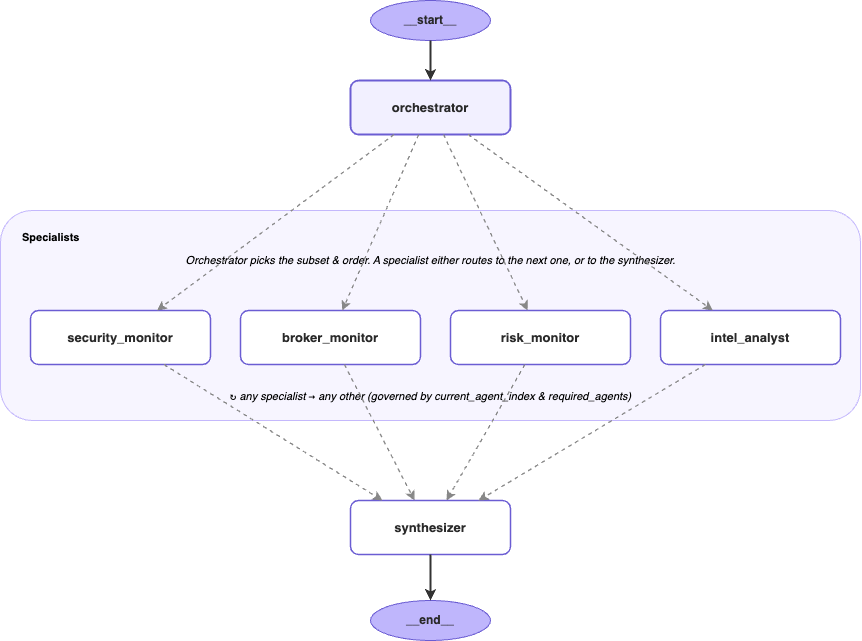
用于市场分析 Agent 的 LangGraph 工作流编排
为什么要结合 LangGraph 和 Strands
许多企业用例必须以严格、预定义的工作流为基础。完全依赖 LLM 的非确定性特征来执行正确步骤存在风险。然而,这些工作流中的某些特定步骤确实需要具备 LLM 智能的敏捷推理能力。
LangGraph 与 Strands 的组合弥合了这一差距。你可以用它构建这样一种系统:确定性的编排承载局部化的动态智能。
以下是这一架构组合如何解决复杂工作流挑战:
节点级智能:LangGraph 定义工作流的高层编排。Strands Agent 被部署在特定节点中,即复杂工作流可能需要 LLM 分析或处理模糊性的地方。它们仅在严格需要这种灵活性的环节应用自主推理和工具使用能力。
通过节点化 Agent 实现上下文隔离:单体 Agent 很容易遗失对其指令的跟踪。将独立的 Strands Agent 放置在不同的 LangGraph 节点中,可以实现记忆分区。每个 Agent 管理自身高度聚焦的上下文和工具调用历史,而 LangGraph 则维护结构化的全局会话状态,不同 Agent 可独立更新和引用该状态。
增强编排能力:LangGraph 的核心是一个低层级路由与编排工具。通过嵌入 Strands,你可以立即将一个全面的企业级 Agent 框架接入图中。在获得 LangGraph 稳健路由能力的同时,你还能获得 Strands 原生的 Model Context Protocol(MCP)集成、引导控制、安全护栏和评估能力。
具体而言,每个专业 Agent 都是一个 LangGraph 节点。该节点会启动一个全新的 Strands Agent,并为其提供独立的系统提示词、工具和隔离上下文。它执行编排器分配的任务,并返回状态更新。LangGraph 将该部分更新合并到其他节点可读取的共享状态中。以下是安全监控节点:
async def security_monitor_node(state: AgentState) -> AgentState:
    """
    Single-day activity analyst agent that assesses price, volume and tick-level trades
    """
    agent = Agent(
        name="security_monitor",
        model=analyst_model,
        system_prompt=SECURITY_MONITOR_PROMPT,
        tools=[get_report_list, get_report_schema, run_report],
        callback_handler=None,
    )

    # Pull this node's task from the shared state the orchestrator populated.
    task = state.get("agent_task_map", {}).get("security_monitor", state["query_text"])

    # Strands runs its own reasoning + tool loop
English / 原文
As artificial intelligence applications evolve from simple chatbots to sophisticated autonomous systems, organizations face new challenges in orchestrating complex multi-agent workflows that can handle real-world production scenarios. Traditional single-agent approaches often fall short when dealing with intricate business processes that require specialized expertise, dynamic decision-making, and robust error recovery mechanisms. The financial services industry exemplifies this challenge. Market surveillance systems must coordinate multiple specialized agents to analyze trading patterns, investigate suspicious activities, and generate comprehensive reports while maintaining strict compliance and reliability standards.
The solution combines two frameworks: LangGraph for macro-level workflow orchestration and Strands for intelligent agent reasoning. LangGraph excels at managing state and directed graphs for multi-agent coordination. It gives you fine-grained control over both workflow execution and state that can be shared between agents. Its central persistence layer supports features critical for production, including human-in-the-loop interactions and robust checkpoint-based recovery from failures. Meanwhile, Strands Agent serves as the reasoning engine within individual workflow nodes. It offers model-agnostic capabilities that integrate with various large language model (LLM) providers while maintaining flexible tool integration and comprehensive observability.
With the release of Amazon Bedrock AgentCore last year, productionizing an agentic solution might be simplified for many use cases. The combination provides a strong foundation for production-ready agentic AI systems that can handle complex use cases while helping to deliver the infrastructure reliability and observability that enterprise applications demand.
In this post, we demonstrate how to architect and deploy a multi-agent AI system using LangGraph and Strands on AWS infrastructure. You learn how to implement state-driven workflow orchestration with LangGraph’s checkpoint system, integrate Strands agents for specialized reasoning tasks, and use AgentCore for scalable production deployment. The complete solution is available on GitHub.
Strands: Intelligent agent reasoning
Strands Agent operates on a model-agnostic architecture that adapts to your existing infrastructure without imposing architectural constraints. The agent implements an agentic reasoning loop that continuously evaluates tool outputs and makes decisions based on intermediate results, so you can build sophisticated multi-step analysis workflows. The framework includes comprehensive session and state management and multiple conversation managers to keep your context window from overflowing.
With Strands, you can configure external tool interactions by defining tool schemas and access patterns. For our surveillance agent, we separate the discovery of data from the retrieval to avoid hallucinations and strengthen the solution against injection attacks. We use tools like get_report_list and get_report_schema to find reports and run_report to build the SQL query with validated parameters and run it.
We create a security_monitor agent with the following tools and a system prompt:
from strands import Agent, tool
from strands.models.bedrock import BedrockModel

model = BedrockModel(
    model_id="us.anthropic.claude-sonnet-4-6",
    region_name="us-east-1",
    max_tokens=16000,
    additional_request_fields={
        "thinking": {"type": "adaptive", "budget_tokens": 8000},
    },
    cache_prompt="default",
)

@tool
def get_report_list(agent_name: str) -> str:
    """Load the list of available reports for a specific agent.

    Args:
        agent_name: Name of the agent (e.g. 'security_monitor').

    Returns:
        str: JSON array of report objects with name and description.
    """
    reports_data = load_agent_reports(agent_name)
    return json.dumps(reports_data["reports"], indent=2)

@tool
def get_report_schema(report_name: str, query_intent: str) -> str:
    """Load column definitions for a report so you can build queries.

    Args:
        report_name: Name of the report (e.g. 'TradeActivity').
        query_intent: Description of what data to extract.

    Returns:
        str: JSON object with parameters and column definitions.
    """
    return json.dumps(load_json_report_definition(report_name), indent=2)

@tool
def run_report(
    report_name: str,
    filters: Dict[str, Any],
    limit: Optional[int] = None,
) -> Dict[str, Any]:
    """Run a predefined report. The tool validates every filter against the
    report's schema and builds a parameterised SQL query. The LLM never writes
    raw SQL, so filter values cannot be injected into the query.

    Args:
        report_name: A report from `get_report_list` (e.g. 'TradeActivity').
        filters: Equality filters keyed by column name, e.g.
            {"symbol": "AAPL", "date": "2024-03-15"}.
        limit: Optional row cap (1..10000).

    Returns:
        dict: {'success': bool, 'data': str (CSV), 'error': str or None}
    """
    schema = load_json_report_definition(report_name)
    allowed_columns = {c["name"] for c in schema["columns"]}

    # Reject any filter field that is not in the report's allowed list of columns.
    unknown = set(filters) - allowed_columns
    if unknown:
        raise ValueError(
            f"Unknown filter field(s) {sorted(unknown)} for {report_name}. "
            f"Allowed: {sorted(allowed_columns)}"
        )

    # Build SQL with named bind parameters.
    where = " AND ".join(f"{field} = :{field}" for field in filters)
    sql = f"SELECT * FROM {schema['reportName']}"
    if where:
        sql += f" WHERE {where}"
    if limit is not None:
        if not isinstance(limit, int) or not 1 <= limit <= 10_000:
            raise ValueError("limit must be an integer in [1, 10000]")
        sql += f" LIMIT {limit}"

    return query_market_data(report_name=report_name, sql=sql, bind=filters)

security_monitor = Agent(
    model=model,
    system_prompt=SECURITY_MONITOR_PROMPT,
    tools=[get_report_list, get_report_schema, run_report],
    name="security_monitor",
)
LangGraph: Macro workflow orchestration
LangGraph provides production-grade orchestration for multi-agent systems through three core capabilities that make it well-suited for complex AI workflows.
Graph-based state machines : LangGraph models agent workflows as directed graphs where nodes represent functions containing agent logic, and edges determine execution flow. This declarative approach transforms complex multi-step reasoning into readable, maintainable code. Graphs support conditional branching, parallel execution, and dynamic routing. These capabilities are important for real-world scenarios where workflows adapt based on intermediate results.
Persistent state management : The framework’s checkpoint system automatically snapshots complete workflow state after every node execution. With these checkpoints, you can recover smoothly from failures and support human-in-the-loop interactions. When analysts need to review intermediate results or errors occur, the system restores from the exact checkpoint. It then resumes without losing previous work. This stateful architecture supports commonly used patterns like multi-turn conversations, iterative refinement, and long-running investigations that span hours or days.
Production reliability: LangGraph includes built-in retry strategies with exponential backoff for handling throttling or other failures that might occur in your system. It also provides comprehensive observability through OpenTelemetry for straightforward integration with most observability applications.
Let’s build an orchestration layer that routes queries between our specialist Strands agents. The following code defines our workflow graph: a shared state, an orchestrator that selects which specialist agents to invoke, conditional routing between them, and checkpoint-backed persistence for recovery and human-in-the-loop review.
from typing import TypedDict, Optional, List, Dict, Any
from langgraph.graph import END, StateGraph
from langgraph_checkpoint_aws import AgentCoreMemorySaver

class AgentState(TypedDict):
    query_text: str
    session_id: Optional[str]
    agent_task_map: Optional[Dict[str, str]]
    required_agents: Optional[List[str]]
    current_agent_index: Optional[int]
    # Each specialist writes its insights here
    security_monitor_insights: Optional[Dict[str, Any]]
    broker_monitor_insights: Optional[Dict[str, Any]]
    risk_monitor_insights: Optional[Dict[str, Any]]
    intel_analyst_insights: Optional[Dict[str, Any]]
    synthesizer_insights: Optional[str]

SPECIALIST_NODES = {
    "security_monitor": security_monitor_node,
    "broker_monitor": broker_monitor_node,
    "risk_monitor": risk_monitor_node,
    "intel_analyst": intel_analyst_node,
}

def route_analysts(state: AgentState) -> str:
    """Dynamic routing --- walk the required_agents list by index."""
    required = state.get("required_agents", [])
    index = state.get("current_agent_index", 0)
    if not required:
        return END
    if index < len(required):
        return required[index]
    return "synthesizer"

# Build the graph
workflow = StateGraph(AgentState)
workflow.add_node("orchestrator", orchestrator_node)
for name, node_fn in SPECIALIST_NODES.items():
    workflow.add_node(name, node_fn)
workflow.add_node("synthesizer", synthesizer_node)
workflow.set_entry_point("orchestrator")

# Conditional edges --- the orchestrator and every specialist route through route_analysts, which can hand off to any specialist or the synthesizer.
ALL_TARGETS = {name: name for name in SPECIALIST_NODES} | {
    "synthesizer": "synthesizer",
    END: END,
}
workflow.add_conditional_edges("orchestrator", route_analysts, ALL_TARGETS)
for name in SPECIALIST_NODES:
    workflow.add_conditional_edges(name, route_analysts, ALL_TARGETS)
workflow.add_edge("synthesizer", END)

# AgentCoreMemorySaver checkpoints the state after every node
checkpointer = AgentCoreMemorySaver(MEMORY_ID, region_name=REGION)
graph = workflow.compile(checkpointer=checkpointer)
LangGraph workflow orchestration for the market analysis agent
Why LangGraph and Strands together
Many enterprise use cases must be grounded in strict, predefined workflows. Relying purely on the non-deterministic nature of an LLM to execute the right steps is a risk. However, specific steps within those workflows do require the agile reasoning with the intelligence of the LLM.
The combination of LangGraph and Strands bridges this gap. You can use it to build systems where deterministic orchestration houses localized, dynamic intelligence.
Here is how this architectural pairing solves complex workflow challenges:
“Node” level intelligence : LangGraph defines the higher-level orchestration for the workflow. Strands agents are placed at specific nodes, where a complex workflow might require LLM analysis or navigating ambiguity. They apply autonomous reasoning and tool use only where that flexibility is strictly required.
Context isolation with nodal agents : Monolithic agents easily lose track of their instructions. By placing individual Strands agents inside separate LangGraph nodes, you compartmentalize memory. Each agent manages its own hyper-focused context and tool history, while LangGraph maintains a structured, overarching session state that these different agents can update and reference independently.
Supercharging orchestration : At its core, LangGraph is a low-level routing and orchestration tool. By embedding Strands, you instantly plug a comprehensive enterprise agent framework into your graph. You get the robust routing of LangGraph alongside Strands’ native Model Context Protocol (MCP) integrations, steering controls, safety guardrails, and evaluation.
Concretely, each specialist is a LangGraph node. The node spins up a fresh Strands agent with its own system prompt, tools, and isolated context. It runs the task the orchestrator assigned and returns a state update. LangGraph merges that partial update into the shared state the other nodes read from. Here is the security monitor node:
async def security_monitor_node(state: AgentState) -> AgentState:
    """
    Single-day activity analyst agent that assesses price, volume and tick-level trades
    """
    agent = Agent(
        name="security_monitor",
        model=analyst_model,
        system_prompt=SECURITY_MONITOR_PROMPT,
        tools=[get_report_list, get_report_schema, run_report],
        callback_handler=None,
    )

    # Pull this node's task from the shared state the orchestrator populated.
    task = state.get("agent_task_map", {}).get("security_monitor", state["query_text"])

    # Strands runs its own reasoning + tool loop; collect the agent's final text.
    chunks = []
    async for event in agent.stream_async(task):
        if "data" in event:
            chunks.append(event["data"])
    result = "".join(chunks)

    # Return shared state updates
    return {
        "security_monitor_insights": {"task": task, "business_insights": result},
        "current_agent_index": state.get("current_agent_index", 0) + 1,
    }
AWS infrastructure and deployment with AgentCore
Amazon Bedrock AgentCore provides a fully managed service for deploying and operating agents at scale, alleviating infrastructure management while delivering production-grade capabilities.
Runtime deployment: AgentCore runtime, a capability of Amazon Bedrock AgentCore, transforms local agent code into cloud-native deployments with minimal configuration. The service is framework agnostic and works with LangGraph and Strands out of the box. It provides purpose-built infrastructure for dynamic agent workloads, including extended runtimes for long-running investigations, low-latency execution for interactive workflows, and automatic scaling based on demand.
Deploy your LangGraph orchestrator and Strands agents using the AgentCore Python SDK, a capability of Amazon Bedrock AgentCore, and the starter toolkit. The runtime handles containerization, networking, and compute provisioning automatically. AgentCore handles the undifferentiated heavy lifting of container orchestration, scaling, and session management.
# api.py --- AgentCore runtime entry point
from bedrock_agentcore.runtime import BedrockAgentCoreApp
from src.agents import Workflow

app = BedrockAgentCoreApp()
workflow = Workflow()

@app.entrypoint
async def market_surveillance_workflow(payload):
    """Invoked by AgentCore for each request. Yields streaming chunks."""
    prompt = payload.get("prompt")
    session_id = payload.get("session_id", "default-session")
    actor_id = payload.get("actor_id", "default-actor")
    async for chunk in workflow.stream_query(
        session_id=session_id, prompt=prompt, actor_id=actor_id
    ):
        yield chunk

if __name__ == "__main__":
    app.run()

# Deploy with the AgentCore starter toolkit
from bedrock_agentcore_starter_toolkit import Runtime

runtime = Runtime()
runtime.configure(
    entrypoint="api.py",
    auto_create_execution_role=True,
    auto_create_ecr=True,
    requirements_file="requirements.txt",
    region="us-east-1",
    agent_name="market_surveillance_workflow",
)
result = runtime.launch()
print(f"Agent ARN: {result.agent_arn}")

# Invoke the deployed agent
import boto3, json

client = boto3.client("bedrock-agentcore", region_name="us-east-1")
response = client.invoke_agent_runtime(
    agentRuntimeArn=result.agent_arn,
    qualifier="DEFAULT",
    payload=json.dumps({
        "prompt": "What caused the AAPL price spike at 11:00 AM on March 15, 2024?",
        "session_id": "session-001",
        "actor_id": "analyst-jane",
    }),
)

# AgentCore returns a server-sent-events stream. Parse it:
for raw in response["response"].iter_lines():
    if not raw:
        continue
    line = raw.decode("utf-8") if isinstance(raw, bytes) else raw
    if not line.startswith("data: "):
        continue
    try:
        chunk = json.loads(line[6:])
        if isinstance(chunk, str) and chunk.startswith("data: "):
            chunk = json.loads(chunk[6:])
    except json.JSONDecodeError:
        continue  # malformed chunk --- skip, don't crash
    if isinstance(chunk, dict) and chunk.get("type") == "text":
        print(chunk["content"], end="")
Memory integration: LangGraph integrates with AgentCore memory, a capability of Amazon Bedrock AgentCore, through the langgraph-checkpoint-aws package with a few lines of code, providing both short-term checkpoint persistence and intelligent long-term memory retrieval.
The AgentCoreMemorySaver class, used in this example, handles checkpoint objects containing user messages, AI responses, graph execution state, and metadata. After each node completion, LangGraph automatically saves checkpoints to AgentCore memory. You get stateful conversations and workflow recovery without managing Amazon DynamoDB tables or implementing custom serialization logic.
The AgentCoreMemoryStore class provides intelligent memory capabilities where AgentCore automatically extracts insights, summaries, and user preferences from conversations. Agents can search through these memories in future interactions, so you can deliver personalized experiences that improve over time. This addresses the fundamental challenge of agent statelessness: each interaction builds upon previous knowledge rather than starting fresh.
import boto3, time

REGION = "us-east-1"
control_client = boto3.client("bedrock-agentcore-control", region_name=REGION)

response = control_client.create_memory(
    name="MarketSurveillanceMemory",
    description="Memory for market surveillance multi-agent workflow.",
    eventExpiryDuration=90,  # days
)
MEMORY_ID = response["memory"]["id"]
print(f"Memory ID: {MEMORY_ID}")

# Wait for ACTIVE, with a 10-minute deadline. Creation normally takes 1-3 min.
deadline = time.time() + 600
while True:
    status = control_client.get_memory(memoryId=MEMORY_ID)["memory"]["status"]
    if status == "ACTIVE":
        break
    if status == "FAILED" or time.time() >= deadline:
        raise RuntimeError(f"Memory {MEMORY_ID} is {status!r} (expected ACTIVE)")
    time.sleep(10)
On graph build:
checkpointer = AgentCoreMemorySaver(MEMORY_ID, region_name=REGION)
graph = workflow.compile(checkpointer=checkpointer)
On invocation, pass thread_id and actor_id to the agent. These are unique identifiers for the user and session:
config = {
    "configurable": {
        "thread_id": "surveillance-session-001",
        "actor_id": "analyst-jane",
    }
}

response = await graph.ainvoke(
    {"query_text": "Which brokers were most active?"},
    config=config,
)
Observability and operations: AgentCore includes built-in observability through integration with Amazon CloudWatch and AWS X-Ray, capturing agent execution traces, tool invocations, and performance metrics. The service provides dashboards for monitoring agent behavior, identifying bottlenecks, and optimizing costs. Combined with LangGraph’s OpenTelemetry events, you gain comprehensive visibility from high-level workflow orchestration down to individual LLM calls and reasoning steps.
Conclusion
In this post, we showed how to build production-ready multi-agent AI systems by combining LangGraph’s robust workflow orchestration with Strands’ intelligent agent reasoning capabilities, deployed on AWS infrastructure.
The hybrid architecture we explored demonstrates how LangGraph excels at macro-level orchestration (managing agent coordination, state persistence, and workflow recovery) while Strands provides the detailed reasoning engine within individual nodes. With this separation of concerns, you can build sophisticated systems that handle complex business processes while maintaining production reliability through checkpoint-based recovery and comprehensive observability.
Consider extending this architecture for other complex orchestration scenarios such as document processing pipelines, customer service automation, or compliance monitoring systems. The model-agnostic nature of Strands combined with LangGraph’s state management makes this pattern particularly valuable for enterprise applications requiring both flexibility and reliability.
To dive deeper into the technical implementation details and build a market analysis agent yourself, see the GitHub repository.
About the authors
Gleb Geinke
Gleb is a Deep Learning Architect at the AWS Generative AI Innovation Center. Gleb collaborates directly with enterprise customers to design and scale transformational generative AI solutions for complex business challenges.
Siddhesh Tiwari
Siddhesh is a Data Scientist at AWS Professional Services. He works with enterprise customers to design and deliver generative AI, agentic AI, and machine learning solutions on AWS.
Wang Teng Lee
Wang Teng is a Delivery Consultant with AWS Professional Services, specializing in AI and agentic solutions. He works hands-on with customers across the full delivery lifecycle – architecture, development, and deployment – and stays on the leading edge of AI, exploring how emerging technologies can simplify the way we live and work.
Efren Faderanga
Efren Faderanga is a Delivery Consultant at AWS Professional Services, building the infrastructure that makes agentic AI systems production-ready. He specialises in multi-agent orchestration, CI/CD pipelines, and the serverless, event-driven foundations that autonomous systems run on. His work focuses on bridging the gap between AI engineering and production infrastructure.