本体论强势回归:AI Agent 为何正在复兴语义 Web
英文标题:Ontologies Are So Back: Why AI Agents Are Reviving the Semantic Web
UC Berkeley 教授 Frank Coyle 在 AI Engineer World’s Fair 上重新向 AI 工程师介绍本体论,认为它可为具备概率性推理能力的 LLM Agent 提供确定性的逻辑护栏。Neo4j 则提出由业务本体、技术本体和执行轨迹组成的共享语义层,让轻量 Agent 能够在统一的数据与知识基础上规模化运行。本体论的结构化规则、知识图谱和 OWL 推理能力,可用于验证 Agent 推理、约束循环执行并降低偏航风险。尽管本体维护仍是难题,业界正探索让 Agent 在自身运行过程中持续更新本体,这或将推动语义 Web 技术在 AI 工程中的复兴。
 1.5 KB
 2.2 KB
 1.3 KB
 125.4 KB
 82.4 KB
 89.7 KB
 200.6 KB
 202.2 KB
 83.6 KB
 1.4 KB
中文
近期 AI Engineer World’s Fair 上最受关注的视频之一,是 UC Berkeley 当前教授生成式 AI 与 LLM 的计算机科学教授 Frank Coyle 的一场 20 分钟演讲。凭借数十年的经验,Coyle 向当今 AI 工程师重新介绍了本体论(ontology)的概念与实践。
Coyle 认为,尽管 LLM 非常擅长提供概率性推理,但要让 Agent 系统真正有效,就需要“逻辑护栏”——而他所说的护栏正是本体论。
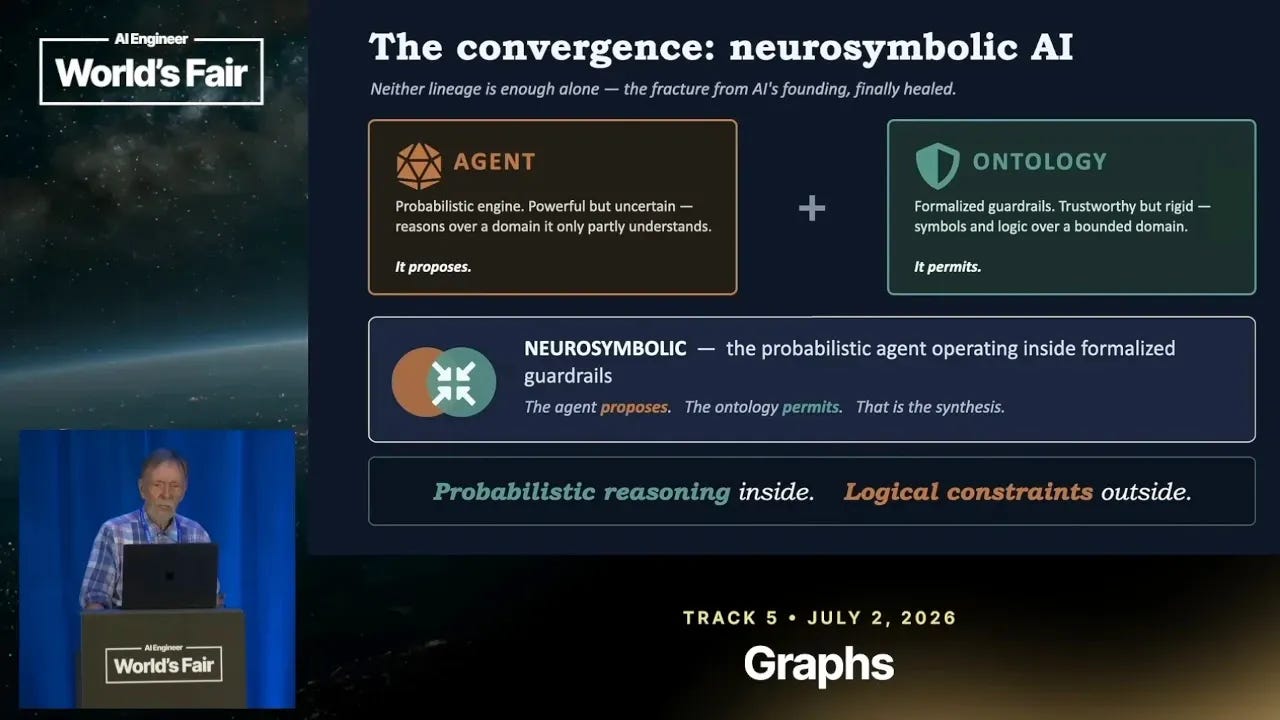
在计算机科学中,本体论是“对数据结构的描述——即某一知识领域中的类别、属性和关系”(Oxford Semantic Technologies 对其作出了恰当定义)。**Coyle 自己则将本体论简单定义为“作为图的数据(data as graphs)”。**他补充说,作为概念的本体论可追溯至亚里士多德,并且贯穿人工智能的发展历史。
以图数据库系统闻名的 Neo4j,也在其 Agent 产品中使用本体论。
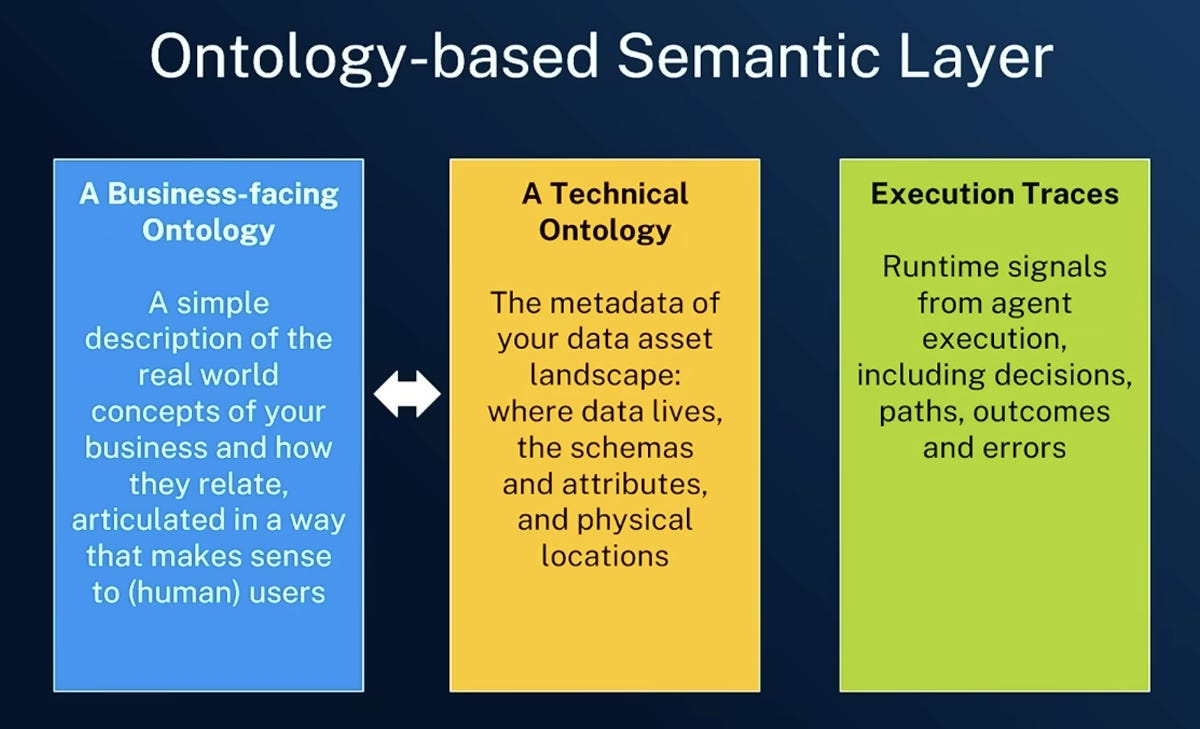
在 AIEWF 的一场主题演讲中,Neo4j CEO Emil Eifrem 谈到了用于构建“更智能的共享底层基础(smarter shared substrate)”、从而支持 Agent 规模化运行的三类不同本体论。第一类是面向业务的本体论,用于描述组织中的关键概念;第二类是技术本体论,Eifrem 将其描述为“企业生态系统中所有数据源和数据资产的全部元数据”;最后一类是执行轨迹,即“来自 Agent 的运行时信号”。
Frank Coyle 认为,Web 本体论尤其适合用于构建 Agent 系统。他提到了 Schema.org、FOAF、Dublin Core,以及其他 Web 开发者熟悉的本体论——至少是有一定资历的 Web 开发者会熟悉的本体论。他还提到 RDFS(Resource Description Framework Schema,资源描述框架模式)和 OWL(Web Ontology Language,Web 本体语言)等“增强技术”。
使用这些既有本体论的一个好处是,它们已经存在于 LLM 的训练数据中,因此开发者只需通过提示词调用它们——这比从第一性原理重新发明本体论要好得多。
Coyle 表示:“这些东西一直都存在,并支撑着我们已经在做的很多事情。所以,要充分利用这些已经存在的东西。”
作为示例,他展示了一个 Claude Agent 循环:该循环在工具运行完成后,利用本体论帮助验证 LLM 的推理结果。
Coyle 将概率型 Agent 与本体论的融合称为“神经符号 AI(neurosymbolic AI)”。
“听起来很高深,”他说,“但它其实就是与符号 AI 相连接的神经网络——基于规则的系统属于这一类别,我们构建的知识图谱也是如此。”
他再次强调,神经符号 AI 是“让 LLM 保持在护栏之内的一种方式”。
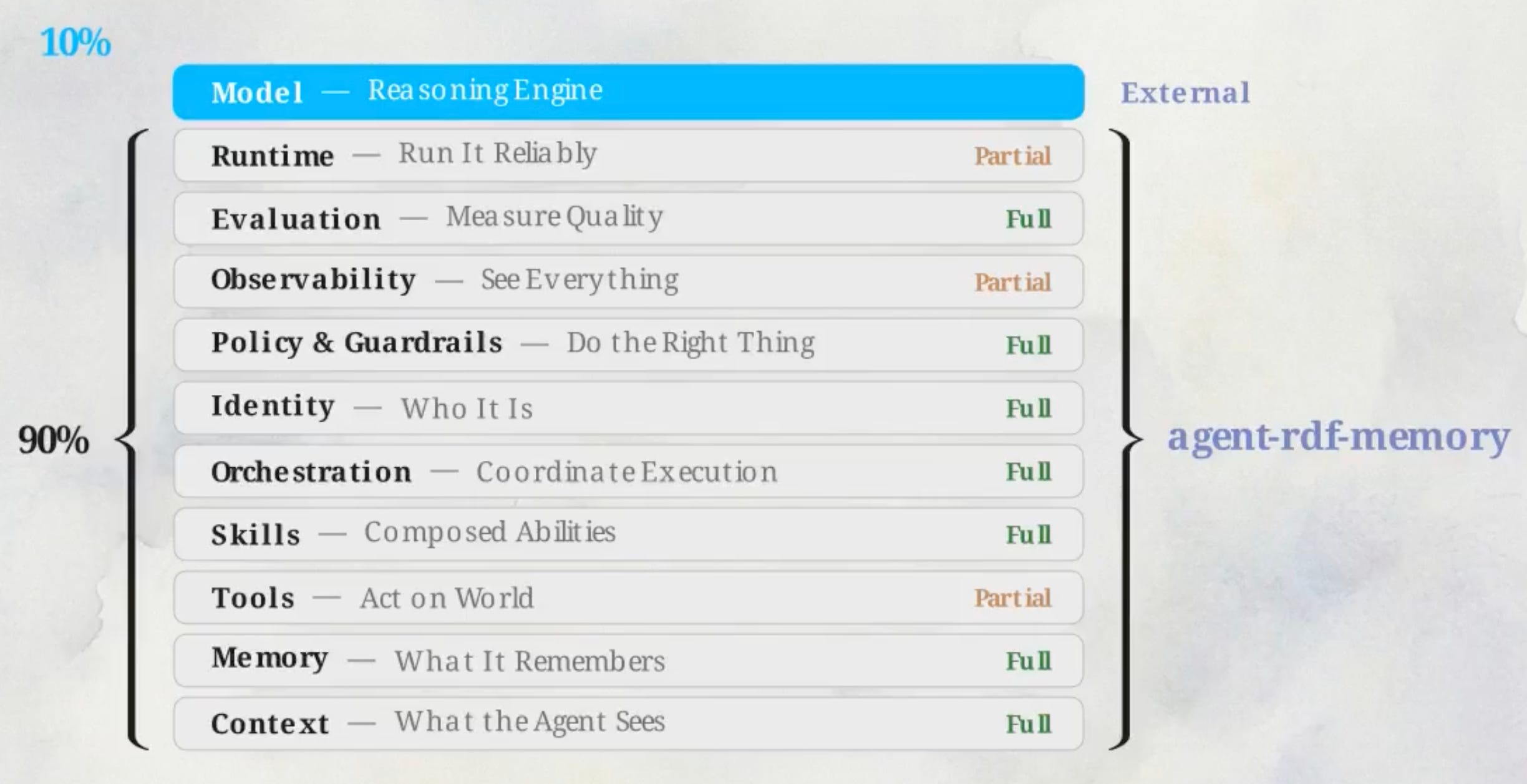
另一位长期深耕本体论、如今正将其与 AI 工程结合的人是 Kingsley Idehen。他经营着一家名为 OpenLink Software 的公司,一直在构建采用语义 Web 技术的“Agent 工程技术栈”——其中包括“拥有 RDF 记忆的 Agent”。
我请 Idehen 向我解释本体论的益处。
“LLM 的美妙之处在于,它们是强大的语言处理器,”他回答道。“**本体论的美妙之处在于,它定义了实体类型和关系,语言正是通过这些类型和关系获得可计算的上下文。**两者结合,便将语言的表达能力带入计算的 UI/UX 技术栈。”
这很有道理;但如果你从事 Web 开发已有一段时间,就会了解本体论所面临的挑战:维护,以及保持其持续更新。这也是基于本体论的“语义 Web(Semantic Web)”愿景——曾在 1990 年代和 2000 年代受到推崇——始终未能真正起飞的原因。
嵌入内容:如果你不到 40 岁,甚至没资格讨论本体论。发布时间:2026 年 7 月 26 日凌晨 12:29;浏览量:357;1 条回复;9 个赞。
当代 AI 开发者 Prasenjit Sarkar 在 X 上为维护问题提出了一种潜在解决方案。他认为,**“当 Agent 将维护本体论作为自身运行的一部分,并在遇到边界情况时更新定义,维护问题的性质就会发生变化。”**不过,他补充说,这仍然是一个困难的问题。
尽管存在这些问题,本体论的结构化特性似乎确实很适合约束概率型 LLM 偶尔失控的倾向。你能获得 LLM 的能力,但本体论会让它们保持受控。
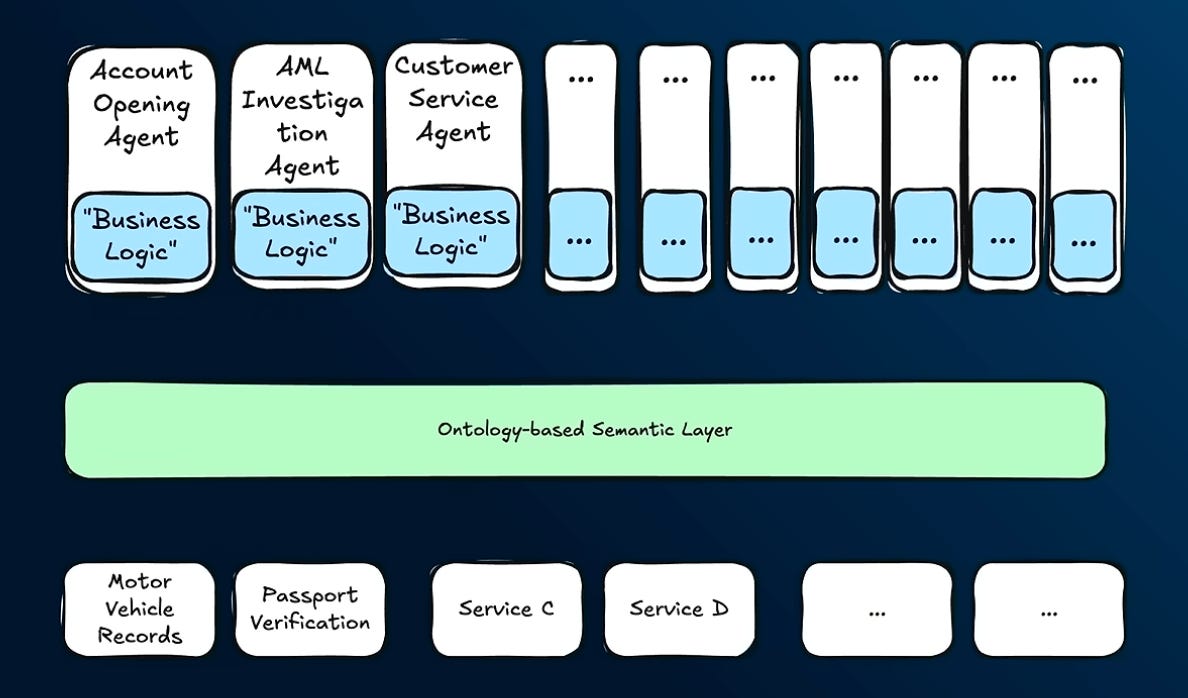
此外,正如 Neo4j 的 Eifrem 所解释的,本体论让我们能够从“拥有手动连接数据源的厚重 Agent 的世界”,迈向一个新世界:在“更智能、基于本体论的共享语义层”上运行轻量 Agent。
回到 Coyle 的演讲。他还就循环工程(loop engineering)提出了一个很好的观点:他指出,循环“在计算机科学中一直都存在”。当然,问题在于,循环可能会中断,或者以其他方式“脱轨”。
同样,本体论系统可以在这里充当概率型 LLM 的护栏。Coyle 的一页幻灯片将其称为:“围绕无界循环的一组有界规则(a bounded set of rules around an unbounded loop)。”
在演讲接近尾声时,Coyle 演示了如何使用 OWL 来检查 Agent。一页幻灯片指出,虽然语言可能含糊不定,但“OWL 公理是机器会强制执行的规则”。
他还展示了“可以构建一个基于本体论的推理器,用来检查[并]让 LLM 保持在正确轨道上——设置护栏来确保它诚实运行”。
本体论或许正开始引起 AI 工程师的共鸣,因为当下的一个核心关注点,是如何对循环工程进行质量控制。我们曾看到这场辩论在 AIEWF 上展开:许多会议演讲者尚不愿完全押注于全自动化的“软件工厂”。该活动的一项关键收获是,系统需要护栏,也需要人类参与闭环。
同样值得关注的是,传统 Web 技术正在 AI 工程领域复兴,尤其是在 2025 年“vibe coding(氛围编程)”趋势让人们觉得任何人都能创建软件之后。当然,此后人们已经意识到一个现实:我们需要维护这些软件,并确保它们不会出错!因此,在 2026 年,我们正看到软件工程纪律的回归——其中也包括 Web 本体论的复兴,它被用来确保概率型 LLM 保持可信和受控。
English / 原文
One of the most watched videos from the recent AI Engineer World’s Fair is a 20-minute talk by Frank Coyle , a professor of computer science who currently teaches generative AI and LLMs at UC Berkeley. Drawing on his decades of experience, Coyle re-introduced the concept and practice of ontologies to today’s AI engineers.
Coyle argued that while LLMs are very effective at providing probabilistic reasoning, for agentic systems to be truly effective they need “logical guardrails” — by which he means ontologies.
UC Berkeley professor Frank Coyle speaking at AIEWF 2026.
In computer science, an ontology is “a description of data structure – of classes, properties, and relationships in a domain of knowledge” (as nicely defined by Oxford Semantic Technologies). Coyle himself defined an ontology as simply “data as graphs.” He added that ontologies as a concept go right back to Aristotle, and have been used throughout the history of Artificial Intelligence.
The company Neo4j, known for its graph database systems, is also using ontologies in its agentic products.
In a keynote session at AIEWF, Neo4j CEO Emil Eifrem talked about three different types of ontologies to enable a “smarter shared substrate” to run agents at scale. The first is a business-facing ontology, describing the key concepts in an organization; next is a technical ontology, which Eifrem described as “all the metadata of all the data sources and data assets in your enterprise ecosystem”; and finally execution traces, which are “the runtime signals out of your agent.”
Neo4j’s ontology-based semantic layer
Frank Coyle thinks web ontologies are especially useful in building agentic systems. He mentioned Schema.org, FOAF, Dublin Core and other ontologies familiar to web developers — or at least, those of a certain vintage. He also mentioned “augmenting technologies” like RDFS (Resource Description Framework Schema) and OWL (Web Ontology Language).
One benefit of using these established ontologies is that they’re already in the training data of LLMs, so developers can just prompt for them — much better than reinventing ontologies from first principles.
“This stuff has been out there underlying a lot of what we already do,” Coyle said. “So take advantage of these things that already exist.”
As an example, he showed a Claude agent loop which used an ontology to help validate the LLM’s reasoning after the tool had run.
Coyle calls the convergence of probabilistic agents with ontologies “neurosymbolic AI.”
“Sounds pretty fancy,” he said, “but it’s really neural networks tied into symbolic AI — rule-based systems come under that category, as do the knowledge graphs that we’re assembling.”
He reiterated that neurosymbolic AI represents “a way to keep the LLM on its guardrails.”
Someone who has been steeped in ontologies for many years and is now combining that with AI engineering is Kingsley Idehen , who runs a company called OpenLink Software. He’s been building an “agent engineering stack” that uses Semantic Web technologies — including an “agent with RDF memory.”
Kingsley Idehen’s agent-rdf-memory system.
I asked Idehen to explain to me the benefits of ontologies.
“The beauty of LLMs is that they are powerful processors of language,” he replied. “The beauty of an ontology is that it defines the types of entities and relationships through which language acquires computable context. Together, they bring the expressive power of language to computing’s UI/UX stack.”
That makes a lot of sense, but if you’ve been a web developer for a while you’ll know the challenges of ontologies: maintenance and keeping them up-to-date. It’s why the 1990s and 2000s vision for a “Semantic Web” — which was based on ontologies — never took off.
[you have to be over 40 to even discuss ontologies12:29 AM · Jul 26, 2026 · 357 Views
1 Reply · 9 Likes](https://x.com/lux/status/2081175084145021293)
Current AI developer Prasenjit Sarkar offered a potential solution for the maintenance problem on X, arguing that “when an agent maintains the ontology as part of its own operation , updating definitions when it encounters edge cases, the maintenance problem changes character.” It’s still a hard problem though, he added.
Despite these issues, the structured nature of ontologies does appear to be a good match with the occasionally wayward tendencies of probabilistic LLMs. You get the power of LLMs, but ontologies will keep them in check.
Plus, as Neo4j’s Eifrem explained, ontologies allow us to move from “a world of thick agents with manually wired data sources” to a new world of “thin agents on a smarter shared ontology-based semantic layer.”
Neo4j’s “thin agents” concept, which relies on ontologies.
Back to Coyle’s presentation. He also had a great point about loop engineering, which he noted “has been around forever” in computer science. The problem, of course, is that loops can break or otherwise “go off the rails.”
Again, this is where an ontology system can act as a guardrail to a probabilistic LLM. One of Coyle’s slides referred to it as “a bounded set of rules around an unbounded loop.”
Near the end of his presentation, Coyle demonstrated how to use OWL as a check on agents. One slide showed that while language can be slippery, “an OWL axiom is a rule a machine enforces.”
He also showed how “you can have a reasoner built on ontology, to check [and] keep the LLM on track — have guardrails to keep it honest.”
Perhaps ontologies are starting to resonate with AI engineers because a central concern at this time is quality control for loop engineering. We saw this debate play out at AIEWF, with many conference speakers not willing to go all-in on fully automated “software factories” just yet. One of the key learnings from the event was that there need to be guardrails and humans in the loop.
Also it’s fascinating to see traditional web technologies make a resurgence in the field of AI engineering, especially after the 2025 trend of “vibe coding” made it seem like anyone could create software. Of course, since then the penny has dropped: we need to maintain that software and make sure it doesn’t break! So in 2026, we’re seeing a return to software engineering discipline — including now a revival of web ontologies as a way to keep probabilistic LLMs honest.