🔶 Orchard:面向可扩展 Agentic AI 的开放框架
英文标题:🔶 Orchard: An open framework for scalable agentic AI
微软推出开源框架 Orchard,其核心 Orchard Env 是基于 Kubernetes 的轻量级环境服务,可在软件工程、网页导航和个人助理等任务中复用,用于数据收集、强化学习 rollout 与评测。Orchard-SWE 仅使用约 30 亿活跃参数,在 SWE-bench Verified 上达到 69.7%,经价值模型重排序后达到 73.0%,接近模型规模大十倍以上的前沿系统。Orchard-GUI 以有限监督数据训练 40 亿参数视觉语言模型,在三项网页导航基准上取得 68.4% 的平均成功率;Orchard-Claw 则展示了在真实 Agent harness 中训练个人助理的效果。该项目同时开放训练数据、评测方法和训练流程,旨在降低开发者和研究团队构建、复现及迭代开放 Agent 系统的基础设施门槛。
 4.0 KB
 1.0 MB
 210.4 KB
 458.5 KB
 141.5 KB
 24.8 KB
 105.7 KB
 15.0 KB
 194.2 KB
 26.2 KB
 50.1 KB
 169.1 KB
 156.2 KB
 22.5 KB
 426.4 KB
 104.0 KB
 168.4 KB
 764 B
 741.2 KB
中文

要点速览
- Orchard 是一个面向可扩展且具成本效益的 Agentic AI 研究的开源框架,围绕 Orchard Env 构建;后者是一项可复用的环境服务,可用于在不同任务领域中训练和评估 Agent。
- 同一套 Orchard 基础设施可支持软件工程、网页导航和个人助理 Agent,并能直接在 Codex、OpenClaw 和 ZeroClaw 等真实部署 harness 中训练它们,使研究人员能够在不同任务之间复用环境、数据流水线和评测工作流。
- Orchard-SWE、Orchard-GUI 和 Orchard-Claw 表明,相对较小的开放权重模型也能在复杂的真实世界任务上取得强劲结果。例如,Orchard-SWE 在 SWE-bench Verified 上达到 69.7%,使用价值模型重排序后达到 73.0%;其仅使用约 30 亿活跃参数,已接近模型规模大十倍以上的前沿系统。
除模型与工作流外,该项目还发布了训练数据和评测方法,旨在帮助更广泛的研究社区构建和研究开放的 Agentic 系统。人工智能正在迅速超越静态问答,迈向能够在复杂、多步骤环境中规划、推理和行动的自主 Agent。这类系统可以修复复杂代码库中的漏洞、代替用户浏览网页,以及管理涉及日历和电子邮件的工作流。
尽管人们对 Agentic AI 的能力充满期待,研究社区仍面临一个长期瓶颈:构建最先进的 Agentic 系统通常需要专有基础设施,包括定制沙箱、封闭训练流水线和专有数据集,而大多数研究人员和从业者无法获得或复现这些资源。
为弥补这一缺口,我们推出了 Orchard(在新标签页中打开),这是一个面向可扩展 Agentic 建模的开源框架。Orchard 的核心是 Orchard Env:一个轻量级 Kubernetes 环境,可为大规模运行和构建 Agent 提供可复用的隔离组件,覆盖训练数据收集、强化学习 rollout 和评测等环节。
与许多现有框架不同,Orchard Env 的设计无需修改即可支持不同的 Agent 系统和任务类型。同一项服务可跨领域支持软件工程 Agent、网页浏览 Agent 和个人助理 Agent。
为展示这一方法,我们发布了三个特定领域的训练配方:Orchard-SWE、Orchard-GUI 和 Orchard-Claw(在新标签页中打开)。我们也发布了用于构建它们的训练数据与评测方法。
可跨任务类型扩展的环境层
Orchard 的核心理念是:运行时环境应当是一项独立、可复用的服务,而不是嵌入某个特定训练框架中的基础设施。Orchard Env 的 Kubernetes 基础使其能够并行创建、管理和移除数千个隔离组件。
该系统旨在适用于编程、网页浏览、工具使用等任务,也可覆盖不同 Agent 系统,以及训练和评测流程中的不同阶段,包括数据蒸馏和强化学习 rollout。
这种灵活性使 Orchard 能够在研究规模下实用落地。团队可以引入新的基准、Agent 系统或训练算法,而无需从零开始重建底层基础设施。
Orchard 还支持在任意 harness 中训练 Agent。当今能力最强的 Agent 很少以裸模型形式运行。它们通过 Claude Code、Codex 和 OpenClaw 等复杂 harness 运行,由这些 harness 管理多轮推理、工具使用以及与外部系统的连接。开放训练工具通常无法处理这类有状态、多进程的 harness,迫使研究人员先在简化替代环境中训练,再部署到真实环境,从而造成不匹配。Orchard 弥合了这一差距:一个轻量级代理会将 harness 自身的模型调用记录为训练数据,同时每个 rollout 都在独立容器中运行,因此 Agent 可以直接在其未来部署所使用的 harness——OpenClaw、Codex、ZeroClaw 或其他 harness——中端到端训练,也可跨多个 harness 训练。
Orchard-SWE:推进开源软件工程 Agent
软件工程是自主 Agent 最具挑战性的应用场景之一。它要求 Agent 针对真实代码库进行多步骤推理、使用工具,并具备从错误中恢复的能力。Orchard-SWE 是我们面向这一领域的训练工作流。它基于 Mini-SWE-Agent 框架构建,旨在自主解决软件工程任务,并在广泛使用的 SWE-bench Verified 基准上进行评测;该基准测试模型导航、诊断和修复真实世界代码库的能力。
为训练该系统,我们从两个先进开放权重模型(MiniMax-M2.5 和 Qwen3.5-397B)中蒸馏了 107,000 次 Agent 交互,覆盖广泛的 GitHub Issues。训练过程采用信用分配监督微调:系统不会丢弃 Agent 未能完整解决问题的尝试,而是从这些部分成功尝试中富有成效的环节学习,从而扩大模型可用的有效训练数据量。
随后是强化学习,但其反馈十分稀疏——Agent 通常只能得知其最终补丁是否通过了隐藏测试。我们首先采用 Balanced Adaptive Rollout,旨在最大化利用这些不频繁出现的成功信号;随后加入两种“稠密奖励”技术,以获得更丰富的指导:其一是 on-policy 蒸馏,即由更强的教师模型逐步评估 Agent 的决策;其二是过程奖励模型,即 AI 评审器奖励合理的问题解决过程——例如编写可复现漏洞的测试、验证修复结果,以及检查既有行为是否仍然正常——而不取决于最终测试是否通过。
最后,我们基于历史 rollout 训练价值模型,对候选解决方案进行重排序。强化学习会生成大量通常会被丢弃的练习轨迹;如今,来自此前 20 个实验的轨迹被用于训练一个紧凑的、拥有 40 亿参数的价值模型,使其能够识别高质量解决方案。在实际解决问题时,该模型对多个候选答案评分并选出最佳答案。综合这些技术,Orchard-SWE 在 SWE-bench Verified 上的表现从 61.4% 的基线提升至采用 Balanced Adaptive Rollout 后的 69.1%,并通过稠密奖励技术达到 69.7%——这是同等规模开源模型中的新纪录(约 30 亿活跃参数);采用价值模型重排序后达到 73%,接近规模大十倍以上的前沿系统,如图 1 所示。
Orchard-GUI:面向真实网页任务的轻量级浏览器 Agent
网页导航带来了另一组挑战。Agent 必须理解视觉布局、与动态界面交互,并完成仅以自然语言描述的开放式任务。
Orchard-GUI 使用相对少量的监督数据,将一个 40 亿参数视觉语言模型训练为浏览器 Agent:包括 400 个蒸馏示例和 2,200 个开放式训练任务。尽管训练数据有限,所得模型仍在多项网页导航基准上取得强劲结果:WebVoyager 为 74.1%,Online-Mind2Web 为 67.0%,DeepShop 为 64.0%,平均值为 68.4%,如图 1 所示。
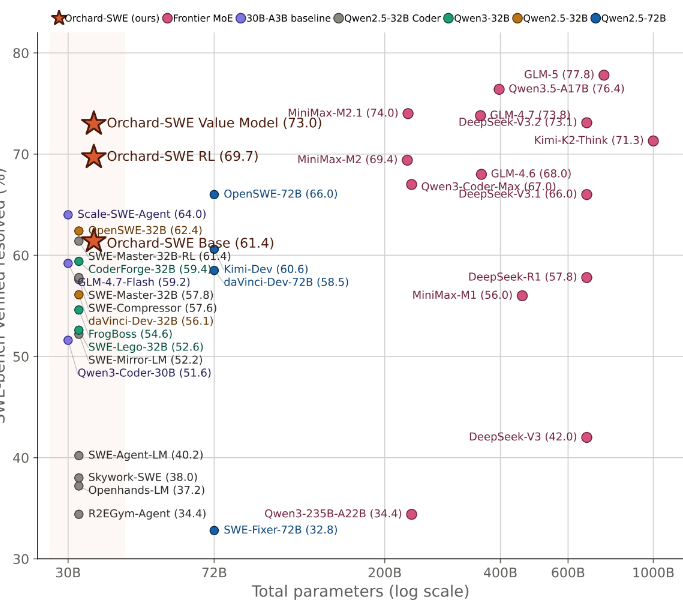
 图 1:性能对比。左图:Orchard-SWE(35B-A3B,约 30 亿活跃参数)在 SWE-bench Verified 上达到 69.7%——采用价值模型重排序后达到 73%——与模型规模大十倍以上的前沿系统相当。右图:Orchard-GUI(4B)在 WebVoyager、Online-Mind2web 和 DeepShop 上取得 68.4% 的平均成功率,成为最强的开源 GUI Agent,同时与 OpenAI 和 Google 的专有系统保持同等水平。
这些结果使 Orchard-GUI 跻身迄今最强的开源网页 Agent 之列,同时仍能与更大规模的专有模型竞争。结果还表明,只要采用合适的训练方法和环境,小型开放模型也能在真实世界网页任务中表现出色。
Orchard-Claw:服务日常生产力的个人助理 Agent
许多最具影响力的 Agentic 应用涉及日常生产力任务,包括阅读和起草电子邮件、管理日历、搜索信息以及跨工具协调。Orchard-Claw 聚焦个人助理任务,仅使用 200 个合成任务来训练 Agent。在覆盖真实生产力工作流的 Claw-Eval 基准上,当获得最多三次尝试机会时,它能成功完成 59.6% 的任务;与更强的 ZeroClaw Agent 系统配合时,这一比例提高到 73.9%。
由于 Orchard 可以直接在真实部署 harness 中训练 Agent,Orchard-Claw 在多个 harness 中完成训练——包括 ReACT、ZeroClaw、OpenClaw 和 Codex——而非仅在单一简化循环中训练。在这些真实 harness 中训练显著提高了 Agent 的可靠性;例如,在 Codex harness 下,其成功率从未训练模型的 18.6% 提升至经过 Orchard 训练后的 51.5%。
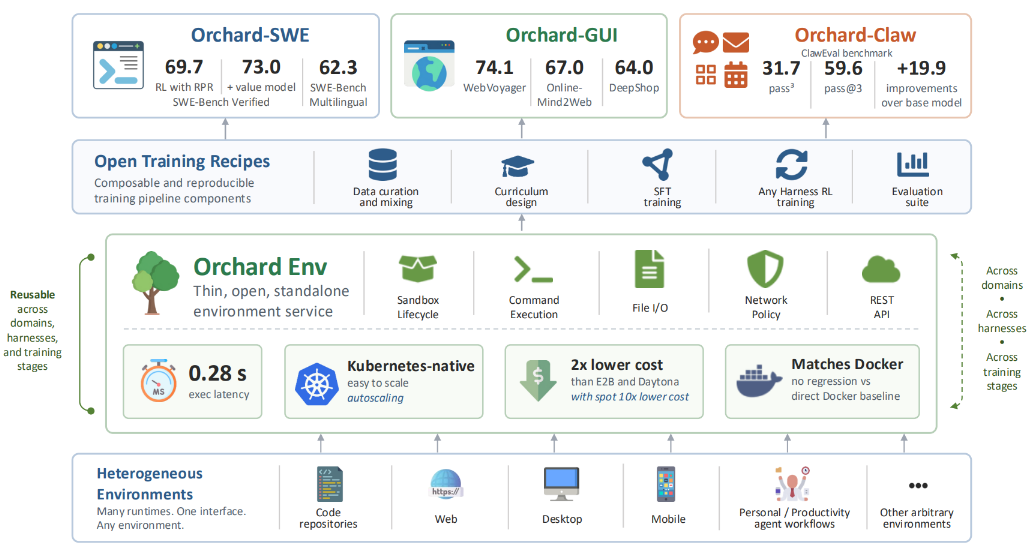 图 2:Orchard 框架概览。Orchard Env(中央)是一项轻量级、Kubernetes 原生的环境服务,提供沙箱管理、命令执行、文件访问、网络控制、REST API 和 Agent 集成等共享能力。它支持多种任务环境(底部一行),并用于三类任务领域(顶部一行):Orchard-SWE(软件工程)、Orchard-GUI(浏览器导航)和 Orchard-Claw(AI 个人助理)。
影响与未来方向
Orchard 的结果进一步强化了一个更广泛的观点:环境层至关重要。通过使底层基础设施保持开放、轻量和可复用,Orchard 降低了 Agentic AI 研究的成本。团队不再需要从零构建定制隔离环境,也不必依赖专有云服务。无需每次重建系统,同一个 Orchard Env 即可用于生成训练数据、运行强化学习 rollout 和评估最终模型。
展望未来,我们认为复用训练经验是迈向累积式 Agent 学习的一个有前景方向。与其在一次训练运行结束后丢弃轨迹,我们将其视为持久资产——例如,将其蒸馏为可复用的价值模型。这使 Agent 经验能够随时间累积,让每一代新 Agent 都能继承并扩展前代获得的知识,而不是从零开始。
Orchard-GUI 展现的数据效率表明,无需大量人工创建的训练数据,也可以训练更大规模的网页 Agent。通过发布完整的 Orchard 技术栈,包括环境服务、训练流水线和训练数据集,我们希望帮助更广泛的研究社区更快构建能力更强的开放 Agent。
致谢
我们感谢 Microsoft Research 及合作机构的团队为 Orchard 作出的贡献,也感谢开源社区提供了使这项研究成为可能的基准与工具。
English / 原文
At a glance
- Orchard is an open-source framework for scalable and cost-effective agentic AI research, built around Orchard Env, a reusable environment service for training and evaluating agents across task domains.
- The same Orchard infrastructure supports software-engineering, web-navigation, and personal-assistant agents, and can train them directly inside real deployment harnesses such as Codex, OpenClaw, and ZeroClaw—letting researchers reuse environments, data pipelines, and evaluation workflows across tasks.
- Orchard-SWE, Orchard-GUI, and Orchard-Claw demonstrate that relatively small open-weight models can achieve strong results on complex real-world tasks. For example, Orchard-SWE reaches 69.7% on SWE-bench Verified—73.0% with value-model reranking—using only about 3 billion active parameters, approaching frontier systems using more than 10 times larger models.
Alongside the models and workflows, the project releases training data and evaluation methods intended to help the broader research community build and study open agentic systems. Artificial intelligence is rapidly moving beyond static question-answering toward autonomous agents that can plan, reason, and act across complex, multistep environments. These systems can fix bugs in complex codebases, navigate the web on a user’s behalf, and manage workflows involving calendars and email.
While there is excitement around agentic AI’s capabilities, the research community faces a persistent bottleneck. Building state-of-the-art agentic systems often requires proprietary infrastructure, including custom sandboxes, closed training pipelines, and proprietary datasets that most researchers and practitioners cannot access or reproduce.
To address this gap, we introduce Orchard (opens in new tab), an open-source framework for scalable agentic modeling. At the center of Orchard is Orchard Env, a lightweight, Kubernetes environment that provides reusable isolated components for running and building agents at scale—from collecting training data to reinforcement learning rollouts and evaluation.
Unlike many existing frameworks, Orchard Env is designed to support different agent systems and task types without modification. The same service can support software-engineering agents, web-browsing agents, and personal-assistant agents across domains.
To demonstrate this approach, we are releasing three domain-specific training recipes—Orchard-SWE, Orchard-GUI, and Orchard-Claw. (opens in new tab) We are also releasing the training data and evaluation methods used to build them.
PODCAST SERIES
The AI Revolution in Medicine, Revisited
Join Microsoft’s Peter Lee on a journey to discover how AI is impacting healthcare and what it means for the future of medicine.
Opens in a new tab
Environment layer that scales across types of tasks
The central idea behind Orchard is that the runtime environment should be a standalone, reusable service rather than infrastructure embedded inside a specific training framework. Orchard Env’s Kubernetes foundation enables it to create, manage, and remove thousands of isolated components in parallel.
The system is designed to work across tasks like coding, web browsing, using tools. It is also designed to work across different agent systems, along with stages of the training and evaluation process, including data distillation and reinforcement learning rollouts.
This flexibility makes Orchard practical at a research scale. Teams can introduce new benchmarks, agent systems, or training algorithms without rebuilding the underlying infrastructure from scratch.
Orchard also makes it possible to train agents inside any harness. Today’s most capable agents rarely run as a bare model. They operate through sophisticated harnesses—such as Claude Code, Codex, and OpenClaw—that manage multi-turn reasoning, tool use, and connections to external systems. Open training tools usually cannot handle these stateful, multi-process harnesses, forcing researchers to train on a simplified stand-in and then deploy in the real setting, which creates a mismatch. Orchard closes this gap: a lightweight proxy records the harness’s own model calls as training data while each rollout runs in its own container, so an agent can be trained end-to-end directly in the harness that it will be deployed with—OpenClaw, Codex, ZeroClaw, or others—and across several harnesses.
Orchard-SWE: Advancing open-source software engineering agents
Software engineering is one of the most demanding settings for autonomous agents. It requires multi-step reasoning over real codebases, tool use, and the ability to recover from mistakes. Orchard-SWE is our training workflow for this domain. It is built using the Mini-SWE-Agent framework, designed to autonomously solve software engineering tasks, and evaluated on the widely used SWE-bench Verified benchmark, which tests a model’s ability to navigate, diagnose, and repair real-world codebases.
To train the system, we distilled 107,000 agent interactions from two advanced open-weight models (MiniMax-M2.5 and Qwen3.5-397B) covering a broad range of GitHub Issues. The training process uses credit-assignment supervised fine-tuning: rather than discarding attempts where the agent failed to fully resolve an issue, the system learns from the productive portions of those partial attempts, expanding the amount of useful training data available to the model.
Reinforcement learning comes next, but its feedback is sparse—an agent usually learns only whether its final patch passed or failed the hidden tests. We start with Balanced Adaptive Rollout, designed to make the most of these infrequent success signals, and then add two “dense reward” techniques for richer guidance: on-policy distillation, in which a stronger teacher model scores the agent’s decisions step by step, and a process reward model, in which an AI judge rewards sound problem-solving process—writing tests that reproduce the bug, verifying the fix, and checking that existing behavior still works—independent of whether the final tests passed.
Finally, we train a value model on past rollouts to rerank candidate solutions. Reinforcement learning generates many practice trajectories that are normally discarded; instead, trajectories from 20 prior experiments train a compact 4-billion-parameter value model that recognizes high-quality solutions, and at problem-solving time it scores several candidate answers and picks the best one. Together, these techniques take Orchard-SWE from a 61.4% baseline on SWE-bench Verified to 69.1% with Balanced Adaptive Rollout and 69.7% with the dense-reward techniques—a new state of the art among open-source models of comparable size (roughly 3 billion active parameters)—rising to 73% with value-model reranking, approaching frontier systems more than 10 times larger, as shown in Figure 1.
Orchard-GUI: A lightweight browser agent for real-world web tasks
Web navigation presents a different set of challenges. Agents must interpret visual layouts, interact with dynamic interfaces, and complete open-ended tasks described only in natural language.
Orchard-GUI trains a 4-billion-parameter vision-language model as a browser agent using a relatively small amount of supervision: 400 distilled demonstrations combined with 2,200 open-ended training tasks. Despite this limited training data, the resulting model achieves strong results across several web-navigation benchmarks: 74.1% on WebVoyager, 67.0% on Online-Mind2Web, and 64.0% on DeepShop, for an average of 68.4%, as shown in Figure 1.
Figure 1. Performance comparison. Left: Orchard-SWE (35B-A3B, ~3B active) reaches 69.7% on SWE-bench Verified—73% with value-model reranking—matching frontier systems more than 10x larger. Right: Orchard-GUI (4B) achieves 68.4% average success across WebVoyager, Online-Mind2web, and DeepShop, making it the strongest open-source GUI agent while staying on par with proprietary systems from OpenAI and Google.
These results place Orchard-GUI among the strongest open-source web agents to date while remaining competitive with larger proprietary models. The results also suggest that with the right training approach and environment, small open models can perform well on real-world web tasks.
Orchard-Claw: Personal assistant agents for everyday productivity
Many of the most impactful agentic applications involve everyday productivity tasks, including reading and drafting emails, managing calendars, searching for information, and coordinating across tools. Orchard-Claw focuses on personal-assistant tasks by training an agent on just 200 synthetic tasks. Evaluated on Claw-Eval, a benchmark covering realistic productivity workflows, it successfully completes 59.6% of tasks when given up to three attempts. That increases to 73.9% when paired with the stronger ZeroClaw agent system.
Because Orchard can train agents directly inside real deployment harnesses, Orchard-Claw is trained across several of them—including ReACT, ZeroClaw, OpenClaw, and Codex—rather than a single simplified loop. Training inside these real harnesses substantially improves the agent’s reliability; under the Codex harness, for example, its success rate rises from 18.6% for the untrained model to 51.5% after Orchard training.
Figure 2. Overview of the Orchard framework. Orchard Env (center) is a lightweight, Kubernetes-native environment service that provides shared capabilities such as sandbox management, command execution, file access, network controls, a REST API, and agent integration. It supports a range of task environments (bottom row) and is used across three task domains (top row): Orchard-SWE (software engineering), Orchard-GUI (browser navigation), and Orchard-Claw (AI personal assistant).
Implications and the road ahead
Orchard’s results reinforce a broader point: the environment layer matters. By making the underlying infrastructure open, lightweight, and reusable, Orchard lowers the cost of agentic AI research. Teams no longer need to build custom isolated environments from scratch or depend on proprietary cloud services. The same Orchard Env can be used to generate training data, run reinforcement learning rollouts, and evaluate final models without rebuilding the system each time.
Looking ahead, we see reusing training experience as a promising direction toward cumulative agent learning. Instead of discarding trajectories once a training run finishes, we treat them as persistent assets—for example, distilling them into reusable value models. This enables agentic experience to accumulate over time, allowing each new generation of agents to inherit and extend the knowledge acquired by previous ones, rather than starting from scratch.
The data efficiency demonstrated by Orchard-GUI suggests that larger-scale web agents could be trained without requiring large amounts of manually created training data. By releasing the complete Orchard stack, including the environment service, training pipelines, and training datasets, we hope to help the broader research community build more capable open agents more quickly.
Acknowledgements
We thank the teams at Microsoft Research and collaborating institutions for their contributions to Orchard, as well as the open-source community whose benchmarks and tools made this research possible.
Opens in a new tab