Mobileye 如何借助 Amazon Bedrock AgentCore 改造支持运营
英文标题:How Mobileye transformed support operations using Amazon Bedrock AgentCore
Mobileye 利用 Amazon Bedrock AgentCore 部署 AI 支持 Agent,将数据采集处理流程中的常规工单响应时间从数小时缩短至约 1 分钟,改善幅度达 90%。该 Agent 通过 MCP 实时访问生产系统,并借助 Anthropic Claude 处理上下文相关的查询,整体成功率达到 98%,超过原定 95% 目标。该方案自动处理了 66% 的工单量,同时通过混合架构连接本地部署的工单系统与 AWS 云服务。基于这一实践,Mobileye 进一步建设内部 Agent 部署平台,使开发团队可在数分钟内交付符合安全、监控和成本治理标准的生产级 AI Agent。
 1.3 MB
 101.1 KB
 124.1 KB
 345.0 KB
 141.2 KB
 346.5 KB
 97.4 KB
 20.6 KB
 28.8 KB
 17.7 KB
 20.5 KB
 23.4 KB
 177.8 KB
中文
如果部署生产级 AI Agent 不需要任何基础设施管理、原生具备企业级可观测性,并且能够轻松与现有本地部署系统协同工作,会怎样?
Mobileye 是自动驾驶领域的先驱,其 EyeQ 系统级芯片已部署在全球约 1,200 种车型中,累计超过 2.3 亿颗。该公司发现了一个机会:将技术熟练的工程师从日常内部工单状态查询中解放出来。
Mobileye 的数据采集处理(Data Collection Processing)流水线每天接收数千个驾驶记录会话,由此持续产生大量来自工程师和数据团队的状态查询。此前,每项查询都需要人工跨多个系统完成多个步骤——识别会话、交叉核对可视化工具、验证输出以及审查日志——然后才能编写回复。借助 Amazon Bedrock AgentCore,Mobileye 部署了一款 AI Support Agent,在零基础设施运维负担的情况下,将响应时间缩短了 90%,准确率超过 95% 的目标。结果极具说服力,Mobileye 随后将 AgentCore 打造成自助式平台,供公司各团队部署自己的 AI Agent。
本文将介绍 Mobileye 如何在 Amazon Bedrock AgentCore 上部署 AI 支持 Agent 解决方案:从促成这一构想的支持瓶颈,到验证其可行性的概念验证(Proof of Concept),再到连接本地部署系统与 AWS 云服务的混合架构。对于希望在维持企业级治理与安全标准的同时扩展 AI Agent 的企业而言,这种方法具有参考价值。
从人工瓶颈到 AI 驱动的支持
随着 Mobileye 数据采集流水线规模扩大,66% 的支持工单变成了常规状态查询,工程师需要手动在多个后端系统中完成 15 次点击操作。这一耗时流程使技术熟练的工程师无法专注于复杂问题,同时内部用户也面临更长的等待时间。
传统自动化方法——脚本、静态工作流和基于规则的决策树——被证明难以胜任。虽然这些方法能够处理可预测的查询,但缺乏理解真实支持请求多样性所需的上下文理解能力。团队因此决定构建一款能够理解上下文并适应不同查询模式的 AI Agent。
验证方案:概念验证
在全面投入生产之前,Mobileye 团队进行了概念验证,目标是在工单分类中达到 95% 的准确率,并将响应时间控制在 2 分钟以内。
该 Agent 使用 Anthropic Claude 基础模型,并通过 Mobileye 的内部 LLM Gateway 访问。该网关为 Amazon Bedrock 上的基础模型提供受治理、配额管理的访问。关键推动因素是模型上下文协议(Model Context Protocol,MCP):它让 Agent 能够实时访问驾驶数据处理平台的 API,使其在推理期间可查询会话状态、获取处理日志并提取诊断信息。
这意味着该 Agent 远不止是一个简单的工单分类工具,而是成为了一名智能调查员,能够处理过去需要耗费大量人工时间才能解决的查询。当用户询问驾驶记录会话时,Agent 可以判断其当前状态并给出答案:对于已完成的会话,确认完成状态并提供访问详情;对于失败的会话,展示具体错误、调试建议和日志链接;对于缺失的请求,指导用户完成提交流程——所有这些均可在两分钟内完成,无需人工干预。
评估选项
在通过 AI Agent 成功验证概念后,Mobileye 需要将其推向生产环境。这一转变要求解决方案既能满足企业级要求,又要保持概念验证阶段所展示的灵活性。经过审慎评估后,该公司选择将 AI Agent 部署在 Amazon Bedrock AgentCore 上;这是一个全托管平台,能够使用任意框架或模型,大规模构建、连接和优化 AI Agent。该决策主要基于五项关键因素:
- 适用于企业工作负载的无服务器基础设施
- 加快支持查询的解决速度
- 全面的内置可观测性
- 支持多种 Agent 框架
- 支持可轻松与现有本地部署工单系统集成的混合架构
最后一点尤其重要。Mobileye 的内部工单系统运行在本地部署环境中,无法从 AWS 访问,因此任何解决方案都必须在不损害安全性或合规性的前提下弥合这一鸿沟。
生产架构:连接两个世界
在概念验证成功后,Mobileye 通过一套复杂的混合架构进入生产阶段,并为两个环境中的组件定义了清晰职责。
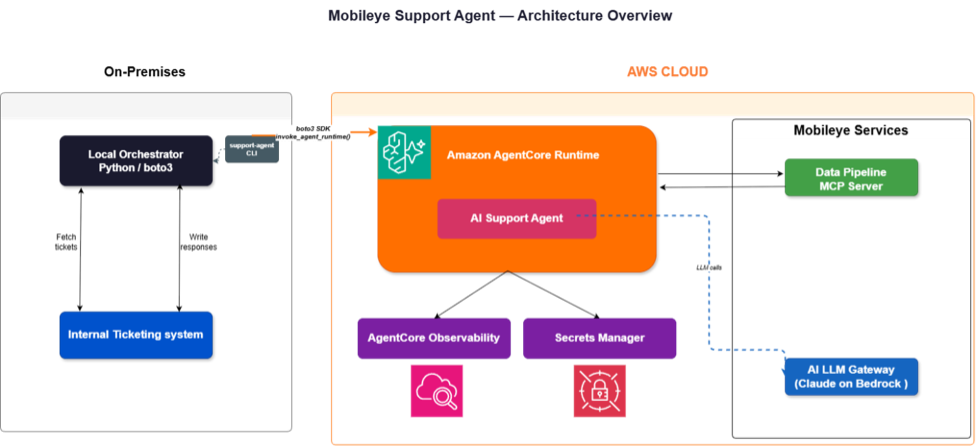
本地部署组件
下表介绍了负责本地工单操作以及连接云端 AI 处理能力的本地部署组件。
| 组件 | 职责 |
|---|---|
| 本地编排器(Local Orchestrator) | 在本地处理工单操作,提取新工单,并将已完成的回复发布回工单系统。 |
| 内部工单系统 | 该本地部署工单管理系统既是支持工单的来源,也是 AI 生成回复的目的地。其无法从 AWS 访问,是采用混合设计的主要原因。 |
AWS 云组件
下表介绍了为 AI Agent 提供无服务器计算、安全和可观测性基础设施的 AWS 云组件。
| 组件 | 职责 |
|---|---|
| AgentCore Runtime | Mobileye 在 AgentCore 的无服务器运行时上运行其 AI Support Agent,免除了所有基础设施管理工作。团队无需配置服务器即可部署和迭代;可受益于自动扩缩容,以应对支持量激增;并保留使用任意 Agent 框架的完全灵活性。通过一次 API 调用即可调用 Agent,使其与现有系统的集成保持简单直接。 |
| AgentCore Observability | Mobileye 工程团队使用内置可观测性,对每一次 Agent 交互进行端到端追踪——从初始请求、通过 MCP 对后端系统的工具调用,到最终回复。详细日志和回溯信息可准确呈现 Agent 如何推理、检索了哪些数据以及错误发生在何处,从而大幅缩短调试时间并加快迭代周期。 |
| AWS Secrets Manager | Mobileye 使用 Secrets Manager 为其 GenAI 平台实现无身份、安全的认证。调用 AI Agent 的团队无需直接接触凭证——与 Agent 和后端系统交互所需的密钥会以编程方式进行存储、轮换和检索,在不增加终端用户使用阻力的同时贯彻企业安全标准。 |
Mobileye 服务
下表介绍了 Mobileye 自有服务,这些服务为 Agent 提供数据连接能力和受治理的模型访问。
| 组件 | 职责 |
|---|---|
| 数据流水线模型上下文协议(MCP) | 数据流水线 MCP 服务器支持在推理期间实时查询在线生产数据,包括驾驶会话预热状态、请求进度和处理错误,使 Agent 能够即时提供具备上下文感知能力的回复。 |
| AI LLM Gateway | Mobileye 针对 Amazon Bedrock 上基础模型及其他 LLM 提供商提供的受治理、配额管理的访问能力。 |
各组件如何协同工作
自动化工作流遵循精简的四步流程:
- **本地编排器(Local Orchestrator)**提取新工单,并将其发送至运行在 AgentCore Runtime 上的 AI Support Agent。
- AI Support Agent 对每张工单进行端到端处理——对查询进行分类、通过 MCP Server 查询实时会话数据、并通过 AI LLM Gateway 访问 Claude——生成包含链接、建议和可执行后续步骤的完整格式化回复。
- 本地编排器(Local Orchestrator)接收完成的回复,并将其连同适当的评论和标签发布回内部工单系统(Internal Ticketing System)。
- AgentCore Observability 捕获 Agent 活动——会话指标、延迟、Token 使用量和追踪记录——以支持持续监控和调试。
不言自明的可量化成果
Mobileye 的 AI Support Agent 在 AgentCore 上投入生产后,取得的结果持续达到或超过最初目标。
- 总体成功率:98%(超过最初 95% 的目标)
- 响应时间:从数小时缩短至约 1 分钟(改善 90%)
- 实现自动化的支持量:占总工单量的 66%
- 月度处理量:100+ 张工单
战略收益
支持工程师得以专注于复杂工作;团队也无需自行建设基础设施,因为 AgentCore 开箱即提供了这些能力。
“Amazon Bedrock AgentCore 让我们能够构建一款生产级 AI Agent,在维持企业所需安全与运营标准的同时,带来可量化的业务价值。AI Support Agent 改造了我们的支持运营,为工程师节省了数百小时原本用于常规工单查询的时间,使他们能够专注于最擅长的工作。” —— Mobileye 首席工程师 Shay Margalit
扩展愿景:从单一 Agent 到企业平台
随着 AI Support Agent 在生产环境中交付成果,Mobileye 面临了新的挑战:组织内大多数开发人员缺乏 AWS 凭证或基础设施访问权限,无法独立在 AgentCore 上部署 Agent。为解决这一问题,Mobileye Cloud Infra 团队构建了一个内部 Agent 部署平台。
这项内部托管服务让 Mobileye 开发人员无需具备 AWS 专业知识或云凭证,即可部署生产级 AI Agent。流程如下:
- 团队提供其 Agent 代码。
- 团队指定所需的 AgentCore 功能——Memory、Browser Tool、Code Interpreter、Observability、Gateway。
- Cloud Infra 团队配置全部基础设施:AWS IAM Roles、Amazon S3 存储、Amazon CloudWatch 监控和 Amazon Cognito 身份验证。
- 开发人员会获得一个预配置的
bedrock_agentcore.yaml文件,可直接集成到项目中。 - 只需一条命令即可部署:
agentcore deploy。
所配置的基础设施符合 Mobileye 在安全性、成本治理和运营卓越性方面的标准。针对代码异常设置的 CloudWatch Alarms 有助于确保问题能够立即暴露。
最初的单一概念验证,如今已发展为一个企业级平台:团队可以在数分钟而非数周内,部署安全、可监控、可追踪成本的 Agent。
从人工流程走向智能自动化的路径比你想象得更短;正如 Mobileye 所展示的那样,成果也可以非同寻常。
关于作者
Shay Margalit
Shay Margalit 是 Mobileye 的首席工程师,负责领导面向公司数据基础设施的 AI 驱动解决方案开发。
Max Rabin
Max Rabin 是 Mobileye Cloud Ops 团队的首席工程师,负责大规模生产云环境的架构设计和运营。
Adi Jabkowsky
Adi Jabkowsky 是 Amazon Web Services 的高级 AI 专家,帮助客户识别并实施高影响力的生成式 AI 用例。
Adir Gozlan
Adir Gozlan 是 Amazon Web Services 的高级 AI/ML 专家技术客户经理,专注于帮助客户在企业规模下实现 AI 工作负载的运营化。
Liat Tzur
Liat Tzur 是 Amazon Web Services 的首席技术客户经理,也是一名 AI 爱好者;她与企业客户合作,加速其云与 AI 转型之旅。
English / 原文
What if deploying production-grade AI agents required zero infrastructure management, came with enterprise observability built-in, and worked easily with your existing on-premises systems?
Mobileye, the autonomous driving pioneer with more than 230 million EyeQ system-on-chips deployed across roughly 1,200 vehicle models worldwide, saw an opportunity to free skilled engineers from routine internal ticket status inquiries.
Mobileye’s Data Collection Processing pipeline ingests thousands of drive-recording sessions daily, generating a constant stream of status inquiries from engineers and data teams. Each inquiry previously required manual steps across multiple systems – identifying sessions, cross-referencing visualization tools, validating outputs, and reviewing logs – before composing a response. Using Amazon Bedrock AgentCore, Mobileye deployed an AI Support Agent that cut response times by 90% and exceeded 95% accuracy targets, with zero infrastructure overhead. The results were so compelling that Mobileye transformed AgentCore into a self-service platform for teams across the company to deploy their own AI agents.
In this post, we’ll explore how Mobileye deployed an AI support agentic solution on Amazon Bedrock AgentCore – from the support bottleneck that sparked the idea, through the proof of concept that validated it, to the hybrid architecture that bridges on-premises systems with AWS cloud services. This approach is relevant for enterprises struggling to scale AI Agents while maintaining enterprise grade governance and security standards.
From manual bottleneck to AI-powered support
As Mobileye’s Data Collection pipeline scaled, 66% of support tickets became routine status inquiries requiring engineers to manually navigate 15 clicks across multiple backend systems. This time-consuming process diverted skilled engineers from complex issues while internal users faced longer wait times.
Traditional automation approaches – scripting, static workflows, and rule-based decision trees – proved inadequate. While these could handle predictable queries, they lacked the contextual understanding needed to interpret the variability of real-world support requests. The team chose to build an AI agent capable of understanding context and adapting to diverse inquiry patterns.
Validating the approach: Proof of concept
Before full production rollout, Mobileye’s team conducted a proof of concept targeting 95% accuracy in ticket classification with sub-2-minute response times.
The agent uses Anthropic Claude foundation models, accessed through Mobileye’s internal LLM Gateway that provides governed, quota-managed access to foundation models on Amazon Bedrock. The critical enabler was the Model Context Protocol (MCP), which gave the agent real-time access to the drive-data processing platform’s APIs -allowing it to query session status, retrieve processing logs, and pull diagnostic information during inference.
This meant the agent went far beyond simple ticket classification, becoming an intelligent investigator capable of handling inquiries that were previously resolved through time-consuming manual effort. When users inquired about drive-recording sessions, the agent could determine current state and respond with answers: confirming completed sessions with access details, surfacing specific errors with debugging recommendations and log links for failures, or guiding users through submission processes for missing requests – all in under two minutes with no human intervention.
Evaluating the options
After successfully proving the concept with their AI agent, Mobileye needed to take it to production. This transition required a solution that could meet enterprise-grade requirements while maintaining the flexibility they had demonstrated in their proof of concept. After careful evaluation, they chose to deploy their AI Agent on Amazon Bedrock AgentCore, a fully managed platform to build, connect and optimize AI agents at scale with any framework or model. The decision came down to five key factors:
- Serverless infrastructure ready for enterprise workloads
- Accelerated time-to-resolution for support inquiries
- Comprehensive built-in observability
- Support for multiple agentic frameworks
- Hybrid architecture support that could integrate easily with their existing on-premises ticketing system
This last point was particularly important. Mobileye’s internal ticketing system operated on-premises and was inaccessible from AWS, so any solution would need to bridge that divide without compromising security or compliance.
The production architecture: Bridging two worlds
Following the successful proof of concept, Mobileye moved to production with a sophisticated hybrid architecture featuring clearly defined component roles across two environments.
On-premises components
The following table describes the on-premises components that handle local ticketing operations and bridge to cloud-based AI processing.
| Component | Role |
|---|---|
| Local Orchestrator | Handles ticketing operations locally, extracting new tickets and posting completed responses back into the ticketing system. |
| Internal ticketing system | The on-premises ticket management system serves as both the source of support tickets and the destination for AI-generated responses. Its inaccessibility from AWS was the primary driver behind the hybrid design. |
AWS cloud components
The following table describes the AWS cloud components that provide serverless compute, security, and observability infrastructure for the AI agent.
| Component | Role |
|---|---|
| AgentCore Runtime | Mobileye runs their AI Support Agent on AgentCore’s serverless runtime, eliminating all infrastructure management. The team deploys and iterates without provisioning servers, benefits from automatic scaling to handle spikes in support volume and maintains full flexibility to use any agentic framework. A single API call invokes the agent – keeping integration with their existing systems straightforward. |
| AgentCore Observability | Mobileye’s engineering team uses built-in observability to trace every agent interaction end-to-end — from the initial request, through MCP tool calls to backend systems, to the final response. Detailed logs and tracebacks surface exactly how the agent reasoned, what data it retrieved, and where errors occur, dramatically reducing debugging time and accelerating iteration cycles. |
| AWS Secrets Manager | Mobileye uses Secrets Manager to enable faceless, secure authentication for their GenAI platform. Teams invoking AI agents never handle credentials directly – secrets required to interact with agents and backend systems are stored, rotated, and retrieved programmatically, enforcing enterprise security standards without adding friction for end users. |
Mobileye service
The following table describes Mobileye’s own services that provide data connectivity and governed model access for the agent.
| Component | Role |
|---|---|
| Data Pipeline Model Context Protocol (MCP) | The Data Pipeline MCP server enables real-time querying of live production data during inference including driving session warming statuses, request progress, and processing errors – allowing the agent to deliver context-aware responses on the fly. |
| AI LLM Gateway | Mobileye’s governed, quota-managed access to foundation models on Amazon Bedrock and other LLM providers |
How it all works together
The automated workflow follows a streamlined four-step process:
- The Local Orchestrator extracts new tickets and sends them to the AI Support Agent running on AgentCore Runtime.
- The AI Support Agent processes each ticket end-to-end – categorizing the inquiry, querying live production systems via the MCP Server for real-time session data, and accessing Claude through the AI LLM Gateway – to generate a fully formatted response with links, recommendations, and actionable next steps.
- The Local Orchestrator receives the completed response and posts it back to the Internal Ticketing System with appropriate comments and labels.
- AgentCore Observability captures agent activity – session metrics, latency, token usage, and traces – for continuous monitoring and debugging
Measurable results that speak for themselves
The production deployment of Mobileye’s AI Support Agent on AgentCore delivered results that consistently met or surpassed initial targets.
- Overall success rate: 98% (surpassing the original 95% target)
- Response time: Reduced from hours to ~1 minute (90% improvement)
- Support volume automated: 66% of total ticket volume
- Monthly throughput: 100+ tickets processed
Strategic benefits
Support engineers are freed to focus on complex work – and the team didn’t have to build the infrastructure themselves, because AgentCore provides it out of the box.
“Amazon Bedrock AgentCore enabled us to build a production-grade AI agent that delivers measurable business value while maintaining the security and operational standards our enterprise requires. The AI Support Agent has transformed our support operations, saving our engineers hundreds of hours previously spent on routine ticket lookups, and freed them to focus on what they do best.” — Shay Margalit, Principal Engineer, Mobileye
Scaling the vision: From single agent to enterprise platform
With the AI Support Agent delivering results in production, Mobileye faced a new challenge: most developers across the organization lacked the AWS credentials or infrastructure access to deploy agents on AgentCore independently. To address this, the Mobileye Cloud Infra team built an internal agent deployment platform.
This internal managed service enables Mobileye developers to deploy production-grade AI agents without AWS expertise or cloud credentials. The process follows these steps:
- Teams provide their agent code
- Teams specify needed AgentCore capabilities – Memory, Browser Tool, Code Interpreter, Observability, Gateway.
- The Cloud Infra team provisions all infrastructure: AWS IAM Roles, Amazon S3 storage, Amazon CloudWatch monitoring, and Amazon Cognito authentication.
- Developers receive a pre-configured
bedrock_agentcore.yamlfile that integrates directly into their project. - Deployment is a single command:
agentcore deploy.
The provisioned infrastructure aligns with Mobileye’s standards for security, cost governance, and operational excellence. CloudWatch Alarms on code exceptions help verify issues surface immediately.
What began as a single proof-of-concept has evolved into an enterprise-wide platform where teams can deploy secure, monitored, cost-tracked agents in minutes rather than weeks.
The path from manual processes to intelligent automation is shorter than you think, and the results, as Mobileye has shown, can be extraordinary.
About the authors
Shay Margalit
Shay Margalit is a Principal Engineer at Mobileye, where he leads the development of AI-powered solutions for the company’s data infrastructure.
Max Rabin
Max Rabin is a Principal Engineer in Cloud Ops at Mobileye, responsible for architecting and operating production cloud environments at scale.
Adi Jabkowsky
Adi Jabkowsky is a Senior AI Specialist at Amazon Web Services, helping customers identify and implement high-impact generative AI use cases.
Adir Gozlan
Adir Gozlan is a Senior AI/ML Specialist Technical Account Manager at Amazon Web Services, focused on helping customers operationalize AI workloads at enterprise scale.
Liat Tzur
Liat Tzur is a Principal Technical Account Manager at Amazon Web Services and an AI enthusiast who partners with enterprise customers to accelerate their cloud and AI journeys.