ONESTRUCTION 如何借助 AWS GenAIIC 构建 Ishigaki-IDS 基础模型
英文标题:How ONESTRUCTION built the Ishigaki-IDS foundation model with AWS GenAIIC
ONESTRUCTION 在 AWS Generative AI Innovation Center(GenAIIC)的技术顾问支持下,构建了面向建筑业 BIM 工作流的 Ishigaki-IDS 基础模型。该团队以 Qwen3 为底座,结合合成数据、持续预训练(CPT)、监督微调(SFT)和可验证奖励强化学习(RLVR)三阶段训练流程,解决了 IDS 领域公开数据稀缺、IFC 术语复杂和 XML 结构严格等难题。模型在内部 IDS-Bench 上的 XML 与 IDS 结构合规性接近 100%,IDS 内容一致性超过 80%,显著优于通用前沿模型。该案例表明,在数据有限的专业领域中,领域专家参与的高质量合成数据、自动化验证奖励和稳定的分布式训练基础设施,能够帮助开发者构建具备实用价值的垂直基础模型。
 1.3 MB
 101.1 KB
 124.1 KB
 345.0 KB
 141.2 KB
 346.5 KB
 105.3 KB
 175.2 KB
 2.7 MB
 2.3 MB
 1.4 MB
 247.7 KB
 496.3 KB
 113.0 KB
中文
本文由 ONESTRUCTION, Inc. 与 Amazon Web Services Japan G.K. 共同撰写,是 GENIAC(Generative AI Accelerator Challenge,生成式 AI 加速器挑战赛)第三阶段项目的一部分,并获得了 AWS Generative AI Innovation Center(GenAIIC) 的技术顾问支持。
在数据稀缺的领域构建专业化基础模型并不容易。你需要足够的训练数据、专业知识,以及验证输出结果的方法。
ONESTRUCTION, Inc. 是一家通过 openBIM 解决行业问题的建筑科技创业公司。在 GenAIIC 的技术顾问支持下,该公司构建了 Ishigaki-IDS——一个专注于建筑行业 BIM(建筑信息模型,Building Information Modeling)工作流的基础模型(FM)。BIM 是建筑物物理与功能特征的数字化表达,贯穿建筑项目的整个生命周期。
日本建筑业长期面临劳动力短缺问题。BIM 在国家层面受到推广,因为它使设计、施工和运维团队能够在同一处共享信息。但采用 BIM 需要专业知识,学习成本减缓了其更广泛的普及。一个典型例子是 IDS(Information Delivery Specifications,信息交付规范)。这是一项基于 XML 的标准,用于定义附加到 BIM 模型并据此进行验证的信息,其中 BIM 模型为 IFC(Industry Foundation Classes,工业基础类) 模型。编写 IDS 文件不仅需要熟悉其语法,还需要了解 IFC 及其规则。Ishigaki-IDS 降低了这一门槛,使非 BIM 专业人士也能审查和管理属性信息。
本文是一篇关于 ONESTRUCTION 如何构建 Ishigaki-IDS 的架构案例研究。如果你是一名从事领域适配的机器学习(ML)工程师,或者正在评估如何在数据稀缺条件下构建专业 AI 模型的技术负责人,你可以从中找到可复用的方法模式。建筑和 BIM 专业人士也能了解 AI 在该领域可以发挥的作用。熟悉基础模型训练流程(预训练和微调)以及基本 AWS 计算概念会有所帮助,但并非必需。
你将了解到:
构建 IDS 基础模型的三项挑战
有三个问题阻碍了我们构建可用的 IDS 模型。
第一项挑战是数据稀缺。IDS 是一项相对较新的标准,于 2024 年发布;而建筑业整体也是一个公开网络内容有限的领域。金融、医疗和法律等许多其他领域可使用包含数十亿至数千亿 token 的语料库训练模型,但 IDS 并不存在可比规模的公开数据集。即使收集了最新的网络数据,其规模仍然较小、深度也不足,这意味着模型无法仅凭数据获得关于 IDS 及相关主题的足够上下文。
第二项挑战是注入包含数千个术语的 IFC 词汇。例如,“梁”对应 IfcBeam,“空调设备”对应 IfcUnitaryEquipment。这种映射过去一直由领域专家手工完成,而我们需要让模型直接学习这一映射关系。
第三项挑战是 IDS 专属语法。IDS 不只是普通 XML:其标签结构会随所附加或验证的信息而变化,编写者必须使用重复模式和专用标签。通用基础模型难以准确生成这种结构。
解决方案
我们的方法结合了三项要素:多阶段训练流水线、与领域专家的紧密协作,以及专为稳定分布式训练构建的基础设施。首先介绍训练流水线。
三阶段训练流水线
我们基于 Qwen3(8B / 14B / 32B)构建 Ishigaki-IDS。Qwen3 是阿里云推出的开源大语言模型(LLM),以出色的多语言能力和广泛的参数规模选择而闻名。借助不同规模的模型,我们可以先在较小规模上开展实验,再决定是否进行完整的 32B 训练。我们采用了三阶段训练流水线。
首先,在_持续预训练(CPT)_阶段,我们使用网络语料以及与内部领域专家共同创建的合成数据,向模型注入 IDS 和 IFC 领域知识。我们大规模生成有效的 IDS 文件,并构建从多个角度解释 IDS 相关文档的合成数据集;合成数据覆盖了训练语料的大部分内容。
其次,在_监督微调(SFT)_阶段,我们使用 IDS 编写指令(CSV 或自然语言形式)及其对应的预期 IDS 输出组成的数据对训练模型。仅使用 SFT 后仍会出现预期中的问题,例如看似合理但实际错误的 XML 标签选择,以及错误的属性值,因此我们设计了第三阶段来解决这些问题。
第三,在_可验证奖励强化学习(RLVR)_阶段,我们将国际标准组织 buildingSMART 提供的 IDS-Audit-Tool 作为奖励函数。该工具会检查 XML 格式是否正确、IDS 结构是否有效以及语义是否一致,因此模型可以依据可机械验证的正确性信号进行迭代。RLVR 非常适合 IDS 任务,因为它无需大量监督数据就能提升输出质量,这对于数据匮乏的领域尤其有用。
GenAIIC 提供的技术顾问支持
我们凭借自身在建筑和 BIM 领域的专业知识主导开发,并每两周与 GenAIIC 进行一次技术顾问会议。在每个里程碑节点,我们都会将训练结果和评估数据带到会议中,共同推进以下五个关键领域:
- 训练数据设计——面向 IDS 领域的合成数据策略,以及如何在 CPT、SFT 和 RLVR 阶段平衡数据配比。
- 评估基准——覆盖 IFC 和 IDS 知识、结构化生成能力以及通用对话能力的指标。
- 训练阶段和技术——持续优化 CPT、SFT 和 RLVR,包括长上下文处理、奖励塑形和结构化生成。
- 训练基础设施——用于分布式训练的并行化、吞吐量和稳定性。
- 结果诊断——当问题出现时,诊断根本原因并为下一轮迭代确定方向。
在每一轮中,围绕“什么改变能够提升 IDS 生成的准确性和实用性”进行迭代,帮助我们在较短时间内,于一个小众且数据稀缺的领域构建了专业化基础模型。
架构
在训练基础设施方面,我们使用 Amazon EC2 P5en 实例,即两个配备 NVIDIA H200 Tensor Core GPU 的 p5en.48xlarge 节点,并通过 AWS ParallelCluster 进行编排。ParallelCluster 是一款开源工具,可简化在 AWS 上部署和管理高性能计算(HPC)集群的过程。我们将训练数据、合成数据和检查点存储在 Amazon FSx for Lustre 上;这是一项针对计算密集型工作负载优化的全托管文件系统,可提供亚毫秒级延迟和高吞吐量。该配置使我们能够进行稳定的多节点分布式训练,并并行访问大型数据集。
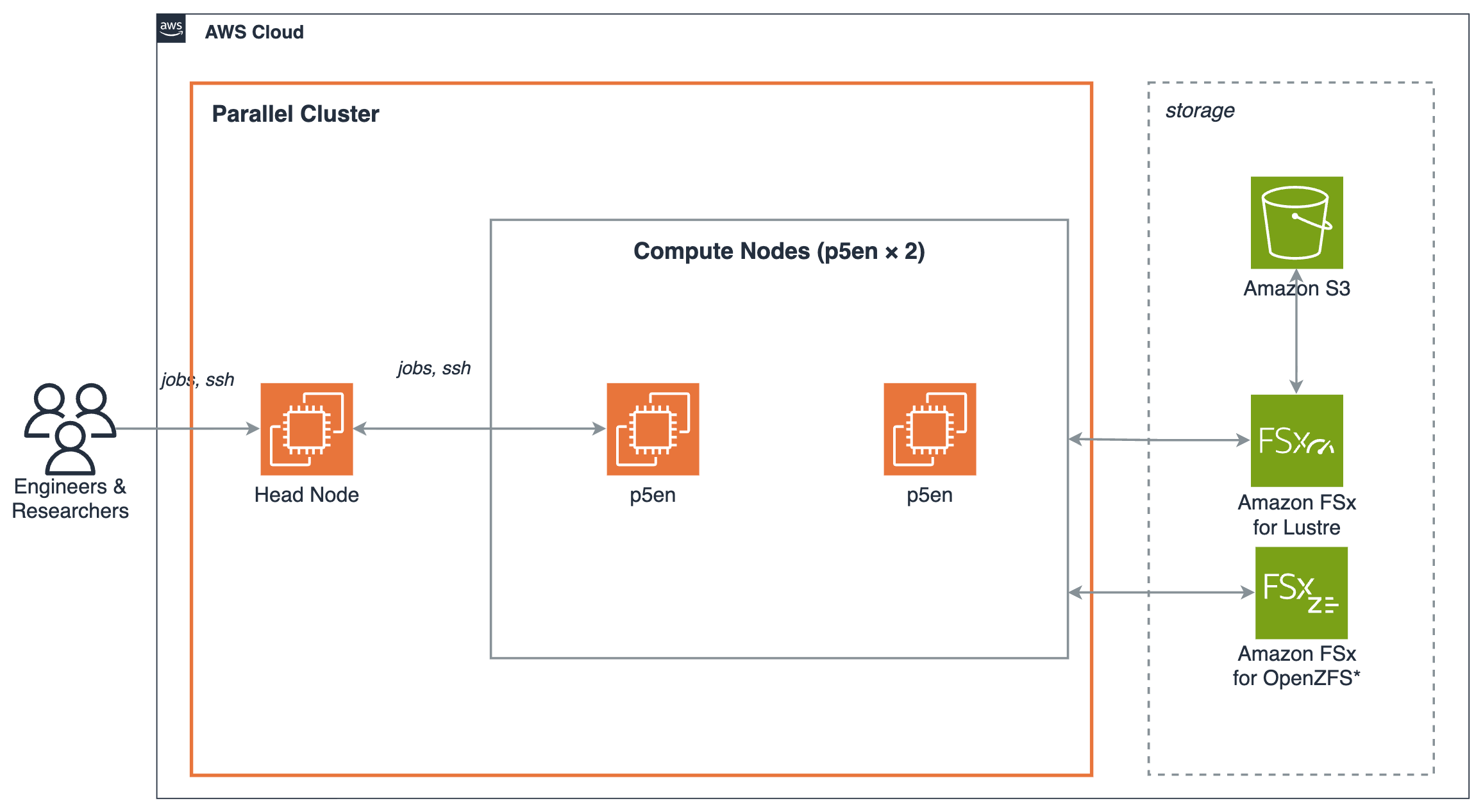
图 1:Ishigaki-IDS 训练架构,使用 AWS ParallelCluster 编排的 Amazon EC2 P5en 实例,并采用 Amazon FSx for Lustre 实现高吞吐量数据访问
评估
我们与内部 IDS 专家共同构建了自己的评估基准 IDS-Bench。IDS-Bench 从 IFC 版本、建筑专业类别(建筑、结构、机电 MEP 和通用)、语言(日语和英语),以及 Implement、Structure 和 Content 三个维度衡量性能,因此评分能够反映模型在实际工作中需要处理的能力。
结果
在 IDS-Bench 评估中,Ishigaki-IDS 在 XML 结构合规性和 IDS 结构合规性上均获得接近 100% 的分数,在 IDS 内容一致性上则超过 80%。通用前沿模型呈现出不同结果:它们能够生成格式正确的 XML,但在 IDS 结构合规性上的得分低于约 25%,IDS 内容一致性得分则接近 0%。IDS 是一个专业且相对较新的领域,这正是领域专用模型能够解决的问题类型。该模型还支持通过 YaRN(Yet another RoPE extensioN) 扩展上下文长度。YaRN 能够将 Transformer 模型的上下文窗口扩展至超出其原始训练长度,同时不会造成明显的性能下降。我们确认,该模型能够针对输入和输出总长度最高约 120k token 的内容正确生成结果。
在与 buildingSMART 联合开展的概念验证中,IDS 专家和非专业人士均对在工作中使用该模型,以及模型即使面对含糊提示也能生成预期 IDS 的能力给予了积极评价。他们还向我们提出了一系列后续开发建议,这进一步印证了我们认为该模型具备实际应用价值的判断。
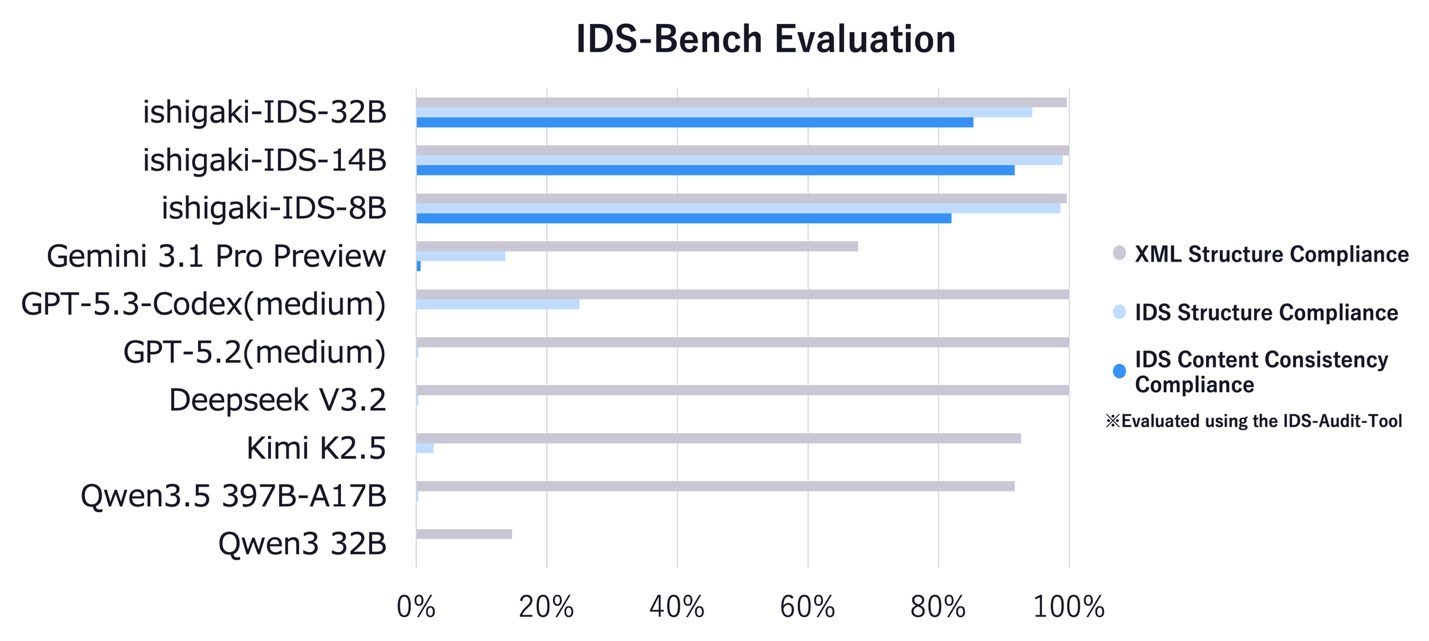
图 2:IDS-Bench 得分,对比 Ishigaki-IDS 各变体与通用前沿模型在 XML 结构、IDS 结构和 IDS 内容一致性上的表现
经验总结
本项目有三项主要收获:
- **合成数据的质量比数量更重要。**领域专家参与合成数据创建,是决定模型性能的关键因素。仅靠数据量无法取得同样的结果。
- **可验证奖励可加速迭代。**将
IDS-Audit-Tool作为自动化奖励信号,使我们能够比人工评估更快地迭代,特别是在数据稀缺的场景中。 - **稳定的基础设施让我们能够自由实验。**Amazon EC2 P5en、AWS ParallelCluster 和 Amazon FSx for Lustre 提供的可靠分布式训练能力,让我们得以专注于模型改进,而非排查集群问题。
结论
将领域专家协作、合成数据,以及与验证工具绑定的 RLVR 相结合,是在数据稀缺的专业领域构建领域专用模型的有效方法。GenAIIC 持续提供的技术顾问支持,帮助我们在 GENIAC 第三阶段的时间表内达到了 IDS-Bench 所衡量的准确率目标。ONESTRUCTION 将继续与 AWS 合作,为建筑行业带来 AI 工具。
后续步骤
如果你有兴趣为所在行业构建领域专用基础模型,以下资源是不错的起点:
作者简介
Koyo Hidaka
Koyo 是 ONESTRUCTION AI 战略部门的经理,负责领导内部 AI 开发、将 AI 集成至公司产品,以及与客户联合开展 AI 研究。最近,他开始将日常决策交给 AI Agent。他最喜欢的科幻作品是《新世纪福音战士》和《命运石之门》。
Ryo Kanazawa
Ryo 是 ONESTRUCTION AI 战略部门的 AI 工程师,专注于建筑 × AI 的基础模型。在 GENIAC 第三周期中,他开发了 IDS 专用模型 Ishigaki-IDS。他是东京理科大学硕士二年级学生,最喜欢的科幻作品是《命运石之门》和《三体》。
Chenguang Wang
Chenguang 是 Amazon Web Services Japan 的应用科学家。他为 APJC 地区的企业客户提供技术支持,涵盖 LLM、VLM 和 MLM 训练,以及 Agent 部署。
Dayuan Jiang
Dayuan 是 Amazon Web Services Japan 的高级深度学习架构师。他在 AI 和机器学习领域拥有超过九年的经验,擅长在商业场景中应用数据科学,包括对现实问题进行建模并解读数据以解决问题。
Angie Wang
Angie 是 Amazon Web Services Japan 的高级生成式 AI 战略师。她帮助 AWS 客户完成从生成式 AI 战略制定到生产部署的全过程。凭借计算机科学和风险投资背景,她能够连接商业战略与技术实施。
English / 原文
This post was co-written byONESTRUCTION, Inc. and Amazon Web Services Japan G.K. as part of GENIAC (Generative AI Accelerator Challenge) Phase 3, with technical advisory from the AWS Generative AI Innovation Center (GenAIIC).
Building domain-specialized foundation models in data-scarce fields is hard. You need enough training data, specialized knowledge, and ways to verify your outputs.
ONESTRUCTION, Inc. is a construction technology startup that solves industry problems through openBIM. With technical advisory from GenAIIC, the company built Ishigaki-IDS, a foundation model (FM) specialized for construction industry BIM (Building Information Modeling) workflows. BIM is a digital representation of a building’s physical and functional characteristics, used across the construction lifecycle.
Japan’s construction sector faces a persistent labor shortage. BIM is promoted at the national level because it lets design, construction, and maintenance teams share information in one place. But adopting BIM requires specialist knowledge, and that learning cost has slowed wider use. A good example is IDS (Information Delivery Specifications), an XML-based standard that defines the information attached to and validated against a BIM model (an IFC (Industry Foundation Classes) model). Authoring an IDS file takes fluency in its grammar plus knowledge of IFC and its rules. Ishigaki-IDS lowers that barrier so practitioners who aren’t BIM specialists can review and manage attribute information.
This post is an architectural case study of how ONESTRUCTION built Ishigaki-IDS. If you’re a machine learning (ML) engineer working on domain adaptation, or a technical leader weighing how to build specialized AI models where data is scarce, you will find a pattern you can reuse. Construction and BIM professionals will also see what AI can do in their field. Familiarity with foundation model training (pre-training and fine-tuning) and basic AWS compute concepts helps, but it isn’t required.
You will learn:
Three challenges in building an IDS foundation model
Three problems stood between us and a working IDS model.
The first was data scarcity. IDS is a relatively new standard, published in 2024, and construction in general is a domain with limited public web content. Many other domains such as finance, healthcare, and law train models on corpora of billions to hundreds of billions of tokens, but no comparable public dataset exists for IDS. Even after collecting recent web data, the volume was small and the depth was shallow, which meant the model couldn’t pick up enough context about IDS and related topics from data alone.
The second was injecting an IFC vocabulary of several thousand terms. For example, “beam” maps to IfcBeam and “air conditioner” maps to IfcUnitaryEquipment. This mapping has historically been done by hand by domain experts, and we needed the model to learn it directly.
The third was IDS-specific grammar. IDS is more than plain XML: its tag structure changes depending on what information is being attached or validated, and authors must use repeated patterns and dedicated tags. General-purpose foundation models struggle to produce this structure with accuracy.
Solution
Our approach combined three ingredients: a multi-stage training pipeline, close collaboration with domain experts, and infrastructure built for stable distributed training. We start with the training pipeline.
Three-stage training pipeline
We built Ishigaki-IDS on top of Qwen3 (8B / 14B / 32B), an open-source large language model (LLM) from Alibaba Cloud known for strong multilingual capabilities and a wide range of parameter sizes. With the size range, we can experiment at smaller scales before committing to full training runs at 32B. We applied a three-stage training pipeline.
First, in continued pre-training (CPT) , we injected IDS and IFC domain knowledge using web corpora plus synthetic data created with our internal domain experts. We generated valid IDS files at scale and built synthetic datasets that explained IDS-related documents from multiple angles, with synthetic data covering most of the training corpus.
Second, in supervised fine-tuning (SFT) , we trained the model on pairs of IDS authoring instructions (in CSV or natural language) and their expected IDS output. SFT alone left expected issues, such as plausible but incorrect XML tag choices and wrong attribute values, so we designed a third stage to address them.
Third, in reinforcement learning with verifiable rewards (RLVR) , we used IDS-Audit-Tool from buildingSMART, the international standards body, as the reward function. The tool checks XML well-formedness, IDS structural validity, and semantic consistency, so the model can iterate against mechanical correctness signals. RLVR fits the IDS task well because it refines output quality without large amounts of supervised data—useful for a data-poor domain.
Technical advisory from GenAIIC
We led development with our construction and BIM domain expertise and met with GenAIIC every two weeks for technical advisory. At each milestone, we brought training results and evaluation data to these sessions, and together we worked through five key areas:
- Training data design – synthetic data strategies for the IDS domain and how to balance the data mix across CPT, SFT, and RLVR stages.
- Evaluation benchmarks – metrics covering IFC and IDS knowledge, structured generation, and general dialogue ability.
- Training stages and techniques – refining CPT, SFT, and RLVR, including long-context handling, reward shaping, and structured generation.
- Training infrastructure – parallelization, throughput, and stability for distributed training.
- Result diagnosis – when issues appeared, diagnosing root causes and setting direction for the next iteration.
Iterating on “what change improves IDS generation accuracy and practicality” at each cycle helped us build a domain-specialized foundation model in a niche, data-poor area within a short timeline.
Architecture
For the training infrastructure, we used Amazon EC2 P5en instances (two p5en.48xlarge nodes with NVIDIA H200 Tensor Core GPUs), orchestrated with AWS ParallelCluster. ParallelCluster is an open source tool that simplifies deploying and managing High Performance Computing (HPC) clusters on AWS. We stored training data, synthetic data, and checkpoints on Amazon FSx for Lustre, a fully managed file system optimized for compute-intensive workloads that delivers sub-millisecond latencies and high throughput. This setup gave us stable multi-node distributed training and parallel access to large datasets.
Figure 1: Ishigaki-IDS training architecture using Amazon EC2 P5en instances orchestrated by AWS ParallelCluster with Amazon FSx for Lustre for high-throughput data access
Evaluation
We built our own evaluation benchmark, IDS-Bench, with our internal IDS specialists. IDS-Bench measures performance across IFC version, construction discipline (architecture, structure, MEP, and common), language (Japanese and English), and the Implement, Structure, and Content axes, so the scores reflect what the model needs to handle in real work.
Results
In our IDS-Bench evaluation, Ishigaki-IDS scored close to 100 percent on XML structural compliance and IDS structural compliance, and above 80 percent on IDS content consistency. General frontier models told a different story: they produced well-formed XML but scored under roughly 25 percent on IDS structural compliance and near 0 percent on IDS content consistency. IDS is a specialized and relatively new area, which is the kind of problem a domain-specialized model can solve. The model also supports context-length scaling with YaRN (Yet another RoPE extensioN). YaRN extends the context window of transformer models beyond their original training length without major performance degradation. We confirmed that the model generates correctly with inputs and outputs up to roughly 120k tokens.
In a joint proof-of-concept with buildingSMART, both IDS specialists and non-specialists responded positively to using the model in their work and to its ability to produce the intended IDS even from ambiguous prompts. They also gave us a list of suggestions for further development, which reinforced our view that the model is useful in practice.
Figure 2: IDS-Bench scores comparing Ishigaki-IDS variants against general frontier models across XML structure, IDS structure, and IDS content consistency
Lessons learned
Three takeaways from this project:
- Synthetic data quality matters more than quantity. Our domain experts’ involvement in synthetic data creation was the difference-maker for model performance. Volume alone wouldn’t have produced the same result.
- Verifiable rewards accelerate iteration. Using
IDS-Audit-Toolas an automated reward signal let us iterate faster than manual evaluation would allow, especially in a data-poor setting. - Stable infrastructure lets us experiment freely. Reliable distributed training on Amazon EC2 P5en, AWS ParallelCluster, and Amazon FSx for Lustre freed us to focus on model improvements rather than debugging cluster issues.
Conclusion
Combining domain expert collaboration, synthetic data, and RLVR tied to a verification tool worked well for building a domain-specialized model in a data-poor specialty area. Continuous technical advisory from GenAIIC helped us reach the accuracy targets measured on IDS-Bench within the GENIAC Phase 3 timeline. ONESTRUCTION will continue working with AWS to bring AI tools to the construction industry.
Next steps
If you’re interested in building domain-specialized foundation models for your industry, the following resources are a good place to start:
About the authors
Koyo Hidaka
Koyo is Manager of the AI Strategy Unit at ONESTRUCTION, where he leads in-house AI development, AI integration into the company’s products, and joint AI research with clients. He has recently started entrusting everyday decisions to AI agents. His favorite science fiction is Evangelion and Steins;Gate.
Ryo Kanazawa
Ryo is an AI Engineer in the AI Strategy Unit at ONESTRUCTION, working on foundation models for construction × AI. In GENIAC Cycle 3 he developed Ishigaki-IDS, the IDS-specialized model. He is a second-year master’s student at Tokyo University of Science. His favorite science fiction is Steins;Gate and The Three-Body Problem.
Chenguang Wang
Chenguang is an Applied Scientist at Amazon Web Services Japan. He provides technical support for training LLMs, VLMs, and MLMs and for deploying agents to enterprise customers across APJC.
Dayuan Jiang
Dayuan is a Senior Deep Learning Architect at Amazon Web Services Japan. With more than nine years of experience in AI and machine learning, he is skilled at applying data science in business settings—modeling real-world problems and interpreting data to solve them.
Angie Wang
Angie is a Senior Generative AI Strategist at Amazon Web Services Japan. She helps AWS customers from generative AI strategy through production deployment. With a background in computer science and venture capital, she bridges business strategy and technical implementation.