OneAdvanced 如何在英国主权 AWS 上部署超过 50 个 AI Agent
英文标题:How OneAdvanced deployed over 50 AI agents on UK-sovereign AWS
英国企业软件提供商 OneAdvanced 为满足严格的数据主权要求,在伦敦 AWS 区域自托管了 Llama 4 Maverick 与 Llama Guard 4,确保用户数据不离开英国。该方案以 Amazon SageMaker AI 上的 vLLM 模型服务为基础,结合 Aurora PostgreSQL 的 pgvector RAG 管道、Amazon ECS 上运行的 Strands Agents SDK,以及 DynamoDB 配置管理。OneAdvanced 在三周内构建并上线超过 50 个面向医疗、法律、HR、营销等领域的专业 Agent,并通过无代码构建器降低非技术人员创建 Agent 的门槛。该案例说明,对于受监管行业,自托管开源权重模型可在保留模型服务控制权的同时,满足数据驻留、隐私和 AI 治理需求。
 1.3 MB
 101.1 KB
 124.1 KB
 345.0 KB
 141.2 KB
 346.5 KB
 143.5 KB
 26.7 KB
 24.1 KB
 31.0 KB
 2.7 MB
 31.6 KB
 27.9 KB
 206.4 KB
中文
本文由 OneAdvanced 团队共同撰写
在英国(UK)主权 AWS 架构上部署 AI Agent,需要针对模型托管、数据驻留和 Agent 编排作出审慎决策。服务超过 10,000 家客户的英国企业软件提供商 OneAdvanced,需要交付 AI 能力,同时确保任何数据都不会离开英国。当时,他们希望使用的特定模型 Llama 4 Maverick 和 Llama Guard 4 尚未通过英国区域的托管服务提供。OneAdvanced 选择了另一条路径:在其完全控制的 AWS 基础设施上自托管开放权重的大语言模型(LLM)。
本文将介绍 OneAdvanced 如何在 Amazon SageMaker AI 上使用 Llama 4 Maverick 和 Llama Guard 4 构建英国主权 AI 解决方案。该解决方案将由 Amazon Aurora PostgreSQL-Compatible Edition 和 pgvector 扩展支持的检索增强生成(RAG)管道、由 Strands Agents SDK 驱动的 50 多个专业 Agent,以及运行在 Amazon Elastic Container Service(Amazon ECS) 上的工具层结合起来。我们将介绍其架构、关键实施决策及成果。
挑战:数据主权与模型托管
OneAdvanced 为医疗、法律以及许多其他受监管行业的组织提供面向行业的软件即服务(SaaS)解决方案。其客户每天都会处理敏感数据,包括患者记录、法律案件文件和合规文档。这些客户期望 AI 工具能够满足严格的数据驻留、安全和隐私标准。
正如 OneAdvanced CTO Andrew Henderson 在 OneAdvanced AI 发布视频中所解释的:
“数据主权,尤其是在英国,是我们许多客户的硬性要求,特别是公共部门和高度受监管行业的客户。他们需要确切知道其数据位于何处、谁能够访问这些数据,以及数据处在英国的法律和监管框架内,从而支持完全合规与信任。”
OneAdvanced 最初使用 Amazon Bedrock 进行原型开发,并在为期两周的冲刺中快速取得成果:聊天补全、用于查询英国成文法的 Amazon Bedrock Agent、Snowflake 数据集成和图表生成。
但是,为满足其主权要求,OneAdvanced 需要将模型完全托管在自己位于英国的 AWS 账户中。在此次合作期间,他们希望使用的模型 Llama 4 Maverick 和 Llama Guard 4 尚未通过英国区域的 AWS 托管服务提供。自托管意味着需要部署、提供服务并扩展这些模型,同时围绕模型构建生产级解决方案。这包括内容审核、文档检索、Agent 编排,以及面向非技术用户的无代码 Agent 构建器。
解决方案概览
下图展示了 OneAdvanced AI 解决方案的高级架构。
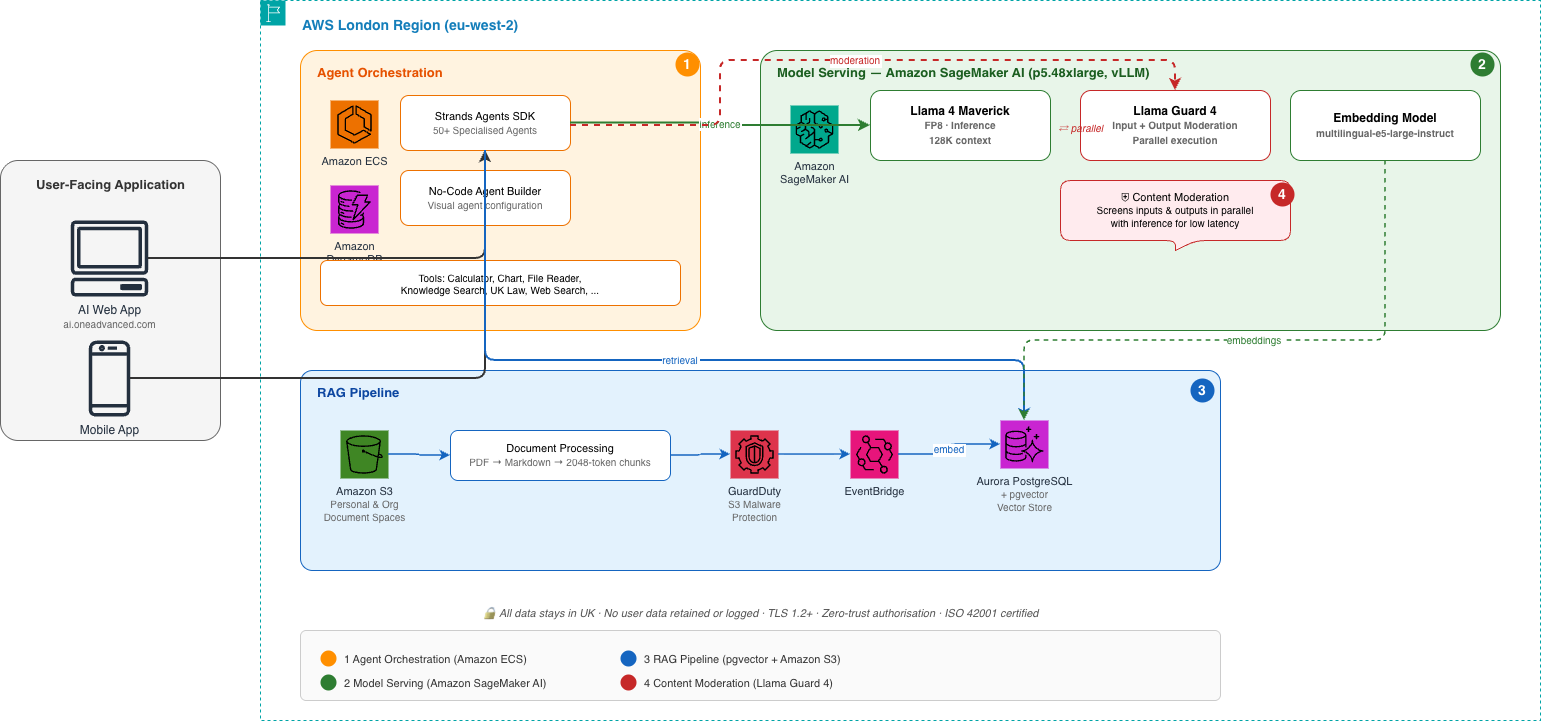
图 1:OneAdvanced 英国主权 AI 解决方案的高级架构
该架构使 OneAdvanced 能够实现完整的英国数据主权和快速 Agent 部署,在保持对模型服务基础设施完全控制的同时,支持其 ISO 42001 AI 治理认证。
该解决方案由四部分构成。vLLM 在 Amazon SageMaker AI 上为 Llama 4 Maverick(FP8)和 Llama Guard 4 提供服务,运行于伦敦(eu-west-2)区域的 p5.48xlarge 实例上。50 多个 Strands Agent 在 Amazon ECS 上运行,每个 Agent 都拥有自己的系统提示词、工具配置和可选输入表单,Agent 配置存储在 Amazon DynamoDB 中。上传到 Amazon Simple Storage Service(Amazon S3) 的文档会被转换为 Markdown、切分,并嵌入 pgvector 以供检索。Llama Guard 4 会在请求到达主模型前检查用户输入是否包含有害内容。
典型的请求流程如下:用户发送消息后,Llama Guard 会检查其中是否有有害内容(该步骤在主推理模型之前执行)。请求随后被路由到 Amazon ECS 上相应的 Strands Agent。该 Agent 会调用工具,并在需要时从 pgvector 和 Amazon S3 检索相关文档,或调用包括 Web 搜索在内的专业工具。
前提条件
要在 AWS 上自托管 AI 模型,需要具备以下资源和技能:
- 一个 AWS 账户,并可在目标区域访问
p5.48xlarge实例。有关申请 GPU 实例配额的信息,请参阅 Amazon SageMaker AI 开发人员指南。 - 具备在 Amazon ECS 上部署容器以及使用 Amazon S3 管理存储的中级知识。入门请参阅 Amazon ECS 开发人员指南。
- 能够访问所选 AI 模型的权重(Llama 4 Maverick 和 Llama Guard 4 要求在 Hugging Face 上接受许可协议)。
- 具备基于 Python 的机器学习(ML)框架和容器编排经验。
- 一个已启用 pgvector 扩展、可用于向量相似度搜索的 PostgreSQL 数据库。
在 Amazon SageMaker AI 上部署模型
OneAdvanced 使用 vLLM 在 Amazon SageMaker AI 端点上为 Llama 4 Maverick(meta-llama/Llama-4-Maverick-17B-128E-Instruct-FP8)和 Llama Guard 4(meta-llama/Llama-Guard-4-12B)提供服务。他们在伦敦区域的 p5.48xlarge 实例上,使用 Hugging Face 模型和 AWS Deep Learning Containers 进行部署。
对更长上下文窗口的需求推动他们转向 P5 实例。OneAdvanced 的目标上下文长度为 120K–128K token,以支持大型文档分析和多轮对话等用例。在与 AWS 的咨询合作中,针对 P5 实例上 vLLM 的负载测试验证了该基础设施能够满足其吞吐量要求。OneAdvanced 最初使用 p4d.24xlarge 实例,后为生产环境迁移至 p5.48xlarge,同时利用 GPU 计算的预留实例折扣。
在 OneAdvanced 发现此前版本存在较高误拒率后,Llama Guard 4 取代了早期部署的 Llama Guard 3。该防护模型在主模型之前串行运行,在推理开始前筛查用户输入中的有害内容。
使用 Strands Agents SDK 构建超过 50 个 Agent
OneAdvanced 解决方案的一项显著特点是其 Agent 库:拥有超过 50 个面向特定任务的 Agent,覆盖医疗、法律、HR、营销、物流等领域。这些 Agent 包括护理事件响应助手、临床安全公告生成器、教育课程方案生成器、运营场景模拟工具、绩效评估助手、文档对比工具和 AWS Architect Agent 等。OneAdvanced 在仅三周内就从第一个 Agent 扩展到超过 50 个,其中大部分 Agent 的构建时间不足一天。
OneAdvanced 在选择 Strands Agents SDK 前,评估了 LangChain、LangGraph 等多个 Agent 框架。最终决定主要基于几个因素:Strands 采用模型优先的方法,没有僵化的工作流定义;支持轮流交互和访谈式互动;并且让 OneAdvanced 能够快速将想法转变为已部署的 Agent。正如 OneAdvanced 首席软件工程师 Nick Heap 所解释的:
“经过评估后,Strands 明显成为该项目的首选。其全面的工具套件不仅满足了我们的要求,也提供了与我们内部愿景高度一致、面向未来的解决方案。”
每个 Agent 都通过系统提示词、一组工具和可选的结构化输入表单进行定义。Agent 被容器化并部署在 Amazon ECS 上,运行时配置存储在 Amazon DynamoDB 中。用户可以浏览 Agent 目录,并选择适合其任务的 Agent。
OneAdvanced 还构建了一个无代码 Agent 构建器,非开发人员可以通过可视化界面创建和配置 Agent。用户可以定义 Agent 的角色,使用拖放字段设计输入表单,编写引用表单字段的系统提示词(使用 @ 语法注入表单值),并从可用工具库中选择工具。这一设计使产品经理、临床医生和业务分析师无需编写代码即可创建 Agent。
Agent 可使用共享工具库,其中包括计算器、图表创建、文件内容阅读器、Mermaid 图表生成器、组织与个人知识搜索、电子表格查询(包括 Snowflake 集成)、文本文件查询、英国成文法搜索以及 Web 搜索(按组织及按用户查询选择启用)。例如,一个 Agent 可以在一次交互中查询 Snowflake 数据库,然后根据结果生成图表。
OneAdvanced 还使用子 Agent 和高级 Agent 模式,在复杂交互中维持上下文窗口。一个值得关注的设计模式是访谈式 Agent。部分 Agent,例如战略思维助手,会在给出建议前提出结构化问题:“第 1 个问题(共 3 个):您的 AI 解决方案旨在解决哪些具体痛点?”这种方式通过轮流交互构建上下文,而不是要求用户一开始就提供所有信息。聚焦且有引导的互动比开放式提示词能产生更好的结果。
RAG 管道
RAG 系统使 Agent 能够访问个人和组织级文档集合。用户通过文件管理界面将文档上传至 Amazon S3 中的个人空间或共享组织空间。文档会被转换为 Markdown,并在嵌入 pgvector 进行向量相似度搜索前切分为 2,048-token 的片段。对于超过片段大小的长文档,系统会通过递归摘要处理内容。
对于嵌入模型,OneAdvanced 使用 intfloat/multilingual-e5-large-instruct,选择该模型是因为其具备强大的多语言支持和遵循指令能力。OneAdvanced 没有采用现成的 RAG 框架,而是构建了自己的检索系统,内部称为“Llamadex”,以便完全控制该管道。他们最初选择 pgvector,是因为其简单性以及快速投入生产的能力。随着方案日益成熟,OneAdvanced 正在审查这一策略并评估替代方案。
当 Agent 需要基于上传文档回答问题时,它会调用相应的检索工具“个人知识搜索”或“组织知识搜索”,该工具查询 pgvector 并返回相关片段及来源引用。用户可以准确查看哪些文档被用于生成响应,从而支持透明度与信任。
安全与负责任 AI
安全性贯穿 OneAdvanced AI 解决方案的每一层,这直接源于其服务的客户每天都在医疗、法律等领域处理敏感数据。
基础设施运行在伦敦 AWS 区域。没有用户数据离开英国。不会保留用户查询或响应,也不会将其用于模型训练。正如 Nick Heap 所写:
“这项 AI 服务仅托管在英国,数据不会被用于训练 AI 模型,OneAdvanced 工程师也无法访问这些数据。”
个人和组织空间中上传的文档被完全隔离,即使 OneAdvanced 员工也无法读取。Llama Guard 4 会在用户输入到达主模型前对其进行有害内容筛查。隐私控制可以在组织层面进行定制。在基础设施层面,Amazon GuardDuty 为 Amazon S3 文档存储层提供威胁检测。
OneAdvanced 持有 ISO 42001 AI 治理认证——该公司称其是英国和欧洲最早获得该认证的组织之一。他们还是《欧盟 AI 公约》的签署方,体现出其在产品和运营中采取积极主动的负责任 AI 方法。
成果
通过 AWS 咨询合作,OneAdvanced 将英国主权 AI 解决方案从原型推进至生产环境。OneAdvanced 在伦敦区域的 P5 实例上部署了 Llama 4 Maverick,使其能够完全控制模型服务基础设施,且没有数据离开英国。他们仅用三周构建并发布了超过 50 个 Strands Agent,覆盖医疗、法律、HR、营销等领域的用例。该解决方案自 2025 年 7 月以来一直在生产环境运行,服务客户已超过一年。它达到了目标性能指标。OneAdvanced 将其公开发布为英国首个面向企业的私有主权 AI,且不会保留、用于训练或记录任何用户数据。该合作获得了 5/5 的客户满意度评分。
“我们非常感谢并享受这次合作。我们学到了很多,这帮助我们推出了一项由战略合作伙伴赋能和支持、面向市场的独特服务。非常感谢所有直接和间接参与其中的人员。”
— OneAdvanced 集成负责人 Alex Savage
结论与后续步骤
本文介绍了 OneAdvanced 如何通过在 Amazon SageMaker AI 上自托管 Llama 4 Maverick 和 Llama Guard 4、使用 Amazon ECS 上的 Strands Agents SDK 编排超过 50 个专业 Agent,以及通过由 pgvector 支持的 RAG 管道将响应基于客户文档,构建了一套英国主权 AI 解决方案。最终成果是一套生产级 AI 解决方案:它既满足严格的数据主权要求,也为受监管行业的企业客户提供实用的 AI 能力。
OneAdvanced 最近已采用 LLM-as-a-judge 和情感 a 建立评估框架。
English / 原文
This post is co-authored with OneAdvanced team
Deploying AI agents on a United Kingdom (UK)-sovereign AWS architecture requires careful decisions about model hosting, data residency, and agent orchestration. OneAdvanced, a UK-based enterprise software provider serving over 10,000 customers, needed to deliver AI capabilities while making sure that no data would leave the UK. At the time, the specific models they wanted, Llama 4 Maverick and Llama Guard 4, weren’t yet available through managed services in the UK region. OneAdvanced took a different path: self-hosting open-weight large language models (LLMs) on AWS infrastructure they fully control.
In this post, we describe how OneAdvanced built a UK-sovereign AI solution using Llama 4 Maverick and Llama Guard 4 on Amazon SageMaker AI. The solution pairs a Retrieval Augmented Generation (RAG) pipeline backed by Amazon Aurora PostgreSQL-Compatible Edition with the pgvector extension, over 50 specialized agents powered by Strands Agents SDK, and a tool layer running on Amazon Elastic Container Service (Amazon ECS). We walk through the architecture, key implementation decisions, and results.
The challenge: Data sovereignty and model hosting
OneAdvanced provides sector-focused software as a service (SaaS) solutions to organizations in healthcare, legal, and many other regulated industries. Their customers handle sensitive data daily, including patient records, legal case files, and compliance documentation. These customers expect that AI tooling meets strict data residency, security, and privacy standards.
As Andrew Henderson, CTO of OneAdvanced, explains in the OneAdvanced AI launch video:
“Data sovereignty, particularly in the UK, is a hard requirement for many of our customers, especially those in the public sector and highly regulated industries. They need to know exactly where their data is, who has access to it, and that it resides within the UK’s legal and regulatory framework to support total compliance and trust.”
OneAdvanced initially prototyped with Amazon Bedrock and saw rapid results within a two-week sprint: chat completion, an Amazon Bedrock Agent for querying UK statute law, Snowflake data integration, and chart generation.
However, to meet their sovereignty requirements, OneAdvanced needed to host models exclusively in their own UK-based AWS accounts. At the time of the engagement, the models they wanted, Llama 4 Maverick and Llama Guard 4, weren’t yet available through AWS managed services in the UK region. Self-hosting meant deploying, serving, and scaling these models while building a production-grade solution around them. This included content moderation, document retrieval, agent orchestration, and a no-code agent builder for non-technical users.
Solution overview
The following diagram shows the high-level architecture of the OneAdvanced AI solution.
Figure 1: High-level architecture of the OneAdvanced UK-sovereign AI solution
This architecture enabled OneAdvanced to achieve full UK data sovereignty and rapid agent deployment, supporting their ISO 42001 certification for AI governance while maintaining complete control over their model serving infrastructure.
The solution consists of four components. vLLM serves Llama 4 Maverick (FP8) and Llama Guard 4 on Amazon SageMaker AI, running on p5.48xlarge instances in the London (eu-west-2) region. Over 50 Strands agents run on Amazon ECS, each with its own system prompt, tool configuration, and optional input form, with agent configuration stored in Amazon DynamoDB. Documents uploaded to Amazon Simple Storage Service (Amazon S3) are converted to markdown, chunked, and embedded into pgvector for retrieval. Llama Guard 4 checks user inputs for harmful content before the request reaches the main model.
A typical request flows like this: the user sends a message, and Llama Guard checks it for harmful content (evaluated before the main inference model). The request routes to the appropriate Strands agent on Amazon ECS. The agent calls tools and retrieves relevant documents from pgvector and Amazon S3 as needed, or invokes specialist tools including web search.
Prerequisites
To self-host an AI model on AWS, you need the following resources and skills:
- An AWS account with access to
p5.48xlargeinstances in your target Region. For information about requesting GPU instance quota, refer to the Amazon SageMaker AI Developer Guide. - Intermediate knowledge of deploying containers on Amazon ECS and managing storage with Amazon S3. For getting started, refer to the Amazon ECS Developer Guide.
- Access to your chosen AI model weights (Llama 4 Maverick and Llama Guard 4 require license acceptance on Hugging Face).
- Experience with Python-based machine learning (ML) frameworks and container orchestration.
- A PostgreSQL database with the pgvector extension enabled for vector similarity search.
Model deployment on Amazon SageMaker AI
OneAdvanced serves Llama 4 Maverick (meta-llama/Llama-4-Maverick-17B-128E-Instruct-FP8) and Llama Guard 4 (meta-llama/Llama-Guard-4-12B) using vLLM on Amazon SageMaker AI endpoints. They deploy on p5.48xlarge instances in the London region, using Hugging Face models with AWS Deep Learning Containers.
Longer context windows drove the move to P5 instances. OneAdvanced targets 120K–128K token context lengths to support use cases like large document analysis and multi-turn conversations. During the advisory engagement with AWS, load testing with vLLM on P5 instances validated that the infrastructure could handle their throughput requirements. OneAdvanced started on p4d.24xlarge instances and moved to p5.48xlarge for production, also taking advantage of reserved instance discounts on GPU compute.
Llama Guard 4 replaced an earlier deployment of Llama Guard 3 after OneAdvanced observed high false rejection rates with the previous version. The guard model runs serially before the main model, screening user inputs for harmful content before inference begins.
Building over 50 agents with Strands Agents SDK
A distinctive aspect of the OneAdvanced solution is its agent library: over 50 task-specific agents spanning healthcare, legal, HR, marketing, logistics, and more. Agents include a Care Incident Response assistant, a Clinical Safety Bulletin generator, a scheme of work generator for education, an operational scenario simulation, a performance review assistant, a Document Comparison tool, and an AWS Architect Agent, among many others. OneAdvanced went from their first agent to over 50 in only three weeks, with most agents built in less than a day.
OneAdvanced evaluated several agentic frameworks, including LangChain, LangGraph, and others, before choosing Strands Agents SDK. The decision came down to a few factors: Strands takes a model-first approach with no rigid workflow definitions, it supports turn-taking and interview-style interactions, and it allowed OneAdvanced to move quickly from idea to deployed agent. As Nick Heap, Principal Software Engineer at OneAdvanced, explains:
“Post-evaluation, Strands stood out as the clear frontrunner for the project. Its comprehensive suite of tools not only met our requirements but also offered a future-proof solution that closely aligned with our in-house vision.”
Each agent is defined with a system prompt, a set of tools, and an optional structured input form. Agents are containerized and deployed on Amazon ECS, with runtime configuration stored in Amazon DynamoDB. Users browse the agent catalog and select the one that fits their task.
OneAdvanced also built a no-code agent builder that non-developers can use to create and configure agents through a visual interface. Users define the agent’s persona, design input forms with drag-and-drop fields, write system prompts with references to form fields (using an @ syntax to inject form values), and select from a library of available tools. This design makes agent creation accessible to product managers, clinicians, and business analysts without writing code.
Agents draw from a shared tool library that includes calculator, chart creation, file content reader, mermaid diagram generator, organization and personal knowledge search, spreadsheet query (including Snowflake integration), text file query, UK statute law search, and web search (opt-in per organization and per user query). For example, an agent can query a Snowflake database and then generate a chart from the results in a single interaction.
OneAdvanced also uses sub-agents and advanced agentic patterns to maintain the context window across complex interactions. A notable design pattern is the interview-style agent. Some agents, like the Strategic Thinking assistant, ask structured questions before providing advice: “Question 1 of 3: What specific pain points does your AI solution aim to address?” This builds context through turn-taking rather than expecting users to provide everything upfront. Focused, guided interactions produce better outcomes than open-ended prompts.
RAG pipeline
The RAG system gives agents access to both personal and organization-level document collections. Users upload documents through the file management interface into either a personal space or a shared organization space on Amazon S3. Documents are converted to markdown and chunked into 2,048-token segments before embedding into pgvector for vector similarity search. For longer documents, recursive summarization handles content that exceeds the chunk size.
For embeddings, OneAdvanced uses the intfloat/multilingual-e5-large-instruct model, chosen for its strong multilingual support and instruction-following capabilities. Rather than adopting an off-the-shelf RAG framework, OneAdvanced built their own retrieval system, internally called “Llamadex,” giving them full control over the pipeline. They initially chose pgvector for its simplicity and the speed it offered in getting to production. As the solution matures, OneAdvanced is reviewing this strategy to evaluate alternatives.
When an agent needs to answer a question grounded in uploaded documents, it calls the appropriate retrieval tool, “Personal knowledge search” or “Organization knowledge search,” which queries pgvector and returns relevant chunks along with source references. Users can see exactly which documents were used to generate a response, supporting transparency and trust.
Security and responsible AI
Security runs through every layer of the OneAdvanced AI solution, a direct consequence of serving customers who handle sensitive data daily in sectors like health and legal.
The infrastructure runs in the London AWS Region. No user data leaves the UK. No user queries or responses are retained or used for model training. As Nick Heap wrote:
“An AI service that is only hosted in the UK and data is not used to train the AI model and OneAdvanced engineers do not have access to the data.”
Uploaded documents in personal and organization spaces are fully isolated and not readable even by OneAdvanced staff. Llama Guard 4 screens user inputs for harmful content before they reach the main model. Privacy controls are customizable at organizational levels. On the infrastructure side, Amazon GuardDuty provides threat detection on the Amazon S3 document storage layer.
OneAdvanced holds ISO 42001 certification for AI governance—a certification they report being among the first organizations in the UK and Europe to achieve. They’re also a signatory to the EU AI Pact, reflecting a proactive approach to responsible AI across their products and operations.
Results
Through the AWS advisory engagement, OneAdvanced went from prototype to production on a UK-sovereign AI solution. OneAdvanced deployed Llama 4 Maverick on P5 instances in the London region, giving them full control over model serving infrastructure with no data leaving the UK. They built and shipped over 50 Strands agents in only three weeks, covering use cases across healthcare, legal, HR, marketing, and more. The solution has been running in production since July 2025, serving customers for over a year. It met its target performance metrics. OneAdvanced publicly launched this as the UK’s first private sovereign AI for business, with no user data retained, trained on, or logged. The engagement received a 5/5 customer satisfaction score.
“We really appreciate and enjoyed the engagement. We learned a lot which helped us launch a unique offering to the market powered and supported by our strategic partner. Thank you very much to all involved directly and indirectly.”
— Alex Savage, Head of Integration, OneAdvanced
Conclusion and next steps
In this post, we showed how OneAdvanced built a UK-sovereign AI solution by self-hosting Llama 4 Maverick and Llama Guard 4 on Amazon SageMaker AI, orchestrating over 50 specialized agents with Strands Agents SDK on Amazon ECS, and grounding responses in customer documents through a RAG pipeline backed by pgvector. The result is a production AI solution that meets strict data sovereignty requirements while delivering practical AI capabilities to enterprise customers in regulated industries.
OneAdvanced has recently implemented an evaluation framework using LLM-as-a-judge with sentiment analysis for continuous quality improvement. Their roadmap also includes backend systems to help users refine their prompts, and running parallel LLM models during version transitions to maintain stability for end users.
If you’re considering a similar approach, start by evaluating your data sovereignty requirements and identifying which models you need to self-host. OneAdvanced began with a two-week prototype on Amazon Bedrock to validate their use cases before committing to self-hosted infrastructure. For more information about deploying models on Amazon SageMaker AI, refer to the Amazon SageMaker AI Developer Guide. To get started with agentic workflows, visit the Strands Agents SDK on GitHub.
To read more about OneAdvanced’s journey building their AI solution, see Nick Heap’s post The AI race and how we fully embraced velocity on the OneAdvanced careers blog.
If you have a similar use case and would like to explore sovereign AI deployment on AWS, contact your AWS account team.
About the authors
Astrid Bowser
Astrid is a Principal Product Manager at OneAdvanced, shaping the OneAdvanced Platform Data and AI initiatives. With degrees in Computer Science and an MBA, she seamlessly blends technical expertise with strategic business acumen. Committed to focussing efforts on developing problem solving solutions with the responsible use of AI, she was Co-Chair of OneAdvanced’s AI Steering Committee, defining and driving the company’s AI-focused vision, including being part of the team driving the objective to be one of the first companies in the UK to secure the new ISO 42001 AI Systems Management standard for OneAdvanced.
Alex Savage
Alex is an Engineering Manager at OneAdvanced based near London, specialising in scalable enterprise platforms, trusted regional AI and agent systems, and API integration strategies. With a strong background in software engineering and cloud infrastructure, he has helped architect and deliver the UK’s sovereign AI platform from the ground up, driven secure integration standards across the organisation, and provided technical leadership that spans diverse business units—from platform development to cross-functional enablement in healthcare, education, legal and customer experience.
Nick Heap
Nick is a Principal Software Engineer at OneAdvanced, where he helps drive innovation across emerging technologies, AI, cloud platforms, DevOps, and software engineering practices. With extensive experience spanning software architecture, API development, automation, data analytics, and platform modernisation, Nick is known for solving complex technical challenges, mentoring development teams, and championing best practices that improve both developer experience and business outcomes. A passionate advocate for continuous improvement and technology innovation, he works across teams to accelerate digital transformation and deliver scalable, high-quality solutions for customers.
Babs Khalidson
Babs is a machine learning engineer at the AWS Generative AI Innovation Center in London, where he specializes in fine-tuning large language models, building AI agents, and model deployment solutions. He has over 7 years of experience in artificial intelligence and machine learning across finance and cloud computing, with expertise spanning from research to production deployment.
Giuseppe Mascellaro
Giuseppe is a Senior Applied Scientist at the AWS Generative AI Innovation Center, where he helps customers design and deploy generative AI solutions, from agentic systems and RAG applications to real-time multimodal AI. He holds an MSc from Politecnico di Milano and has over 8 years of experience in AI/ML, with research published at AAAI.
Dr Anil Giri
Anil is a Solutions Architect at AWS, specializing in helping ISV customers build generative AI applications and serverless architectures. He is passionate about guiding clients toward innovative, scalable solutions powered by cutting-edge cloud technology.