借助 Amazon Bedrock AgentCore 加速并购尽职调查
英文标题:Accelerating M&A due diligence with Amazon Bedrock AgentCore
本文介绍如何使用 Amazon Bedrock AgentCore 构建多智能体并购(M&A)尽职调查系统,通过主管智能体协调目标筛选、财务分析、战略匹配和合规验证四类专业智能体。该参考架构结合 RAG、结构化财务数据、外部工具调用、长期记忆以及基于策略的治理控制,将原本需要数周的重复性研究工作缩短至数小时。系统要求每项事实性主张附带来源引用,并通过 Lambda 驱动的引文检查评估器自动验证,从而增强审计可追溯性。AWS 提供了可一键部署的示例仓库,使用合成数据,完整部署、运行和清理的预估成本低于 5 美元。
 1.3 MB
 101.1 KB
 124.1 KB
 345.0 KB
 141.2 KB
 346.5 KB
 291.6 KB
 1.6 MB
 506.4 KB
 267.5 KB
 221.9 KB
中文
并购(M&A)团队长期面临一项挑战:既要对多个收购目标开展全面尽职调查,又要维持速度和分析严谨性。团队通常需要花费数周时间手动审查目标公司,才能识别出可行机会。Amazon Bedrock AgentCore 是一个可使用任意框架或模型,以规模化方式构建、连接和优化智能体的平台。它能够通过编排 AI 智能体,在既定护栏内自主完成数据收集、分析和合规检查,从而加快这一流程。
本文介绍如何在 Amazon Bedrock AgentCore 上构建多智能体尽职调查系统。我们将展示一个结合智能体编排、知识检索和治理控制的参考架构,然后说明如何借助完整示例仓库部署和运行该解决方案。
并购尽职调查面临的挑战
例如,在交通运输和物流行业,分析师需要从金融数据库、市场研究应用、监管备案文件和内部知识库中提取数据,再手动核对这些信息。该过程缓慢且资源密集。
当团队重复劳动时,问题会进一步加剧。行业研究、估值模型和竞争分析会针对每一笔新交易重新创建,而不是基于以往交易积累的机构知识。同时,治理方面的顾虑也会减缓 AI 的采用速度,因为法务和合规团队需要确信 AI 生成的洞察准确、可追溯,并且有来源引用支持。
这四项压力——周期缓慢、数据碎片化、工作重复和治理要求——为 AI 智能体从根本上改变尽职调查运作方式创造了机会。
AI 智能体如何改变尽职调查
AI 智能体通过自主数据收集、智能路由、持久记忆和内置可审计性相结合的方式,应对上述每一项挑战。
在数据收集方面,智能体可自主查询多个来源(金融数据库、知识库、市场数据 API),并将结果综合为初步评估。在我们的测试中,由于智能体无需人工干预即可处理重复性的搜索和总结循环,原先需要数周分析师时间的工作可在数小时内完成。
在优先级排序方面,智能体会依据战略标准评估机会,并将高优先级交易路由给合适的专家。系统不再按顺序审查每一个目标,而是优先呈现最有前景的候选对象,并标记需要深入分析的具体维度,例如财务表现、战略契合度和合规风险。
智能体还会持续构建机构知识。每次完成的分析都会丰富共享记忆层,使未来交易能够受益于此前的研究、估值假设和整合经验。团队无需再从零开始重新构建背景信息。
治理从一开始就内置于智能体工作流中,而不是事后追加。系统经过配置,确保智能体输出的每一项主张都有引用作为依据,并由引文检查评估器验证。每次智能体调用都会生成审计跟踪,护栏则在运行时执行组织策略。合规团队可以将每项被引用的主张追溯至其源文档。
架构选择:集成套件还是自定义构建
我们提供两条实现路径,分别适合不同的组织需求。
选项 1:Amazon Quick(集成式解决方案)
Amazon Quick 提供面向商业智能和研究工作流的即用型 AI 功能。如果你的需求符合标准分析模式,它提供了一条快速投入生产的路径。Amazon Quick Research 可生成专业、可导出的深度报告。Amazon Quick Flows 可通过预构建工作流自动执行重复性任务。Amazon Quick Index 可在已连接的数据源之间提供统一搜索。
如果你希望快速部署、工作流符合标准商业智能模式,并且偏好全托管服务而非自定义开发,请选择 Amazon Quick。有关更多信息和参考架构,请参阅 Announcing Amazon Quick。
你也可以通过自定义 Amazon Bedrock AgentCore 智能体扩展 Quick,以满足专有估值模型或战略契合度框架等专业需求。有关该模式的实际示例,请参阅 Building Intelligent Contract Management with Quick and AgentCore。该文章展示了 Amazon Quick 如何负责文档管理和用户界面,而 Amazon Bedrock AgentCore 则为专业智能体协作提供支持。
选项 2:使用 Amazon Bedrock AgentCore 的自定义架构
Amazon Bedrock AgentCore 让你能够精细控制智能体行为、记忆和协作。该方式适用于拥有专有方法论、复杂多智能体协作要求、需要集成专业内部系统,或需要完全控制智能体行为和模型选择的并购团队。
本文余下部分将以交通运输和物流尽职调查场景为背景,详细探讨这一自定义架构。我们将部署一个可运行的多智能体系统,以合成目标对其进行调用,并通过自动化引文检查评估器验证输出。
参考架构
对于选择自定义路径的并购团队,以下参考架构展示了各组件如何端到端协同工作。
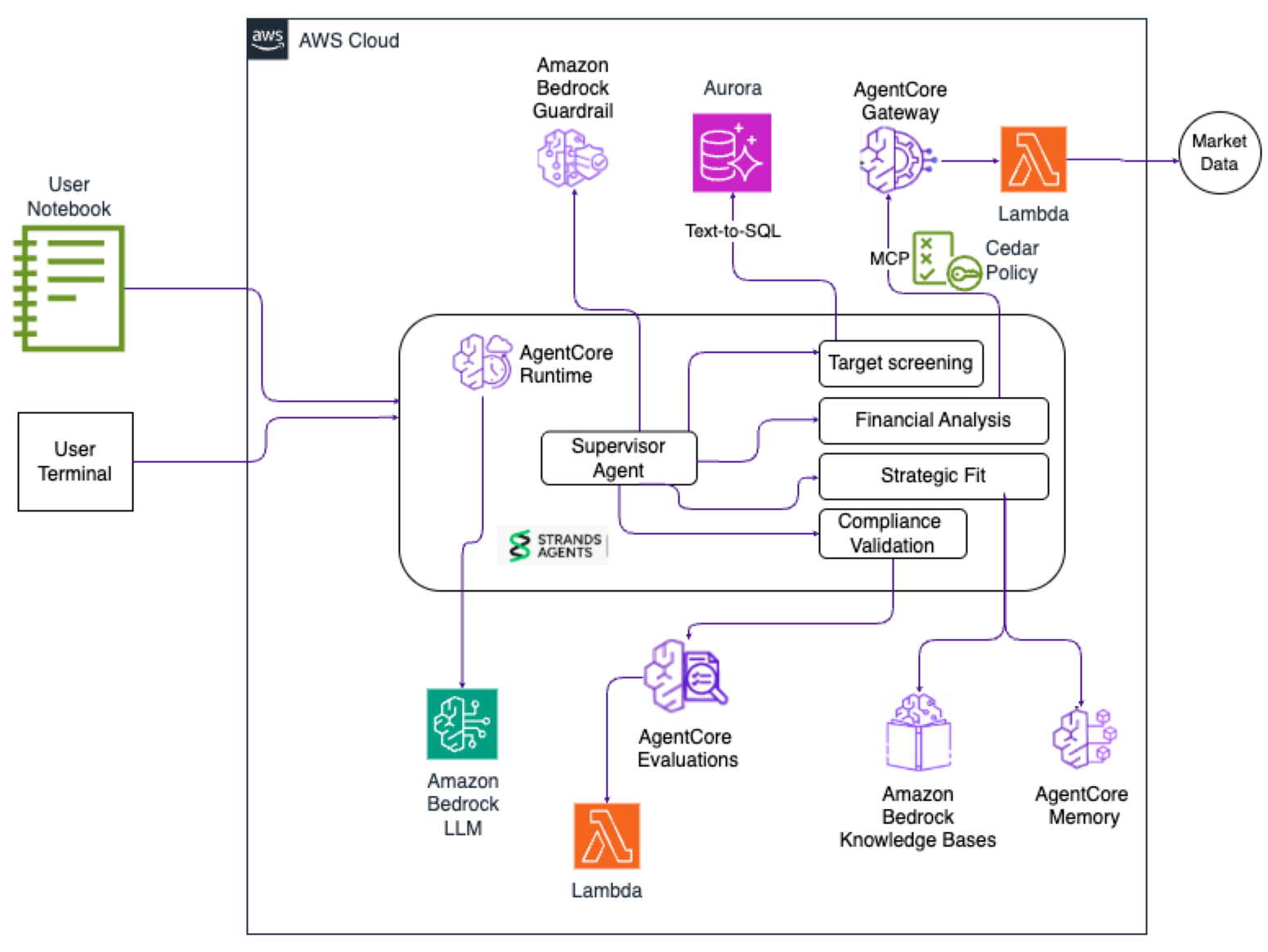
图 1:采用 Amazon Bedrock AgentCore 的多智能体并购尽职调查架构
该架构使用 Amazon Bedrock AgentCore 编排多智能体尽职调查工作流。一个主管智能体协调四个专业智能体,每个智能体负责尽职调查流程中不同的阶段。用户通过 Jupyter notebook 或终端界面进行交互,而 AgentCore 运行时负责管理智能体执行和协作。该系统结合检索增强生成(RAG)、结构化财务分析、外部工具集成、记忆和基于策略的治理机制,以支持可投入生产的尽职调查工作流。
智能体编排层
Amazon Bedrock AgentCore 运行时通过 Strands Agents SDK 协调多个专业智能体。主管智能体使用“智能体即工具”(agents-as-tools)模式,根据任务要求将请求路由至领域专属专家。
**目标筛选智能体(Target Screening Agent)**通过将自然语言查询转换为 SQL,并针对 Amazon Aurora PostgreSQL 执行查询,识别收购候选目标。当分析师要求查找“营收介于 1 亿至 5 亿美元、EBITDA 利润率高于 12% 的中端物流公司”时,该智能体会将请求转换为参数化查询。随后,它检索匹配行,并利用知识库中的叙述性背景信息丰富结果。
**财务分析智能体(Financial Analysis Agent)**使用结构化和非结构化数据源执行估值分析。它应用包括贴现现金流(DCF)分析和可比公司分析在内的标准估值方法,并通过由 AgentCore Gateway 支持的工具获取市场倍数。该智能体生成初步估值,在文中内联记录支持性假设,并标记与历史表现存在偏离的管理层预测。
**战略契合度智能体(Strategic Fit Agent)**评估整合风险、协同效应和组织匹配度。它从存储在 AgentCore memory 中的历史交易记录里检索背景信息,使用专用的 prior_deals 命名空间。随后,它将当前目标的画像与已完成收购进行比较,并识别整合风险,同时提供源备忘录引用。
**合规验证智能体(Compliance Validation Agent)**根据并购治理检查清单审计回答。它调用一个自定义引文检查评估器(实现为 AWS Lambda 函数),检查回答中的每一项事实性主张,并标记缺乏支持性来源引用的断言。
关键架构组件
该架构结合结构化和非结构化企业数据,使智能体回答以经验证的来源为依据。
- Amazon Aurora PostgreSQL Serverless v2 存储结构化财务和运营数据集。目标筛选智能体可从自然语言生成 SQL,并通过 RDS Data API 执行查询,从而快速访问目标公司的指标,无需分析师自行编写 SQL。
- Amazon Bedrock Knowledge Bases 是 Amazon Bedrock 的全托管 RAG 功能,可为尽职调查文档建立索引,包括保密信息备忘录(CIM)、财务报表、媒体资料包和内部治理检查清单。智能体会检索相关段落并以内联方式引用。
- AgentCore Gateway 是 Amazon Bedrock AgentCore 的一项功能,可让智能体通过兼容模型上下文协议(MCP)的集成,安全地与外部工具和服务交互。在此架构中,智能体通过该网关调用基于 AWS Lambda 的市场数据服务,而 Cedar 策略则对工具使用和智能体交互实施确定性的访问控制。
- AgentCore memory 可在不同交互之间维护上下文状态和可复用的机构知识。会话记忆保持对话连续性,而长期
prior_deals命名空间则存储已完成收购的经验教训,为未来分析提供参考。 - AgentCore Evaluations 是 Amazon Bedrock AgentCore 的一项功能,使用基于 Lambda 的评估器自动验证输出质量、引文准确性和领域专属标准。引文检查评估器会返回结构化的通过/失败结果,并统计有支持和无支持主张的数量。
- Amazon Bedrock Guardrails 在整个工作流中执行安全和响应控制,应用于主管层级,因此专业智能体的输出会经过组织策略检查。
每次调用都会生成一个 Amazon CloudWatch 日志流和一个 AWS X-Ray 跟踪记录,捕获从主管智能体到专业智能体再到工具调用的完整层级结构,从而提供端到端可观测性。
安全性
并购尽职调查涉及企业所处理的一些最敏感数据:未发布的财务数据、交易条款和整合计划。因此,安全性是该架构中的一等组成部分。智能体可调用的每项 IAM 权限都限定到特定的 Amazon Resource Name(ARN),而不是使用通配符。AgentCore Gateway 市场数据工具借助 Cedar 策略引擎进一步实现了默认拒绝、基于属性的授权。只有当请求的行业代码与获批准的垂直领域匹配时,该工具才会运行。其他所有请求都会在执行前被拒绝。数据库层位于虚拟私有云(VPC)端点后方的私有、与互联网隔离的子网中。数据存储使用 KMS 进行静态加密,Amazon Bedrock Guardrails 则会筛查每一条主管智能体响应中的有害内容和个性化金融建议。由 IAM、Cedar、网络隔离和加密构成的这一分层模型,覆盖了处理机密交易数据的系统可能面临的不同失效模式。
部署并运行示例
完整参考实现可在 M&A Due Diligence Multi-Agent Sample 仓库中获取。该仓库包含合成数据(不含真实公司、财务数据或个人身份信息)、一键部署功能和 Jupyter notebook 演练。完成一次完整部署、运行和清理周期的预估成本低于 5.00 美元。
前提条件
部署前,请确认你具备以下条件:
- 已启用 Anthropic Claude 和 Amazon Nova 的 Amazon Bedrock 模型访问权限的 AWS 账户。有关各 AWS 区域的模型可用性,请参阅 Supported models by AWS Region in Amazon Bedrock。
- AWS Command Line Interface(AWS CLI)v2.15 或更高版本。
- Python 3.11 或更高版本。
- Node.js 20 或更高版本。
- AWS Cloud Development Kit(AWS CDK)v2(
npm install -g aws-cdk)。 - 无需在本地安装 Docker。智能体容器镜像将在 AWS CodeBuild 上构建。
部署至以下受支持区域之一:us-east-1、us-west-2、ap-southeast-2 或 eu-central-1。
第 1 步:部署堆栈
克隆仓库并运行部署脚本。首次部署需要 20–25 分钟。
# macOS / Linux
git clone https://github.com/aws-samples/sample-ma-due-diligence-agentcore.git
cd sample-ma-due-diligence-agentcore
./deploy.sh

# Windows
git clone https://github.com/aws-samples/sample-ma-due-diligence-agentcore.git
cd sample-ma-due-diligence-agentcore
.\deploy.ps1
部署脚本会验证你的区域和模型访问权限,创建虚拟环境,运行 cdk deploy --all,植入合成数据,并执行部署后冒烟测试。它还会以可编辑模式安装项目,由此注册你用于
English / 原文
Mergers and acquisitions (M&A) teams face a persistent challenge: conducting thorough due diligence on multiple acquisition targets while maintaining speed and analytical rigor. Teams often spend weeks manually reviewing targets before identifying viable opportunities. Amazon Bedrock AgentCore is a platform to build, connect, and optimize agents at scale, with any framework or model. It can accelerate this process by orchestrating AI agents that handle data gathering, analysis, and compliance checks autonomously within defined guardrails.
In this post, we show how to build a multi-agent due diligence system on Amazon Bedrock AgentCore. We present a reference architecture that combines agent orchestration, knowledge retrieval, and governance controls, then walk through deploying and running the solution using a complete sample repository.
The M&A due diligence challenge
In transportation and logistics, for example, analysts pull data from financial databases, market research applications, regulatory filings, and internal knowledge bases, then reconcile that information by hand. The process is slow and resource intensive.
The problem compounds when teams duplicate work. Industry research, valuation models, and competitive analyses get recreated for each new deal instead of building on institutional knowledge from prior transactions. Meanwhile, governance concerns slow AI adoption because legal and compliance teams require confidence that AI-generated insights are accurate, traceable, and supported by source citations.
These four pressures (slow cycles, fragmented data, duplicated effort, and governance requirements) create an opportunity for AI agents to fundamentally change how due diligence operates.
How AI agents transform due diligence
AI agents address each of these challenges through a combination of autonomous data gathering, intelligent routing, persistent memory, and built-in auditability.
On the data-gathering front, agents autonomously query multiple sources (financial databases, knowledge bases, market data APIs) and synthesize the results into preliminary assessments. In our testing, work that previously required weeks of analyst time was completed in hours because the agent handles the repetitive search-and-summarize loop without human intervention.
For prioritization, agents evaluate opportunities against strategic criteria and route high-priority deals to the right specialists. Rather than reviewing every target sequentially, the system surfaces the most promising candidates first and flags the specific dimensions (financial performance, strategic fitness, compliance risk) that warrant deeper analysis.
Agents also build institutional knowledge over time. Each completed analysis enriches a shared memory layer so that future deals benefit from prior research, valuation assumptions, and integration lessons. Teams stop recreating context from scratch.
Governance is built into the agent workflow from the start, not added as an afterthought. The system is configured so that each assertion the agent emits is grounded in a citation, validated by the citation-check evaluator. Each agent invocation produces an audit trail, and guardrails enforce organizational policies at runtime. Compliance teams can trace each cited claim back to its source document.
Architecture decision: integrated suite or custom build
We present two implementation paths, each suited to different organizational needs.
Option 1: Amazon Quick (integrated solution)
Amazon Quick provides ready-to-use AI capabilities tailored for business intelligence and research workflows. It offers a fast path to production if your needs align with standard analysis patterns. Amazon Quick Research generates professional, exportable in-depth reports. Amazon Quick Flows automates repetitive tasks with pre-built workflows. Amazon Quick Index delivers unified search across connected data sources.
Choose Amazon Quick if you want to deploy rapidly, your workflows align with standard business intelligence patterns, and you prefer fully managed services over custom development. For additional information and reference architecture, see the Announcing Amazon Quick.
You can also extend Quick with custom Amazon Bedrock AgentCore agents for specialized requirements such as proprietary valuation models or strategic fit frameworks. For a practical example of this pattern, see Building Intelligent Contract Management with Quick and AgentCore. That post demonstrates how Amazon Quick handles document management and the user interface while Amazon Bedrock AgentCore powers specialized agent collaboration.
Option 2: Custom architecture with Amazon Bedrock AgentCore
Amazon Bedrock AgentCore gives you fine-grained control over agent behavior, memory, and coordination. This approach suits M&A teams with proprietary methodologies, complex multi-agent coordination requirements, integration with specialized internal systems, or a need for complete control over agent behavior and model selection.
The remainder of this post explores this custom architecture in detail using a transportation-and-logistics due diligence scenario as context. We deploy a working multi-agent system, invoke it against synthetic targets, and validate outputs through an automated citation-check evaluator.
Reference architecture
For M&A teams choosing the custom path, the following reference architecture shows how the pieces fit together end to end.
Figure 1: Multi-agent M&A due diligence architecture with Amazon Bedrock AgentCore
The architecture uses Amazon Bedrock AgentCore to orchestrate a multi-agent due diligence workflow. A supervisor agent coordinates four specialist agents, each responsible for a distinct phase of the due diligence process. Users interact through a Jupyter notebook or terminal interface, while AgentCore runtime manages agent execution and collaboration. The system combines Retrieval Augmented Generation (RAG), structured financial analysis, external tool integration, memory, and policy-based governance to support production-ready due diligence workflows.
Agent orchestration layer
Amazon Bedrock AgentCore runtime coordinates multiple specialized agents through the Strands Agents SDK. The supervisor agent uses the agents-as-tools pattern to route requests to domain-specific specialists based on task requirements.
The Target Screening Agent identifies acquisition candidates by converting natural-language queries into SQL and executing them against Amazon Aurora PostgreSQL. When analysts ask for “mid-market logistics companies with revenue between 100M and 500M USD and EBITDA margins above 12 percent,” the agent translates that into a parameterized query. It then retrieves matching rows and enriches the results with narrative context from the knowledge base.
The Financial Analysis Agent performs valuation analysis using structured and unstructured data sources. It applies standard valuation methodologies including discounted cash flow (DCF) analysis and comparable company analysis, pulling market multiples through an AgentCore Gateway-backed tool. The agent generates preliminary valuations with supporting assumptions documented inline and flags management projections that diverge from historical performance.
The Strategic Fit Agent evaluates integration risks, synergies, and organizational alignment. It retrieves context from prior transactions stored in AgentCore memory (using a dedicated prior_deals namespace). It then compares the current target’s profile against completed acquisitions and identifies integration risks with citations to source memos.
The Compliance Validation Agent audits responses against the M&A governance checklist. It invokes a custom citation-check evaluator (implemented as an AWS Lambda function) that examines every factual claim in a response and flags assertions that lack a supporting source citation.
Key architecture components
The architecture combines structured and unstructured enterprise data to ground agent responses in verified sources.
- Amazon Aurora PostgreSQL Serverless v2 stores structured financial and operational datasets. The Target Screening Agent generates SQL from natural language and executes queries through the RDS Data API, providing fast access to target-company metrics without requiring analysts to write SQL themselves.
- Amazon Bedrock Knowledge Bases, the fully managed RAG capability in Amazon Bedrock, indexes due diligence documents including confidential information memoranda (CIMs), financial statements, press packs, and internal governance checklists. Agents retrieve relevant passages and cite them inline.
- AgentCore Gateway , a capability of Amazon Bedrock AgentCore, lets agents securely interact with external tools and services through Model Context Protocol (MCP)-compatible integrations. In this architecture, agents invoke an AWS Lambda-based market data service through the gateway, with Cedar policies enforcing deterministic access controls over tool usage and agent interactions.
- AgentCore memory maintains contextual state and reusable institutional knowledge across interactions. Session memory preserves conversation continuity, while a long-term
prior_dealsnamespace stores lessons from completed acquisitions that inform future analyses. - AgentCore Evaluations , a capability of Amazon Bedrock AgentCore, uses Lambda-based evaluators to automatically validate output quality, citation accuracy, and domain-specific criteria. The citation-check evaluator returns a structured pass/fail result with counts of supported and unsupported claims.
- Amazon Bedrock Guardrails enforces safety and response controls throughout the workflow, applied at the supervisor level so specialist outputs pass through organizational policy checks.
Every invocation produces an Amazon CloudWatch log stream and an AWS X-Ray trace that captures the full supervisor-to-specialist-to-tool call hierarchy, providing end-to-end observability.
Security
M&A due diligence involves some of the most sensitive data a company handles: unreleased financials, deal terms, and integration plans. Security is therefore a first-class part of the architecture. Every IAM permission the agents can invoke is scoped to a specific Amazon Resource Name (ARN) rather than a wildcard. The AgentCore Gateway market-data tool goes a step further with a Cedar policy engine that enforces default-deny, attribute-based authorization. The tool runs only when the requested industry code matches an approved vertical. Everything else is denied before it runs. The database tier lives in private, internet-isolated subnets behind virtual private cloud (VPC) endpoints. Data stores are encrypted at rest with KMS, and Amazon Bedrock Guardrails screen every supervisor response for harmful content and personalized financial advice. This layered model of IAM, Cedar, network isolation, and encryption covers different failure modes for systems that handle confidential deal data.
Deploy and run the sample
The complete reference implementation is available in the M&A Due Diligence Multi-Agent Sample repository. It ships with synthetic data (no real companies, financial data, or personally identifiable information), one-command deployment, and a Jupyter notebook walkthrough. The estimated cost for a full deploy-run-cleanup cycle is under USD $5.00.
Prerequisites
Before deploying, verify you have:
- An AWS account with Amazon Bedrock model access enabled for Anthropic Claude and Amazon Nova. For model availability by AWS Region, refer to Supported models by AWS Region in Amazon Bedrock.
- AWS Command Line Interface (AWS CLI) v2.15 or later.
- Python 3.11 or later.
- Node.js 20 or later.
- AWS Cloud Development Kit (AWS CDK) v2 (
npm install -g aws-cdk). - You don’t need Docker installed locally. The agent container image is built on AWS CodeBuild.
Deploy to one of the supported Regions: us-east-1, us-west-2, ap-southeast-2, or eu-central-1.
Step 1: Deploy the stack
Clone the repository and run the deploy script. First-time deployment takes 20–25 minutes.
# macOS / Linux
git clone https://github.com/aws-samples/sample-ma-due-diligence-agentcore.git
cd sample-ma-due-diligence-agentcore
./deploy.sh


# Windows
git clone https://github.com/aws-samples/sample-ma-due-diligence-agentcore.git
cd sample-ma-due-diligence-agentcore
.\deploy.ps1
The deploy script verifies your Region and model access, creates a virtual environment, runs cdk deploy --all, seeds synthetic data, and executes a post-deploy smoke test. It also installs the project in editable mode, which registers the mna command-line tool that you use to invoke agents in the next step.
Step 2: Invoke the agents
Use the mna CLI to send prompts to individual specialists or let the supervisor route across them:
# Let the supervisor orchestrate across specialists
mna invoke supervisor "Screen the mid-market logistics targets with revenue 100M-500M, then run a DCF on the top hit." --session-id walkthrough-session-00000000-0001

# Target Screening: text-to-SQL on Aurora + KB narrative enrichment
mna invoke target_screening "Screen the target pipeline for transportation companies with revenue between 100M and 500M USD, EBITDA margin above 12%, and fleet size above 200. Surface the top three and tell me what the CIM says about the leader's growth trajectory." --session-id walkthrough-session-00000000-0001

# Financial Analysis: KB retrieval + Gateway-backed market data tool
mna invoke financial_analysis "Run a DCF on Example Corp using the CIM in the knowledge base. Flag any management projection that diverges from historical performance by more than 20% and pull comparable multiples for transportation-logistics mid-market." --session-id walkthrough-session-00000000-0001

# Strategic Fit: AgentCore Memory long-term retrieval
mna invoke strategic_fit "Compare Example Corp' integration profile against our three most recent completed acquisitions. Identify the top three integration risks and cite the source memos." --session-id walkthrough-session-00000000-0001
Every invocation prints a trace_id in its footer. Use mna trace <trace_id> to inspect the full X-Ray trace for that call.
Step 3: Validate outputs with the evaluator
The mna evaluate subcommand runs the citation-check evaluator against a specialist’s output:
# Capture a response in JSON format
mna --json invoke financial_analysis "Run a DCF on Example Corp using the CIM." --session-id blog-demo-session-00000000-000002 > run.json

# --session-id accepts any string between 33 and 256 characters --- AgentCore Runtime enforces this length range for runtimeSessionId. The value above is just an example; use a unique string per session (a UUID works well) if you want to keep invocations isolated or omit --session-id entirely to let the client generate one for you.

# Extract response text and citations
python -c "import json,pathlib;d=json.loads(pathlib.Path('run.json').read_text());pathlib.Path('response.txt').write_text(d['text'])"

python -c "import json,pathlib;
d=json.loads(pathlib.Path('run.json').read_text());
pathlib.Path('citations.json').write_text(json.dumps(d['citations']))"

# Run the citation-check evaluator
mna evaluate --response-file response.txt --citations-file citations.json
The evaluator returns a structured result indicating pass or failure, with counts of total claims, supported claims, and any unsupported assertions. The exit code is 0 on pass and 1 on fail, making it composable in CI pipelines.
Step 4: Explore the notebook
For a guided, cell-by-cell tour of the same workflow:
jupyter lab notebooks/walkthrough.ipynb
The notebook walks through environment validation, data overview, one cell per specialist agent (with rendered responses and citations), and trace inspection.
Clean up
To avoid ongoing charges, destroy all deployed resources as soon as you finish exploring:
# macOS / Linux
./cleanup.sh
The cleanup script runs cdk destroy --all --force to tear down every stack in reverse dependency order. It then executes a verification sweep that scans for orphaned resources:
- S3 buckets matching
mna-*. - ECR repositories matching mna-*.
- Amazon Bedrock Knowledge Bases with
mnain the name. - AgentCore runtimes, memories, and gateways.
- AWS CloudFormation stacks starting with
Mna.
The verification script prints copy-paste commands for resources it finds so you can confirm a zero-cost end state. If the script output is empty for every sweep, all billable resources have been removed. For additional details on CDK resource cleanup, see the AWS CDK documentation.
Next steps
We encourage you to extend this architecture for your own use cases. Here are several paths forward:
- Add a production front end. The Full-Stack Starter Template for AgentCore (FAST) provides a React-based UI, Amazon Cognito authentication, and Amazon CloudFront distribution that integrates directly with AgentCore runtime.
- Build additional specialist agents. The sample’s CONTRIBUTING.md documents the file layout, Strands pattern, and supervisor registration process for adding new agents (for example, a regulatory-filing agent or an ESG-scoring agent).
- Explore advanced orchestration. The Strands Agents SDK supports multiple coordination approaches including agents-as-tools, swarms, and agent graphs. The multi-agent collaboration patterns documentation covers each approach in detail.
- Connect additional data sources. AgentCore Gateway supports HTTP APIs, MCP servers, and Amazon API Gateway targets beyond the single Lambda tool demonstrated here.
Conclusion
In this post, we showed how to build a multi-agent system on Amazon Bedrock AgentCore that automates M&A due diligence in transportation and logistics. We walked through the architecture that coordinates specialized agents for target screening, financial analysis, strategic fit assessment, and compliance validation. We then deployed the working sample and invoked it against synthetic acquisition targets.
The reference implementation demonstrates how each architectural layer (agent orchestration, knowledge retrieval, structured data access, institutional memory, and automated evaluation) contributes to a system that is both capable and auditable. The patterns shown here extend naturally to other due diligence domains including healthcare, financial services, and technology acquisitions.
To get started, clone the sample repository, deploy the stack in your AWS account, and try modifying a specialist agent or adding a new one. The FAST template provides the path from this sample to a hosted application with authentication, observability, and a polished UI.
Resources
About the authors
Anand Komandooru
Anand is a Principal Solutions Architect on the Well-Architected AI team at AWS, where he focuses on AI-driven architecture guidance for agentic systems. He has over 20 years of experience building software and previously spent four years helping customers design and deliver cloud-native applications in AWS Professional Services.
Sachin Doshi
Sachin is a Senior Application Architect in AWS Professional Services. He helps customers design and build production-ready solutions using generative AI, serverless architectures, and cloud-native AWS services. He is based in the New York metropolitan area.
Ray Elkins
Ray is a Senior Solutions Architect at Amazon Web Services. With 15 years of enterprise cloud and security experience, he partners with customers to solve complex security and compliance challenges on AWS. Ray focuses on the intersection of agentic AI and cloud security, helping customers adopt frontier agents to automate threat detection and response at scale.