使用 Amazon Bedrock AgentCore Gateway 治理 AI Agent 的工具访问
英文标题:Govern AI agent tool access with Amazon Bedrock AgentCore Gateway
企业在部署 MCP 和 AI Agent 时,常面临凭证蔓延、策略漂移、审计缺口、成本不透明和影子 IT 等治理问题。本文提出由 Connect、Control、Catalog、Harden 构成的四阶段成熟度模型,建议团队仅在实际治理痛点出现时逐步增加控制能力。Amazon Bedrock AgentCore Gateway 可作为面向组织工具的统一安全入口,并结合 AgentCore Identity、AgentCore Policy、Amazon Bedrock Guardrails 和 AWS Agent Registry 实现认证、授权、数据防护与工具目录管理。对开发者而言,该方案可减少本地 `mcp.json` 中的凭证和配置负担;对企业而言,则可在不集中迁移全部基础设施的前提下获得可审计、可治理的 Agent 工具访问能力。
 1.3 MB
 101.1 KB
 124.1 KB
 345.0 KB
 141.2 KB
 346.5 KB
 217.5 KB
 155.2 KB
 257.2 KB
 338.7 KB
 422.2 KB
 5.7 KB
 27.1 KB
 160.3 KB
中文
在过去几个月与客户的交流中,我们不断看到同一种模式。无论他们使用的是编程 Agent、自主 Agent,还是与人交互的 Agent,也无论其工作负载成熟度如何,我们都会从同一个问题开始:“哪些 AI Agent 能访问客户数据,谁授予了这些权限,如果今天某个凭证泄露,可能造成怎样的暴露?”如果组织中没有人能在一分钟内回答这个问题,那么本文正适合你。
当 AI Agent 在没有集中治理的情况下连接内部工具时,组织会面临难以发现的访问风险。设想一名基础设施工程师为调试构建问题而打开同事的笔记本电脑。在配置文件夹中,有一个名为 mcp.json 的文件,其中以明文保存着生产数据库密码,旁边还有一条注释:TODO: rotate this。安全团队无法了解哪些 AI Agent 正在访问内部工具、谁授予了访问权限,以及该凭证被意外暴露时会产生什么风险。
本文提出的方案使用支持 Model Context Protocol (MCP) 的助手,包括 Kiro、Claude Code、Cursor 等 IDE 助手,以及 Amazon Quick 等 AI 工具。本文重点介绍 AWS 托管服务 Amazon Bedrock AgentCore:这是一个可使用任意框架或模型,大规模构建、连接和优化 Agent 的平台。借助 AgentCore Gateway(Amazon Bedrock AgentCore 的一项功能),你可以为 Agent 流量提供一个面向组织工具的统一、安全入口。它依赖 AgentCore Identity(Amazon Bedrock AgentCore 的一项功能)实现安全的身份验证、授权和凭证管理。要为 AI Agent 与工具之间的交互定义并强制执行安全控制,可使用 AgentCore Policy。随后,你可以通过 Amazon Bedrock Guardrails 为策略补充安全性和隐私控制,并使用 AWS Agent Registry 构建集中式目录,用于组织、精选和发现工具。也存在自托管方案(Kong Gateway、Open Policy Agent、NeMo Guardrails 和 LangFuse),本文会在相关处提及它们。
问题
在采用 MCP 部署的企业系统中,存在五种结构性失效模式,通常称为:凭证蔓延(每个本地配置中都存有密钥)、策略漂移(N×M 配置在无声中逐渐偏离)、审计缺口(无法回答“谁在何时调用了什么”)、成本不透明(支出无法归属到团队)以及影子 IT(集成在审查流程之外部署)。
以策略漂移为例。每个 AI 助手都带有自己的 mcp.json,这是一个存放后端凭证和工具端点、且没有监管的本地文件。一个团队若有 10 个助手连接 5 个内部 API,就需要维护 50 套相互独立的凭证,每一套都由人工配置。当某个后端中的策略发生变化时,必须在全部 50 个位置进行更新。
回到之前的问题:哪些助手能够访问客户数据,谁授予了这些权限?大多数团队的应对方式是在允许任何 AI 使用之前先构建一个完整网关,但这需要数月时间,而且往往会交付错误的东西。我们建议改为让控制措施与实际需求相匹配。
解决方案:四阶段成熟度之旅
受治理的网关提供一个统一且受管控的端点,能够识别调用方及其授权依据,在工具和参数级别执行策略,并记录每一项决策。团队也可以无需提交工单即可发布工具。每个阶段都能独立提供价值,同时保留迈向下一阶段的路径。
阶段 1:Connect。 提供一扇受治理的统一入口,让 AI Agent 能够访问组织资源。当 MCP 凭证存放在本地配置中、安全团队没有资产清单时,应采用 SSO 身份验证、集中管理凭证,并启用 CloudTrail 审计。
阶段 2:Control。 了解谁做了什么,并清理传输途中的敏感数据。当你无法回答“谁在何时、依据哪项策略调用了哪个工具”时,应采用 Cedar RBAC/ABAC、PII 脱敏、3LO 同意和 DCR。
阶段 3:Catalog。 让团队自行发现和发布工具,包括本地部署工具。当工具注册需要工单、而本地系统始终被排除在外时,应部署 Registry、Resources MCP、OPA 和按工具划分的成本归因。
阶段 4:Harden。 锁定边缘、全面监控,并为故障做好准备。当用户数量超过 1,000 人、却没有熔断器、公共 DNS 和故障转移机制时,应增加私有连接、治理仪表板、弃用工作流和多 Region 故障转移。
每个阶段都能独立提供价值。只有在下一个痛点出现时才推进。下图可作为进行阶段决策的参考。
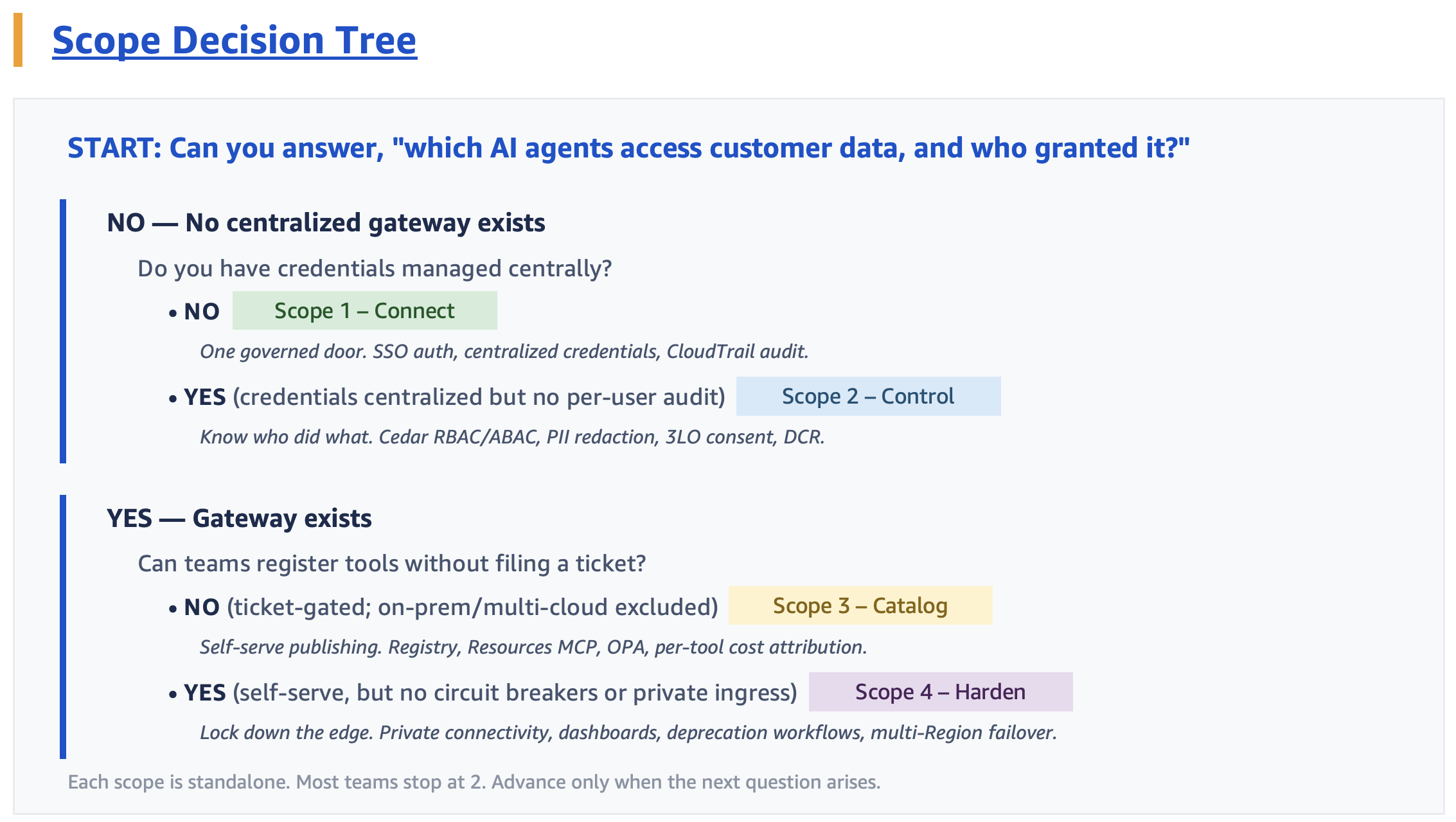
图 1:根据所面临的治理痛点选择阶段的参考
解决方案演练
以下各节将逐阶段构建网关。先从前提条件开始,然后随着新的治理问题出现,逐步推进至各个阶段。
前提条件
要按照本文操作,你需要一个拥有创建 Amazon Bedrock AgentCore 和 Amazon Cognito 资源权限的 AWS 账户,熟悉 OAuth 2.0 和 AWS Identity and Access Management (IAM),具备基本的 AWS Command Line Interface (AWS CLI) 使用经验,并了解 Model Context Protocol (MCP)。
阶段 1:Connect,最小化受治理网关
下图展示了阶段 1 的最小拓扑:
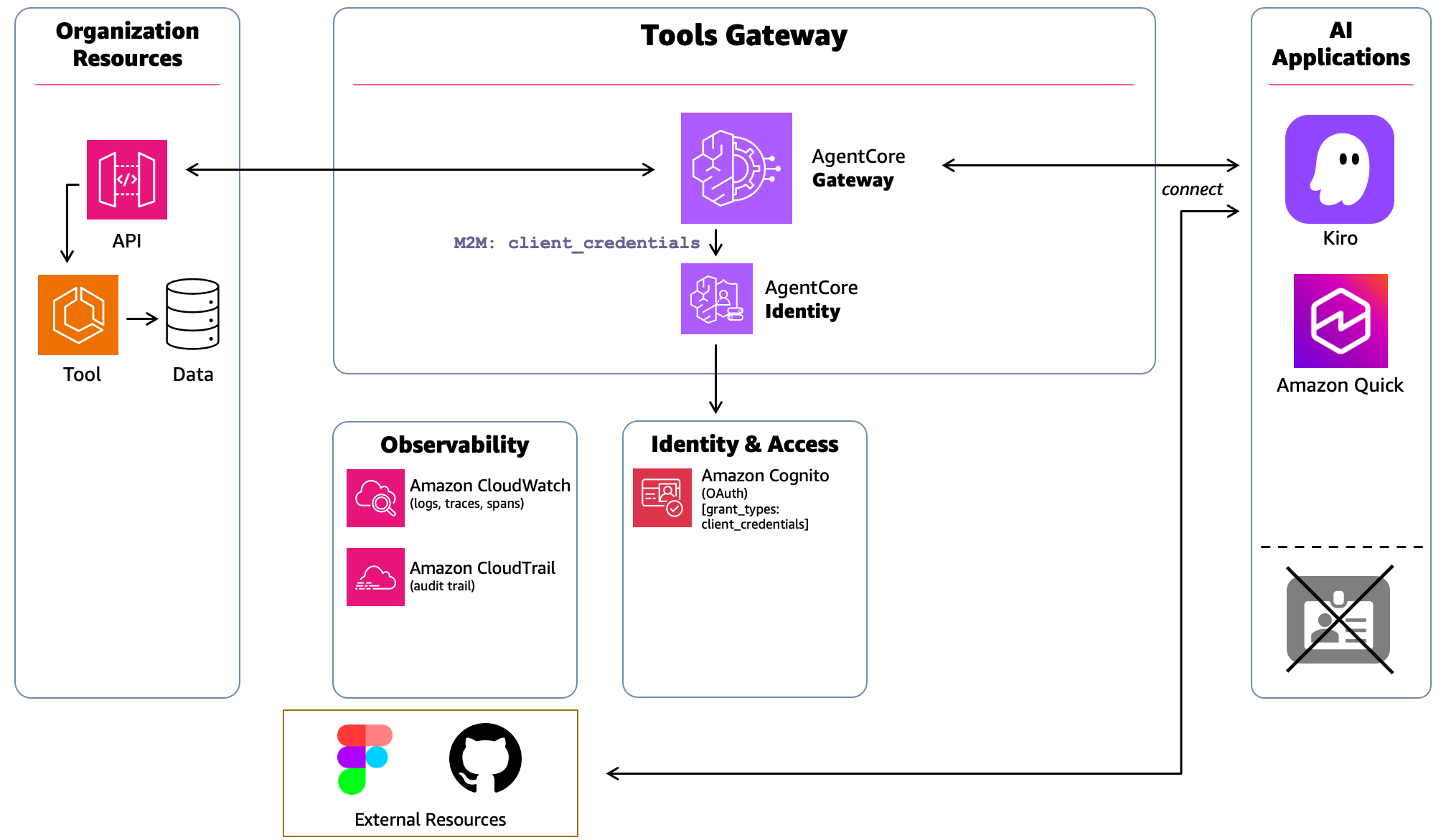
图 2:MCP 客户端连接至 AgentCore Gateway,Amazon Cognito 为身份验证签发 JWT,AgentCore Identity 管理出站凭证,一个已注册目标接收工具调用
何时需要此阶段:1–20 名试点用户、低风险工具、开始出现影子 MCP。
关键决策: 网关归属权(基础设施工程、安全团队或共同负责)。第一个工具的选择。是否强制仅允许通过网关访问,还是与旧版 mcp.json 共存。
变化内容
你需要搭建一个配置 Cognito 支持的 JWT 授权器的 AgentCore Gateway,并注册一个低风险 Lambda 目标(例如只读工单搜索)。授权仍保持粗粒度:任何已验证身份的客户端都可以调用任何已注册工具。mcp.json 会在现有公共资源旁新增一个条目,强调缓慢、增量式的变更。
你可以引入自己的身份提供商 (IdP),例如 Amazon Cognito,并与 AgentCore Identity 集成。后者可通过 OAuth 2.0 处理机器到机器 (M2M) 身份验证、AWS 资源的出站身份验证,或使用 AWS Secrets Manager 实现基于 API 密钥的身份验证。现在,你可以通过原生 Amazon CloudWatch Logs 和 AWS CloudTrail 了解组织资源何时被访问,以及访问了哪些资源。
客户端流程
- 助手使用预置的 client_id/client_secret 和网关 URL 完成初始化。
- 在每个会话中,它获取 Cognito 令牌,并将 bearer 附加至 tools/list 和 tools/call。
- 网关验证 JWT 并路由至目标。
- 后端凭证绝不会离开 AWS。
实现代码片段。
创建一个 JWT 授权器指向 IdP(例如 Cognito)的网关,并配置 allowedClients:
aws bedrock-agentcore-control create-gateway \
  --name pilot-gateway \
  --role-arn arn:aws:iam::<account-id>:role/GatewayRole \
  --protocol-type MCP \
  --authorizer-type CUSTOM_JWT \
  --authorizer-configuration '{
  "customJWTAuthorizer": {
    "discoveryUrl": "https://cognito-idp.<region>.amazonaws.com/<pool-id>/.well-known/openid-configuration",
    "allowedClients": ["pilot-gateway-client"]
  }
}'
该命令会将 Cognito 签发的 JWT 转换为网关唯一接受的凭证。
然后注册一个 AWS Lambda 目标(例如只读工单搜索):
aws bedrock-agentcore-control create-gateway-target \
  --gateway-identifier pilot-gateway \
  --name TicketSearch \
  --target-configuration '{
  "mcp": { "lambda": { "lambdaArn": "arn:aws:lambda:<region>:<account-id>:function:ticket-search", "toolSchema": {"inlinePayload": "<tool-schema-json>"} } }
}'
该 Lambda 现在可以作为 MCP 工具访问,无需进行客户端接线配置。分布式的 mcp.json 将替换本地服务器条目:
{
  "mcpServers": {
    "enterprise-tools-gateway": {
      "url": "https://<gateway-name>.gateway.bedrock-agentcore.<region>.amazonaws.com/mcp",
      "type": "http"
    }
  }
}
由于用户群规模较小,可将此条目分发到现有的 mcp.json 文件中。
上线部署
阶段 1(第 1 天): 配置 Cognito User Pool。部署网关。注册一个低风险 Lambda 目标。阶段 2(第 2–3 天): 通过 MDM 分发更新后的 mcp.json。验证端到端流程:获取令牌 → tools/list → tools/call。阶段 3(第 1 周): 确认每次调用都在 CloudWatch Logs 和 CloudTrail 中生成相应记录。
结果。端到端路径可以正常运行,mcp.json 现在包含一个可访问组织级资源的端点,管理层也能看到生产力提升与控制措施能够同步交付。
在完成此阶段后,如果开始收到以下问题:
- 用户是否会在工具调用中传递任何 PII(个人身份信息)?我们如何防止这种情况?
- 我们是否会征求用户同意,代表他们执行操作?如何验证问责性?
- 不同用户组应拥有不同的工具访问权限。这能实现吗?
那么你就已准备好扩展范围。如果阶段 2 已能满足当前需求,请跳转至“注意事项”部分查看运营指导。
阶段 2:Control,具备身份感知的授权与防护栏
在入口开放后,阶段 2 将识别调用者,并清理其中流动的数据。
下图展示了身份、策略和防护栏如何在阶段 2 中集成:
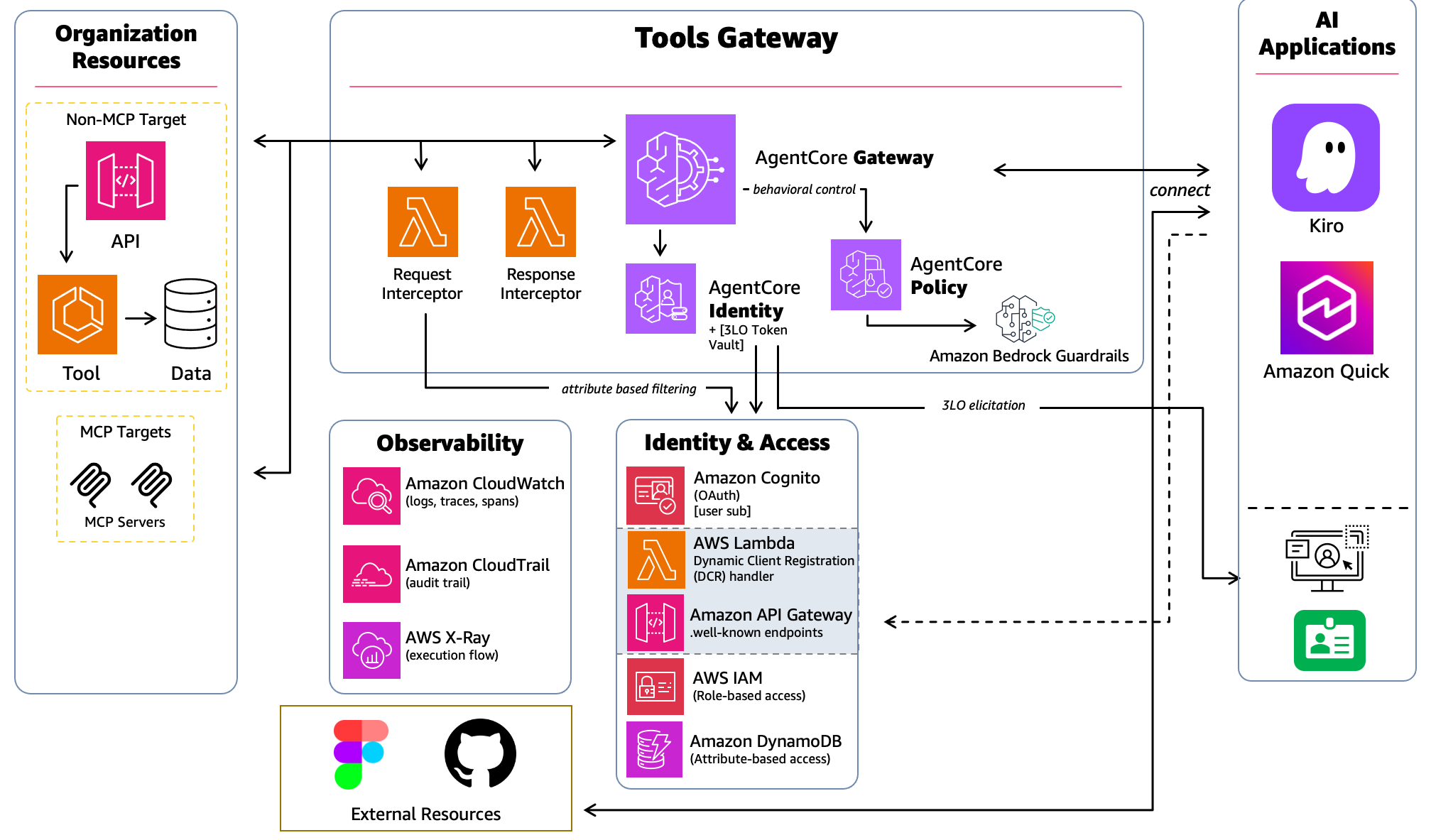
图 3:Gateway、Identity 和 Policy 位于搭载 Amazon Bedrock Guardrails 的请求与响应拦截器之间;Identity 增加了 DCR 接口(用于 .well-known 端点的 Lambda 和 Amazon API Gateway)、AWS IAM 与 Amazon DynamoDB,而 3LO elicitation 会将用户重定向至浏览器以获取同意
何时使用: 用户群正在增长,合规团队开始询问“谁依据哪项策略做了什么”。你需要给出答案,并且要在 PII 落地前将其清理。
关键决策: 身份提供商选择。认证模型迁移路径(授权码流程与客户端凭证流程的比较)。从 LOG_ONLY 切换到 ENFORCE 前的持续时间。第一条 Cedar 拒绝规则。
变化内容
你将把网关从机器级信任转变为用户级信任。现在,客户端会通过 动态客户端注册 (DCR) 机制动态加入 AgentCore Gateway 的 allowedClients。在首次调用网关的 tools/list 时,客户端会收到用于调用 DCR shim 的 (RFC 9728/8414) 元数据。该 shim 是位于 Amazon API Gateway 之后的 Lambda:它在 POST /register 时创建 Cognito app client,并通过 UpdateGateway 将新的 client_id 添加至 AllowedClients。
用户使用 SSO 登录并完成 Authorization Code 流程。此时,访问令牌的 sub 声明即为实际用户。从此,每个请求都携带该用户身份。第一道安全关卡是 AgentCore Policy:Cedar 规则会根据 IdP 组声明、令牌声明和参数门控应用 RBAC。例如,可以将 DeployCI___invoke 限制为 context.input.environment == "staging",从而允许或禁止特定用户访问。
若请求获得允许,AgentCore Policy 会通过其原生 Amazon Bedrock Guardrails 集成评估请求,在网关层应用 PII 过滤器、内容策略和提示攻击检测,无需编写自定义代码。对于 Guardrails 覆盖范围之外的结构化转换或 ABAC 规则,请求拦截器 Lambda 会处理剩余部分。当目标资源需要将用户身份传递给 SaaS 系统(例如 GitHub 或 Figma)时,AgentCore Identity Credential Providers 会处理 3LO Authorization Code 流程。网关会发出 MCP elicitation(-32042 错误),使助手能够引导用户在浏览器中完成同意流程。
在响应阶段,拦截器会清理非预期数据。每条日志记录都包含主体、匹配的策略 ID、防护栏标志和延迟。
客户端流程:从 M2M 到用户委托。
- MCP 客户端访问网关 URL,并收到带有 WWW-Authenticate 的 401 响应。
- 它遵循 RFC 9728 / [8414](https
English / 原文
In our conversations with customers over the past months, one pattern keeps recurring. Whether they work with coding agents, autonomous agents, or human-interactive ones, and regardless of workload maturity, we start with the same question: “Which AI agents have access to customer data, who granted it, and what would exposure look like if a credential leaked today?” If nobody in your organization can answer that in under a minute, this post is for you.
When AI agents connect to internal tools without centralized governance, organizations encounter access risks that are difficult to detect. Consider an infrastructure engineer opening a teammate’s laptop to debug a build. In the config folder sits a file named mcp.json containing a production database password in plain text, next to a comment that reads TODO: rotate this. The security team has no visibility into which AI agents are reaching internal tools, who granted the access, or what the exposure would be if that credential were inadvertently exposed.
The proposed solution uses Model Context Protocol (MCP)-enabled assistants, including IDE helpers like Kiro, Claude Code, Cursor, and AI tools like Amazon Quick. This post focuses on the AWS managed service Amazon Bedrock AgentCore, a platform to build, connect, and optimize agents at scale with any framework or model. With AgentCore Gateway (a capability of Amazon Bedrock AgentCore), you provide a single, secure entry point to your organizational tools for agentic traffic. It relies on AgentCore Identity (a capability of Amazon Bedrock AgentCore) for secure authentication, authorization, and credential management. To define and enforce security controls for AI agent interactions with tools, you use AgentCore Policy. You can then augment the policy with safety and privacy controls using Amazon Bedrock Guardrails, and build a centralized catalog for organizing, curating, and discovering tools using AWS Agent Registry. Self-hosted options (Kong Gateway, Open Policy Agent, NeMo Guardrails, and LangFuse) also exist, and this post calls them out where relevant.
The problem
There are five structural breakdown patterns in enterprise systems with MCP deployments, commonly described as: credential sprawl (secrets in every local config), policy drift (N×M configurations diverging silently), audit gaps (no answer to “who invoked what, when”), cost opacity (spend unattributable to teams), and shadow IT (integrations deployed outside review).
Take policy drift as an example. Each AI assistant carries its own mcp.json, a local file with backend credentials and tool endpoints, without oversight. A team with 10 assistants connecting to 5 internal APIs maintains 50 independent credential sets, each configured by hand. When a policy changes in one backend, it must be updated in all 50 places.
Recall the earlier question: which assistants access customer data, and who granted it? Most teams respond by building a complete gateway before allowing any AI use, which takes months and ships the wrong thing. We recommend matching controls to actual needs instead.
The solution: a four-scope maturity journey
A governed gateway provides one governed endpoint, knows who is calling and under what authority, enforces policy at the tool and parameter level, and logs every decision. Teams can also publish tools without tickets. Each scope delivers standalone value while preserving the path to the next.
Scope 1: Connect. One governed door so AI agents can reach organizational resources. When MCP credentials sit in local config and security has no inventory, apply SSO authentication, centralize credentials, and enable CloudTrail audit.
Scope 2: Control. Know who did what, and scrub sensitive data on the way through. When you can’t answer “who invoked which tool, when, under which policy?”, apply Cedar RBAC/ABAC, PII redaction, 3LO consent, and DCR.
Scope 3: Catalog. Let teams find and publish tools themselves, including on-premises ones. When tool registration requires tickets and on-prem systems stay excluded, deploy the Registry, Resources MCP, OPA, and per-tool cost attribution.
Scope 4: Harden. Lock down the edge, watch everything, and plan for failure. When you reach over 1,000 users with no circuit breakers, public DNS, and no failover, add private connectivity, governance dashboards, deprecation workflows, and multi-Region failover.
Each scope delivers standalone value. Advance only when the next pain appears. The following figure is a reference for scope decisions.
Figure 1: Reference for choosing a scope based on the governance pain point you face
Solution walkthrough
The following sections build the gateway one scope at a time. Start with the prerequisites, then advance through each scope as new governance questions appear.
Prerequisites
To follow this post, you need an AWS account with permissions to create Amazon Bedrock AgentCore and Amazon Cognito resources, familiarity with OAuth 2.0 and AWS Identity and Access Management (IAM), basic AWS Command Line Interface (AWS CLI) experience, and an understanding of the Model Context Protocol (MCP).
Scope 1: Connect, the minimal governed gateway
The following diagram illustrates the minimal topology for Scope 1:
Figure 2: MCP clients connect to AgentCore Gateway, Amazon Cognito issues JWTs for authentication, AgentCore Identity manages outbound credentials, and one registered target receives tool calls
When you need this scope : 1–20 pilot users, low-risk tools, shadow MCP appearing.
Key decisions: Gateway ownership (infrastructure engineering, security, or shared). First tool choice. Whether to mandate gateway-only or coexist with a legacy mcp.json.
What changes
You stand up AgentCore Gateway with a Cognito-backed JWT authorizer and register one low-risk Lambda target (for example, a read-only ticket search). Authorization stays coarse: any authenticated client can invoke any registered tool. The mcp.json gains one new entry alongside existing public resources, emphasizing slow, additive change.
You can bring in your identity provider (IdP), for example Amazon Cognito, and integrate with AgentCore Identity, which handles Machine-to-Machine (M2M) authentication through OAuth 2.0, outbound authentication of your AWS resources, or AWS Secrets Manager for API key-based auth. You now know when and which organizational resources were accessed through native Amazon CloudWatch Logs and AWS CloudTrail.
Client flow
- The assistant bootstraps with a pre-provisioned client_id/client_secret and gateway URL.
- Per session, it fetches a Cognito token and attaches the bearer to tools/list and tools/call.
- The gateway validates the JWT and routes to the target.
- Backend credentials never leave AWS.
Implementation snippets.
Create the gateway with a JWT authorizer pointed at your IdP (for example, Cognito) and configure the allowedClients:
aws bedrock-agentcore-control create-gateway \
  --name pilot-gateway \
  --role-arn arn:aws:iam::<account-id>:role/GatewayRole \
  --protocol-type MCP \
  --authorizer-type CUSTOM_JWT \
  --authorizer-configuration '{
  "customJWTAuthorizer": {
    "discoveryUrl": "https://cognito-idp.<region>.amazonaws.com/<pool-id>/.well-known/openid-configuration",
    "allowedClients": ["pilot-gateway-client"]
  }
}'
This command turns Cognito-issued JWTs into the gateway’s only accepted credential.
Then register an AWS Lambda target (for example, a read-only ticket search):
aws bedrock-agentcore-control create-gateway-target \
  --gateway-identifier pilot-gateway \
  --name TicketSearch \
  --target-configuration '{
  "mcp": { "lambda": { "lambdaArn": "arn:aws:lambda:<region>:<account-id>:function:ticket-search", "toolSchema": {"inlinePayload": "<tool-schema-json>"} } }
}'
The Lambda is now reachable as an MCP tool with no client-side wiring. A distributed mcp.json replaces the local server entry:
{
  "mcpServers": {
    "enterprise-tools-gateway": {
      "url": "https://<gateway-name>.gateway.bedrock-agentcore.<region>.amazonaws.com/mcp",
      "type": "http"
    }
  }
}
Because the user base is small, distribute this entry to existing mcp.json files.
Rollout
Phase 1 (day 1): Provision a Cognito User Pool. Deploy the gateway. Register one low-risk Lambda target. Phase 2 (day 2–3): Distribute the updated mcp.json through MDM. Validate end-to-end: token fetch → tools/list → tools/call. Phase 3 (week 1): Confirm CloudWatch Logs and CloudTrail entries appear for each invocation.
Result. The end-to-end path works, the mcp.json now contains an endpoint that reaches org-wide resources, and executives observe that productivity and controls ship together.
After this stage, if you start getting questions such as:
- Are users passing any PII (personally identifiable information) through tool invocations? How are we preventing that?
- Do we ask for users’ consent to perform actions on their behalf? How are we verifying accountability?
- User groups should have different access to tools. Is that possible?
Then you’re ready to expand the scope. If Scope 2 meets your current needs, skip to Considerations for operational guidance.
Scope 2: Control, identity-aware authorization and guardrails
With the door open, Scope 2 names the caller and scrubs what flows through.
The following diagram shows how identity, policy, and guardrails integrate in Scope 2:
Figure 3: Gateway, Identity, and Policy bracketed by request and response interceptors with Amazon Bedrock Guardrails; Identity adds a DCR interface (Lambda and Amazon API Gateway for .well-known endpoints), AWS IAM, and Amazon DynamoDB, and a 3LO elicitation redirects users to the browser for consent
When: User base is growing and compliance asks “who did what, under which policy.” You need an answer, with PII scrubbed before it lands.
Key decisions: Identity provider selection. Transition auth model (code flow compared to client credentials). LOG_ONLY duration before ENFORCE. First Cedar deny rule.
What changes
You shift the gateway from machine-level trust to user-level trust. Clients now get dynamically added to the AgentCore Gateway allowedClients through a Dynamic Client Registration (DCR) mechanism. On the first tools/list call to the gateway, the client receives (RFC 9728/8414) metadata to call a DCR shim, which is a Lambda behind Amazon API Gateway that creates a Cognito app client on POST /register and appends the new client_id to AllowedClients through UpdateGateway.
The user signs in using SSO, completing the Authorization Code flow. Now the access token’s sub claim is the actual user. From here, every request carries that user identity. The first security gate, AgentCore Policy, intervenes where Cedar rules apply RBAC based on IdP group claims, token claims, and parameter gates. For example, DeployCI___invoke can be restricted to context.input.environment == "staging", allowing or forbidding access to certain users.
If allowed, AgentCore Policy evaluates the request through its native Amazon Bedrock Guardrails integration, which applies PII filters, content policies, and prompt-attack detection at the gateway layer without custom code. For structural transforms or ABAC rules beyond what Guardrails covers, a request interceptor Lambda handles the remainder. When the target resource needs the user’s identity toward a SaaS system (for example, GitHub or Figma), AgentCore Identity Credential Providers handle the 3LO Authorization Code flow. The gateway emits an MCP elicitation (-32042 error) so the assistant can walk the user through consent in a browser.
At the response stage, interceptors scrub unintentional data. Every log record carries principal, matched policy ID, guardrail flag, and latency.
Client flow: M2M to user-delegated.
- The MCP client hits the gateway URL and receives a 401 with WWW-Authenticate.
- It follows RFC 9728 / 8414 / 7591 discovery and calls your DCR shim to mint a user-scoped client.
- The user signs in through Authorization Code + PKCE against hosted UI (backed by corporate SSO). The token’s sub claim is the actual user.
- tools/list returns a catalog filtered by AgentCore Policy. Two users in different groups receive different tool lists.
- Invocation flows: Policy, then Request Interceptor, then Guardrails, then target, then Response Interceptor, then Guardrails.
- When a target needs the user’s identity for SaaS (GitHub, Slack), the gateway emits a -32042 elicitation with an authorization URL. For targets sharing the inbound identity chain, OBO token exchange replaces the browser redirect entirely. The assistant opens the browser, calls CompleteResourceTokenAuth on consent, and retries.
Implementation
Attach the policy engine in LOG_ONLY mode by using the update-gateway command.
The following Cedar policy combines RBAC and parameter-level ABAC:
// Payments deployers can deploy, but only to staging
permit (
  principal,
  action == AgentCore::Action::"DeployCI___invoke",
  resource
)
when {
  principal.hasTag("groups") &&
  principal.getTag("groups").contains("repo-payments-service") /* Note: for Cognito, the claim is cognito:groups, not groups. Refer to your deployed Gateway Cedar schema for the precise tag names. */ &&
  context.input.environment == "staging"
};

// Read-only tools are open to any authenticated principal with a group
permit (
  principal,
  action in [
    AgentCore::Action::"TicketSearch___invoke",
    AgentCore::Action::"DocsSearch___invoke"
  ],
  resource
) when { principal.hasTag("groups") };
The first rule pins risky deploys to staging. The second keeps low-risk reads frictionless. The following OpenTelemetry span attributes (emitted to the aws/spans log group) show a Deny decision:
{
  "principal": "user:alice@example.com",
  "action": "DeployCI___invoke",
  "resource": "gateway/pilot-gateway/target/DeployCI",
  "decision": "Deny",
  "matchedPolicy": "policy-payments-deploy-staging",
  "reason": "context.input.environment != 'staging'"
}
That record is the audit trail your compliance team has been asking for.
With native Amazon Bedrock Guardrails integration in AgentCore Policy (shipped July 2026), guardrails are expressed directly inside Cedar policies using the suppressOutput effect and when guardrails condition. The interceptor-Lambda approach remains available for structural transforms that guardrails don’t cover. The following shows the native Cedar approach for PII filtering:
{
  "contentPolicyConfig": {
    "filtersConfig": [{ "type": "PROMPT_ATTACK", "inputStrength": "HIGH", "outputStrength": "NONE" }]
  },
  "sensitiveInformationPolicyConfig": {
    "piiEntitiesConfig": [
      { "type": "EMAIL", "action": "ANONYMIZE" },
      { "type": "US_SOCIAL_SECURITY_NUMBER", "action": "BLOCK" },
      { "type": "CREDIT_DEBIT_CARD_NUMBER", "action": "BLOCK" }
    ]
  }
}
SSNs and card numbers never reach the model. Emails are masked.
Deploy the DCR shim: a Lambda behind Amazon API Gateway that creates Cognito app clients on POST /register and appends new client_id to allowedClients. Serve RFC 9728 .well-known/oauth-protected-resource metadata pointing to Cognito.
Create the 3LO credential provider and attach it to a target. The following is the minimal -32042 elicitation the client must handle:
{
  "jsonrpc": "2.0", "id": 7,
  "error": {
    "code": -32042,
    "message": "authorization_required",
    "data": {
      "authorization_url": "https://oauth.example.com/auth?session_uri=urn:session:9f3a",
      "session_uri": "urn:session:9f3a"
    }
  }
}
When the downstream resource trusts the same identity chain as the inbound token (for example, an internal microservice or a Microsoft Entra ID-protected API), the gateway can use On-Behalf-Of (OBO) token exchange instead. OBO exchanges the inbound access token for a new, scoped token that carries both the user’s identity and the agent’s identity, with no browser redirect and no additional consent flow. Add an onBehalfOfTokenExchangeConfig block to the existing OAuth credential provider on the target, and the gateway handles the exchange transparently (RFC 8693 or RFC 7523 depending on your IdP).
Rollout
Phase 1 (day 1–2): Deploy the DCR shim Lambda and API Gateway endpoint. Update the gateway authorizer to accept dynamically registered clients. Phase 2 (week 1–2): Wire AgentCore Policy in LOG_ONLY mode. Deploy Guardrails in detect-only. Monitor aws.agentcore.policy.log_only_decision_flipping_policies to identify policies that would change decisions if promoted. Phase 3 (week 3+): Switch Policy to ENFORCE. Switch Guardrails to active blocking. Communicate the SSO consent prompt to users.
Result. Auditors get answers: who called which tool, when, under which policy. PII gets scrubbed before the assistant receives responses.
After this stage, if you start getting questions such as:
- Are platform engineers buried under “please add this tool” tickets? Can users discover and subscribe to tools without filing one?
- Do users need access to systems that don’t live on AWS, such as on-premises databases, another cloud, or external SaaS?
- Can finance attribute gateway spend to the team that actually drove it?
Then, you’re ready to expand the scope. If Scope 2 meets your current needs, skip to Considerations for operational guidance.
Scope 3: Catalog, self-service, registry, and cross-environment reach
Now make it self-serve and reach systems off AWS.
The following diagram shows the expanded architecture for Scope 3, including cross-environment connectivity:
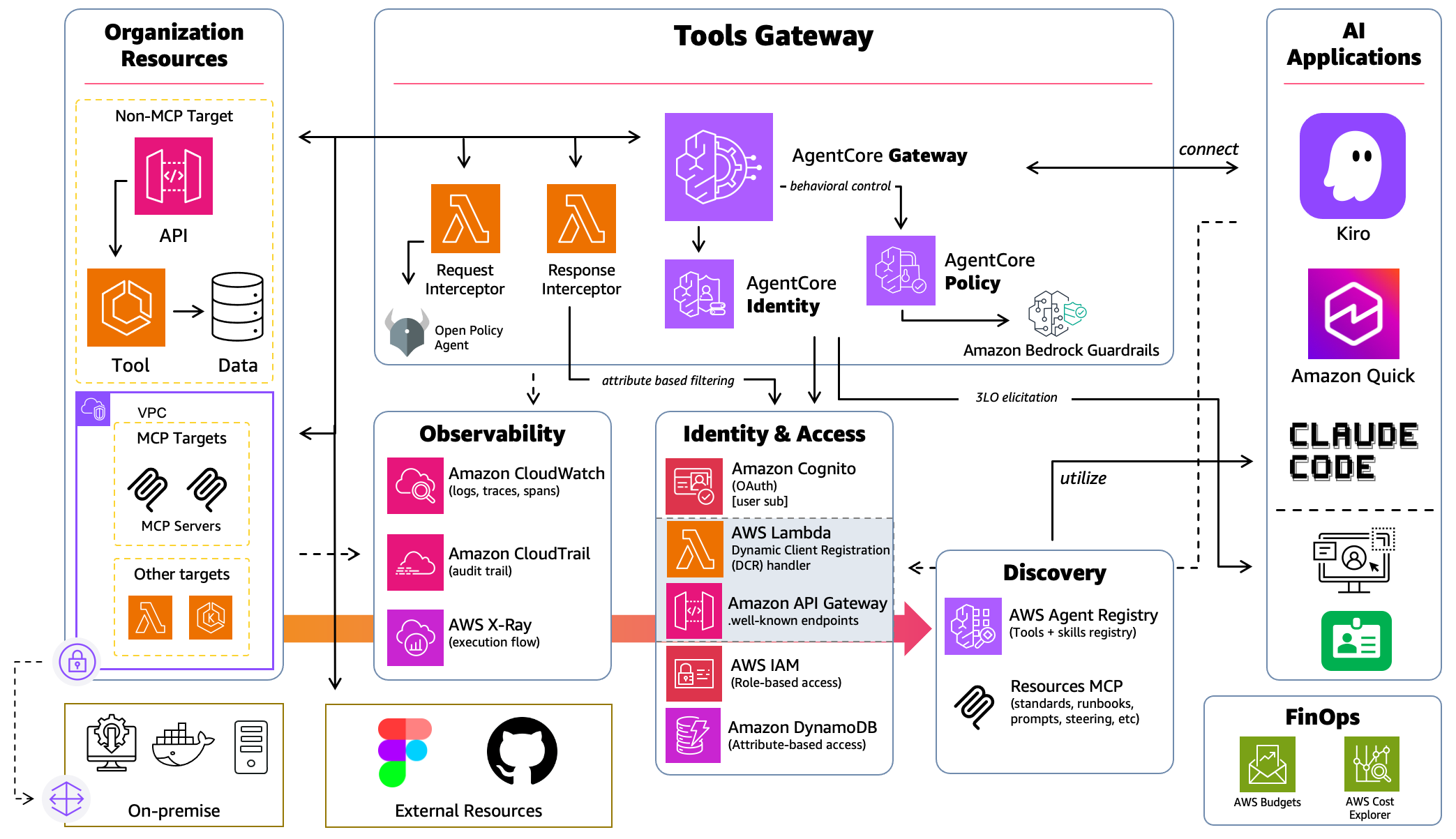
Figure 4: Organization resources span on-premises systems reached through AWS PrivateLink or AWS Direct Connect and external SaaS through outbound OAuth; a Discovery block holds AWS Agent Registry with a Resources MCP server, an OPA interceptor joins the request and response paths, and a FinOps block captures AWS Budgets and AWS Cost Explorer
When: “add this tool” tickets pile up, or you need reach into another vendor or on-premises. Past 100 users, central catalog and reach beyond AWS are not optional.
Key decisions: Self-serve publishing with approval, or ticket-gated. First on-premises or multi-cloud target. OPA for org-wide policy rules, and sophisticated ABAC logic or Cedar only.
What changes
You stop being the bottleneck for tool intake, and the gateway extends to systems outside AWS. Tool owners now create a YAML manifest to request new tools and open a pull request that triggers a security scan and platform review. On merge, your continuous integration pipeline calls create-gateway-target and updates the Cedar policy automatically. No ticket required, no manual UpdateGateway.
You can now centralize skills your IDE might need: it queries AWS Agent Registry (now in the agent-registry namespace, available in nine AWS Regions) to list skills and download the ones relevant for the task. Administrators govern discoverability through an approval workflow, so people receive only what they need, keeping irrelevant skills out of the assistant’s context and reducing prompt pollution.
When a request leaves the gateway, the target might live anywhere: AWS Lambda, an on-premises database that you reach through Gateway VPC Egress (using managedVpcResource or selfManagedLatticeResource configurations) with AWS Direct Connect or AWS Site-to-Site VPN behind it, or a SaaS API that you reach through NAT egress with outbound OAuth. The client cannot tell the difference.
Inside the request path, Open Policy Agent (OPA) evaluation is added inside the existing request-interceptor Lambda to cover rules Cedar can’t natively express: time windows, payload content inspection, rate-based access, and change-ticket requirements. A second MCP connection (the Resources MCP server) auto-fetches on session start and distributes organizational context such as steering files, coding standards, prompt templates, release checklists, and on-call runbooks. Every assistant in the org picks up the same context without per-developer config.
For FinOps, Amazon CloudWatch metric filters and AWS Cost Explorer tags attribute cost per tool and per group. Finance can finally answer who drove the bill. The mcp.json is now managed centrally, with no way to add your own public configurations, and it is distributed through MDM or a central MCP registry. In addition to the gateway, you also manage IDE admin configuration centrally, which controls behavior.
Client flow. Bootstrap matches Scope 2, with no new auth flow. A second mcp.json entry for the Resources MCP server is auto-fetched on session start, providing organizational standards and approved skills. Invocation still goes through the gateway. The target might live on-premises or in SaaS, and the client can’t tell. Scope 3 is additive on the client side, making it a low-risk rollout.
Implementation snippets.
The following OPA Rego policy handles a rule Cedar cannot natively express. db_write is allowed only on weekdays, 09:00 to 17:00 UTC, with a change ticket attached:
package mcp.tools

import rego.v1

default allow := false

allow if {
  input.tool == "db_write"
  clock := time.clock(time.now_ns())
  clock[0] >= 9
  clock[0] < 17
  weekday := time.weekday(time.now_ns())
  not weekday in {"Saturday", "Sunday"}
  input.claims.change_ticket_id != ""
}
OPA handles clock and weekday checks natively, complementing Cedar’s identity and resource-based policies.
The following is a Registry YAML manifest for a new tool:
# registry/tools/payment-refund.yaml
name: PaymentRefund
owner: payments-platform@example.com
target:
  type: lambda
  arn: arn:aws:lambda:us-west-2:<account-id>:function:payment-refund
access:
  allowed_groups: [finance-ops, senior-support]
  environments: [staging] # prod requires separate approval
  risk_tier: high
Tool ownership, access, and risk live in version control alongside the rest of your infrastructure. Your continuous integration pipeline validates the manifest, runs a security scan, opens a pull request for review, and on merge calls create-gateway-target and updates the Cedar policy.
The following Resources MCP server config is distributed to every assistant, exposing tools such as get_coding_standards, get_prompt_library, get_release_checklist, and get_oncall_runbook:
{
  "mcpServers": {
    "resources-gateway": {
      "url": "https://<gateway-name>.gateway.bedrock-agentcore.<region>.amazonaws.com/mcp/resources",
      "type": "http"
    }
  }
}
Every assistant in the org now accesses the same coding standards and runbooks without manual setup.
The following command creates a PrivateLink endpoint into the gateway from a virtual private cloud (VPC) that peers with on-premises through AWS Direct Connect:
aws ec2 create-vpc-endpoint \
  --vpc-id vpc-0a1b2c3d4e5f67890 \
  --service-name com.amazonaws.<region>.bedrock-agentcore \
  --vpc-endpoint-type Interface \
  --subnet-ids subnet-0aaa1111 subnet-0bbb2222 \
  --security-group-ids sg-0ccc3333
Gateway traffic now stays on the AWS network. From there, AWS Direct Connect handles the on-premises hop. For non-MCP endpoints (A2A agent URLs, legacy REST APIs), HTTP passthrough targets route traffic directly without protocol translation.
The following AWS Budgets alert fires when a tool exceeds a monthly invocation-cost threshold:
{
  "BudgetName": "GatewayTool-PaymentRefund",
  "BudgetLimit": { "Amount": "250", "Unit": "USD" },
  "TimeUnit": "MONTHLY",
  "BudgetType": "COST",
  "CostFilters": { "TagKeyValue": ["user:AgentCoreTool$PaymentRefund"] }
}
Per-tool tagging means finance can attribute spend to the team that owns the tool, not the platform.
Rollout
Phase 1 (week 1): Set up the YAML manifest schema and CI pipeline. Migrate existing targets to manifest-driven registration. Phase 2 (week 2–3): Deploy the OPA interceptor. Create the Resources MCP server. Establish PrivateLink or Direct Connect for on-premises targets. Phase 3 (week 4+): Configure cost allocation tags and Budgets alerts. Distribute the updated mcp.json. Roll out group by group, starting with teams that filed the most tool-request tickets.
Result. The Scope 2 ticket-driven intake is eliminated. Natural-language discovery shortens onboarding, and the gateway reaches on-premises and multi-cloud without lifting workloads.
After this stage, if you start getting questions such as:
- Is your gateway still reachable from the public internet, and would a regulator be comfortable with that?
- If your primary Region fails during business hours, what is the documented recovery path users would follow?
- How many registered tools had zero invocations last quarter, and who is paying to keep them on the books?
Then, you’re ready to expand the scope. If Scope 3 meets your current needs, skip to Considerations for operational guidance.
Scope 4: Harden, resilience and governance
Catalog and reach are working. Scope 4 hardens the edge and plans for outages.
The following diagram shows the hardened architecture with private ingress and governance dashboards:
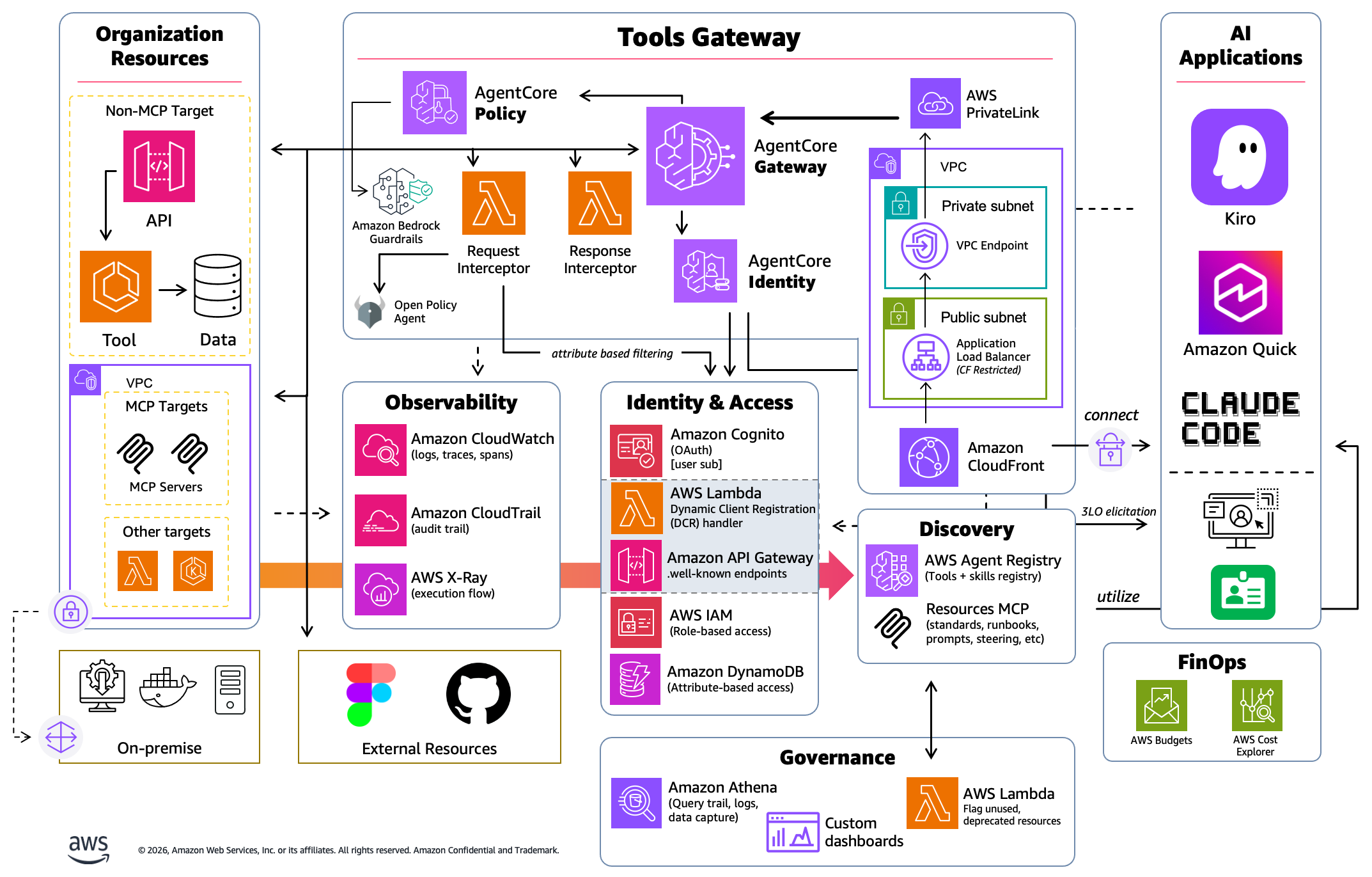
Figure 5: A new ingress stack with Amazon CloudFront, a CloudFront-restricted Application Load Balancer in a public subnet, a VPC endpoint in a private subnet, PrivateLink, and the gateway; a governance panel holds Amazon Athena, custom dashboards, and a Lambda function that flags unused resources
When : AI workloads that require high availability and resilience, heavily regulated industries, or a global user base with low-latency and DR requirements.
Key decisions: Circuit breaker blast radius. Active-active or active-passive DR. Gateway SLO target. Deprecation authority ownership.
What changes
You harden the perimeter and turn governance into something a regulator can read at a glance. The request now starts inside your corporate network. Your IDE no longer resolves a public gateway hostname. Instead, it routes through Amazon CloudFront at the edge (close to users), which forwards to a CloudFront-restricted Application Load Balancer in a public subnet using a shared-secret header that prevents traffic from bypassing CloudFront. The request then moves through a VPC Endpoint in a private subnet to PrivateLink and finally the gateway. Public DNS exposure is gone, and the gateway is reachable only through your private path. For Runtime-hosted agents, enable inbound-only enforcement so the Runtime rejects any invocation that does not originate from the gateway. This prevents callers from bypassing policy, guardrails, and audit.
The request follows the same Scope 3 path, but now every decision flows into Amazon CloudWatch and AWS CloudTrail where Amazon Athena queries answer compliance-grade questions. For example: “Which principals had the highest deny rate last week, and which policies denied them?” Custom dashboards surface invocations, latency percentiles, guardrail intervention rates, deny rate per policy, top-denied principals, and an executive compliance view with anomaly alerts.
For global users, Multi-AZ provides strong resilience within a Region. You extend with Amazon Route 53 health-checked failover and a multi-Region active-passive deployment where gateway definitions and registry state replicate through your pipelines. Design tools to be idempotent so the first retry after a DNS failover is safe.
Finally, a nightly deprecation Lambda reads Amazon CloudWatch invocation metrics and opens a pull request for any tool with zero usage over 30 days. Owners are notified, the registry marks the tool, the policy moves to LOG_ONLY, and after 90 days the target is removed. Your gateway never accumulates zombies.
Client flow. Auth and discovery stay unchanged from Scope 3. The assistant runs on the corporate network with a route to the gateway’s PrivateLink endpoint, and the hostname might resolve only on-network. With Route 53 failover, a failed request triggers DNS re-resolution and lands in the secondary Region. Clients now additionally handle Deprecation headers (RFC 8594) surfaced to the user, 429 with Retry-After for quota exhaustion, and optionally OpenTelemetry traces correlated through traceparent with the gateway’s spans.
Implementation.
The following Amazon Route 53 failover record set configures gateway endpoints in two Regions:
[
  {
    "Name": "gateway.example.com.", "Type": "CNAME", "SetIdentifier": "primary-us-west-2",
    "Failover": "PRIMARY", "TTL": 30,
    "HealthCheckId": "hc-0123456789abcdef0",
    "ResourceRecords": [{"Value": "dxxxxxxxxxxxxx.cloudfront.net"}]
  },
  {
    "Name": "gateway.example.com.", "Type": "CNAME", "SetIdentifier": "secondary-eu-west-1",
    "Failover": "SECONDARY", "TTL": 30,
    "ResourceRecords": [{"Value": "dyyyyyyyyyyyyy.cloudfront.net"}]
  }
]
When the primary health check fails, DNS switches to the secondary Region within one TTL.
The following Amazon Athena query over AWS CloudTrail answers “Which principals had the highest deny rate last week, and which policies denied them?”:
SELECT attributes.`aws.agentcore.policy.determining_policies` as policies, COUNT(*) AS denies,
  DATE_TRUNC('day', from_iso8601_timestamp(event_time)) AS day
FROM aws_spans_export
WHERE attributes.`aws.agentcore.policy.authorization_decision` = 'DENY'
  AND from_iso8601_timestamp(event_time) > current_date - INTERVAL '7' DAY
GROUP BY principal, matched_policy, DATE_TRUNC('day', from_iso8601_timestamp(event_time))
ORDER BY denies DESC
LIMIT 25;
This CloudWatch Logs Insights query (run against the aws/spans log group with tracing enabled on the gateway) feeds the dashboard tile that surfaces drift before users start filing tickets.
The following AWS Cloud Development Kit (AWS CDK) snippet sets up the CloudFront, CloudFront-restricted Application Load Balancer, and VPC Endpoint stack:
distribution = cloudfront.Distribution(self, "GatewayEdge",
    default_behavior=cloudfront.BehaviorOptions(
        origin=origins.LoadBalancerV2Origin(alb,
            custom_headers={"X-Origin-Verify": origin_secret.secret_value.unsafe_unwrap()}),
        allowed_methods=cloudfront.AllowedMethods.ALLOW_ALL,
        viewer_protocol_policy=cloudfront.ViewerProtocolPolicy.HTTPS_ONLY,
    ),
    web_acl_id=waf_acl.attr_arn,)

ec2.InterfaceVpcEndpoint(self, "GatewayEndpoint",
    vpc=vpc, service=ec2.InterfaceVpcEndpointAwsService("bedrock-agentcore.gateway"),
    subnets=ec2.SubnetSelection(subnet_type=ec2.SubnetType.PRIVATE_WITH_EGRESS))
The shared-secret header makes sure traffic only reaches the ALB through CloudFront, not through direct DNS.
The following nightly deprecation Lambda (pseudocode) reads Amazon CloudWatch metrics and opens a deprecation pull request:
def handler(event, _ctx):
    for tool in list_registry_tools():
        datapoints = cw.get_metric_statistics(
            Namespace="AWS/BedrockAgentCore",
            MetricName="Invocations",
            Dimensions=[{"Name":"ToolName","Value":tool.name}],
            StartTime=now()-timedelta(days=30), EndTime=now(),
            Period=86400, Statistics=["Sum"],
        )["Datapoints"]
        if sum(p["Sum"] for p in datapoints) == 0:
            open_pr(f"deprecate/{tool.name}",
                body="No invocations in 30d; moving to LOG_ONLY, removal in 90d.")
Zombie tools get retired automatically through the same code-review process that created them.
Rollout
Phase 1 (week 1–2): Deploy CloudFront + ALB + VPC Endpoint stack. Update DNS. Validate public endpoint is no longer resolvable. Phase 2 (week 3–4): Deploy Athena tables and governance dashboard. Set up Route 53 health checks and failover records. Replicate gateway definitions to secondary Region. Phase 3 (month 2): Deploy the deprecation Lambda. Run a failover drill: disable the primary health check and validate DNS switches.
Result. Zero-trust network controls, private connectivity, global low-latency access at the edge, and documented recovery paths. Governance becomes a visible product.
That covers the full four-scope build, but most teams don’t need every scope. The rest of this post helps you decide where to stop, provides a real-world example, and covers operational considerations.
Reference deployment timeline
The following timeline shows how a representative financial services organization walked these four scopes in six months.
Scope 1 (Week 1). Two analysts ran Amazon Quick against a staging SQL tool. AgentCore Gateway fronted it with Cognito M2M auth. Infrastructure engineering owned the gateway from day one.
Scope 2 (Weeks 2–4). Thirty analysts across three desks. DCR shim, Authorization Code + PKCE, desk-level RBAC, Guardrails for PII, CloudTrail. Switching auth flows mid-rollout was awkward. Compliance’s first audit query returned complete results on the first attempt.
Scope 3 (Months 2–3). Two hundred users across five departments. The Registry made tools discoverable. Trading stayed on-premises through Direct Connect. Resources MCP distributed checklists. The ticket queue dropped about 40 percent in two weeks.
Scope 4 (Month 6). Bank-wide, 1,000 users. MiFID II required immutable audit and network isolation. PrivateLink removed public DNS. Route 53 failover met the 4-hour RTO.
Outcome. Regulators could trace which analyst queried which positions, under which policy. The graduation trigger for each scope was a concrete organizational question, not a predetermined timeline.
Considerations
These considerations cut across every scope. Note that Amazon Bedrock AgentCore Gateway and Amazon Bedrock Guardrails availability varies by AWS Region. See the Amazon Bedrock AgentCore documentation for current Region support.
Gateway operations. Treat the gateway with operational practices equivalent to your production services from day one. Later changes cost more. Run dev, staging, and production across separate AWS accounts, IdP client IDs, and policy engines, promoted through IaC. Choose one org-wide gateway or per-BU for isolation. Enforce naming at intake. Evaluate new tools on risk tier, data classification, owner SLA, and auth-model fit. Registration flow: request, review, scan, staging, soak, production.
Security. Plaintext credentials and unscoped egress create opportunities for inadvertent access. Store credentials in AWS Secrets Manager or HashiCorp Vault with rotation, or eliminate shared secrets entirely by using Private Key JWT client authentication (private key in AWS KMS, every signing operation recorded in CloudTrail). Never store credentials in environment variables. Distribute a centrally managed mcp.json through MDM. Block assistant traffic to non-gateway MCP endpoints at the corporate proxy or endpoint detection and response (EDR). Require TLS 1.2+ and AWS Key Management Service (AWS KMS) encryption at rest. Apply AWS IAM Service Control Policies (SCPs) with aws:CalledViaAWSMCP or aws:ViaAWSMCPService to deny destructive operations invoked through AWS-managed MCP servers (these keys don’t apply to traffic through your own AgentCore Gateway. For your own gateway, restrict the target execution role instead):
{
  "Version": "2012-10-17",
  "Statement": [{
    "Sid": "DenyDestructiveFromMCP",
    "Effect": "Deny",
    "Action": ["s3:DeleteBucket","kms:ScheduleKeyDeletion","dynamodb:DeleteTable"],
    "Resource": "*",
    "Condition": { "Bool": { "aws:ViaAWSMCPService": "true" } }
  }]
}
If a Cedar policy slips through review, the SCP backstop blocks the worst outcomes.
Resilience. When the gateway is down, all assistants relying on it are unavailable. Every gateway, target, policy, and registry entry ships as code. Federated regional gateways cover data residency (EU, China, Russia). Replicate policy , not data. One gateway serves Kiro, Claude Code, Amazon Quick, and Glean.
Cost. Cost surprises arrive faster than usage reports. Rate-limit per principal and per tool (natively supported by Gateway configurable rate limiting at no extra charge, with dimensional scoping by JWT claims, targets, and tool names). Set budgets and quotas per group with soft alerts before hard stops. Cache responses for idempotent read tools at the interceptor to reduce redundant invocations. For reference pricing, about 50 developers running 572,000 operations in total per month cost approximately $17 for Gateway and Policy combined (Gateway InvokeTool at $5 per million plus Policy authorization at $25 per million; Identity costs $0 when consumed through Gateway) (refer to the Amazon Bedrock AgentCore pricing page for current rates).
Clean up resources
If you deployed resources while following this post, remove them to avoid ongoing charges. Delete resources in reverse order of creation to avoid dependency errors.
Scope 4 resources :
- Delete the Amazon Route 53 failover records and health checks.
- Delete the CloudFront distribution.
- Delete the Application Load Balancer, target group, and associated security groups.
- Delete the VPC Endpoint for
bedrock-agentcore. - Remove the deprecation Lambda and its CloudWatch Events rule.
- Drop the Amazon Athena tables and workgroup.
Scope 3 resources :
- Delete AWS Budgets alerts and cost allocation tags.
- Remove the PrivateLink VPC Endpoint for on-premises connectivity.
- Delete the Resources MCP server target from the gateway.
- Remove registered tool targets created from YAML manifests.
- Delete the OPA interceptor Lambda.
Scope 2 resources :
- Delete the Guardrails configuration.
- Delete the Request and Response Interceptor Lambdas.
- Delete the DCR shim Lambda and its Amazon API Gateway endpoint.
- Remove Cedar policies from AgentCore Policy.
- Delete the DynamoDB table used for ABAC rules.
Scope 1 resources :
- Delete gateway targets (for example, TicketSearch) using DeleteGatewayTarget.
- Delete the gateway itself:
aws bedrock-agentcore-control delete-gateway --gateway-identifier pilot-gateway(see DeleteGateway). - Delete the Cognito User Pool app client and, if created for this purpose, the User Pool.
- Delete the IAM role used by the gateway (
GatewayRole).
Continuous improvement
Governance is a living system.
Quarterly. Review deny logs and adjust policies to tighten overly permissive rules and relax those that create friction without reducing risk. Audit PrivateLink endpoints and egress rules. Remove anything unused. Narrow gateway execution roles. Keep Resources MCP content fresh and version steering files. Enforce the deprecation mechanism so your registry has zero zombie tools.
Monthly. Review cost anomalies, guardrail intervention spikes, and top-denied principals. A top-denied principal often signals that the policy is too tight.
Continuously. Every tool registration and policy change ships as a pull request reviewed by security and platform groups.
Conclusion
In this post, we walked through a four-scope maturity model for governing AI agent tool access, from a single governed endpoint to enterprise-wide hardening. With this approach, teams ship AI productivity and governance controls together, advancing only when real pain demands it.
If you’re getting started, stand up a Scope 1 gateway in a development account, point one assistant at it, and distribute the new mcp.json.
If you need compliance, start with Scope 1 as the foundation (it takes a day), then layer Scope 2: add the DCR shim, wire Cedar in LOG_ONLY, and enable Guardrails in detect-only mode. The two scopes deploy together within a sprint.
If you are scaling production, Scope 3’s registry and self-serve publishing deliver the immediate user-visible gains. Per-tool tagging gives finance attribution. Roll out group by group.
As IDE-driven assistants mature, the same gateway becomes the control plane for autonomous agents. The gateway provides not only tool access but also agent-to-agent task delegation, with every invocation flowing through policy.
Pick the scope that matches today’s pain and use the Amazon Bedrock AgentCore Gateway developer guide to deploy your first gateway. Start with a single low-risk tool behind the gateway, validate the end-to-end token flow with your identity provider, and expand scope only when you encounter the next governance question from your team.
This guide shows you a sample implementation of how to build a governance layer and a tools gateway using AgentCore Gateway.
Further reading
About the authors
Talha Chattha
Talha is a Sr. Agentic AI Specialist SA, based in Stockholm. With 10+ years of experience working with AI, he now helps establish practices to ease the path to production for Agentic AI workloads. Talha is an expert in AgentCore and supports customers across entire EMEA. He is passionate about meta-agents, async patterns, advanced hierarchical solutions and optimized context engineering for agents.
Mia Chang
Mia is a Specialist Solutions Architect for Agentic AI, based in Berlin, Germany. She helps enterprise customers across EMEA design, operationalize, and scale agentic AI workloads, from first agents to production on managed platforms; and hybrid architectures with self-managed infrastructure. Her expertise spans agentic application architecture, agent security and governance, Responsible AI, and platform engineering.