Panasonic Avionics 借助 AWS 上的 Agentic AI 加速飞机 IFEC 故障诊断
英文标题:Accelerating aircraft IFEC diagnostics with agentic AI on AWS
Panasonic Avionics 与 AWS 及 AWS Generative AI Innovation Center 合作,在 Amazon Bedrock、Amazon SageMaker 和 AWS Glue 上构建了面向机上娱乐与连接(IFEC)系统的多智能体诊断平台。该系统通过趋势分析、并行诊断、历史事件语义检索和 Claude 汇总,将原本需要数小时的人工排查缩短至数分钟自动分析。公司在目标应用场景中实现了 20% 至 40% 的运营效率提升,同时改善了平均检测时间(MTTD)和平均解决时间(MTTR)。这一案例表明,受治理的 Agent 工作流、数据湖和检索增强能力可帮助大型复杂设备运营方扩大诊断能力,并保留人工对关键修复决策的监督。
 1.3 MB
 101.1 KB
 124.1 KB
 345.0 KB
 141.2 KB
 346.5 KB
 261.4 KB
 1.5 MB
 4.0 MB
 333.2 KB
 27.6 KB
 57.0 KB
 2.9 MB
 220.0 KB
 1.1 MB
 264.9 KB
中文
Panasonic Avionics Corporation 为庞大的全球机队提供机上娱乐与连接(IFEC)系统,其服务覆盖数百家航空公司,每年惠及数十亿乘客。当系统问题在如此规模下影响乘客体验时,工程师必须在数千种独特部署配置中快速诊断根本原因。若依靠人工完成这一工作,需要关联不同机队变体中的日志、指标和工单数据,通常耗时数小时,并且依赖深厚的组织内部知识。
本文将介绍 Panasonic Avionics Corporation 如何与 AWS 以及 AWS Generative AI Innovation Center 合作,并在后者的架构指导下构建一个 Agentic AI 系统。该解决方案使用 Amazon Bedrock、Amazon SageMaker 和 AWS Glue,在保持高准确率的同时显著缩短诊断时间。
挑战:大规模维护的演进
Panasonic Avionics Corporation 的运营数据是监控机队 IFEC 健康状态的关键资产。该公司依托构建在 AWS 上的数据湖和数据系统,存储并组织从全机队收集的运营数据,每天处理海量数据。
尽管拥有稳健的数据基础设施,要将原始运营数据转化为可执行的诊断结论,在大规模运营中仍面临挑战。Panasonic Avionics Corporation 所部署服务的配置会根据不同运营需求进行定制。每个部署都会生成独特的日志模式,这使机队范围内的性能评估更为复杂。团队需要进行人工审查,以关联多个运营数据源中的指标。
这一过程在运营效率和工程生产力方面存在多项优化机会:
- 人工分析工作量——跨不同配置进行关联需要细致的人工调查。虽然这有助于诊断准确性,但也延长了整体分析周期。
- 平均检测时间(MTTD)——检测主要依赖工单生成和人工审查,这会影响发现新出现模式的速度。
- 平均解决时间(MTTR)——在开始纠正措施之前,解决过程需要投入大量调查工作,导致端到端解决周期较长。
- 自动化机会——重复性的调查任务和日志审查带来了显著的智能自动化机会,尤其是在活动高峰期。
- 知识规模化——人工关联流程需要对系统有深入了解,因此可借助 AI 将组织内部知识更广泛地扩展至整个工程团队。
- 资源优化——工程师持续将时间投入诊断活动,减少了可用于创新、功能开发和长期可靠性改进的资源。
Panasonic Avionics Corporation 发现了一个明确机会:在保留严谨诊断能力的同时,向主动健康监控和全机队模式识别演进。其目标是在保持分析深度的前提下,显著改善 MTTD 和 MTTR,让工程师更多专注于解决方案设计、优化和战略性可靠性提升,而非调查性开销。
解决方案概览
Panasonic Avionics Corporation 与 AWS 及 AWS Generative AI Innovation Center 合作,探索生成式 AI 如何增强其机队 IFEC 运营的内部诊断工作流。这项合作结合了 Panasonic Avionics Corporation 在 IFEC 运营方面深厚的领域专长、AWS 服务提供的生成式 AI 能力,以及 Innovation Center 在系统设计方面的架构指导。
架构
下图展示了 AWS 上的诊断架构。该解决方案采用多智能体工作流系统,通过三个相互协同的不同层级处理数据。趋势分析器(Trend Analyzer) 通过分析关键绩效指标和服务降级指标来识别异常。并行诊断 Agent 执行特定诊断功能,包括关联分析、系统检查和日志模式匹配。由大语言模型(LLM)驱动的 汇总器(Summarizer) 则将输出整合为连贯的诊断报告,其中包含根本原因分析和建议措施。
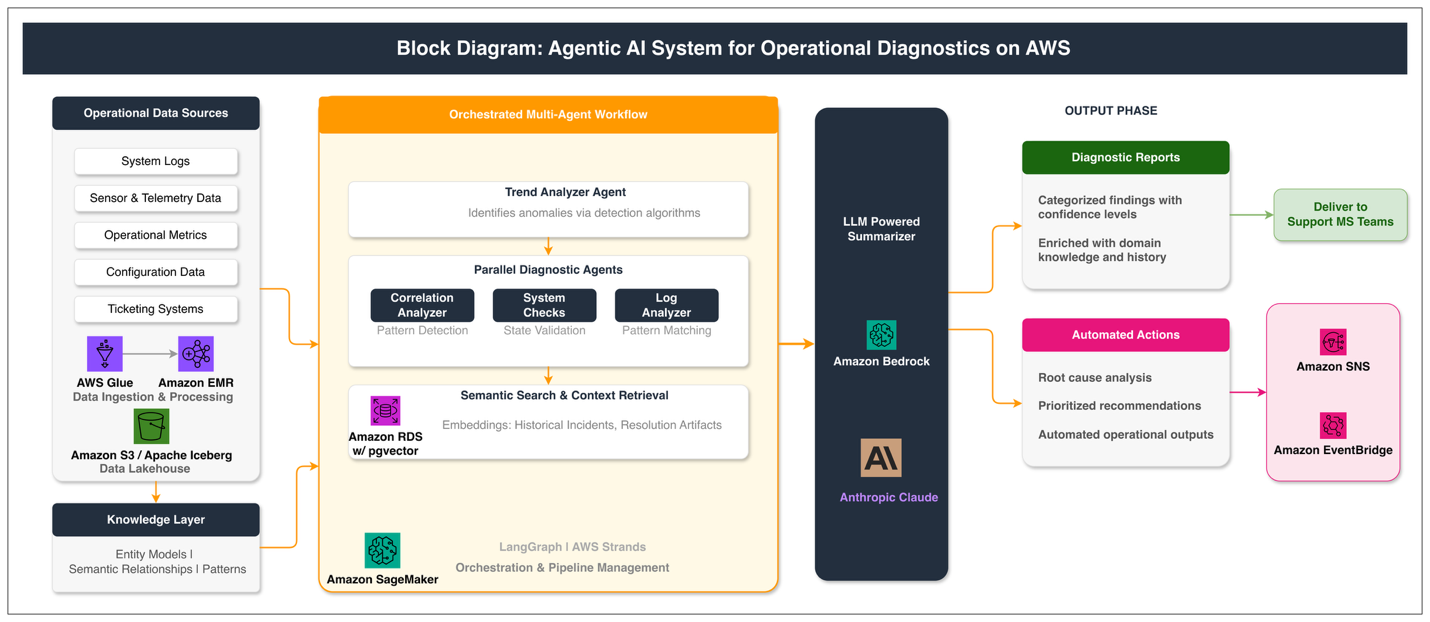
图 1:AWS 上的多智能体 IFEC 诊断架构
解决方案演练
该系统通过以下五个阶段处理运营数据:
1. 摄取与标准化
系统从整个机队摄取原始运营数据,将其转换为标准化服务指标,并使用 Apache Iceberg 将其存储在 Amazon Simple Storage Service(Amazon S3)数据湖仓中。AWS Glue 和 Amazon EMR 负责这一提取、转换和加载(ETL)管道。领域本体是一套定义机队实体及其关系的共享词汇表,可统一不同机队变体之间的术语。这种一致性使来自不同配置的数据能够在机队规模上进行比较。本体还将性能指标与配置元数据及工单信息关联起来,为跨机队诊断创建统一视图。
2. 检测
趋势分析器 Agent 持续评估关键绩效指标、服务级别达标情况和降级指标。机队范围的关系建模可以检测单独检查各部署时无法发现的模式,例如仅影响采用某个特定配置变体的部署的渐进式性能下降。
这使 Panasonic Avionics Corporation 从通过生成工单进行被动检测,转向在问题升级前主动识别新出现的问题。
3. 诊断
当趋势分析器标记出某项关注问题时,并行诊断 Agent 会从多个角度同时展开调查:
- 关联分析器(Correlation Analyzer): 检测采用相同配置的各部署之间反复出现的模式,识别问题是孤立事件还是系统性问题。
- 系统检查(System Checks): 根据工单工作流验证元数据和服务状态,确定已知维护活动是否能够解释观察到的行为。
- 日志分析器(Log Analyzer): 使用基于规则和基于模式的检测方法,将当前日志模式与此前已识别的故障模式库进行匹配。
Amazon SageMaker 使用 LangGraph 来编排这些 Agent。LangGraph 是一个用于管理有状态 AI 工作流的开源框架。用于构建 AI Agent 的开源 Python 框架 Strands Agents SDK 则提供 Agent 实现和执行能力。二者结合后可并行运行这些 Agent;在 Panasonic Avionics Corporation 的内部测试中,这将原本需要数小时人工审查的调查工作缩短为数分钟的自动化分析。
4. 上下文化
系统会查询以向量形式存储在配备 pgvector(用于向量相似性搜索的 PostgreSQL 扩展)的 Amazon Relational Database Service(Amazon RDS)中的历史事件和解决方案工件。语义搜索能够检索相似模式及其解决方案,即使实际症状并不完全相同,从而为系统提供可在整个工程组织中扩展的组织记忆。
5. 建议与执行
Amazon Bedrock 上的 Anthropic Claude 会将关联分析器、系统检查和日志分析器的发现汇总为结构化诊断报告。每份报告均包含根本原因假设、受影响机队分组的影响分析,以及按优先级排列的修复建议。
系统会按严重程度对报告进行分类。对于关键发现,系统会自动创建警报、确定事件优先级,并将其连同建议的解决措施路由至相应工程团队,在为修复决策保留工程监督的同时减轻人工分诊负担。
AI 生成的建议以检索到的运营数据和历史事件为基础,经过确定性业务规则验证,并附带支持证据呈现。对于运营上具有重要意义的事件,人类工程师会审查诊断结论并批准修复行动。系统还会保留 Agent 决策和建议的可追溯记录,以支持可审计性和持续改进。
在这五个阶段中,构建机队规模的诊断系统需要能够随需求增长而扩展的基础设施。AWS Glue 和 Amazon EMR 提供的无服务器数据处理、Amazon Bedrock 的模型灵活性,以及 Amazon SageMaker 的受治理 Agent 运行时,使 Panasonic Avionics Corporation 能够专注于诊断逻辑,而非基础设施。
从概念到生产
Panasonic Avionics Corporation 在 AWS Generative AI Innovation Center 顾问团队的指导下验证了该解决方案,指导内容包括事件驱动设计模式、并行处理策略和面向生产环境可扩展性的性能优化技术。
尽早建立严格验证机制: Panasonic Avionics Corporation 针对真实数据实施交叉引用验证,在整个测试过程中实现了持续超过要求的准确率。
为模块化和透明度而设计: 设计原则强调原子化 Agent 操作、提示词和逻辑的透明性,以及人在回路中的审查能力。随着解决方案规模扩大,这种模块化方法允许独立更新 Agent,而无需进行全系统改动。
战略性优化 AI 组件: 相关指导强调使用经过调优的参数配置来获得确定性输出和聚焦的响应。团队将 LLM 的使用限制在摘要生成和错误推理任务中,即仅限生成式能力可带来明确价值的场景。
通过持续反馈迭代: 只有当自动化操作与人工专家评估一致时,该解决方案才会投入生产,因此系统能在缩短解决时间的同时保持诊断准确性。系统目前每天都会生成覆盖活跃机队的诊断报告。
结论
Panasonic Avionics Corporation 在 AWS 上构建的 AI 驱动诊断系统,在关键运营指标方面实现了可量化改进。人工分析工作量显著降低,平均检测时间(MTTD)和平均解决时间(MTTR)均得到改善。在目标应用场景中,该系统已展现出 20% 至 40% 的运营效率提升。支持团队确认,重复性调查负担大幅减轻,因为系统如今能够处理此前需要数小时人工完成的工作。独立诊断的工程能力显著提升,使团队能够诊断和解决过去需要升级处理的问题。这些改进从根本上改变了系统随规模增长时的运营模式,使团队能够通过 AI Agent 应对不断扩大的规模,并同时降低成本和运营风险。
如需了解 AWS Generative AI Innovation Center 如何帮助您的组织构建类似解决方案,请访问 AWS Generative AI Innovation Center。如需进一步了解本文使用的服务,请参阅 Amazon Bedrock、Amazon SageMaker 和 AWS Glue。如需了解航空领域的特定应用场景,请访问 AWS for Aerospace and Satellite。
如需进一步了解 AWS 上的多智能体编排,请参阅以下文章:
免责声明:本文介绍 Panasonic Avionics Corporation 与 AWS 合作开展的一项内部计划。所述架构和方法反映的是特定实施方案。实际结果可能因数据特性、运营环境和系统配置而异。
作者介绍
Satyen Yadav
Satyen 是 Panasonic Avionics Corporation 的首席技术官,负责领导该组织的端到端工程战略,并推动 AI、云、数字化、数据管理和数据治理领域的创新。
Ram Chintala
Ram 是 Panasonic Avionics Corporation 的高级工程总监,领导 AI、云、数字化、数据管理和数据治理领域的工程计划,重点是交付可扩展的企业平台和技术解决方案。
Rajesh Balakrishnan
Rajesh 是 Panasonic Avionics Corporation 的机器学习工程总监,领导数字化、数据管理和数据治理领域 AI 与机器学习解决方案的开发。
Yifu Hu
Yifu 是 AWS Generative AI Innovation Center 的应用科学家。他为多个行业的企业客户领导并交付机器学习和生成式 AI 解决方案。Yifu 专注于技术领导力和创造性问题解决,在 Agentic AI 系统、大语言模型和 AWS 上的 AI 应用方面拥有专业经验。
Nimish Radia
Nimish 是 AWS Generative AI Innovation Center 的高级生成式 AI 战略师,负责为 AWS 最大规模客户推动企业生成式 AI、Agentic AI 和 Physical AI 战略及价值创造。他与 C-suite 高管合作,设计架构并扩展生产级 AI 解决方案,通过加速采用、运营效率提升和新收入来源推动价值创造。
Shubham Dhoka
Shubham 是 AWS 高级解决方案架构师。他担任推动数字化转型的企业客户的战略顾问,在大规模安全云解决方案的设计、开发和交付方面拥有丰富经验,专长包括无服务器应用、Agentic AI、容器技术和数据中心迁移。
Matt Backel
Matt 是 AWS 高级客户经理
English / 原文
Panasonic Avionics Corporation provides in-flight entertainment and connectivity (IFEC) systems across a large global fleet serving hundreds of airlines and billions of passengers annually. When a system issue affects passenger experience at this scale, engineers must diagnose the root cause quickly across thousands of unique deployment configurations. Doing this manually, correlating logs, metrics, and ticketing data across diverse fleet variants, can take hours and requires deep institutional knowledge.
In this post, you will learn how Panasonic Avionics Corporation worked with AWS and the AWS Generative AI Innovation Center for architectural guidance to build an agentic AI system. The solution uses Amazon Bedrock, Amazon SageMaker, and AWS Glue to significantly reduce diagnosis time while maintaining high accuracy.
Challenge: Evolving maintenance at scale
Panasonic Avionics Corporation’s operational data serves as a critical asset for monitoring fleet IFEC health. The company relies on a data lake and data system built on AWS to store and organize operational data gathered from across its fleet, processing large volumes of data daily.
Despite this robust data infrastructure, translating raw operational data into actionable diagnostics presented operational challenges at scale. Panasonic Avionics Corporation deploys services with configurations tailored to individual operational requirements. Each deployment generates unique log patterns, which complicates fleet-wide performance assessment. Teams performed manual reviews to correlate metrics across multiple operational data sources.
This process presented several opportunities for optimization across operational efficiency and engineering productivity:
- Manual analysis effort – Correlation across diverse configurations required detailed manual investigation. This facilitated diagnostic accuracy but extended the overall analysis cycle.
- Mean Time to Detect (MTTD) – Detection relied primarily on ticket generation and manual review, which influenced how quickly emerging patterns were identified.
- Mean Time to Resolve (MTTR) – Resolution timelines included significant investigative effort before corrective action could begin, contributing to longer end-to-end resolution cycles.
- Automation opportunities – Repetitive investigative tasks and log reviews created significant opportunities for intelligent automation, particularly during peak activity periods.
- Knowledge scaling – Manual correlation processes required deep system familiarity, creating opportunities to use AI to scale institutional knowledge more broadly across engineering teams.
- Resource optimization – Engineers spent recurring time on diagnostic activities, reducing bandwidth for innovation, feature development, and long-term reliability improvements.
Panasonic Avionics Corporation identified a clear opportunity to evolve toward proactive health monitoring and fleet-wide pattern recognition, while preserving diagnostic rigor. The objective was to maintain analytical depth while significantly improving MTTD and MTTR, so engineers can focus more on solution design, optimization, and strategic reliability enhancements rather than investigative overhead.
Solution overview
Panasonic Avionics Corporation partnered with AWS and the AWS Generative AI Innovation Center to explore how generative AI could enhance internal diagnostic workflows across its fleet IFEC operations. The collaboration combined Panasonic Avionics Corporation’s deep domain expertise in IFEC operations with generative AI capabilities available through AWS services and the Innovation Center’s architectural guidance on system design.
Architecture
The following diagram illustrates the diagnostic architecture on AWS. The solution uses a multi-agent workflow system that processes data through three distinct layers working in harmony. A Trend Analyzer identifies anomalies by analyzing key performance indicators and service degradation metrics. Parallel Diagnostic Agents execute specific diagnostic functions including correlation analysis, system checks, and log pattern matching. A Summarizer powered by a large language model (LLM) integrates outputs into coherent diagnostic reports with root cause analysis and recommended actions.
Figure 1: Multi-agent IFEC diagnostic architecture on AWS
Solution walkthrough
The system processes operational data through the following five phases:
1. Ingest and normalize
The system ingests raw operational data from across the fleet, transforms it into standardized service metrics, and stores it in an Amazon Simple Storage Service (Amazon S3) data lakehouse using Apache Iceberg. AWS Glue and Amazon EMR handle this extract, transform, and load (ETL) pipeline. A domain ontology, a shared vocabulary that defines fleet entities and their relationships, normalizes terminology across fleet variants. This consistency lets data from diverse configurations be compared at fleet scale. The ontology also links performance metrics with configuration metadata and ticketing information, creating a unified view for cross-fleet diagnostics.
2. Detect
The Trend Analyzer agent continuously evaluates key performance indicators, service-level adherence, and degradation metrics. Fleet-wide relationship modeling detects patterns invisible when examining individual deployments in isolation, such as gradual degradation affecting only deployments sharing a specific configuration variant.
This moves Panasonic Avionics Corporation from reactive detection through ticket generation to proactive identification of emerging problems before they escalate.
3. Diagnose
When the Trend Analyzer flags a concern, parallel diagnostic agents investigate simultaneously from multiple angles:
- Correlation Analyzer: Detects recurring patterns across deployments that share configurations, identifying whether an issue is isolated or systemic.
- System Checks: Validates metadata and service status against ticketing workflows, determining whether known maintenance activities explain observed behavior.
- Log Analyzer: Matches current log patterns against a library of previously identified failure modes using rule-based and pattern-based detection.
Amazon SageMaker orchestrates these agents using LangGraph, an open source framework for managing stateful AI workflows. The Strands Agents SDK, an open source Python framework for building AI agents, provides the agent implementation and execution capabilities. Together, they run these agents in parallel, which reduces investigation from hours of manual review to minutes of automated analysis in Panasonic Avionics Corporation’s internal testing.
4. Contextualize
The system queries past incidents and resolution artifacts stored as vector representations in Amazon Relational Database Service (Amazon RDS) with pgvector (a PostgreSQL extension for vector similarity search). Semantic search retrieves similar patterns and their resolutions, even when exact symptoms differ, giving the system institutional memory that scales across the engineering organization.
5. Recommend and act
Anthropic Claude on Amazon Bedrock synthesizes findings from the Correlation Analyzer, System Checks, and Log Analyzer into structured diagnostic reports. Each report includes root cause hypotheses, impact analysis across affected fleet segments, and prioritized remediation recommendations.
The system categorizes reports by severity. For critical findings, the system automatically creates alerts, prioritizes incidents, and routes them to the appropriate engineering teams with recommended resolution actions, alleviating manual triage while preserving engineering oversight for remediation decisions.
AI-generated recommendations are grounded using retrieved operational data and historical incidents, validated against deterministic business rules, and presented with supporting evidence. Human engineers review diagnostic findings and approve remediation actions for operationally significant incidents. The system also maintains traceability of agent decisions and recommendations to support auditability and continuous improvement.
Across these five phases, building a fleet-scale diagnostic system required infrastructure that grows with demand. Serverless data processing through AWS Glue and Amazon EMR, the model flexibility of Amazon Bedrock, and the governed agent runtime of Amazon SageMaker let Panasonic Avionics Corporation focus on diagnostic logic rather than infrastructure.
From concept to production
Panasonic Avionics Corporation validated the solution with guidance from the AWS Generative AI Innovation Center advisory team on event-driven design patterns, parallel processing strategies, and performance optimization techniques for production scalability.
Establish rigorous validation early: Panasonic Avionics Corporation implemented cross-reference validation against ground truth data, achieving accuracy that consistently exceeded requirements throughout testing.
Design for modularity and transparency: Design principles emphasized atomic agent operations, transparency in prompts and logic, and human-in-the-loop review capabilities. This modular approach allowed for independent agent updates without requiring system-wide changes as the solution scales.
Optimize AI components strategically: Guidance emphasized using tuned parameter configurations for deterministic outputs and focused responses. The team limited LLM use to summarization and error reasoning tasks where generative capabilities add clear value.
Iterate with continuous feedback: The solution moved to production only when automated actions aligned with manual expert assessment, so the system maintained diagnostic accuracy while reducing time to resolution. The system now generates diagnostic reports daily covering the active fleet.
Conclusion
Panasonic Avionics Corporation’s AI-driven diagnostic system on AWS delivers measurable improvements across key operational metrics. Manual analysis effort decreased significantly, while Mean Time to Detect (MTTD) and Mean Time to Resolve (MTTR) both improved. In targeted use cases, the system has demonstrated 20–40 percent improvements in operational efficiency. Support teams confirmed significant reduction in repetitive investigative burden, as the system now handles work that previously required hours of manual effort. Engineering capacity for independent diagnostics increased meaningfully, so the team can diagnose and resolve issues that previously required escalation. These improvements fundamentally shift the operational model as systems grow, so the team can handle increased scale through AI agents and reduce both costs and operational risk.
To explore how the AWS Generative AI Innovation Center can help your organization build similar solutions, visit the AWS Generative AI Innovation Center. For more on the services used in this post, refer to Amazon Bedrock, Amazon SageMaker, and AWS Glue. For aviation-specific use cases, visit AWS for Aerospace and Satellite.
For more information about multi-agent orchestration on AWS, refer to the following posts:
Disclaimer: This post describes an internal initiative by Panasonic Avionics Corporation in collaboration with AWS. The architecture and approach described reflect a specific implementation. Actual results might vary based on data characteristics, operational context, and system configuration.
About the authors
Satyen Yadav
Satyen is the Chief Technology Officer at Panasonic Avionics Corporation, leading the organization’s end-to-end engineering strategy and driving innovation across AI, Cloud, Digital, Data Management, and Data Governance.
Ram Chintala
Ram is the Senior Director of Engineering at Panasonic Avionics Corporation, leading engineering initiatives across AI, Cloud, Digital, Data Management, and Data Governance, with a focus on delivering scalable enterprise platforms and technology solutions.
Rajesh Balakrishnan
Rajesh is the Director of Engineering – Machine Learning at Panasonic Avionics Corporation, leading the development of AI and Machine Learning solutions across Digital, Data Management, and Data Governance.
Yifu Hu
Yifu is an Applied Scientist at the AWS Generative AI Innovation Center. He leads and delivers machine learning and generative AI solutions for enterprise customers across diverse industries. Yifu specializes in technical leadership and creative problem-solving, with expertise in agentic AI systems, large language models, and AI applications on AWS.
Nimish Radia
Nimish is a Senior Gen AI Strategist at AWS Generative AI Innovation Center, where he drives enterprise Generative AI, Agentic AI, and Physical AI strategy and value creation for AWS’s largest customers. He partners with C-suite executives to architect and scale production-grade AI solutions—driving value creation through accelerated adoption, operational efficiencies, and new revenue streams.
Shubham Dhoka
Shubham is a Senior Solutions Architect at AWS. He serves as a strategic advisor to enterprise customers driving digital transformation. He brings extensive experience in the design, development and delivery of secure cloud solutions at scale specializing in serverless applications, agentic AI, container technologies, and data center migrations.
Matt Backel
Matt is a Senior Account Executive at AWS. He serves as the primary relationship lead for some of AWS’s strategic enterprise accounts, partnering with business and technology teams to drive cloud adoption and innovative solutions that accelerate digital transformation. Matt specializes in aligning AWS’s broad suite of AI and core services with enterprise-wide objectives to deliver measurable business outcomes.
Hardik Shah
Hardik is a Sr. Technical Account Manager at AWS. He brings extensive experience from the finance, travel, and retail industries to support customers on their cloud journey. With a deep passion for technology and networking, Hardik enjoys solving complex technical challenges and helping customers optimize their AWS infrastructure. He works with customers to unlock business value through generative AI and agentic AI.