Claude Opus 5.5、GPT-6 Sol、GPT-6 Luna,以及一场新的价格战
英文标题:Claude Opus 5.5, GPT-6 Sol, GPT-6 Luna, and a new price war
Anthropic 发布 Claude Opus 5.5 约一小时后,OpenAI 随即推出 GPT-6 Sol 和 GPT-6 Luna,几款新模型同时加剧了高性能模型 API 市场的价格竞争。GPT-6 Luna 的输入、缓存输入和输出价格分别降至每百万 token 0.10、0.01 和 0.50 美元,GPT-6 Sol 相比 GPT-5.6 Sol 也实现约半价下调。Claude Opus 5.5 同样降价 20%,但其最高推理档位在作者的 SVG 鹈鹕测试中因过度思考耗尽 128,000 输出 token 而未能返回结果。对开发者而言,GPT-6 Luna 以极低成本提供可观能力,而 Sol、Opus 等中高端模型的定价重排,将直接影响 Agent、编程和长上下文应用的模型选型。
 184.0 KB
 128.5 KB
 240.0 KB
中文
Claude Opus 5.5、GPT-6 Sol、GPT-6 Luna,以及一场新的价格战
2026 年 9 月 22 日
昨天发布的是 Grok 4.7(鹈鹕)和 MiMo v2.6 Flash/Pro(更多鹈鹕)。今天,Anthropic 发布了 Claude Opus 5.5,大约一小时后,OpenAI 发布了 GPT-6 Sol 和 GPT-6 Luna。要对所有这些新模型形成可靠判断还需要一些时间,但以下是我目前的印象。
GPT-6 Sol 和 Luna 的价格是对应 GPT-5.6 模型的一半
GPT-5.6 Luna 原本已经是我最喜欢用于构建应用的模型,因为它兼具出色性能与极低价格。不知怎么地,GPT-6 Luna 的价格又在此基础上减半;与 GPT-5.6 Sol 相比,GPT-6 Sol 也有类似幅度的降价。
以下是当前的定价格局:
| 模型 | 输入 | 缓存输入 | 输出 |
|---|---|---|---|
| GPT-6 Luna | $0.10/M | $0.01/M | $0.50/M |
| GPT-5.6 Luna | $0.20/M | $0.02/M | $1.20/M |
| Grok 4.7 | $2/M | $0.50/M | $6/M |
| GPT-6 Sol | $2/M | $0.20/M | $10/M |
| GPT-5.6 Terra | $2/M | $0.20/M | $12/M |
| Claude Opus 5.5 | $4/M | $0.20/M | $20/M |
| GPT-5.6 Sol | $4/M | $0.40/M | $20/M |
| Claude Fable 5.1 | $10/M | $0.25/M | $50/M |
| GPT-6 Astra | $10/M | $1/M | $50/M |
请注意,GPT-5.6 计划在 11 月涨价 25%,因此 GPT-6 的价格是这些模型促销价的一半。
(由于 GPT-5.6 Terra 的定价与 GPT-6 Sol 相同,继续使用 Terra 的任何理由几乎都消失了。)
很难夸大这一价格的竞争力。Grok 4.7 定价为 $2/$6,不到 GPT-5.6 Sol 价格的一半;但如今它在输入价格上与 GPT-6 Sol 持平,输出价格也更接近了。
以 $0.10/$0.50 的价格来看,GPT-6 Luna 是 OpenAI 发布过的最便宜模型之一,只有明显更弱的 GPT-4.1 Nano($0.10/$0.40,2025 年 4 月)和 GPT-5 Nano($0.05/$0.40,2025 年 8 月)更便宜。
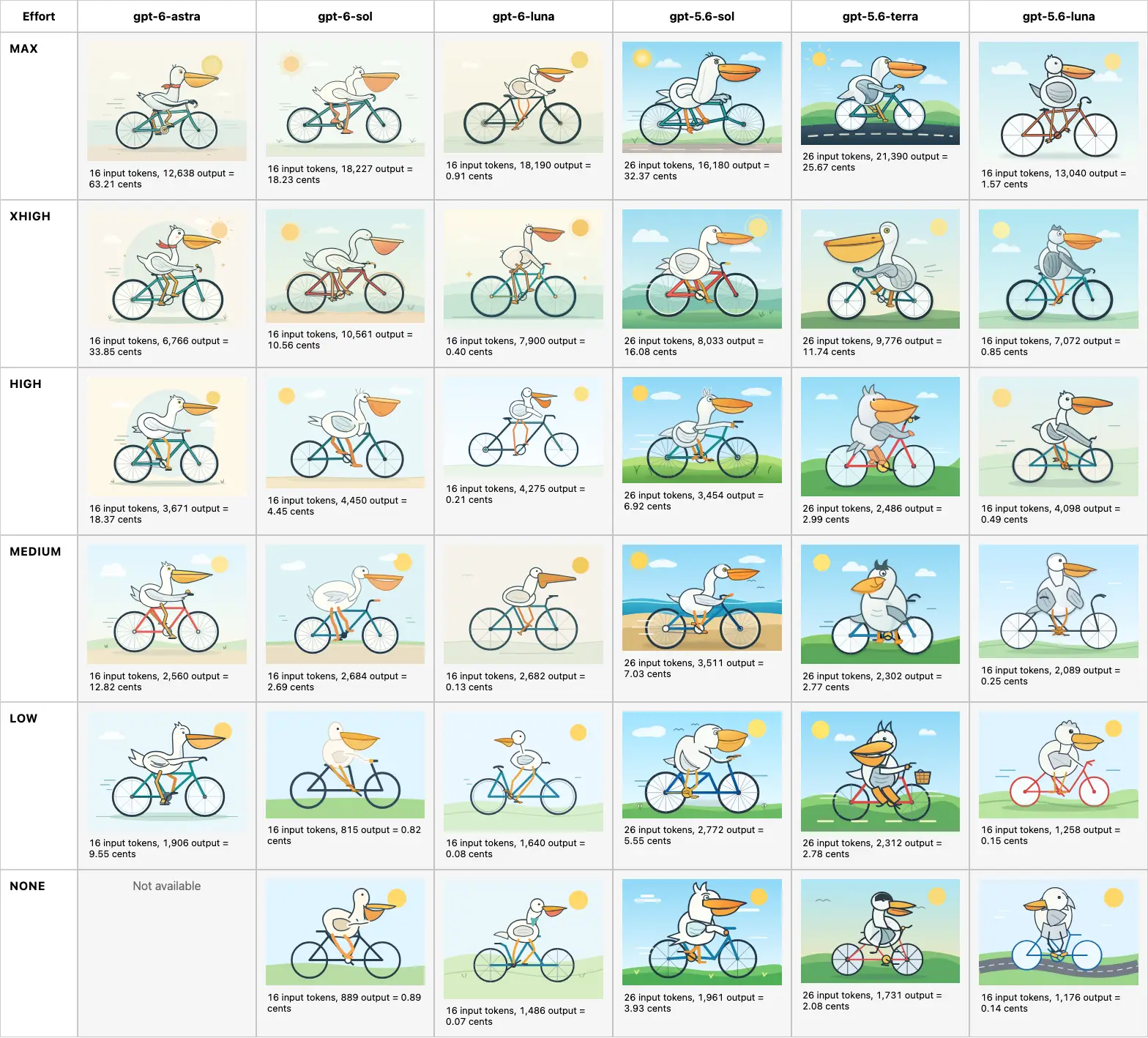
我为 GPT-6 Luna 生成了鹈鹕,也为 GPT-6 Sol 生成了鹈鹕,然后将它们与 GPT-5.6 的鹈鹕一起整合进了这个对比网格。我喜欢其中呈现出的鲜明差异:5.6 系列选择了更大胆、更明亮的色彩,而 6 系列则低调得多。我仍然认为,开启最高档位的 GPT-6 Astra 生成了最好的鹈鹕。
Claude Opus 5.5 也降价了
Opus 5.5 看起来解决了人们对 Opus 沟通风格最大的抱怨。Thariq Shihipar:
Opus 5.5 是你们反馈的成果。
它沟通清晰;每个 token 的价格低于 Opus 5.0,同时具备 Fable 5.1 的智能水平;它的 token 使用效率很高,并且适用于每一个推理强度档位。
它还旨在更擅长使用 Blender。我很期待对它进行充分测试。
Opus 4.5、4.6、4.7、4.8 和 5 的价格一直相同:输入每百万 token 5 美元,输出每百万 token 25 美元。5.5 降价了 20%,即输入 $4/M、输出 $20/M。
缓存读取价格下降了 60%。对于较长的 Agent 对话而言,这一点意义重大,因为其中 90% 以上的输入 token 都是按缓存 token 价格处理的。
Opus 5.5 的新价格与 GPT-5.6 Sol 相同,但那是 OpenAI 将 Sol 价格砍半之前的价格。
GPT-6 Astra 和 Claude Fable 5.1 的价格均为输入每百万 token 10 美元、输出每百万 token 50 美元。目前的价格战影响的是低于这一档的下一层模型。
Anthropic 表示 Sonnet 5.5 和 Haiku 5.5 即将推出。鉴于当前 Haiku 4.5 的价格为 $1/$5,而最新 GPT-6 Luna 的价格仅为其十分之一,即 $0.10/$0.50,Haiku 能否在低端市场重新获得价格竞争力将很有意思。
Claude Opus 5.5 max 过度思考,以至于无法完成任务
在我的“生成一只骑自行车的鹈鹕 SVG”测试中,Claude Opus 5.5 在“max”推理档位首次未能返回响应!
它一开始称这是“一项经典测试请求”,随后就对自己正在做的事进行了非常、非常深入的思考:
这是一项经典测试请求,因此我想规划一只构图良好的鹈鹕:它应有独特的喙和喉囊,骑着一辆拥有合适车轮、车架和脚踏板的自行车,背景则采用简洁的天空和地面。[…]
确认胫骨长度约为 95.2,足够接近。现在我在处理靠近一侧的腿部路径,从臀部到膝盖再到脚踝;然后勾勒放在踏板上的脚部形状——使用直线和曲线绘制脚跟、脚趾尖端和鞋底轮廓,使其自然地落在 y=478-494 附近的踏板表面上。[…]
我喜欢那条从篮子里显眼伸出的鱼,以及鹈鹕注视着它这一有趣细节,值得保留。我还在确认喙根附近的眼睛位置是否符合典型鹈鹕解剖结构,并考虑让它带上一点更愉快的表情。[…]
远侧的腿看起来确实从车架后方穿过,因此我继续检查链轮齿,并确认图层顺序——远侧曲柄臂应大部分被座管和链轮遮住。我正在确定最终 SVG 的 width 和 height 属性以及 viewBox,以确保正确缩放;同时注意到其中没有文本,因此不需要 font-family。[…]
我当时非常期待看到这只鹈鹕……但随后它停止了。Opus 5.5 的最大输出 token 限制是 128,000(其他 Claude 模型也是如此),而它还在推理 SVG 时就触及了这个上限!
我第二次尝试时得到了相同结果。这让我怀疑“max”实际上毫无用处——如果它会在一个愚蠢的 SVG 提示词上过度思考到崩溃,我无法相信它不会在更有价值的工作上做同样的事。
(这两次失败每次都花了我 $2.56,并且耗时近 20 分钟。)
处于“max”档位的 Fable 5.1 没有过度思考,并且确实生成了我在 Anthropic 任何模型中见过的最好的鹈鹕。
以下是 Opus 5.5 的鹈鹕,不包括 5.5 max。
我还制作了这个对比网格,将它们与 Opus 5、Fable 5.1 和 Sonnet 5 生成的鹈鹕进行比较:
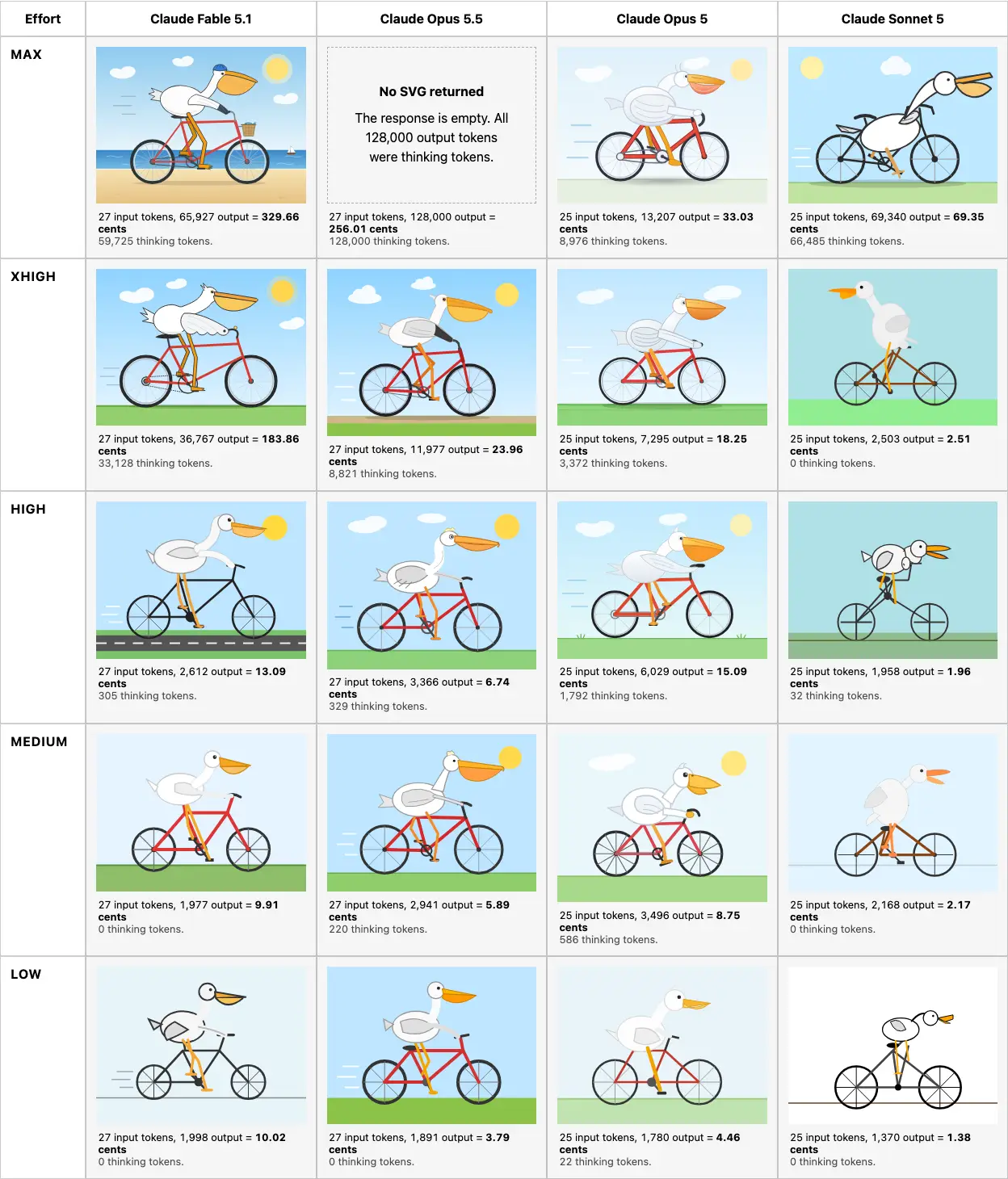
通过模型厂商画“骑自行车的鹈鹕”的能力来进行比较,现在或许已经没有太大意义(如果它曾经有意义的话);但我仍然发现,用它比较同一模型系列在不同推理档位下的表现很有价值。
我现在将 GPT-6 Sol 和 Claude Opus 5.5 作为 Codex 和 Claude Code 中的默认模型。我还将 agent.datasette.io 上的 Datasette Agent 演示升级为使用 GPT-6 Luna;它在 SQL 查询以及为 Datasette Apps 构建 HTML 和 JavaScript 两方面,似乎都既快速又称职。
English / 原文
Claude Opus 5.5, GPT-6 Sol, GPT-6 Luna, and a new price war
22nd September 2026
Yesterday was Grok 4.7 (pelicans) and MiMo v2.6 Flash/Pro (more pelicans). Today Anthropic released Claude Opus 5.5, and around an hour later OpenAI released GPT-6 Sol and GPT-6 Luna. It’s going to take a while to get a good read on all of these new models, but here are my impressions so far.
GPT-6 Sol and Luna are half the price of their GPT-5.6 equivalents
GPT-5.6 Luna was already my favorite model for building applications against, because it combined excellent performance with being really cheap. Somehow GPT-6 Luna is half the price of that again—and GPT-6 Sol had a similar reduction compared to GPT-5.6 Sol.
Here’s what the pricing landscape looks like today:
| Model | Input | Cached input | Output |
|---|---|---|---|
| GPT-6 Luna | $0.10/M | $0.01/M | $0.50/M |
| GPT-5.6 Luna | $0.20/M | $0.02/M | $1.20/M |
| Grok 4.7 | $2/M | $0.50/M | $6/M |
| GPT-6 Sol | $2/M | $0.20/M | $10/M |
| GPT-5.6 Terra | $2/M | $0.20/M | $12/M |
| Claude Opus 5.5 | $4/M | $0.20/M | $20/M |
| GPT-5.6 Sol | $4/M | $0.40/M | $20/M |
| Claude Fable 5.1 | $10/M | $0.25/M | $50/M |
| GPT-6 Astra | $10/M | $1/M | $50/M |
Note that GPT-5.6 has a scheduled 25% price increase for November, so GPT-6 is half the price of the promotional pricing for those models.
(With GPT-5.6 Terra priced the same as GPT-6 Sol, any remaining reasons to use Terra just evaporated.)
It’s hard to overstate how competitive this pricing is. Grok 4.7 priced itself at $2/$6, less than half the price of GPT-5.6 Sol, but is now equally priced to GPT-6 Sol on input and closer on output.
At $0.10/$0.50 GPT-6 Luna is one of the cheapest models OpenAI have ever released, beaten only by the far weaker GPT-4.1 Nano ($0.10/$0.40, April 2025) and GPT-5 Nano ($0.05/$0.40, August 2025).
I rendered pelicans for GPT-6 Luna and for GPT-6 Sol, then I combined them all together in this comparison grid along with the GPT-5.6 pelicans. I like how you can instantly see that the 5.6 family chose bolder, brighter colors, while the 6 family is a lot more muted. I still think GPT-6 Astra on max produced the best pelican.
Claude Opus 5.5 got a price cut too
Opus 5.5 looks like it addresses the biggest complaints people had about Opus in terms of its communication style. Thariq Shihipar:
Opus 5.5 is the result of your feedback.
It communicates clearly, it’s cheaper per token than Opus 5.0 with the intelligence of Fable 5.1 it’s very token efficient and works across every effort level.
It’s also meant to be better at Blender. I’m looking forward to putting it through its paces there.
Opus 4.5, 4.6, 4.7, 4.8, and 5 all shared the same price: $5/million tokens for input and $25/million for output. 5.5 is a 20% reduction—$4/million and $20/million.
The price for cache reads fell 60%. That’s significant for longer agentic conversations, where 90%+ of input tokens are processed at cached token prices.
The new price for Opus 5.5 is the same as the price for GPT-5.6 Sol, but that was before OpenAI dropped their Sol prices by half.
GPT-6 Astra and Claude Fable 5.1 are both priced at $10/million input and $50/million output. The price war currently affects the next tier of models below that.
Anthropic say that Sonnet 5.5 and Haiku 5.5 are coming soon. It’s going to be interesting to see if Haiku can regain its price competitiveness at the lower end, given current Haiku 4.5 is $1/$5 while the latest GPT-6 Luna is one tenth of that price at $0.10/$0.50.
Claude Opus 5.5 max over-thinks to the point of breaking
In a first for my "Generate an SVG of a pelican riding a bicycle" test, Claude Opus 5.5 at "max" thinking level failed to return a response!
It started by calling this “a classic test request”, and then thought really, really hard about what it was doing:
This is a classic test request, so I want to plan out a well-composed pelican with its distinctive beak and pouch riding a bicycle with proper wheels, frame, and pedals, set against a simple sky and ground backdrop. [...]
Verifying the shin length checks out at roughly 95.2, close enough. Now I’m working out the near leg path from hip to knee to ankle, then sketching the foot shape resting on the pedal — outlining the heel, toe tips, and sole contour with a path using lines and curves to sit naturally on the pedal surface around y=478-494. [...]
I like the fish sticking prominently out of the basket with the pelican eyeing it as a fun detail worth keeping. I’m also confirming the eye placement near the bill base matches typical pelican anatomy, and considering giving it a slightly happier expression. [...]
The far leg reads correctly as passing behind the frame, so I’m moving on to check the chainring teeth and confirm layer ordering—the far crank arm should be mostly hidden by the seat tube and chainring. I’m settling on the final SVG’s width and height attributes alongside the viewBox to ensure proper scaling, noting there’s no text so no font-family is needed. [...]
I was so excited to see this pelican... but then it stopped. Opus 5.5 has a 128,000 maximum output token limit (as do the other Claude models), and it hit that while it was still reasoning about the SVG!
I tried a second time and got the same result. This makes me suspect that “max” is effectively useless—if it over-thinks to breaking point on a stupid SVG prompt I don’t trust it not to do the same for more interesting work.
(Those two failures each cost me $2.56 and took nearly 20 minutes.)
Fable 5.1 on “max” didn’t over-think and did give me the best pelican I’ve seen from any Anthropic model.
Here are the Opus 5.5 pelicans, excluding 5.5 max.
I also built this comparison grid comparing them with pelicans by Opus 5, Fable 5.1, and Sonnet 5:
Comparing different model vendors by how well they draw a pelican riding a bicycle may not make much sense now (if it ever did), but I’m still finding value in using them for comparisons of the same model families at different reasoning levels.
I’m now using GPT-6 Sol and Claude Opus 5.5 as my default models in Codex and Claude Code. I’ve upgraded the Datasette Agent demo at agent.datasette.io to use GPT-6 Luna, and it seems to be fast and competent at both SQL queries and building HTML and JavaScript for Datasette Apps.