KTern.AI 如何基于 Amazon Bedrock AgentCore 为 SAP 构建智能体 AI
英文标题:How KTern.AI built agentic AI for SAP on Amazon Bedrock AgentCore
KTern.AI 从传统 SaaS 平台演进为智能体 AI 平台,基于 Amazon Bedrock AgentCore 和 Strands Agents SDK 部署了 20 多个专业智能体,实现 SAP 转型中的逆向工程、代码分析、异常挖掘等流程自主编排。实际生产数据显示,整体项目时间缩短 45%,发现与评估耗时减少 60–70%,90% 的财务与销售异常被自动识别,每月回收 480 个工程小时。新智能体通过配置即可在 4–6 小时内上线,无需自定义编排代码,基础设施成本降低 70%,为开发者展示了如何将基础设施交给平台、聚焦领域智能。该案例为企业 SAP 大规模转型提供了一条可复制、高可靠的智能体化路径。
 1.5 MB
 21.1 KB
 485.6 KB
 37.4 KB
中文
本文介绍 SAP 数字化转型平台 KTern.AI 如何利用 Amazon Bedrock AgentCore 构建并部署适用于企业级 SAP 转型工作负载的 AI 智能体。这些智能体能够自主编排从逆向工程、标准匹配、代码分析到财务与销售流程异常挖掘等工作流。其成果是在无需自定义智能体基础设施的情况下实现了自动化。
SAP 数字化转型是企业所能进行的最复杂、风险最高的工作之一。它们横跨数月甚至数年,涉及业务流程和定制代码之间错综复杂的依赖关系,并且需要仅靠人力顾问难以规模化提供的领域专业知识。在 KTern.AI,我们多年来致力于构建一套使这类转型更快捷、更可预测的系统。向智能体 AI 的转型是我们至今在该使命上迈出的最大飞跃。
从传统的软件即服务(SaaS)平台演变为下一代智能体 AI 平台,意味着要在长期运行的企业项目中编排多个专业化智能体。每个智能体都需具备持久上下文、安全工具访问权限以及生产级别的可靠性。我们基于 Amazon Bedrock AgentCore 并使用 Strands Agents SDK 构建了该系统。本文将深入介绍我们如何设计架构、构建了哪些智能体以及为客户带来了哪些成果。
KTern.AI 概览
KTern.AI 是 SAP 明星合作伙伴,也是 SAP 认证的数字化转型即服务(DXaaS)平台。它通过五个自动化流(数字地图、数字项目、数字流程、数字实验室和数字矿山)加速 SAP S/4HANA 迁移、系统转换及数字化转型项目。专有的制度知识智能引擎将多年的 SAP 转型模式与最佳实践编码到系统中,结合数据驱动的超自动化,可带来快 7 倍的转型速度,并将总体工作量减少 24%。
挑战
随着 KTern.AI 平台的成熟,真正自主的 SAP 转型需要的不再是单轮的 AI 交互。智能体必须能够在持续数月甚至数年的项目中进行推理,同时协调多个领域,并在严格的企业安全与合规边界内运行。
一系列相互关联的挑战构成了障碍,任何拼凑的自定义基础设施都无法干净利落地解决:
- 大规模持久上下文。智能体需要在上百次交互中保持状态,引用历史决策,并在整个项目生命周期中积累上下文,而不是每次会话都重置。目标是正确的上下文而非所有上下文。过多上下文会拖慢智能体、增加成本并提高幻觉几率。
- 安全、受管控的工具集成。实时访问 SAP API、客户企业资源计划(ERP)系统、流程存储库以及 KTern.AI 数据存储,需要企业安全团队认可的、经过身份验证且可审计的连接。
- 多租户与配置驱动的灵活性。每个客户都以独立的租户运行,拥有各自的流程、异常和业务规则。智能体必须能够按租户进行配置,而无需工程人员为每次部署编写定制代码。
- 动态可伸缩性。一次快速 SAP 评估可能只需要少数几个智能体运行几个小时。而完整的企业迁移则需要数十个智能体持续运行数月。
- 生产级可观测性。在企业环境中调试多智能体工作流,如果没有详尽的日志、追踪和指标是行不通的。每个智能体的决策和工具调用都必须可追溯。
在 AgentCore 之前,我们自行构建并运维的自管容器栈虽然可用,但它消耗的工程时间与我们的核心差异化——设计理解 SAP 转型的智能体——毫无关系。
解决方案概述
我们在 Amazon Bedrock AgentCore 上使用 Strands Agents SDK 构建了 KTern.AI 的智能体 AI 平台。核心原则是清晰的关注点分离:SAP 领域智能驻留在 KTern.AI 层,而所有基础设施关注点(托管、伸缩、内存、工具访问、身份和可观测性)则委托给 AgentCore。
每个智能体通过配置部署,零自定义编排代码。每个智能体的行为由其提示词、工具绑定和编排模式定义。一个新智能体可在 4–6 小时内达到生产就绪状态,无需基础设施供应或流水线工程。我们根据工作负载使用 Strands 多智能体模式:群组模式用于并行发现,工作流模式用于顺序阶段,图模式用于条件流水线。
架构
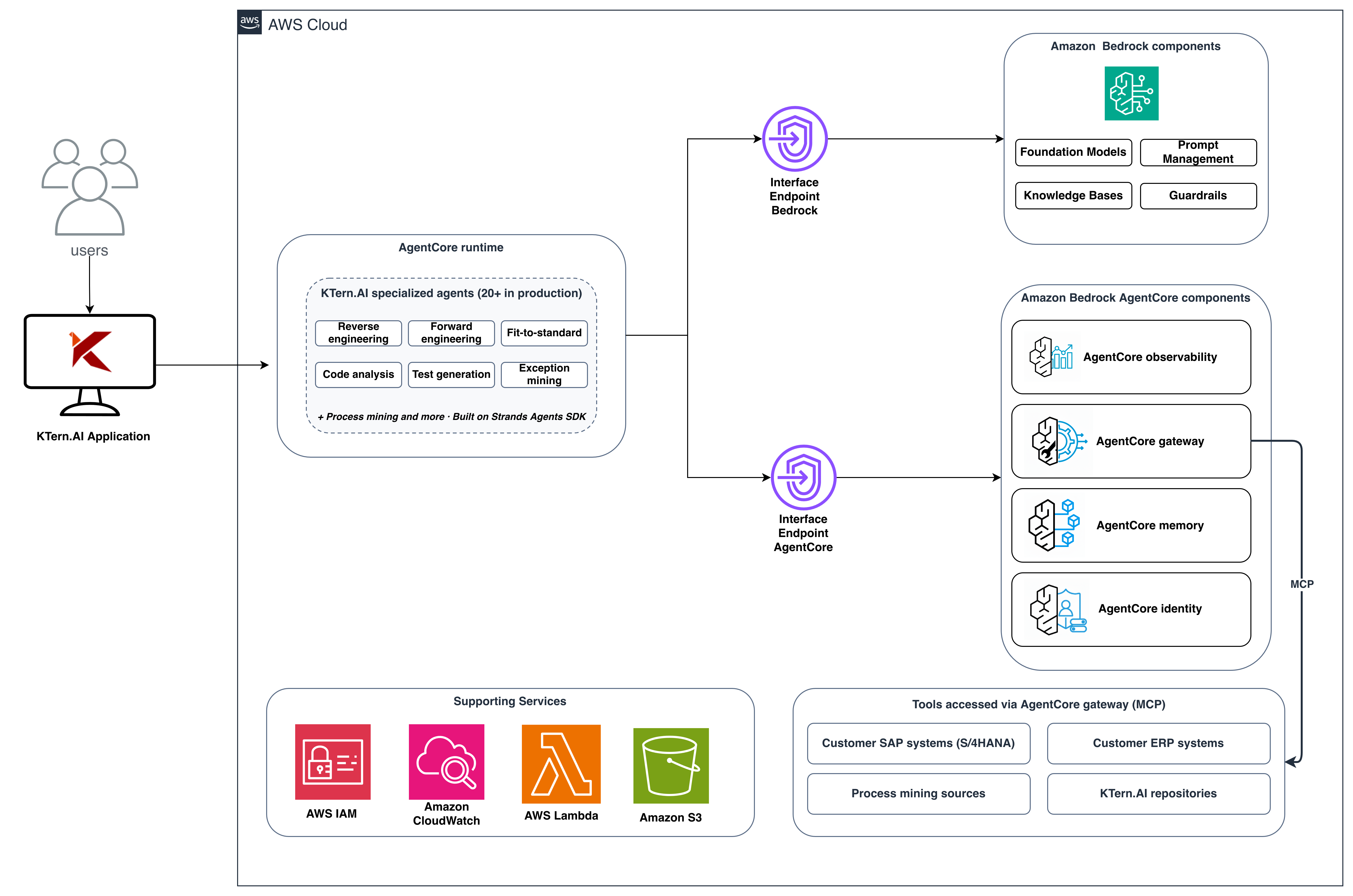
图 1. KTern.AI 在 Amazon Bedrock AgentCore 上的智能体 AI 架构。
架构从客户端层向内流动。企业用户通过 KTern.AI 平台提交转型请求。这些请求被路由到智能体编排层,在那里,专业智能体在 AgentCore 运行时 上运行,并具有完整的会话隔离,因此一个客户的上下文无法被其他客户访问。每个智能体通过 AgentCore 网关模型上下文协议(MCP)层调用外部工具,该层管理与 SAP API、客户 ERP 系统以及 KTern.AI 存储库的经过身份验证的连接。智能体通过由 AWS PrivateLink 驱动的虚拟私有云(VPC)接口端点私密地访问 Amazon Bedrock 和 AgentCore,因此流量不会进入公共互联网。
当智能体被调用时,AgentCore 内存将检索并更新与项目绑定的持久上下文,在多次会话中保留流程决策、代码模式和累积的洞察。AgentCore 身份强制对智能体和工具执行身份认证和最小权限访问。AgentCore 可观测性捕获每一次操作和模型响应,并将其作为日志、指标和追踪发送到 Amazon CloudWatch。在基础层,Amazon Bedrock 提供模型访问,包括 Anthropic 的 Claude 模型系列。Amazon Simple Storage Service (Amazon S3)、AWS Lambda 和 AWS Identity and Access Management (IAM) 为整个系统提供支持。
成果与成效
向基于 Amazon Bedrock AgentCore 的智能体 AI 平台转变,改变了 KTern.AI 客户的可能性。在生产环境中,KTern.AI 的智能体将整体 SAP 项目时间线缩短了 45%,并将发现与评估时间减少了 60–70%。它们还能自主识别 90% 的财务与销售运营异常,并每月回收 480 个工程小时。过去需要大型顾问团队和数月人工分析的 SAP 转型,如今在很大程度上实现了自动化。这些数据反映了 KTern.AI 在其生产 SAP 转型项目中的内部衡量结果。
开发速度
在 AgentCore 之前,构建新的智能体能力意味着要拼凑用于编排、内存、工具访问、身份和监控的自定义基础设施,每个智能体至少需要 2–3 周。配置驱动的方法消除了这些开销。
- 首个生产智能体在 4–6 小时内通过纯配置部署,零行自定义编排代码,开发周期缩短 85%。
- 基础设施搭建时间减少 95%:无需供应,无需自定义流水线工程。
- 新智能体通过配置部署即可在同一天上线生产。
运营效率
随着基础设施由 AWS 管理,运营状况改善,同时成本下降。
- 生产部署保持 99.8% 的智能体可用性。
- 与之前自管容器栈相比,基础设施成本降低 70%。
- 每月回收 480 个工程小时(相当于三位全职工程师),全部重新投入到智能体智能和新能力建设。
SAP 转型影响
智能体自动化的复合价值最清晰地体现在客户成效上。
- SAP 项目整体时间线平均缩短 45%。
- 发现与评估时间减少 60–70%,该阶段以往占用了早期项目预算的最大份额。
- 分析阶段对人工业务专家(SME)和顾问的依赖最高减少 60%。
- 自动生成的测试用例首次通过率达 82%。
- 财务与销售模块中 90% 的运营异常被异常挖掘智能体自主识别。
- 由于更早、更全面的风险识别,上线后支持事件减少 40%。
风险降低与质量
速度的提升只有在质量得以保持时才有意义。智能体 AI 提高了 KTern.AI 所支持的转型的一致性和可靠性。
- 逆向工程与定制代码分析智能体可提前暴露技术债务和迁移风险,避免其累积成代价高昂的下游问题。
- 标准化的智能体驱动方法减少了项目间的质量差异,与具体投入的顾问团队无关。
- 集中式提示管理提供了版本控制、回滚和跨智能体部署的一致治理。
- 对智能体配置、编排模式和模型选择的配置驱动测试,支持在不增加部署开销的情况下持续改进。
Amazon Bedrock AgentCore 组件
KTern.AI 的平台使用了六项 AgentCore 能力。AgentCore 运行时托管智能体,AgentCore 内存保留项目上下文,AgentCore 网关连接工具,AgentCore 身份管控访问,AgentCore 可观测性追踪行为,AgentCore 评估衡量质量。以下各节介绍 KTern.AI 如何使用每一项。
AgentCore 运行时
我们首个生产智能体的部署仅用了 4–6 小时,且零基础设施代码。AgentCore 运行时负责计算供应、伸缩以及在同时运行的客户环境间进行会话隔离。多租户隔离是内置的,无需我们自己设计、实现和审计。
AgentCore 内存
SAP 转型项目跨发现、设计、测试和切换,持续 12–18 个月,涉及数百次智能体交互。AgentCore 内存让我们的智能体能够跨这些交互保留项目上下文,包括定制代码清单、流程决策和异常模式,而无需构建任何内存基础设施。智能体在每次交互中都携带完整的项目历史,而不是从零开始。
AgentCore 网关(MCP)
KTern.AI 的智能体需要实时访问实时 SAP 环境、客户 ERP API、流程挖掘源和分析存储库,并且这个列表随着每个客户不断增长。AgentCore 网关对 MCP 的实现使我们能够通过配置注册新工具,而无需编写自定义集成代码。异常挖掘智能体通过网关直接访问客户系统中的财务与销售数据。
AgentCore 身份
企业安全团队会仔细审查接触其 SAP 环境的每一个系统。AgentCore 身份 为我们提供了每个智能体的最小权限访问、工具调用的完整审计追踪,以及与客户现有身份基础设施的兼容性。这使安全团队有信心批准智能体用于生产,而无需我们进行自定义的访问控制工作。
AgentCore 可观测性
在拥有 AgentCore 可观测性(结合 Amazon CloudWatch 与 OpenTelemetry)之前,调试一个多步骤的智能体故障意味着需要手动关联跨不连接系统的日志。如今,我们可以在几分钟内从初始请求追踪整个智能体决策和工具调用链条,直到最终响应。这种可见性支撑了我们 99.8% 的智能体可用性。
AgentCore 评估
早期的担忧集中在质量一致性上,尤其是对测试用例生成智能体,其准确性直接影响上线风险。我们并非为每个智能体构建评估工具,而是使用 AgentCore 评估,结合 KTern.AI 特定的 SAP 测试用例进行周期性运行。在每次配置变更时都进行评估(而不仅仅是在上线时),以维持 82% 的首次通过率,并尽早发现模型驱动的行为变化。
KTern.AI 的智能体网络
KTern.AI 在生产环境中运行了 20 多个专业智能体,每个智能体都负责 SAP 转型生命周期中的一个独立领域。它们通过配置构建,其行为由提示词、工具绑定和编排模式定义。截至本文撰写时,我们在不同客户场景中维护了 50 多种智能体配置。以下是推动上述成果的核心智能体。
逆向工程智能体
逆向工程智能体对客户现有 SAP 环境进行深度自动分析,扫描自定义 ABAP 代码、用户出口、增强功能、配置和流程变体,以构建现状清单。过去需要顾问花费数周完成的工作现在可在极短时间内完成。其输出作为共享基础供给下游智能体,用于推理迁移影响和现代化路径。
前向工程智能体(Forward enginee)
English / 原文
In this post, learn how KTern.AI, an SAP digital transformation platform, used Amazon Bedrock AgentCore to build and deploy AI agents ready for enterprise-scale SAP transformation workloads. These agents autonomously orchestrate workflows from reverse engineering, fit-to-standard, and code analysis to exception mining in Finance and Sales processes. The result is automation without custom agent infrastructure.
SAP digital transformations are among the most complex, high-stakes initiatives an enterprise can undertake. They span months or years, involve intricate interdependencies across business processes and custom code, and demand domain expertise that is hard to scale with human consultants alone. At KTern.AI, we have spent years building a system that makes these transformations faster and more predictable. Our move to agentic AI is the most significant leap in that mission to date.
Evolving from a traditional software as a service (SaaS) platform into a next-generation agentic AI platform meant orchestrating multiple specialized agents across long-running enterprise programs. Each agent operates with persistent context, secure tool access, and production-grade reliability. We built that system on Amazon Bedrock AgentCore using the Strands Agents SDK. This post walks through how we architected it, which agents we built, and the outcomes for our customers.
Overview of KTern.AI
KTern.AI is an SAP Spotlight Partner and SAP-certified Digital Transformation as a Service (DXaaS) platform. It accelerates SAP S/4HANA migrations, system conversions, and digital transformation programs across five automation streams: Digital Maps, Digital Projects, Digital Process, Digital Labs, and Digital Mines. A proprietary institutional knowledge intelligence engine encodes years of SAP transformation patterns and best practices into the system, and combined with data-driven hyperautomation it delivers 7x faster transformations with a 24 percent reduction in overall effort.
The challenge
As KTern.AI’s platform matured, truly autonomous SAP transformation required more than single-turn AI interactions. Agents had to reason across projects spanning months or years, coordinate across multiple domains at once, and operate within strict enterprise security and compliance boundaries.
Several interlocking challenges no patchwork of custom infrastructure could cleanly solve stood in the way:
- Persistent context at scale. Agents needed to retain state across hundreds of interactions, reference historical decisions, and build cumulative context over the full project lifecycle, not reset with every session. The goal is the right context rather than all of it. Overloading an agent with excess context slows it down, raises cost, and increases the chance of hallucination.
- Secure, governed tool integration. Real-time access to SAP APIs, customer enterprise resource planning (ERP) systems, process repositories, and KTern.AI data stores required authenticated, auditable connections that enterprise security teams could stand behind.
- Multi-tenancy and configuration-driven flexibility. Each customer runs as an isolated tenant with its own processes, exceptions, and business rules. Agents had to be configurable per tenant without engineering writing custom code for every deployment.
- Dynamic scalability. A rapid SAP assessment might engage a handful of agents for a few hours. A full enterprise migration runs dozens of agents continuously over months.
- Production-grade observability. Debugging multi-agent workflows without detailed logs, traces, and metrics in enterprise environments isn’t viable. Every agent decision and tool invocation needed to be traceable.
Before AgentCore, the application ran on a self-managed container stack we built and operated ourselves. It worked, but it consumed engineering time on infrastructure that had nothing to do with our core differentiation: designing agents that understand SAP transformation.
Solution overview
We built KTern.AI’s agentic AI platform on Amazon Bedrock AgentCore using the Strands Agents SDK. The core principle is a clean separation of concerns: SAP domain intelligence lives in KTern.AI’s layer, while every infrastructure concern (hosting, scaling, memory, tool access, identity, and observability) is delegated to AgentCore.
Every agent deploys through configuration with zero custom orchestration code. Each agent’s behavior is defined by its prompt, tool bindings, and orchestration pattern. A new agent reaches production in 4-6 hours, with no infrastructure provisioning or pipeline engineering. We use Strands multi-agent patterns by workload: swarm for parallel discovery, workflow for sequential phases, and graph for conditional pipelines.
Architecture
Figure 1. KTern.AI’s agentic AI architecture on Amazon Bedrock AgentCore.
The architecture flows from the client layer inward. Enterprise users submit transformation requests through the KTern.AI platform. Those requests route to the agent orchestration layer, where specialized agents run on AgentCore runtime with full session isolation, so one customer’s context isn’t accessible to another. Each agent invokes external tools through the AgentCore gateway Model Context Protocol (MCP) layer, which manages authenticated connections to SAP APIs, customer ERP systems, and KTern.AI’s repositories. Agents reach Amazon Bedrock and AgentCore privately over virtual private cloud (VPC) interface endpoints powered by AWS PrivateLink, so traffic stays off the public internet.
As agents are invoked, AgentCore memory retrieves and updates persistent context tied to the project, preserving process decisions, code patterns, and accumulated insights across sessions. AgentCore identity enforces authentication and least-privilege access for agents and tools. Every action and model response is captured by AgentCore observability and sent as logs, metrics, and traces to Amazon CloudWatch. At the foundation, Amazon Bedrock provides model access, including Anthropic’s Claude family of models. Amazon Simple Storage Service (Amazon S3), AWS Lambda, and AWS Identity and Access Management (IAM) support the broader system.
Results and outcomes
The shift to an agentic AI platform on Amazon Bedrock AgentCore changed what’s possible for KTern.AI’s customers. In production, KTern.AI’s agents cut overall SAP project timelines by 45 percent and reduced discovery and assessment time by 60–70 percent. They also surface 90 percent of Finance and Sales operational exceptions autonomously and reclaimed 480 engineering hours per month. SAP transformations that once required large consultant teams and months of manual analysis are now substantially automated. These figures reflect KTern.AI’s internal measurements across its production SAP transformation engagements.
Development velocity
Before AgentCore, building a new agent capability meant assembling custom infrastructure for orchestration, memory, tool access, identity, and monitoring, a minimum of 2–3 weeks per agent. The configuration-driven approach removed that overhead.
- First production agent deployed in 4–6 hours, configuration-only, with zero lines of custom orchestration code. That’s an 85 percent reduction in development cycle.
- Infrastructure setup time reduced by 95 percent: no provisioning, no custom pipeline engineering.
- New agents ship to production same-day through configuration deployment.
Operational efficiency
With infrastructure managed by AWS, the operations posture improved while costs fell.
- 99.8 percent agent uptime sustained across production deployments.
- 70 percent reduction in infrastructure costs versus the self-managed container stack we previously operated.
- 480 engineering hours per month reclaimed (equivalent to three full-time engineers), all reinvested in agent intelligence and new capabilities.
SAP transformation impact
The compounding value of agentic automation is clearest in customer outcomes.
- 45 percent average reduction in overall SAP project timelines.
- 60–70 percent reduction in discovery and assessment time, the phase that historically consumed the largest share of early project budget.
- Up to 60 percent reduction in manual subject matter expert (SME) and consultant dependency during analysis phases.
- 82 percent first-pass success rate on automatically generated test cases.
- 90 percent of operational exceptions in Finance and Sales modules autonomously identified by exception mining agents.
- 40 percent reduction in post-go-live support incidents driven by earlier, more comprehensive risk identification.
Risk reduction and quality
Speed gains matter only when quality holds. Agentic AI improved the consistency and reliability of the transformations KTern.AI supports.
- Reverse engineering and custom code analysis agents surface technical debt and migration risk early, before it compounds into expensive downstream problems.
- Standardized agent-driven approaches reduce quality variance across projects, independent of which consultant team is engaged.
- Centralized prompt management provides version control, rollback, and consistent governance across agent deployments.
- Configuration-driven testing of agent configurations, orchestration patterns, and model selections supports continuous improvement without deployment overhead.
Amazon Bedrock AgentCore components
KTern.AI’s platform uses six AgentCore capabilities. AgentCore runtime hosts the agents, AgentCore memory preserves project context, AgentCore gateway connects tools, AgentCore identity governs access, AgentCore observability traces behavior, and AgentCore evaluations measures quality. The sections that follow describe how KTern.AI uses each one.
AgentCore runtime
Deploying our first production agent took 4–6 hours, with zero infrastructure code. AgentCore runtime handled compute provisioning, scaling, and session isolation across simultaneous customer environments. Multi-tenant isolation came built in, not something we had to design, implement, and audit ourselves.
AgentCore memory
SAP transformation projects run 12–18 months across discovery, design, testing, and cutover, with hundreds of agent interactions. AgentCore memory let our agents retain project context across them, including custom code inventories, process decisions, and exception patterns, with no memory infrastructure to build. Agents carry full project history into every interaction rather than starting from scratch.
AgentCore gateway (MCP)
KTern.AI’s agents need real-time access to live SAP environments, customer ERP APIs, process mining sources, and analytical repositories, and that list grows with every customer. The AgentCore gateway implementation of MCP let us register new tools through configuration rather than custom integration code. Exception mining agents reach Finance and Sales data directly in customer systems through the gateway.
AgentCore identity
Enterprise security teams scrutinize every system that touches their SAP landscape. AgentCore identity gave us least-privilege access per agent, full audit trails of tool invocations, and compatibility with customers’ existing identity infrastructure. That gave security teams the confidence to approve agents for production without custom access-control work from us.
AgentCore observability
Before AgentCore observability with Amazon CloudWatch and OpenTelemetry, debugging a multi-step agent failure meant correlating logs across disconnected systems by hand. Today we trace issues from the initial request through every agent decision and tool call to the final response in minutes. That visibility underpins our 99.8 percent agent uptime.
AgentCore evaluations
Quality consistency was an early concern, especially for the test case generation agent where accuracy affects go-live risk. Rather than build evaluation harnesses per agent, we run cycles using AgentCore evaluations with KTern.AI-specific SAP test cases. Evaluating on every configuration change, not only at launch, sustains an 82 percent first-pass success rate and flags model-driven behavior shifts early.
KTern.AI’s agent network
KTern.AI operates over 20 specialized agents in production, each owning a discrete domain of the SAP transformation lifecycle. They’re built through configuration, with behavior defined by prompts, tool bindings, and orchestration patterns. As of this writing we maintain over 50 agent configurations across customer scenarios. The core agents driving these outcomes follow.
Reverse engineering agent
The reverse engineering agent performs deep automated analysis of a customer’s existing SAP landscape, scanning custom ABAP code, user exits, enhancements, configurations, and process variants to build a current-state inventory. Work that once took consultants weeks now completes in a fraction of the time. Its output feeds downstream agents as a shared foundation for reasoning about migration impact and modernization paths.
Forward engineering agent
After the current state is mapped, the forward engineering agent converts those insights into clean-core-aligned target architectures, standard integration patterns, and migration-ready code. It applies clean-core principles (keep only standard functionality in the digital core, externalize extensions) to recommend what to retain, refactor, or retire. Together the two agents form a continuous reverse-to-forward pipeline that cuts design and blueprinting effort on S/4HANA migrations.
Fit-to-standard agent
The fit-to-standard agent evaluates a customer’s business processes against SAP standard processes, identifying where customizations diverge and recommending alternatives. This is one of the most consultant-intensive activities in any transformation, normally requiring functional consultants to review hundreds of processes by hand. The agent automates that analysis at scale, with up to 60 percent reduction in the SME time this phase requires.
Custom code analysis agent
Custom ABAP code is one of the biggest risk factors in any S/4HANA migration. The custom code analysis agent assesses the full landscape for migration compatibility, deprecated API usage, performance risk, and modernization potential. It then classifies each object by complexity with prioritized remediation guidance. This early visibility is a primary driver of the 40 percent reduction in post-go-live support incidents across engagements.
Test case generation agent
Testing is one of the most resource-intensive phases of SAP transformation. The test case generation agent automates executable test cases from business process flows, custom code analysis outputs, and configuration data. It produces scripts with test data, expected outcomes, and validation criteria at a coverage manual authoring cannot match. It achieves an 82 percent first-pass execution success rate.
Process mining agent
The process mining agent analyzes SAP event logs (purchase-to-pay, order-to-cash, record-to-report, and others) to surface how processes actually run versus how they are designed. It identifies deviations, bottlenecks, rework loops, and automation opportunities invisible in static documentation, providing evidence to prioritize redesign mid-transformation and continuous health monitoring post-go-live.
Exception mining agent
Operational exceptions in Finance and Sales (unmatched invoices, blocked purchase orders, open credit memos, billing exceptions) are usually found reactively. The exception mining agent proactively identifies and classifies them across FI, CO, SD, and MM modules. In production, 90 percent of these exceptions are now surfaced autonomously, cutting manual effort and supporting resolution before business impact.
Lessons learned
Building over 20 production agents on Amazon Bedrock AgentCore sharpened our view of what it takes to build agentic AI reliably for enterprise use cases. For other independent software vendors (ISVs) and SaaS builders, these lessons shaped our approach most.
- Start with configuration, not code. Each time we were tempted to write custom orchestration logic, a configuration-based equivalent proved faster to build and easier to maintain. Staying configuration-driven is what compressed per-agent deployment from weeks to hours.
- Memory architecture is a first-class design decision. In long-running enterprise workflows, memory schema design determines whether agents reason like experienced consultants or start from scratch every session. This is context engineering: bringing enough context for the agent to reason well, without overloading it. Design memory before writing the first prompt.
- Instrument from day one. Multi-agent systems fail in ways that are invisible without distributed tracing, so observability from the first deployment turns hours of debugging into minutes, and the payoff compounds as agent count grows.
- Evaluate on every configuration change, not only at launch. Agents drift as underlying models update and production data shifts, and continuous evaluation catches that drift before customers do.
- Make enterprise security credible before the first conversation. Regulated-industry customers ask hard questions about authentication, access control, and auditability before any agent touches their systems, and confident answers move procurement from blocker to fast-track.
Conclusion
KTern.AI’s journey from a traditional SaaS platform to a production-scale agentic AI platform on Amazon Bedrock AgentCore shows what becomes possible when deep domain expertise meets fully managed AI infrastructure. We set out to build a fleet of specialized agents that autonomously orchestrate the full complexity of SAP transformation, without diverting engineering to infrastructure. Customers now complete SAP programs 45 percent faster, with 60–70 percent less manual discovery effort, and exceptions that once took weeks of expert review surface autonomously at 90 percent coverage.
If you’re an SAP customer, partner, system integrator, or an ISV building agentic AI on AWS, we hope these patterns accelerate your path. KTern.AI is expanding its agent network across Supply Chain, HR, and Basis operations, and deepening its integration with Amazon Bedrock AgentCore as new capabilities emerge.
Related posts and resources
About the authors
Vijayaraghavan C P
Vijayaraghavan is Senior GenAI and AWS Architect at KTern.AI. He is deeply passionate about generative AI, agentic systems, and enterprise SAP architecture, with a keen interest in advancing foundation models and agent frameworks to solve complex business challenges at scale. Outside work, he is passionate about off-roading and loves tackling challenging terrains behind the wheel.
Prabhu G
Prabhu is a Solutions Architect at AWS, where he helps enterprise customers across India securely build, innovate, and scale their cloud environments. He brings more than 12 years of networking and security experience to designing robust AWS architectures. Outside work, he enjoys reading and researching the history of technology and science.