Holo4:赋能通用型计算机使用 Agent
英文标题:Holo4: powering generalist computer-use agents
H 公司发布新一代 Agent 模型系列 Holo4,包括 27B Dense 和 35B-A3B MoE 两种规格,并同步推出 Holotron4 Nano。Holo4 可通过 GUI、代码、MCP 和 API 操作软件,面向桌面、Web、Android、代码沙箱及企业 API 等多种环境使用。在 OSWorld 2.0 等基准上,Holo4 以显著更少的参数和更低的单任务成本,与前沿闭源模型展开竞争。开发者现可通过 H Models API 调用模型,也可从 Hugging Face 获取多种精度格式的权重及公开评测轨迹。
 4.5 KB
 6.8 KB
 1.3 KB
 5.0 KB
 5.4 KB
 397 B
 5.6 KB
 8.9 KB
 1.0 KB
 397 B
 397 B
 397 B
 7.1 KB
 1.3 KB
 11.4 KB
 15.9 KB
 397 B
 1.2 KB
 1.3 KB
 1.3 KB
中文

Holo4 是我们推出的新一代 Agent 模型系列,提供两种规格:27B Dense 和 35B-A3B Mixture of Experts。两者均已在 H Models API 上提供。我们还发布了 Holotron 3 的更新版本:Holotron4 Nano。
Holo4 基于此前的模型构建,可通过任何可用接口与软件交互,包括 GUI、代码、MCP 和 API。它在学术基准上表现出色,但其设计目标是真实的企业工作流。模型通过监督学习和强化学习,在大量环境与任务上完成训练,其中包括由我们的 Agentic Task Factory 生成的环境和任务。
立即开始:
面向每一种接口构建的模型
Holo4 可以在屏幕上点击和输入,自行编写并运行代码,也可以调用 MCP 或 API 工具。它会选择最适合任务的方法。大多数 Agent 模型只针对一种接口进行训练:以 GUI 为中心的模型在没有屏幕时便无法工作,而偏好工具调用的模型面对没有 API 的应用程序时则会受阻。真实工作并非如此割裂,一项企业任务往往需要结合这些不同的方法。
Holo4 可在桌面端、Web、Android、代码沙箱中运行,也可面向企业 API 工作。所有情况下使用的都是同一个模型,调用方式也完全相同。你无需为每个平台选择不同的模型。
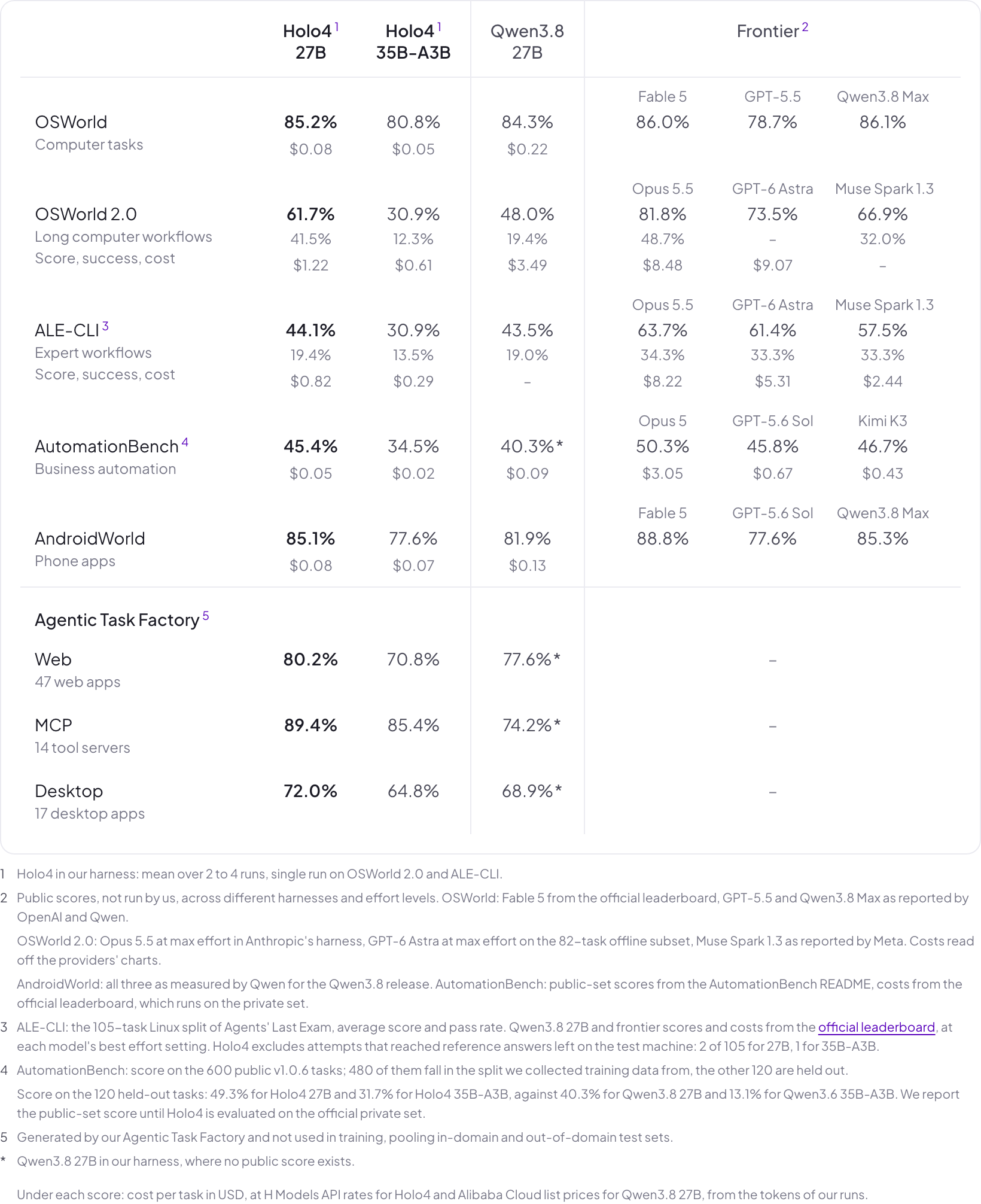
Holo4 模型相较其 Qwen 基座模型实现了显著提升。在长流程任务上,Holo4 仅落后于最强的闭源模型:在 OSWorld 2.0 上,Holo4 27B 得分为 61.7%,而 Opus 5.5 为 81.8%;Holo4 35B-A3B 达到 30.9%。不过,Holo4 使用的参数量低了数个数量级,成本也大幅更低。我们开源了公开基准评分背后的每一条轨迹:可在 trajectories.hcompany.ai 回放每一步,或从 Hugging Face 下载。
以远低于前沿模型的成本实现竞争力
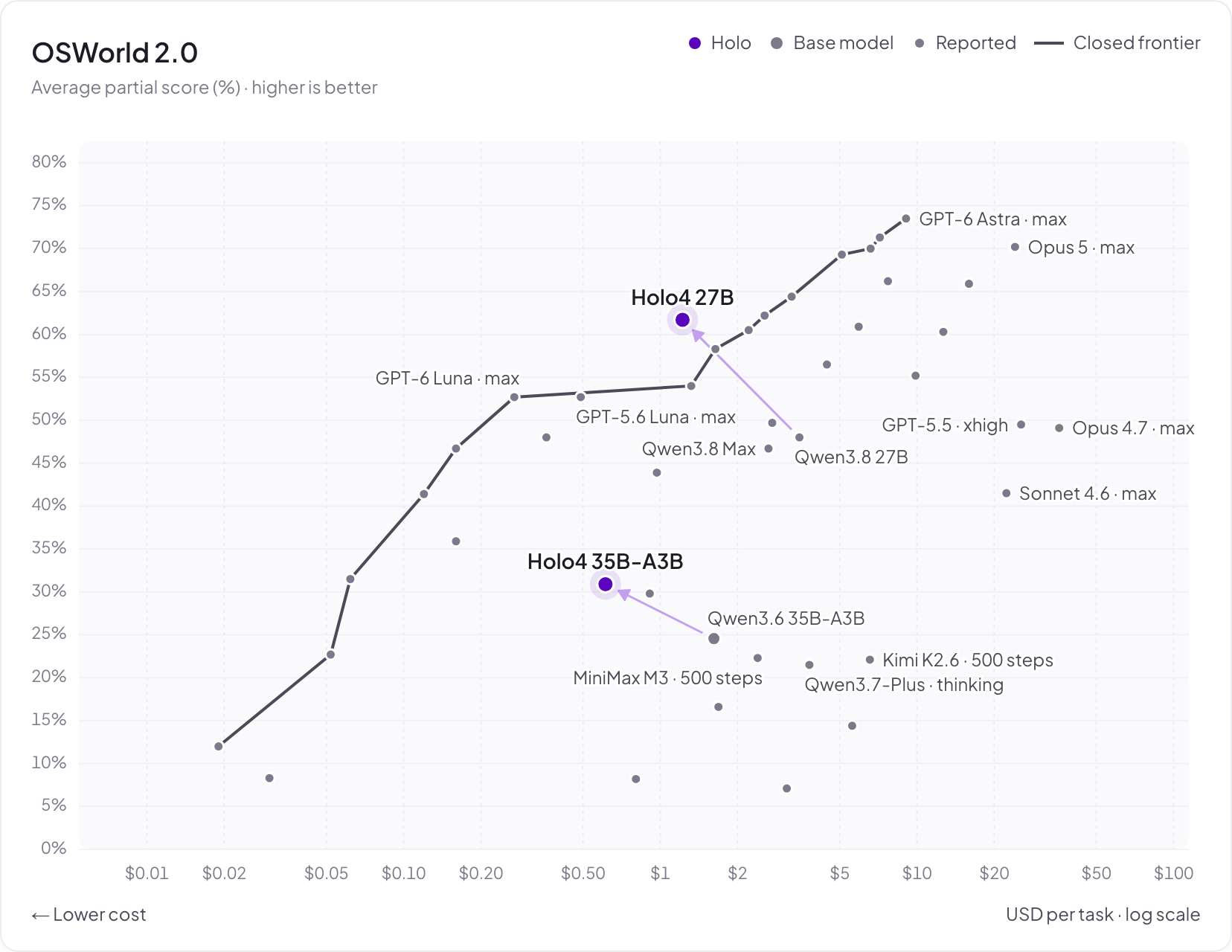
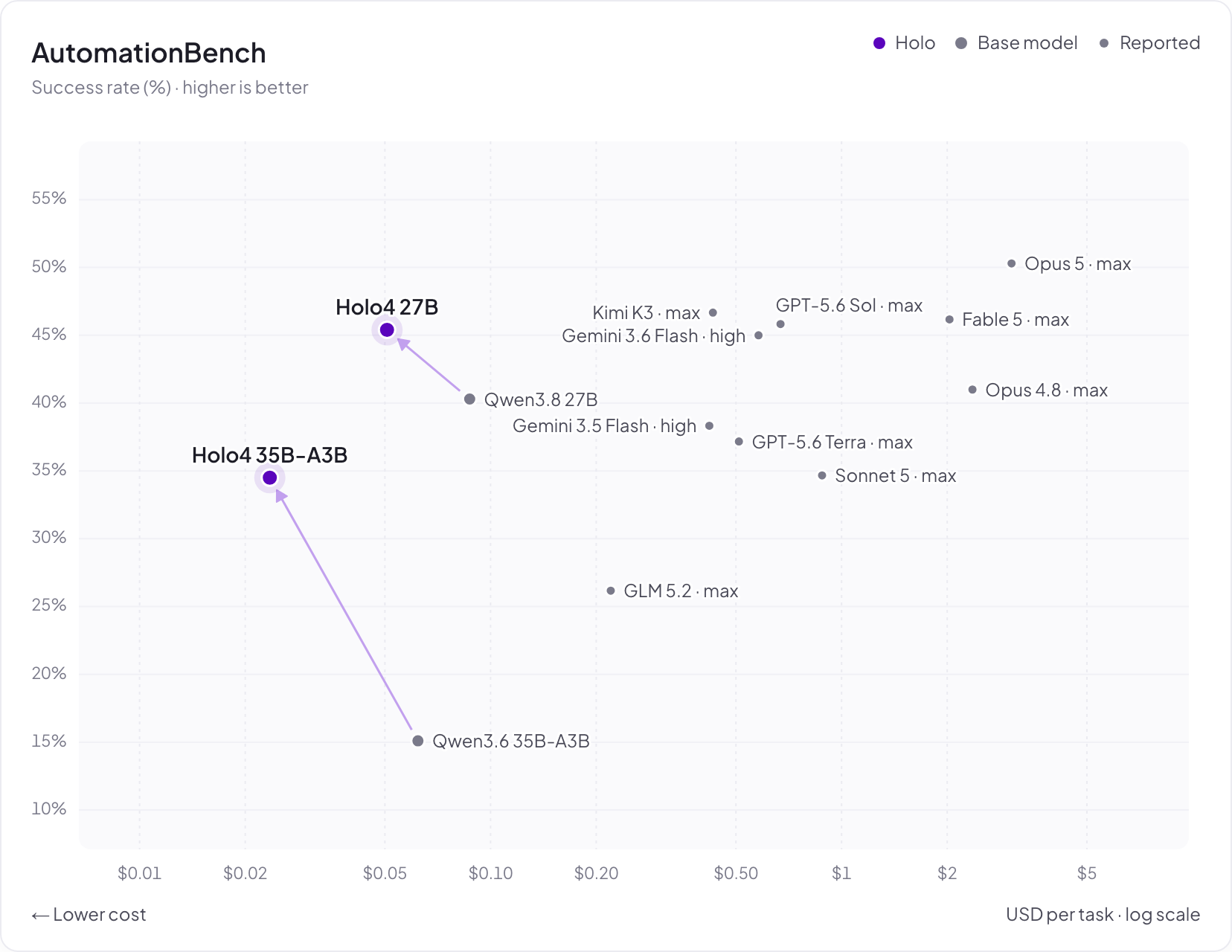
在最具挑战性的桌面控制学术基准 OSWorld 2.0 和 API 使用基准 AutomationBench 上,Holo4 能以低得多的单任务成本与前沿模型竞争。
成本—性能图表说明
OSWorld 2.0。 成本根据每次 Agent 运行的输入和输出 token 估算。Holo4 按 H Models API 定价计算(单次运行)。Qwen3.8 27B:得分来自模型卡,成本按我们运行所用 token、依据阿里云目录价格计算。Qwen3.6 35B-A3B:在我们的 harness 中单次运行,按阿里云目录价格计算,其中缓存命中按输入价格的 20% 计费。GPT 和 Opus 的 effort 扫描数据来自 OpenAI 的发布数据;其他闭源和开放权重模型的数据点使用官方 OSWorld 2.0 排行榜。不同发布版本、harness 和任务子集之间存在差异。图中的连线连接闭源模型中未被支配的得分与成本组合;Holo4 未纳入其中。
AutomationBench。 Holo4、Qwen3.8 27B 和 Qwen3.6 35B-A3B:使用 AutomationBench v1.0.6,得分和成本均在我们的内部 harness 中测量。其他模型:公开测试集得分来自 AutomationBench README,单任务成本来自官方排行榜,后者运行于私有测试集。Holo4 完成私有测试集评估后,我们将报告其结果。
能够完成实际工作的 AI
Holo4 模型在来自 Agentic Task Factory 的环境和任务上进行训练,因此擅长操作专业软件。以下示例展示 Holo4 27B 与其基座模型 Qwen3.8 27B 的对比。两个模型使用相同的提示词和 harness。
3D 建模 · 埃菲尔铁塔
在 FreeCAD 中构建埃菲尔铁塔的 3D 模型,比例为 1 毫米对应 1 米,模型以原点为中心,并与 X 轴和 Y 轴对齐。请按照以下设计制作。
铁塔在每一个高度的平面均为正方形,绝不能是圆形。从中心轴量至角点的半宽度:地面高度为 62.5 mm,高度 57 处为 32.5 mm,高度 115 处为 17.5 mm,高度 276 处为 9.35 mm。在这些高度之间,半宽度应遵循一条平滑曲线:近地面处快速收窄,越往上收窄越平缓,不能出现直线。
设置四条完全相同的支腿,每个象限一条;每条支腿均为方柱,其外侧角点沿上述轮廓延伸。每条支腿地面处宽 14 mm,并逐渐收窄至高度 276 处的 4 mm。支腿从地面到第一层平台之间彼此分离,并在上升过程中逐渐汇合。支腿之间不得填充任何空间:铁塔应为开放结构,从每一侧都能直接透视。
设置三层平台,每层均为以中心轴为中心的实心方形板:高度 57 处的平台宽 72 mm、厚 4 mm;高度 115 处的平台宽 40 mm、厚 3 mm;高度 276 处的平台宽 22 mm、厚 3 mm。
设置一根从高度 276 延伸至 324 的桅杆,截面为方形,底部宽 8 mm,顶部逐渐收窄至 2 mm。
每个部分都必须是具有非零体积的封闭实体,且任何部分均不得填充支腿之间的空间。
Holo4 27B(84 次调用,130 万 token)
Qwen3.8 27B(60 次调用,100 万 token)
3D 建模 · H 徽标
在 FreeCAD 中构建 H 公司徽标的 3D 模型:一个实心填充圆盘与一个块状无衬线大写字母 H 并排放置,两种形状挤出至相同厚度,二者高度相近且彼此分开、不发生重叠,圆盘中心与字母 H 的中部齐平。将两种形状均设为黑色。
Holo4 27B(94 次调用,150 万 token)
Qwen3.8 27B(118 次调用,190 万 token)
游戏设计 · 吃豆人
使用 Godot 构建一款吃豆人风格的游戏,并让它保持运行。
创建一个由墙体构成的矩形网格迷宫,在每一条开放走廊中填满豆子。玩家标记沿走廊持续移动,吃掉经过的每一颗豆子,并为每颗豆子获得 1 分。三只幽灵在相同走廊中移动并追逐玩家。若幽灵抓到玩家,玩家失去一条生命,且所有内容重置到初始位置。屏幕上应显示得分和生命数。
不会有人实际游玩这个游戏。玩家必须依靠简单启发式规则自动操作:在每个路口向最近的豆子前进,除非附近有幽灵,此时应远离幽灵。游戏必须能够无人值守、无限期运行,完全不需要键盘输入。
完成后,启动游戏并让其持续运行。
Holo4 27B(68 次调用,240 万 token,268 行代码)
Qwen3.8 27B(197 次调用,1140 万 token,327 行代码)
我们如何构建 Holo4
Agentic Task Factory
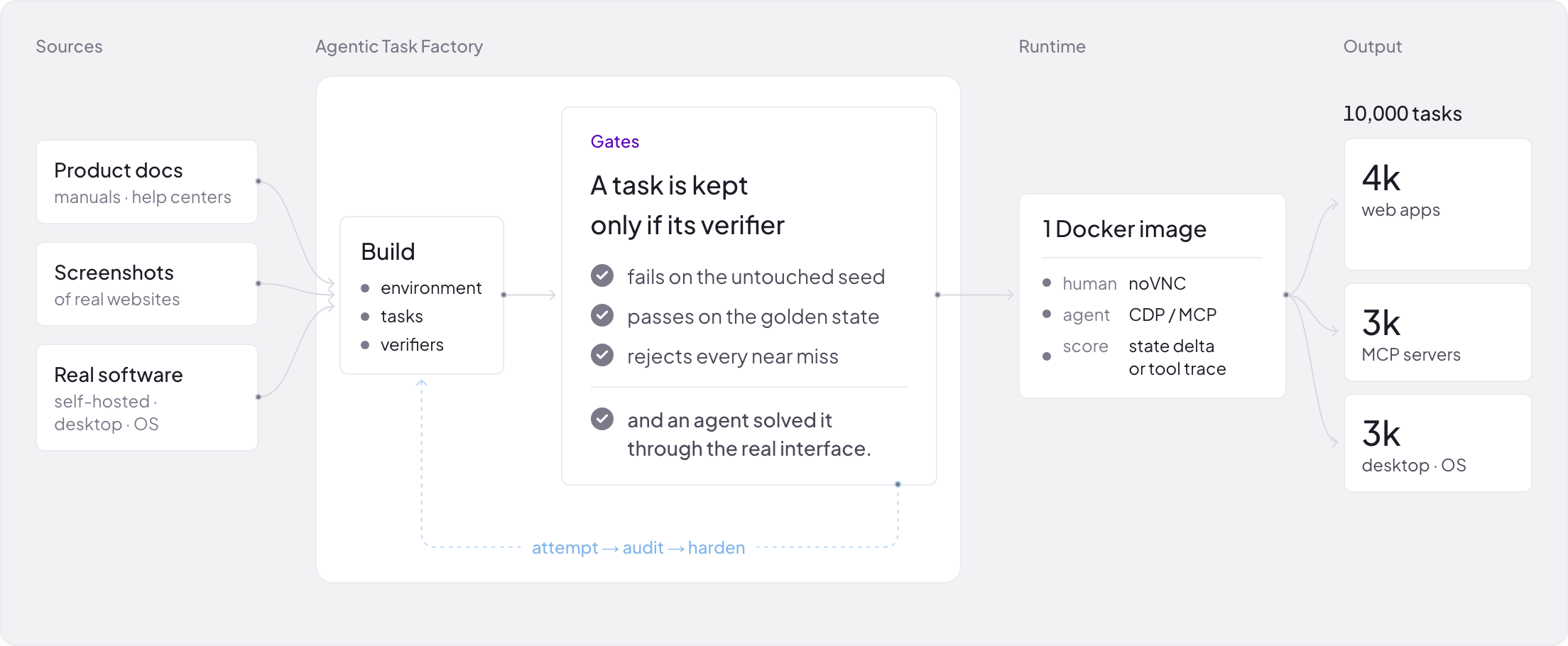
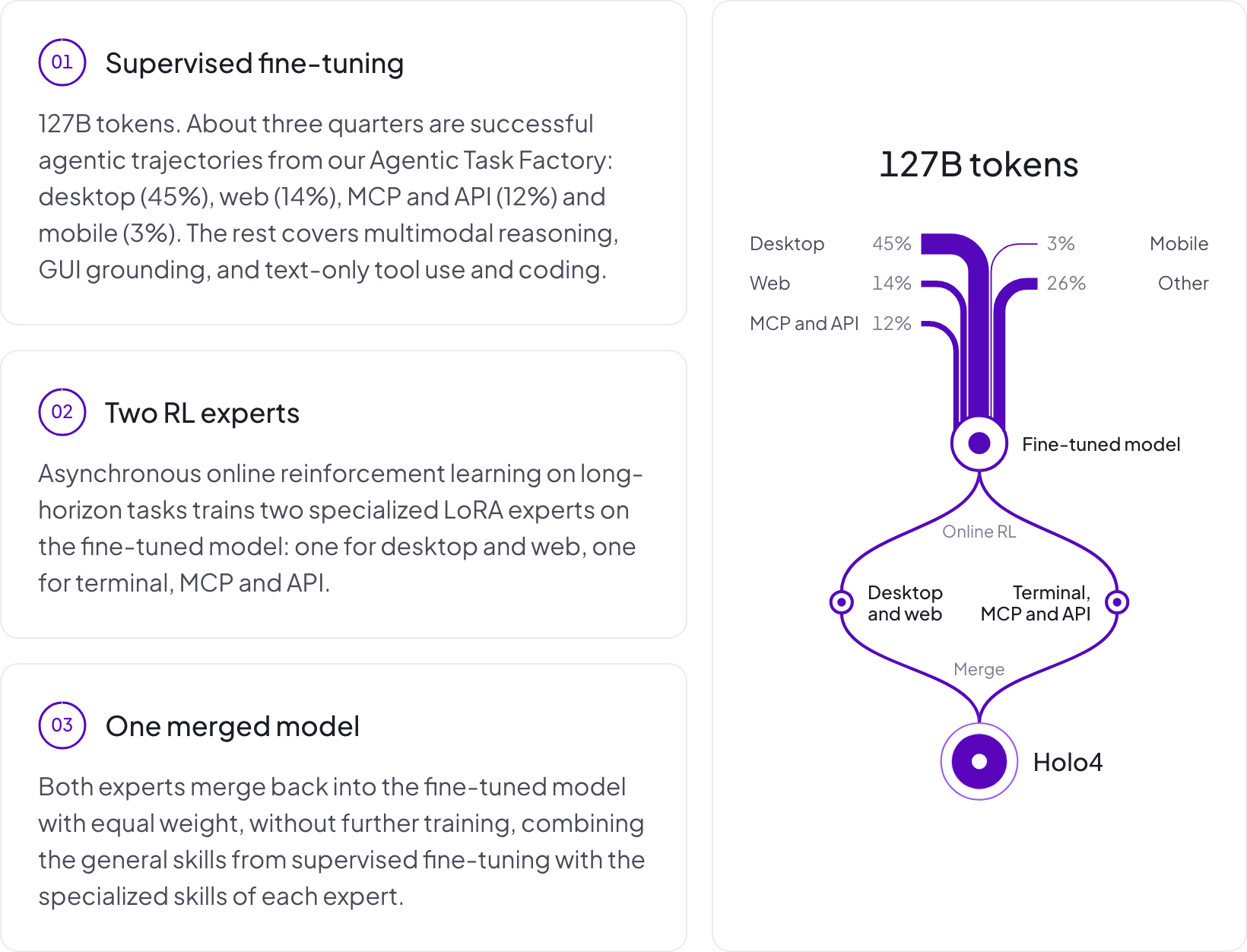
我们的内部 Agent 流水线集合仅根据文档构建交互环境和可验证任务,例如真实网站截图或开源软件文档。迄今为止,它已在 Web 应用、MCP 服务器和桌面环境中生成约 10,000 项任务,其中包括通过 GUI 和 MCP 暴露同一状态的混合环境。
训练
Harness
除训练外,我们还重构了 harness,即执行模型动作并在数百步过程中管理其上下文的循环,并利用 OSWorld 2.0 上的 Agent 性能反馈持续改进。Agent 会标记每项任务失败的原因,工程师则审查其修复方案。最大的改进包括:为 Agent 提供可靠的记忆能力,使其能够跟踪数百个步骤;以及让其能够访问桌面机器本身的 shell。
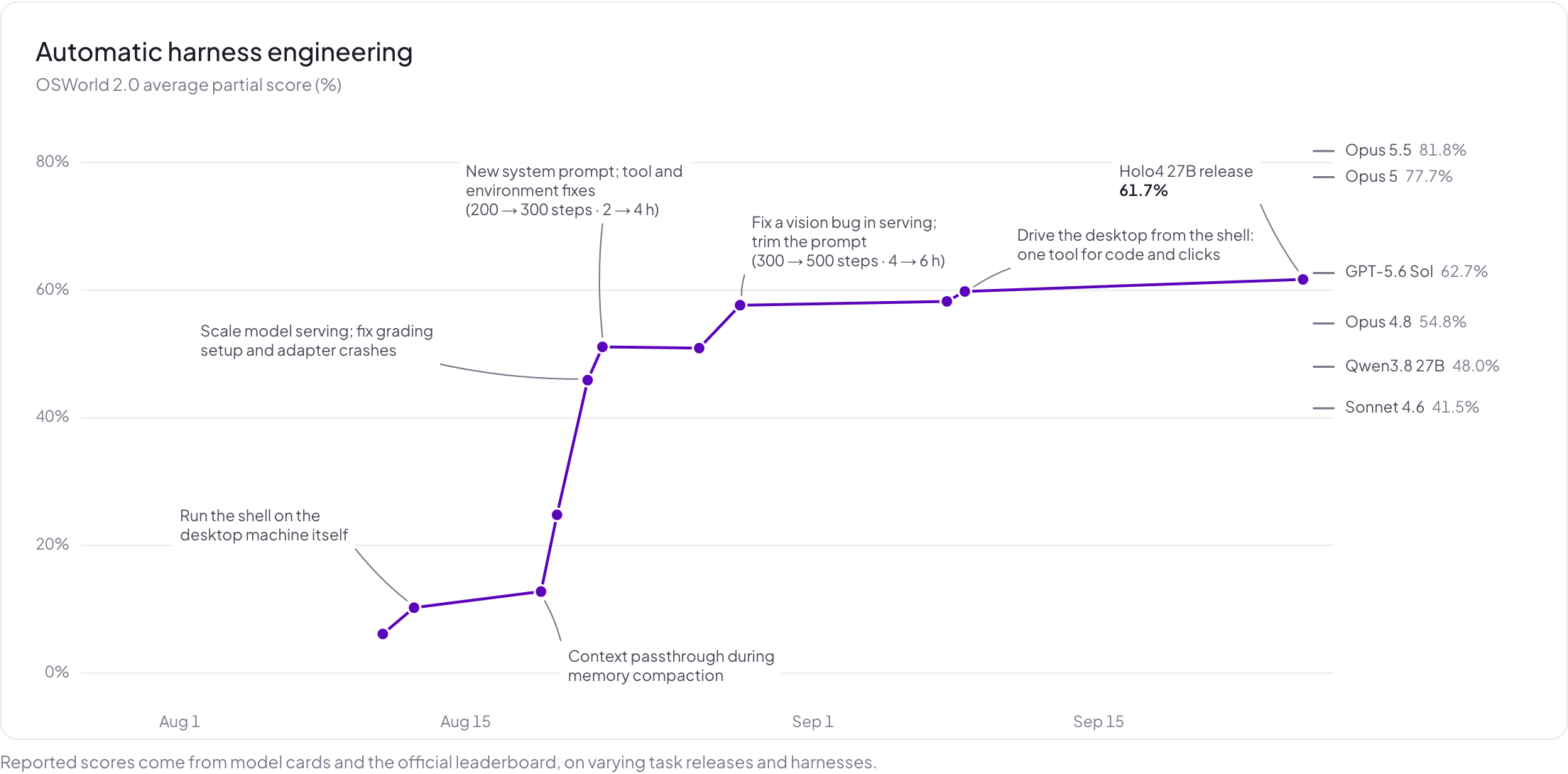
Opus 5(70.2%)和 GPT-5.6 Sol(66.2%)在 v2026.08.08 离线测试集上使用最大 effort 的部分奖励,数据来自OpenAI 发布图表,与成本—性能图中的处理方式一致。其他参考分数来自模型卡和官方排行榜。任务发布版本、子集和 harness 均有所不同。
Holotron4 Nano
我们的后训练技术栈旨在适配新的基础模型,并产出能够跨接口、跨环境泛化的 Agent。作为 NVIDIA Nemotron Coalition 的成员,我们将最新技术栈应用于 Nemotron 3 Nano Omni 模型,作为 Holotron 3 的后续版本。
同一套方法将 Nemotron 3 Nano Omni 转化为 Holotron4 Nano。这是一款通用型 Agent 模型,在 GUI 工作流以及暴露 MCP、API 或代码沙箱的环境中,相较基座模型都有显著提升。
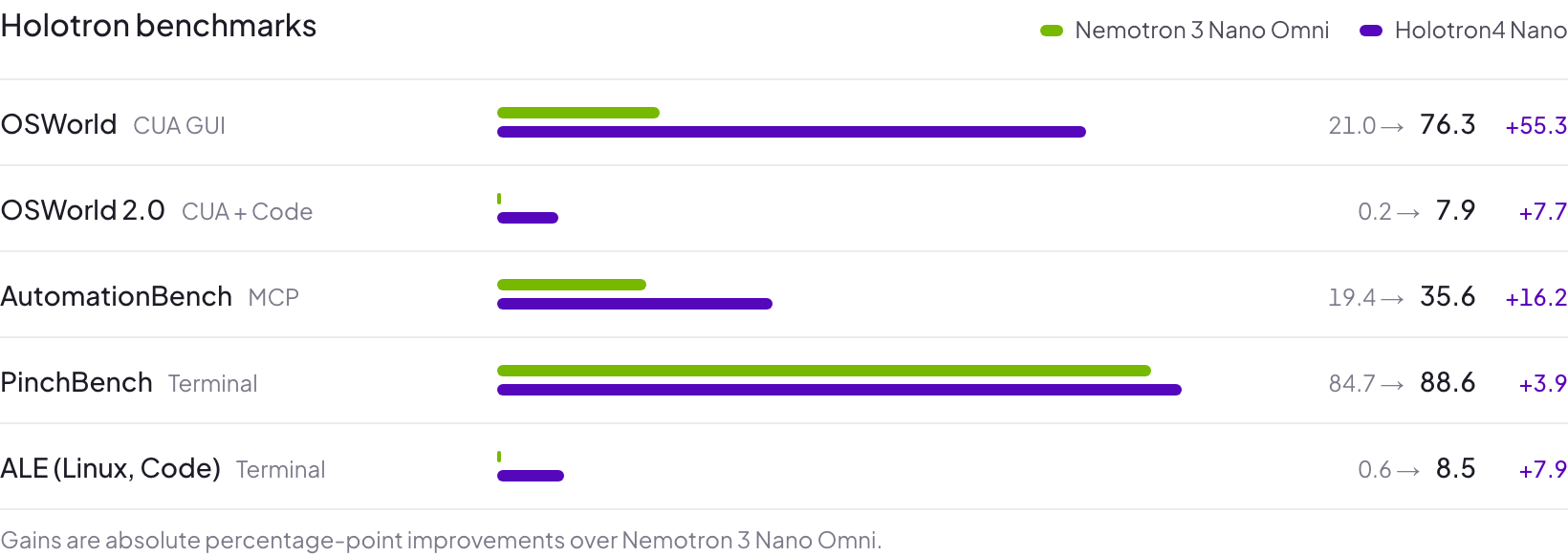
提升幅度为相对于 Nemotron 3 Nano Omni 的绝对百分点增幅。
这些增益表明,我们的方法具有良好的迁移性,能够将通用模型转化为 Agent 专家。该方法并不局限于特定模型规模。
自行运行
两种规格现已可通过 H Models API 使用。权重已上传至 Hugging Face,提供 BF16、FP8、NVFP4 和 4-bit GGUF 格式;我们的轻量模型 Holotron4 Nano 也同步提供。
未来几天,我们将发布经过优化的 DSpark drafter checkpoint,以进一步加速推理。
English / 原文
Holo4 is our new series of agentic models. It comes in two sizes: 27B dense and 35B-A3B Mixture of Experts. Both are available on the H Models API. We are also releasing an updated version of Holotron 3: Holotron4 Nano.
Holo4 builds on our previous model and interacts with software through any available interface: GUIs, code, MCP and APIs. It scores well on academic benchmarks, but we built it for real business workflows. It was trained through supervised and reinforcement learning on a large set of environments and tasks, including those generated by our Agentic Task Factory.
Get started now:
Models built for every interface
Holo4 clicks and types on a screen, writes and runs its own code, and calls MCP or API tools. It uses whichever fits the task. Most agentic models are trained for one interface only: GUI-focused models are blind without a screen, while models that prefer tool calling are stuck in front of an application that has no API. Real work is not siloed that way, and a single business task can require combining these different approaches.
Holo4 runs on desktops, on the web, on Android, in a code sandbox and against business APIs. It is the same model in each case and it is called the same way. You do not need to select a different model for each platform.
Holo4 models improve significantly over their Qwen base. Holo4 trails only the strongest closed models on long workflows: on OSWorld 2.0, Holo4 27B scores 61.7% against 81.8% for Opus 5.5, and Holo4 35B-A3B reaches 30.9%. However, it does so with orders of magnitude fewer parameters and at a much lower cost. We open-source every trajectory behind our scores on public benchmarks: replay each step at trajectories.hcompany.ai or download them from Hugging Face.
Competitive with the frontier, at a fraction of the cost
On the hardest academic benchmarks for desktop control (OSWorld 2.0) and API use (AutomationBench), Holo4 competes with frontier models at a much lower cost per task.
Notes on the cost-performance charts
OSWorld 2.0. Costs are estimated from the input and output tokens of each agentic run. Holo4 is priced at H Models API rates (single run). Qwen3.8 27B: model card score, cost from the tokens of our run at Alibaba Cloud list prices. Qwen3.6 35B-A3B: single run in our harness, at Alibaba Cloud list prices with cache hits at 20% of the input price. OpenAI launch data supplies the GPT and Opus effort sweeps; other closed and open-weight points use the official OSWorld 2.0 leaderboard. Releases, harnesses and task subsets differ. The line connects non-dominated score and cost pairs among the closed models; Holo4 is excluded.
AutomationBench. Holo4, Qwen3.8 27B and Qwen3.6 35B-A3B: AutomationBench v1.0.6, scores and costs measured in our internal harness. Other models: public-set scores from the AutomationBench README, cost per task from the official leaderboard, which runs on the private set. We will report Holo4 on the private set once it is evaluated.
AI that does work
Trained on environments and tasks from our Agentic Task Factory, Holo4 models excel on professional software. The examples below show Holo4 27B alongside Qwen3.8 27B, its base model. Same prompt and harness for both models.
3D modeling · Eiffel tower
Build a 3D model of the Eiffel Tower in FreeCAD, at a scale of 1 mm to 1 metre, centred on the origin and aligned to the X and Y axes. Work to this design.
The tower is square in plan at every height, never round. Its half-width, measured from the central axis out to the corner, is 62.5 mm at ground level, 32.5 mm at height 57, 17.5 mm at height 115, and 9.35 mm at height 276. Between those heights the half-width follows a smooth curve that falls steeply near the ground and gently higher up, never a straight line.
Four identical legs, one per quadrant, each a square column whose outer corner follows that profile. Each leg is 14 mm across at the ground and tapers to 4 mm at height 276. The legs stand apart from the ground up to the first platform, and converge as they rise. Nothing fills the space between them: the tower is open, and you can see straight through it from every side.
Three platforms, each a solid square slab centred on the axis: 72 mm across and 4 mm thick at height 57; 40 mm across and 3 mm thick at height 115; 22 mm across and 3 mm thick at height 276.
A mast from height 276 to 324, square, 8 mm across at its base tapering to 2 mm at the tip.
Every part must be a closed solid with non-zero volume, and no part may fill the space between the legs.
Holo4 27B (84 calls, 1.3M tokens)
Qwen3.8 27B (60 calls, 1.0M tokens)
3D modeling · H logo
Build a 3D model in FreeCAD of the H company logo: a solid filled disc beside a blocky sans-serif capital letter H, both extruded to the same thickness, the two shapes of similar height and set apart so they do not overlap, with the centre of the disc level with the middle of the H. Colour both shapes black.
Holo4 27B (94 calls, 1.5M tokens)
Qwen3.8 27B (118 calls, 1.9M tokens)
Game design · Pac-Man
Build a Pac-Man-style game in Godot and leave it running.
A rectangular maze of walls laid out on a grid, with pellets filling every open corridor. A player marker moves continuously along the corridors, eating each pellet it passes over and scoring a point for it. Three ghosts move through the same corridors and chase the player. If a ghost catches the player, the player loses a life and everything resets to its starting position. Score and lives are drawn on screen.
No one is going to play this. The player drives itself with a simple heuristic: at each junction it heads toward the nearest pellet, unless a ghost is close, in which case it moves away from the ghost. The game must run unattended and indefinitely, with no keyboard input at all.
When it works, start the game and leave it playing.
Holo4 27B (68 calls, 2.4M tokens, 268 lines)
Qwen3.8 27B (197 calls, 11.4M tokens, 327 lines)
How we built Holo4
Agentic task factory
Our internal set of agentic pipelines builds interactive environments and verifiable tasks from documentation alone, such as screenshots of real websites or open-source software. So far it has produced about 10,000 tasks across web apps, MCP servers and desktop environments, including hybrid environments that expose the same state through a GUI and MCP.
Training
Harness
Alongside training, we rebuilt our harness, the loop that executes the model's actions and manages its context over hundreds of steps, using feedback from agentic performance on OSWorld 2.0. Agents tagged why each task failed and engineers reviewed their fixes. The largest changes were giving the agent a reliable memory that can keep track of hundreds of steps, and a shell on the desktop machine itself.
Opus 5 (70.2%) and GPT-5.6 Sol (66.2%) use max-effort partial rewards on the v2026.08.08 offline set fromOpenAI's launch chart, as in the cost-performance plot. Other reference scores come from model cards and the official leaderboard. Task releases, subsets and harnesses vary.
Holotron4 Nano
Our post-training stack is designed to adapt to new foundation models and produce agents that generalize across interfaces and environments. As a member of the NVIDIA Nemotron Coalition, we applied our latest stack to the Nemotron 3 Nano Omni model as a follow-up to Holotron 3.
The same recipe turns Nemotron 3 Nano Omni into Holotron4 Nano, a generalist agentic model that significantly improves over the base model on GUI workflows and in environments exposing MCP, APIs or coding sandboxes.
Gains are absolute percentage-point improvements over Nemotron 3 Nano Omni.
These gains show that our recipe transfers well and can turn a generalist model into an agentic expert. Nothing in it is size-specific.
Run it yourself
Both sizes are available today on the H Models API. Weights are on Hugging Face in BF16, FP8, NVFP4 and 4-bit GGUF, next to our small model, Holotron4 Nano.
We will release optimized DSpark drafter checkpoints in the coming days to further accelerate inference.